Amy: [00:00:00] I was like, well, what if I try this as a story about a bunch of friends, which is what I like to read from different perspectives. Just make the heart of it about friendship and about the impact of witnessing a friend in childhood, what that ripple effect is on all of those people, not just the person who has impacted the patient, but on all of the loved ones and the people around them. And I had no background in fiction and it just, it just clicked.
Welcome to Dear Nina, conversations about Friendship. I am your host, Nina Badin. Been writing about friendship for over 10 years, podcasting about it for four years. Today’s episode is actually coming out right before my live event in Chicago, in Highland Park where I grew up. there’s a reason I’m putting this episode right before then.
Part of the element of this live event is that a portion of ticket sales are going to National Pediatric Cancer Foundation. The event is being hosted at my [00:01:00] favorite store in Highland Park, ENAZ. And they are very generously donating 15% of all sales that day at really any of their locations, not just the Highland Park location to National Pediatric Cancer Foundation.
Part of the reason that is important to me, other than just always feeling for any family going through pediatric cancer in their family, and especially the child who is going through treatment and, missing school and everything that goes along with dealing with cancer, is that my nephew, my sister’s son, died in 2017 of brain cancer and he was 11 when he was diagnosed. He fought hard for 11 months leaving behind, my sister, his two sisters, and his father, and, his stepparents. he had DIPG, which is a certain kind of aggressive and very difficult to treat brain tumor . I don’t talk about it much on the podcast.
I don’t feel it’s my story to tell but I did have, his [00:02:00] stepdad, my brother-in-law on, and I’ll link that episode, and Dave, my brother-in-law is also one of the people I. Who was really instrumental in helping me start the podcast at the very beginning.
He was helping me produce it, helping me edit it. He taught me so much and I’m so grateful to Dave. And he then also came on as a guest. and we talked a little bit about that period of life when Joshua was sick and just the importance of friends and how community and friends came together.
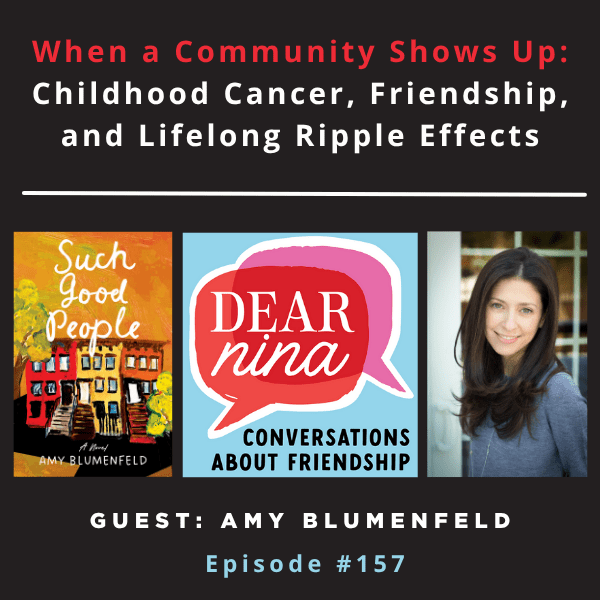
Today’s episode also has that topic in mind. I’m speaking to author Amy Blumenfeld, who herself had cancer as a child, different kind of cancer. She did survive. She has done a lot of writing about and thinking about, of course, adult survivors of childhood cancer. We get into her story and how she turned that experience into fiction and how the friendship that was so important and necessary and lifesaving for her family and for her in that time became the seeds for her first novel many, many years [00:03:00] later, and I will let Amy tell that story herself. just to tell you a little bit about Amy, she is an award-winning author and journalist, a graduate of Barnard College and Columbia University. She received her master’s degree in Journalism from Columbia, her essays and articles have been in the New York Times, Oprah Magazine, people Magazine, all kinds of places.
Her debut novel, The Cast was selected as a New York Post best book of the Week, and Such Good People is her second novel. And we talk about both here. I don’t normally go into such deep detail about people’s books because I really feel strongly that it’s can be hard to listen to a story about a book without having read the book.
And I actually, myself, have not read these two novels yet, but I really want to, and I’m excited to read them, especially after talking to Amy. In this case, it really made sense because Amy’s origin story of going through cancer herself as a child and the way her community came together, both her childhood friend community and her parents’ community was just so instrumental in how [00:04:00] these books came to be that we had to get into it.
It’s a huge part of the story. So you can see why I wanted this episode to be right before my event that is Raising Money for National Pediatric Cancer. thank you for being here and let’s hear from Amy.
Nina: hi Amy. Welcome to Dear Nina.
Amy: Thanks for having me.
Nina: this is going to be an extra special episode, because I don’t always have the chance to go so far back into a guest childhood. Your experience and story is so extraordinary, it does factor into your work. But I want us to build there and I want you to take us on the journey of your experience and as somebody who may have read your work will already know, but I think it will be new for some of my listeners.
Amy: Sure. I am born and bred Queens, New York, I grew up , going to a Jewish Day school and my parents were active in our local synagogue . I went to the nursery school there, my parents had all of their friends. It was this vibrant community. My friends were my parents’, friends’, children. When I was 13, I actually had [00:05:00] scoliosis and it was in a cast body cast for three months. I got out of the body cast, thought everything was fine, came home with a virus. They thought it was just any old virus. I never got better, and eventually it was diagnosed when I was in eighth grade as Hodgkin’s lymphoma, a form of cancer.
I then had, about 11 months of chemotherapy at a local hospital, and we thought I was fine. I didn’t even lose my hair. they said, all right, great. You’re in remission. See ya. And a month after that, all the symptoms came back. And so my parents switched hospitals. They brought me to Memorial Sloan Kettering Cancer Center in Manhattan, I became the first adolescent with Hodgkin’s Disease to have an autologous bone marrow transplant.
And so they had done this on other kids with leukemia and other diseases, but they had never done it on an adolescent with Hodgkin’s.
Nina: just to, for the listeners, you were about 14 at this point or 15?
Amy: this point I was, I was turning 15.
Nina: And what year are we in?
Amy: ’89 So I was diagnosed in 88 and at the point that I went [00:06:00] into the hospital for the transplant, it was 89, at this point I was in the end of ninth grade I, went into an isolation room for two months and they destroyed my immune system and then built it back with my own marrow.
I had high dose of chemo, high dose of radiation, the whole shebang. And then eventually after about two months I came out of that. But while I was in there, and this is really the heart of all of it, is that that community that I grew up in really rallied. Not only did they come and they donated blood and they, you know, supported and took care of my brother and brought him to baseball games and took him to their house to make dinner while, he was doing his homework while my parents were busy with me, they created this videotape called Amy Night Live because I was obsessed with Saturday Night Live at the time. Still am, they did 90 minutes of, just silliness and skits Saturday Night Live. they brought it to me in the hospital. It was one of the greatest gifts that I ever received. So it was about 40 people, my parents, friends from the synagogue and their kids, about 10 families
Nina: the adults were in it too?
Amy: Oh, completely. Yeah. It was [00:07:00] directed and run by the adults. I mean, the book is inspired by, the book is fictionalized inspired by what actually happened, and
Nina: And we should pause to remind people that it wasn’t like so easy to make a video. This isn’t like picking up your iPhone and having 8,000 apps that you can edit with. I mean, this is like real
Amy: No, they had all those gigantic Sony Handycam things, you know, with microphone, the whole shebang. they did it in the multipurpose room of the synagogue. There was a bar mitzvah going on upstairs. The caterer was bringing the extra food down to this multipurpose room so that the family that were making this video for me could, have a little nosh. It was just The kindest, most thoughtful gift. and then the kids, some of them came to visit me, some of them were too afraid to come. ‘Cause you had to wear a gown and a mask and the hat and the booties and gloves and the whole thing ’cause it was an isolation room. So it was a little overwhelming for actually for many of them.
But my parents’ friends came and they, they visited and they donated blood. it was that community that really became my model for what friendship should be. You are there during the hard times and then you’re there to get on the dance floor and [00:08:00] celebrate during, the great times.
that’s what these people were. Years later, I wanted to become a broadcast journalist. That was my dream. My goal in life was to be the anchor on the local New York News. And so I went to graduate school for journalism They ask you at Columbia, at least, they ask you to do a master’s project and they say, pick a topic that will sustain your interest throughout the course of the year.
I had no idea what I wanted to write about in a true to form, I left it to the very last second to submit my topic the day before the topic was due, I went to my annual check up at Sloan Kettering, and so I’m sitting there in the pediatrics department. I’m 22 years old at the time. And so this is several years after my transplant. I was sitting there and my little reporter’s notebook jotting down different ideas of, potential topics for this master’s project.
Nothing was sticking, everything was boring the woman sitting to my right taps my shoulder. She’s like, oh, are you waiting for somebody? And I said no. So I pulled up and I showed her my wristband. I had my name and I said, no, I’m a [00:09:00] patient. And she was sort of taken aback. She started asking me all these questions because her daughter, who was 15, was sitting to her, right? And so she asked me all these questions about survivorship, how long I was outta treatment and what it was like.
After that appointment, I walked back from the east side to the west side across the park, and I’m like, all right, I got my topic. It’s about adult survivors of childhood cancer. And so I ended up writing my master’s project in journalism school about that. And then at graduation, my professor said, you need to turn this into a book I’d never dreamed of writing a book. that was the first seed that was planted. And he didn’t say, what kind of book? And I was like, all right, well, it’s probably gonna be nonfiction, a series of interviews with survivors, and then I’ll turn it into something.
But at the time I was 23. I had no job. I needed money, I needed rent. I had needed health insurance. I couldn’t just take time off to write a book. when I had a free moment here and there on the weekends or whenever, I would sock away a chapter and I would continue to interview people, I continued to stay up on the research and everything that was going on in the survivorship community.
[00:10:00] eventually it was turning into this really boring um, series of interviews that I just, I would not read. I was like, all right, well maybe I’ll write a little bit of a memoir. It was not working.
Nina: What were you doing for work in the meantime?
Amy: so in the meantime, I was working as a magazine editor. I realized in graduate school that I was not cut out to be on tv. It was not, it was like a different type of writing. I was better in print I got a job as a, an editor and staff writer, first at American Health Magazine, and then I was a staff writer at George Magazine, Jonathan Kennedy Jr’s
Nina: remember George magazine. Oh, it was so cool. That was a beautiful, physically it was, it’s a
Amy: It was a great, yes. I actually have the posters in my house, some of them that were in our office when we folded. We all,
Nina: yeah, I mean, it’s like a historical moment. I mean, it was larger. I feel like it was a, a physically bigger magazine. Am I remembering that
Amy: Yeah. Mm-hmm. Yeah, I was writing a piece at the time actually about kids who grew up in the White House. And so I interviewed the children of former US presidents. [00:11:00] We had this big feature spread out. And then we folded with that issue, which of course, and so the editor in chief at the time he’d set up a meeting with People Magazine and then People Magazine said, come continue to report it for us.
they ended up running it as a big story for people. from there I started freelancing and that’s what I was continuing to do. But all this time this thing was sitting inside of me I couldn’t get rid of this book.
I knew whether it was my own need to fulfill this suggestion from my professor, or if there was just this need. I knew I wasn’t going to medical school and this was my way to give back to the cancer community. This was my contribution. I could not let go of this book, and I did not know what form it was gonna take.
life goes on. Get married, I have my daughter, one day I’m thinking, all right, I gotta do something with this. It’s not working out in all these other formats. What would I want to read? I like contemporary fiction, so I was like, well, what if I try this as a story about a bunch of friends, which is what I like to read from different perspectives.
And then just make the heart of it, [00:12:00] about friendship and about the impact of witnessing a friend in childhood, what that ripple effect is on all of those people, not just the person who has impacted the patient, but on all of the loved ones and the people around them. And I had no background in fiction and it just, it just clicked.
Nina: So you have some of your own experience in there. Did you also have all those interviews you had done earlier, maybe thinking this might be a nonfiction did some of that make its way, do you think,
Amy: for sure. I had my own experience, but there’s so many other people’s long-term experiences, especially at that time. we were sort of Guinea pigs in the first generation, the generation before the high dose radiation really could make you deformed in so many ways or have long-term, serious, long-term effects physically and emotionally.
And it still is the case, but over time it got better in terms of the treatments, they improved things. you don’t necessarily look at somebody now from my generation and say you were sick. I don’t know if you would look at me and necessarily know, but there’s a whole bunch of scars and [00:13:00] background and that’s there.
And I think it’s important to sort of share those stories so people don’t feel alone, but also to see it’s not just, as I said, not just the person who is in treatment. This impacted siblings. It impacted parents. It impacts your spouse down the road. It impacts your children down the road. It impacts your friends in various ways.
It impacts your relationships and your priorities and the way you select friends and who’s gonna make the cut and who is not worth your time. And it’s just everything. And so for me, and for many people, it changes perspective. I thought that was worthwhile. And also religion too.
That’s a really interesting one. It impacts faith and your career choice. there’s a ripple effect in many, many ways.
Nina: I am thinking about this whole ripple effect that we’re talking about and the way that the experience of having a child with cancer obviously affected you. the person going through treatment and being in junior high when you first are having symptoms and through right, because like when you’re [00:14:00] the very first time then into high school.
Then your parents and, their friends and their community. I have to imagine that some people really rose up in ways that were unexpected. And did they become closer,
Amy: for sure. my parents friends who were really there for my brother and for me and for my parents became to this day, like second parents to me.
Nina: I also grew up with parents who have very close friends, and it is an extended family in, in a way. this is who you count on except when something really. Severe happens where you need not just the theory of help, like, oh, you know, people would be there for you, but you actually need someone to pick up the younger brother and take him to school and keep him on the weekend.
And all the, you don’t always know, until you’re tested how people are able to step up. So when you did the, fiction version in your book, the cast I’m curious how much of your personal story, fully made it in there,
Amy: It is so funny. people think they know the truth. They don’t.
Nina: right?
Amy: There are definitely elements I [00:15:00] took, the most important things that I wanted to get across and I put that in there, but then I twisted it and I made it more dramatic. I went off in other directions and I lifted from other people from their stories, and I put it in the main character story, so.
There were some things that I wanted to get in there. The long-term effects, which is what happens to Becca, the main character there are long-term effects from treatment, especially back then, and they didn’t know what they were doing, and the main goal was to save a life.
there was also this goal of, okay, we’re gonna save the life and also try to ensure that there’s a quality to that life that we’re saving. It didn’t always work out. And there were also these long-term effects. I wanted to get as part of long-term effect fertility.
That was a big one. with me, I was very fortunate I was able to have my daughter, and so she’s biologically me and we look alike, and she’s my husband, but I wasn’t able to carry because of the radiation that I had. And so we used a surrogate to have my daughter. I wanted to have that story and the story of teaching [00:16:00] my daughter, to be proud and to not be, ashamed of her birth story.
I put that into the book, and so that was from me. But a lot of the other parts were just a mix of a story from here, a story from there. I sort of chopped up the impact of religion, the impact of that connection that tethering to your friend And career also the impact that it has on career and priorities and choosing a spouse and, really what matters to you.
And, and seeing it all from the perspective of oh my God, how short life can be and how that played out in all of the friends in different ways. the cast is essentially like the big chill I say meets the fault in our stars. it’s a reunion of old friends. It is so not a cancer book, but it’s about how.
All these friends are, it’s a reunion. 25 years after her, their friend goes through a cancer treatment. She’s fine. She survives. They all reunite for a weekend in the country over July 4th, and all of their lives are in different places. And it comes back to that illness, but it’s not about the illness.
Nina: I can’t wait to read it. [00:17:00] I don’t know how, I haven’t read it yet. It’s so my kind of book, I’ll definitely be reading it. I can’t talk about it yet ’cause I haven’t read it yet, it’s such a good premise. Was it easy to find an agent? I bet it was.
When I read. Just what the book’s about in the way that it’s written on the back of the book. It’s so compelling. I know that query letters and getting an agent, I mean, there’s probably many iterations, how hard was it to get it published?
Amy: It’s funny at the beginning when it wasn’t fiction, when it was the the survey of interviews, and then it was the memoir. Nobody wanted it. when I put it together and I pitched it exactly the way I just explained it to you, someone came through
Nina: I knew that. I just could tell because I mean, I’ve been in the whole like trying to get an agent world a long time ago when I was writing fiction. I know it’s not easy to get an agent, so I wasn’t suggesting it would be, it’s just that this story and the way you say it is, so to me, a no brainer as a book. So I’m not surprised that it got scooped up
Amy: the community that I grew up in really inspired me and they created that model for me friendship really is at the core of my work. and [00:18:00] so such good people my second book, I knew that I wanted to write another book that had at the heart of it, long-term friendship, childhood friendship.
but I didn’t wanna write about health. I didn’t wanna do anything medical. I grew up hanging on our wall was set, set tear in our living room. Justice. Justice shall you pursue? And my dad when I was young was a criminal defense lawyer at the Legal Aid Society in the Bronx.
When I was in seventh grade, he became a judge. But when he a criminal court judge, I. But when I was young, he would have his colleagues come over to our house and they would discuss their case around our dining room table. And so I would listen to them, plotting out, talking about the fact patterns, when he would, as a judge, I used to sit with him on the bench and during arraingments particularly, and I would. Watch this whole drama unfold and it was a whole language and the action with the prosecutors and the defense attorneys and the defendant, but directly in my line of sight across from the bench were the pews, the [00:19:00] audience section where these, loved ones of the people were sitting.
I didn’t know if they were there for the defense, or from the side of the prosecution. All I could see were these angst riddled faces directly in my line of sight. And I’m like, what’s their story? that has stayed in my head for many years.
When I knew that I wanted to write a second novel and I wanted it to be about friendship, I was like, I want it to be about the criminal justice system. I have just no clue what that’s gonna be. eventually we were invited to a gala event for a fundraiser for a halfway house, we have a family friend who’s involved administratively, and so we just got put on the invite list for this.
We were not able to go, but we ended up receiving their newsletters and I read the newsletter. they were profiling some of these teachers that worked at the halfway house and they were fascinating profiles and some of those teachers had their own criminal past and their background of being incarcerated [00:20:00] inspired them when they got out to become teachers and help people transition after they were incarcerated back into society and to give them a leg up.
That’s how I created April, the main character for my new book. Such Good People. I was like, alright, she’s gotta have a childhood friend who inspired this? What happened to that childhood friend? What happened between them? It’s about the lengths that you go to for the people that you love.
It impacts her kids at school, it impacts her husband. And she is then torn between showing up for her best friend who risked and sacrificed so much for her in this beautiful life that she created in Chicago, and her husband needs her at home. That’s part of the story.
Nina: Yes. Right. Of course there’s more in there. I remember when you and I were first, talking about doing an episode and we were sort of playing around with the idea of loyalties and I’m even thinking way back to your first book and your actual real life experience, and I.
That is hard when your friends need you, like your parents and their friends, the way they showed up for your family. I try to advise people through that. Sometimes you just have to [00:21:00] choose and someone’s gonna be disappointed.
The family’s gonna be disappointed or the friends are gonna be disappointed. ’cause we talk a lot on the show about showing up and showing up and showing up. And. You can’t actually show up for everything. and then if you care a lot about being a good friend, I mean, that eats away at us too.
Amy: Yep, absolutely. It’s tough. There’s a lot of gray areas. There’s these dual loyalties and you just do the best you can.
Nina: Even in happy times. There’s times when more so in my twenties I remember, but there’d be a friend’s wedding, a good, really good friend and a cousin’s wedding, the same weekend.
Amy: You try to please everybody. It doesn’t always work.
Nina: can’t be in two places.
Amy: that’s the essence of the book. But in, it’s similar and in spirit to the cast, in the sense that it’s, based on the childhood friendship. It’s about that commitments. Of to these people who mean so much, and what do you do?
Nina: My final question and then we’ll wrap up, is how are readers responding, to both books? do people end up telling you about their friendships? are they picking up on the huge friendship part of this story, or do they wanna talk more about the cancer parts or the criminal justice part for the new [00:22:00] book?
Amy: the greatest compliment for me is that people say it’s thought provoking. people are having different reactions. some people are gravitating towards the social justice and the criminal justice part of it. Some people are really moved by the friendship and their heart is breaking.
I think friendship is really at the heart of my books. because it’s so important to me. It was such a formative part of my childhood and my life. My friends are so important to me and they have been forever because of that model that was set for me. I really got to see the importance and the good in people.
And I think it’s also part of just going through these life cycles, you see people in times of celebration, you see them at their worst moments, and it’s the ones that stick by you and that you are there for, and you wanna be there for that mean the most. And that’s what it’s all about.
Nina: Beautiful. That’s a perfect place to end. Everyone. You can find the cast and such good people anywhere you buy books, but I’ll have direct links in the show notes too . Amy, thank you so much for being here and, and sharing your experience with us. I’m glad you are healthy and thank God for all [00:23:00] those amazing doctors and teams
Amy: Thank you so much for having me. I loved it.
Nina: listeners, come back next week when our friendships are going well, we are happier all around.