Nina: [00:00:00] your only chance of meeting somebody older or younger and having this beautiful addition to your life, which is what it is, is by trying something new. Because you’re not going to meet somebody just sitting in your house and you’re not going to meet someone just doing the same old thing all the time.
You gotta do something different. Welcome to Dear Nina, conversations about friendship. I am your host, Nina Badzin. I have been writing about friendship for over a decade, podcasting about it for over four years now. Officially, I started in July of 2021 with the podcast. now we are summer of 2025. We are well over halfway through our 2025 Friendship Challenge. I am not going to go over all the other challenges this time.
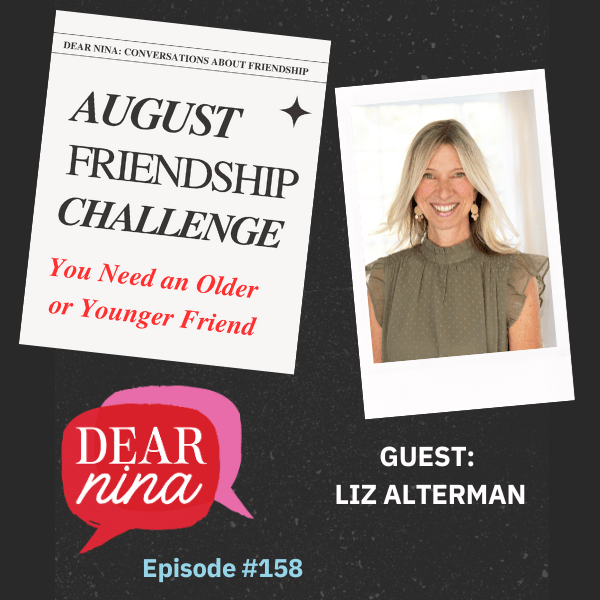
I have done that in past episodes. I will have that in the show notes though if you want to take a quick peek. there will be easy links to listen to the past challenges, or at least see what they were about. The August challenge is all about intergenerational friendships or [00:01:00] mixed aged friendships, we could call ’em either way because there is a technical number for what counts as a different generation.
I don’t want to get bogged down in 10 years apart, or 12 years, or 15, or just five or eight years apart. The point is having a friend who is not your exact age and stage has so much value for both parties, the younger friend and the older friend.
And in my own life I have that and have benefited from it. I am the younger friend in some cases, and I’m the older friend in some cases. 15 years is the threshold for considering it intergenerational. now that I’m thinking about it, I don’t think I have a friend who is more than 12 years older or more than 12 years younger. I do have it in the ten year, so I will need to follow my own advice.
Well, I always follow my own advice , most of the time these challenges are first and foremost for me. ’cause I, I do this work also for me to be a better friend, to have better friends, I will not be the only one talking about these mixed aged friendships on this episode. I am thrilled to be [00:02:00] joined by Liz Alterman.
She is the author of the award-winning memoir, Sad Sacked. She’s written multiple thrillers, too, a completely different genre. But the reason I am having her on is because her most recent book is a romantic comedy called Claire Casey’s Had Enough and it includes an intergenerational friendship between a 46-year-old and a 78-year-old, they inspire one another to remember the women they once were and the dreams they still hope to fulfill. Those are Liz’s words. I loved that.
Let’s welcome Liz to talk to us about why we need a friend like this in our lives and why it is worthy of being one of the 12 monthly challenges. We don’t have many, only 12, and this is going to be one of them. That’s how important it is.
Hi Liz. Welcome to Dear Nina.
Liz: Hi, Nina. Thank you so much for having me.
Nina: Since your most recent book, like I mentioned in the intro, Claire Casey’s had Enough, includes a friendship between a 46-year-old and a 78-year-old I [00:03:00] wanted to start there why you chose that friendship? just tell me more about it and then we’ll get to real life, but let’s start there. Tell me a little bit about this fictional relationship.
Liz: Oh, thanks for asking. So it sort of develops almost as a surprise friend who lives down the street. It’s actually her mom who has unfortunately fallen down some stairs and is sort of recuperating from that just down the block. And Claire’s friend needs to work in her office on Thursdays, and so she’s asked Claire, please just pop in. Don’t make it look like you’re checking up on her. Say you’re there for a bowl of sugar or something. And then of course, Claire, she’s a busy mom with her own job and. Always volunteering all the demands that we all face. But over time she begins confiding in D and d confides back in her. a lot of this story focuses on Claire having those what if moments or just questioning where she is in life. I think no matter where we are, we tend to always. Idealize [00:04:00] people who are older and think that they have it all figured out. And what she learns is that Bee also has this unfinished business in the past.
And even though she’s reached 78 years old, she wants to go back to her home. She wants to be independent, but her daughter is kind of like, Hey, we’re going to sell your house. You’re going to move in here. So sort how did, and. Inspire each other in listening to each other’s stories. there, there’s not like a Selma and Louise component, but they do go on a little journey together at the end of the book. I don’t want to spoil anything, but it really is how each one opens the other’s eyes to, you know, we’re not stuck in these situations.
We can do something about it. And wondering isn’t necessarily the answer we need to take some action.
Nina: That sounds so great. I can’t wait to read it.
Liz: Oh, thank you.
Nina: Was it based on any friendship in your real life?
Liz: I have to say it is not, but I am very fortunate to have [00:05:00] a few friends who are in I’d say maybe like 20 to 30 years older than I am, who I find very inspirational. in all sorts of ways. They’re very accomplished, but also they, they kind of know what they want at this point and what they don’t want, and so I really draw inspiration from them.
Nina: That is fantastic, and I’m going to want to hear more about that because the A A RP defines an intergenerational friendship as 15 years or more, and I didn’t even actually know that was the technical, how they consider it, because I thought I had an intergenerational friendship. Well, I don’t even know if I would’ve called it intergenerational.
I maybe would call it mixed age.So tell me about your couple of friends who 20 some years is, did you say 30 years?
Liz: Yes, I, well, I’d say pretty close to 30 for one. So I have to say how I, I don’t want to say I found her, but I was very fortunate to connect with her probably ten years ago. I was writing an article a. a For The Muse, which is a career site, and [00:06:00] I needed an expert on networking. just in Google search and Amazon and looking for bestselling authors, I happened upon this absolute gem treasure uh, Susan Rowan who wrote the bestselling How to Work a Room, and she sold over a million copies. It’s been. with journalism, sometimes if you don’t get a source to write back right away, you move along. You have to find somebody else. You’ve got a deadline to hit. But I just thought she’d be perfect for this. So I sent an email and I didn’t hear back and my deadline was approaching and I, I had maybe watched her on YouTube, read some articles, I was so smitten with her personality.
She’s from Chicago, she’s hilarious. Got such a sense of humor. So I forwarded my email and. I don’t mean to bother you, but if you’re interested. And she got back to me right away and she said, I’m so sorry. This the first one landed in my spam folder. How is today? we just connected over that phone call.
And so she’s out in California, I’m in New Jersey. Whenever she comes to New York she’s been [00:07:00] so kind and gracious. Shell invite me to her networking dinners and she’s introduced me to so many people. And then she and I have had lunches, dinners together. Now we zoom to catch up with another she’s hysterical.
So she has been through. You know, the good and the bad of publishing and she is not afraid to, with her humor, just lay it out there, bear like how she sees it, what she’s doing next, truly values her time, that is something that I I think maybe because of her wisdom and experience.
She’s like, I know I’m not doing that. I’m not, my time is valuable. It’s worth more than that. I’m not doing it. And I feel like that’s a lesson that I need in my own life, so I, and she, I just love when I talk with her, you know, she’s, she’s got boundless energy and uh, it’s truly, she’s an inspiration.
Nina: Yeah. One thing I read about these kind of friendships and, your friendship you just described does hit on this. It is hard to avoid and it’s not a bad thing. Maybe you just acknowledge it [00:08:00] somewhat of a mentor mentee dynamic, right? Like if they’re, if we’re talking 30 years, 20 years, or, to the A A RP definition, 15 years, there is going to be a little bit of, I have something to teach you and on the other side, I have something to learn.
I guess I would say thinking about it instead of pretending that’s not true and avoiding it and pretending like you’re in the exact same stage. Use the age difference to the advantage. a lot of us have plenty of friends our own age, like we don’t need to pretend that this person’s also our own age.
What would be the point?
Liz: Right. I totally agree. And I feel like that’s kind of reciprocal in that she will say to me, we were talking about conferences she was saying, you know, I haven’t really gotten a lot of value out of any conferences I’ve attended lately. Are there any that you’d recommend? And I said to her last spring, I went to the Erma Bombeck Writers Conference in Dayton, Ohio.
And she right away was like, tell me more. This is right up my alley. Because she’s saying, you know, maybe I don’t want to write another book, but I would be open to short [00:09:00] humor pieces or something different. So now we’re going to meet there next April. And uh, I’m so excited and she’s saying good I’ve got this on my calendar.
And she tells me when I have a book coming out. think outside the box. Don’t just say I’m going to be at this bookstore for a signing or something, you know, really make it special. Offer people a little something different. And she just has really great ideas based on her own experiences, and she’s willing to share what worked, what didn’t work.
And I try to do the same for her. And so I think because we’re at different stages and just at different places in our lives, just to have that different perspective that neither one of us might get from a peer. It’s really valuable and I think we always come away from our calls energized with new ideas of how to move forward.
Nina: That’s such a good point. It does go both ways. ’cause you probably have, I mean this is really stereotyping, so if I’m wrong, tell [00:10:00] me. But you probably have somewhat of a different relationship with social media and technology than she might have just based on experience. And so you might have something to teach her and you could learn from someone much younger than you as well.
Liz: Right. I will say she is out there. She is. She’s on all these different things. And she is funny too, ’cause she’s saying, you know, with the political climate, she’s like, what have I got to lose? I’m not shying away from speaking my mind. she’s hysterical. And I love just the freedom that, a lot of times people are afraid to voice their opinion or to stand up for what they believe in in the world, but I feel like she’s kind of like, you know what? am who I am and I’m owning it, and, and I, I really admire that.
Nina: That is something I get from friends, even 10 or more years older than I am, is more of a push, like they push me more to stop worrying so much what other people think in general on all topics and all topics. And that, that’s my personal Achilles heel is, you know, being a people pleaser. And I do think there seems to be a theme as people get older, and I think I’ve tried to help other people with it too, [00:11:00] even on because I’m only one inch better at it maybe than someone younger of letting go of that stuff. I was on a walk recently with a friend who’s quite a bit younger. She was talking about something exactly the kind of thing I would have worried about and still probably voice sometimes.
But hearing her say it, I was like, oh, that’s so not going to matter, I promise you. it’s not the thing you think it is. I was able to see it more clearly. Now, of course, she’s also go through it and I’ve had friends be able to say that to me too, This won’t matter to you when you’re 60, when you’re, you know, and I’m glad it’s like having a crystal ball. I’m like, thank you. I hope you’re right.
Liz: It is so true.
Nina: One piece of advice I got from a younger friend, she’s more than 10 years younger than me, and I think I kept drawing attention to our age difference. I was the one who would make comments about it.
You know, like self-deprecating things, about, you know, having to get my hair colored, every, almost three and a half weeks now I can barely make it four weeks. Um, things like that. ’cause I’m in my late forties. She’s in her, I. late thirties, so maybe we’re just 10 years apart.
my kids are quite a bit older and I don’t know, I would always come up and it would because of me, she never brought it up. Finally she said to me, [00:12:00] and it was very good advice, and I would pass it on to other people who are the older person in a mixed age friendship. She said to me I like you. I like being friends with you. you don’t need to keep bringing up our age difference. something along those lines. Like she was like assuring me that we are friends. It’s like we’re friends. It’s like, Nina, we’re friends. You can stop kind of joking about your age, like you’re drawing attention to it.
Liz: I know what you mean. I have a younger friend and she’s probably in her late thirties. I just turned 54 there are times where I almost don’t want to come off like a vampire, where like I’m trying to suck her youthful energy out of her because, and I don’t want to bring it up. But then for example, sometimes we’ll be out to lunch and she’ll be like, I gotta get back from school bus. or, you know, different things, things that I haven’t thought about in a while. And then when it does pop up, I’m like, oh my gosh, I wonder if she feels like she’s out her grandmother this.
Nina: Yeah, it is hard not to sometimes feel funny about it. The different stage I think, could work for these friendships and against it. It, depends what point of view you’re coming from. One thing that came up a little bit in the Facebook group is [00:13:00] this idea that your older friend might be available for you in a way that your peers aren’t.
your peers maybe don’t have to be at the school bus or maybe you don’t have kids and perhaps some of your friends are starting to have kids. It’s not the worst idea to go either a lot older or yet a lot younger. If you are not finding peers who don’t have kids, let’s say, so you might need to like look for someone whose kids have moved out or someone who is younger and doesn’t have kids and maybe never will.
Not that you can’t be friends with people who have kids in a mixed situation like that, but things come up. I mean, it is an issue. The point that was being made is that while it might be great to be the person who has more free time, it’s like you don’t want to always be the person who’s bending around the person who doesn’t have as much free time.
But that is part of what happens in these relationships. This is why we had to have diversity in our friendships of age and stage. You don’t want everybody to have the same issues that come up in the schedule and like then no one’s available.
Liz: That’s what I was going to say. I know sometimes you’ll get these group texts and it goes on and on. [00:14:00] Nobody can meet on the same night because everybody has different obligations or you want to take a friend to a concert or a show and no one’s available because everybody has a different conflict,
Nina: So other than like a networking situation, which is where you met your friend, how have you heard from others who have heard about your book, let’s say, or like know about your friendship, your actual real life friendship, where are people meeting their mixed age friends these days?
Liz: That’s a great question. I will also say I feel like for me, a lot goes back to writing. I took a memoir workshop years ago, I have friends. One is in her sixties, the other, he’s in his seventies, and we still meet for lunch periodically. And I mean, we know all about each other’s personal lives, of course, because we were sharing uh, excerpts from memoir. So you get close very fast
Nina: Yeah, for sure.
Liz: know, intimate details you might not otherwise know. so we’ve stayed close and of course we catch up on each other’s lives and families. Uh, But then we also check in on each other’s writing.
[00:15:00] that is really nice. , and we try to support each other. My one friend’s book is coming out in the fall and. You know, we’ll rally around and support him however we can. That’s a great question. I’d say based things. That’s what I would guess. And I know my friend who’s younger where I was saying I, I hope I’m not trying to, to
Nina: Right.
Liz: of her youthful energy. She actually, when I had a book come out, she and her husband came to a reading and it turns out she is a poet. And so. we have a lot in common, our love for books.
And so when we get together we’ll talk about, you know, what have you read lately. And, I felt like we bonded over our love of bookstores and I often joke she’s new to New Jersey, but I say she should be like our official ambassador. I’ve lived here my whole life and she has been far more places than I have.
And so I feel like I’m also, I’m learning from her, you know, she’ll post a gorgeous photo on Instagram. I’m like, oh, I’ve been meaning to get there for 20 or [00:16:00] 30 years. And and so she inspires me that way. And then I feel like on the flip side, she’ll kind of pick my brain. I’m like. How did you find an editor for that? Or how did you find an agent? So, I’m trying to share any wisdom that I can in this world. Her
Nina: I do find that I love sharing parenting wisdom with younger friends, whether they want it or not, because everything seems so massively urgent when you’re in the middle of it, not just with parenting, you know, in all topics. And even, in writing, some of my older friends I have also met through they’re not that much older, they’re at all as we’re talking probably eight to 12 years.
I’ve got also through writing and writing groups, I guess that speaks to our hobby point and they’ve helped me on also parenting stuff and writing stuff. And even though I’m actually the leader in this situation, like I, I run the writing group with my friend Julie. Yes. And Julie and I are 10 years apart.
I don’t think of us as intergenerational because that seems like such a heavy word, but we definitely are mixed [00:17:00] age. one fun thing is we each have four kids and her youngest is the same age as my oldest. So sometimes we have overlapping things in common, like our kids went to college around the same time, but she’d already been through it three times, And she’s going through lasts as I’m going through first, but we’re still each going through something somewhat similar and now I have that on the flip side, I just highly recommend it to people. It’s like, it’s not like you could just go out and meet an older or younger friend, but I think something Liz and I are both getting at is if you put yourself in a situation where you might meet somebody who’s a different age, you still have to do something.
And that’s the theme of all of my episodes. So with Susan, for example. You had this great phone call, but still something had to happen after that and something, I really try to urge people a lot. These things do not just magically come to be.
Somebody makes a move, somebody receives the move, makes the move back. Someone doesn’t keep track. Maybe someone makes the move three times in a row and doesn’t say, well, she didn’t really text back right away and then give up. You have to [00:18:00] keep going. Somebody has to be brave.
Liz: Absolutely. I think so too. And make the first move, like do you want to meet in person? Do you want to go out for lunch? Do you want to take a walk if they’re nearby. I loved your recent episode on traveling, like taking a car trip because it’s true, it’s downtime. Why not make different plans for how you’re going to spend that time together?
Nina: yes. Is this unchanging the venue of how you hang out? What Liz is referring to is the May challenge. In the May challenge, my advice was, and it was one of people’s favorites of all the monthly challenges, was to change how you hang out with their friends.
So it was less about making a new friend, which can be sort of exhausting, but it’s sort of acknowledging who’s already in your life and if you just change where or how you communicate or how you hang out, it really could deepen the friendship. So if it’s somebody from a writing group or pickleball or whatever else you’re doing, or a community organization that you just kinda like you have good chemistry in some capacity, you just could tell that you like their vibe. You still have to do something to deepen that friendship and the doing something may be as simple as asking someone who [00:19:00] you go to these community meetings with for their phone number so that you could text here and there.
That doesn’t seem like a big deal, but that’s enough of a change that that could lead to a coffee or a walk or something else.
Liz: Yes. I guess the one that stuck out to me, ’cause I feel like I’m often running errands and I was thinking it would be so much fun to just grab a friend instead of me listening to an audio book in the car or like have a real live buddy in there and be like, okay, I’ve gotta go here, here, here. Do you need anything? You know, especially, we’re always out running to one grocery post office or something. Why not take a friend then grab a coffee when you’re in the middle of it? I’m accepting the challenge.
Nina: I love that. So Liz, I think what we’re both saying is, yes, people need a friend who’s younger and a friend who’s older.
If you can only have one, it doesn’t matter which way, but they are different. It is different to be the younger one in this mixed age friendship and the older one. I think in an ideal world you would get the chance to be in both positions. Do you agree?
Liz: Absolutely. I feel so fortunate because I, I just [00:20:00] think it opens your worldview and your perspective and both ends, I see my younger friend with her energy and her vitality and, as she goes through different milestones with her kids like it, and I’m not that. Nostalgic or sentimental of a person.
But it does kind of remind me of the, like, those simpler times And I try not to ever say to her the old, like, it goes so fast. But um, I’m making note of it in my head that, you know, next time I see my kids, I’m going to, or when I get home from hanging out with her, I’m going to try to really appreciate just how fast time does go.
And then on the other side, my friends who are older, who. I guess have that sense of, of urgency about what they want to accomplish and that they’re not going to let anything stand in their way or they’re not, and as you said, they’re not going to worry about what people think. They’re going to do it their way and use the wisdom that they’ve gained over time to pursue what really matters. And I think that’s such an important reminder.
Nina: I was going to sum it up, but I think you summed it up and I’m glad you [00:21:00] did go out there and join different things. It’s actually advice for just. Your friendships in general, you all know if you’ve listened to other episodes, I never do general episodes.
This is about intergenerational friendships, but it’s still just good friendship advice. These are friendship muscles that you need to use and you need to practice reaching out to people. You need to practice trying different things in different places, trying different activities. It may be that you leave this new activity with someone your own age.
But that’s good too. I mean, at least you’re out there, you’re trying, and your only chance of meeting somebody older or younger and having this beautiful addition to your life, which is what it is, is by trying something new. Because you’re not going to meet somebody just sitting in your house and you’re not going to meet someone just doing the same old thing all the time.
You gotta do something different. So it’s almost like a combo and a reminder for people to check out that May episode. I’ll link it here about changing the venue and it may just be that you have to go by yourself to change the venue so that you meet somebody different who’s a different age.
Liz: I think so too. That’s great advice.
Nina: Liz, thank you for being here. I’m going to have all the information [00:22:00] on your latest novel and all your novels ’cause I know you are quite a prolific writer you might know ‘ you’ve listened to a few episodes that I’m going to say right now. Come back next week when our friendships are going well, we are happier all around.
Liz: You, Nina.
Nina: Thank you. Hello listeners, huge favor to ask of you if you have been enjoying this podcast. I would love if you would share it with a friend. It is truly the best way to spread the word. If you have time to leave a review on Apple, that is wonderful, or to leave five stars on Apple or Spotify, that’s great.
But if you’re going to just do one thing to help out the show because it has helped you in some way, sharing it with a friend is the best. I’m just so appreciative. I love having the community here that is growing. Thank you for considering that.
Have a great week. [00:23:00]