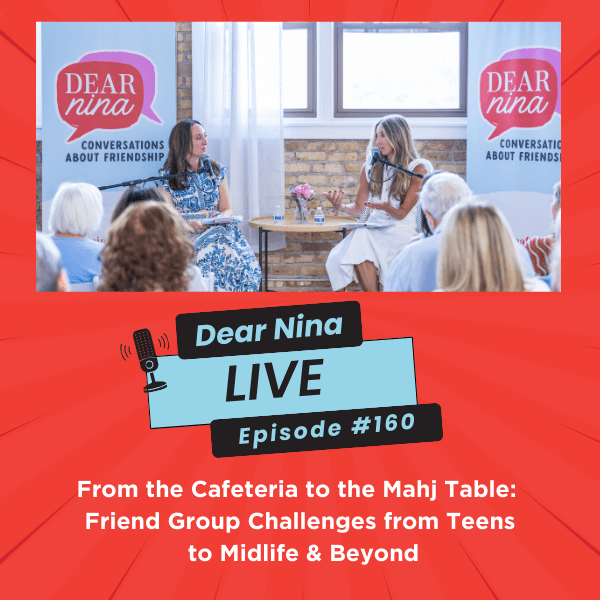
Nina: [00:00:00] Welcome to Dear Nina, conversations about Friendship. This is an episode I’ve been so excited to share with you. It is my live episode from Highland Park, Illinois that I did two weeks ago with my assistant producer friend, and just wonderful partner and many ways for lots of things I do at Dear Nina, Rebekah Jacobs.
She has been on other episodes with me and when it was time to figure out who I wanted to be with me in the live episode, I had no question that I wanted to be with Rebekah.
Both of us are from the area. I’m from Highland Park. She spent a lot of her childhood in Northbrook and her adolescence, and we both had old friends there, new friends. We had family there and we had, as I say in the episode, I hope also people who did not know us, there were 120 people in that room.
You will hear their laughter, their applause. You will feel the energy. I think it [00:01:00] really is a different kind of episode. I loved having a live audience. That was a lot of fun. Rebekah enjoyed it too. In the episode, I name all of the sponsors, so I’m not going to thank them again right here, but just do know that all the sponsors of the event, all of the companies that contributed to the swag bags, that was so fun to give out to the people who bought tickets to the event, and all the businesses that gave out raffle prizes at the end will all be in the show notes.
I want to just tell you about this episode for a moment. It is about friend groups. It is about the hurt and the pain that can come with not having a group. About the relief sometimes that comes with getting out of a group that isn’t working for you. On the invitation when I invited people to this event on social media and through email and all kinds of other marketing, the title was from the Cafeteria to the Mage Table Friend Group, challenges through the ages, and I really think that spoke to people.
I think most people there felt it. I am going to do a live event in [00:02:00] Minneapolis next. I’m not exactly sure when. I don’t have the date yet because it is a big undertaking. But if you live in Minneapolis and you are interested in any capacity in sponsoring part of the event and being part of all the marketing, and I always add the logo and everything to everything I do.
If, if you sponsor the event and I will name you lots. One other little housekeeping note, when you hear at the very end of the episode, you will hear that after the raffle it just starts to get kind of mayhem and I just had the recording cut off there.
There really isn’t an ending. uh, I will be back again at the end of this episode just to leave you a note at the end, since the live episode just kind of randomly ends. and before we get to the live episode, I want to remind you to stay in touch with me. My newsletter is at dearnina.substack.com.
My Instagram and TikTok accounts where I am pretty active are @Dearninafriendship. And you can join my Facebook page, which is really turning into a nice [00:03:00] community. You can find that on Facebook at Dear Nina, the group. Here we are going back in time to Chicago two weeks ago. I really hope you enjoy it as much as I did.
Welcome to Dear Nina, conversations about friendship. I am your host, Nina Badzin. With me is Rebekah Jacobs. Please look out and see your family and friends.
I will tell you more about Rebekah soon, but I wanted to tell you that on your chair you had a postcard with ways to stay in touch, follow on Instagram, get my newsletter. And also there is a blank note card and you have a pen in your bag that my sister-in-law, Tobi, designed and you can write any questions you have. I cannot tell you that we’re going to answer them today because we probably aren’t, but they will be used in future episodes. And I just wanted to tell you a brief moment that I’ve been writing about friendship for 11 years, [00:04:00] and I am not a therapist.
I am not a social worker, and I don’t call myself a friendship expert, but I started as a friendship enthusiast. I’m a writer and writers land on a beat. I’ve written about all kinds of things. I’ve written about every Jewish holiday that you can imagine. I’ve written about so many parenting things, and eventually through a very long story that you can hear on an episode that I will put in my show notes, which I’ll explain in a second.
It is the story of how I ended up on this friendship beat. But that’s where I’ve been since 2014, writing an advice column. And I still do the classic advice column stuff in the newsletter. And Rebekah and I, Rebekah’s my assistant producer, by the way. But I would, I’ll be telling you that too. We, I’d say once every six weeks answer questions.
Why it’s called Dear Nina. It came from an advice column. So that’s what we’re up to some of the time, and I interview a lot of guests. I know some of you are listeners and some of you have not only have you never heard of the podcast, you don’t even listen to podcasts, which is totally fine. Maybe you will after [00:05:00] this. Each week I do a different, very small issue of friendship and if you can believe that I have been writing about friendship for 11 years and have not run out of material. Because friendship’s complicated, right? There’s ups and downs and friendship groups in particular bring out all the feelings they really do.
You want in one, you want out of one, you want your kid in one. You want your kid out of one. You want in the group chat, you’re like, get me out of this group chat. I know we all have that feeling. very painful when you want to be part of something and you’re not welcomed in. And it’s also really tricky when you don’t want to do everything with 18 people.
It’s not realistic. So how do we be kind and inclusive, but also have deep relationships that mean so much to us? it is quite impossible to do all of that. So sometimes we do have to make things smaller and I don’t have a perfect answer of [00:06:00] how you can do that without hurting feelings.
I wish I did I don’t. But we are going to address some questions that address all of that. I’m going to first, before we even go on, do the most important thing was thank our amazing sponsors. We have, let’s do a quick round of applause first.
Twisted Alchemy represented in the corner at the bar and downstairs at the bar. They had amazing cold pressed juices that were mixed with our next sponsor and Inspiro tequila, thank you to Inspiro Tequila. They made those drinks extra special. And Glickman Levy Residential did the beautiful dessert bar in the back.
And then I want to just tell you what the show notes are because if you’re not a person who listens to a podcast, or even if you are, you might be like, why is that podcaster always talking about show notes when you are listening to a podcast on Spotify, apple, wherever you’re listening, YouTube, it doesn’t matter.
I’m on YouTube too, it’s so uncomfortable to look at. But I am there [00:07:00] on video. you look wherever you are listening to the podcast, there are links that somebody. It’s me in this case, took the trouble to put the links in of where you can listen to episodes that were referenced or in this case, well that will be the case, but also the sponsors.
So all the sponsors will have links in the show notes in addition to the companies that are in your swag bag. And thank you to my sister-in-law Toby, who filled every one of those swag bags at her house in Highland Park because I don’t live here and Rebekah doesn’t live here. So she received all the items, stopped all the items and brought them all here and did a beautiful job with my husband Bryan, who met me here a couple days ago from Minneapolis to be my helper.
So that’s Bryan. He’s been on the episode. Last intro. Before we turn it over to Rebekah, will you raise your hand if you’re in this room and you’ve been a guest on the show? ’cause I know there’s or about to be Leslie that counts you. Yes. Okay. Thank you. We got Debra. Bryan’s been a guest.
Taryn’s been on like four times. We got my mom, Kathy up here. Who [00:08:00] is like number one guest he quoted all the time. Mom, will you stand up for a second and just wave? That’s Kathy and I. Did I miss anybody else? I guess I don’t think Leslie Randolph will be on soon. And I’ve been on Leslie’s and Rebekah Jacobs is on all the time. So Rebekah, we turn it over to you.
Rebekah: Well, we also want to thank Enaz who donated 15% of your purchases. And I’m looking around, uh, ladies and a few brave men and I see you understood the assignments. So great job. I just bought these. And that is going to the National Pediatric Cancer Foundation and that’s a very important, charity and cause uh, for Nina’s family.
And so thank you to everyone here who really did that. And so we so appreciate it. And there’s many special guests. This room is just filled with. People we love and we’re going to thank you at the end. The woman of the hour. It is so nice for us to be in our [00:09:00] hometown and many of you are familiar with this incredible woman.
And now I can say my dear friend, Nina Badzin. Nina’s the host of Dear Nina, conversations about friendship, a top 1% charted podcast. Her friendship, work has been recently featured on NPR. She’s been in the Chicago Tribune, the Washington Post, the Guardian Time Magazine and elsewhere. And what looks like overnight success is actually years and years of hard work as a mom of four alongside Bryan. So shout out to Bryan as well. And she’s helped so many people with her direct and sensible approach to friendship. I know ’cause I see these letters from women and men who are just grateful for your. No nonsense, but empathetic approach.
Nina: Oh, thanks Rebekah. If you can believe Rebekah, this is only the second time we’ve ever met in person. That’s true for real. We are very close friends. And it is, um, another good example, not the topic of this episode, but a topic of another episode [00:10:00] of having a long distance friendship and a friendship that started online. Rebekah was really a listener. We know a ridiculous amount of people in common. We did not know each other growing up.
We just both happened to grow up in different suburbs here. But we, Rebekah wrote me lots of different emails with ideas and so many ideas and I said finally after a couple years, I’m like, can I just hire you to be part of the team? So Rebekah, we work really closely. We talk all the time. We met once years ago when I was going to a bnai Mitzvah in Maryland and we weren’t even working together yet.
So this is the second time we have been together the past couple days, but we speak. A lot, lot, a lot. And Rebekah is, like I said, my assistant producer, she’s a writing professor in Maryland. Wait, what suburb do you live in? Uh, Potomac. I always say Bethesda. Sorry about that. Okay. They’re the same. Oh yeah.
Okay. It’s all the same. It’s all like here. The’s, like Deerfield when it’s really high, whatever. Um, she’s a college essay specialist and you can hire her virtually, by the way. [00:11:00] And she is a mom of three. And someone as obsessed with friendship as I am, I’d say she was equally a friendship enthusiast. She maintains so many friends all over the place.
She’s a wonderful friend and person. And, I actually have at length talked about the story of me hiring her in a different episode. And we will put that in the show notes. Now you know what the show notes are. So we talked already about why we chose friend groups a little bit. I told you that people have a lot of feelings.
We get a lot of letters about it. So just to refresh, if I didn’t say it, people write me anonymous letters and I actually have a form on my website that doesn’t require an email address. So if you’ve ever written into a website before, usually you have to fill in something or it won’t send it. It has an asterisk next to it and you have to, you can make up an email address.
People do that, but I made a form that doesn’t require that, so that people really would write to me and they’ve been doing it for 11 years. It’s crazy. A lot of them are about friend groups in one way or another. Like I said, being [00:12:00] left out, your kid being left out or wanting to go, it’s not just women.
I want to be clear. It’s ageless and timeless and a lot of my topics I like to think are ageless and timeless because we have our friends with us, God willing for a long time if we can maintain them, which takes a lot of work. As you all know. It’s not so easy. It takes a lot of work. The friend group thing just really is a pain point for so many people.
And it affects boys too. It’s not just girls, not just women, boys, men. I have to shout out Bryan one more time, who was listened to every single episode every so often. Just every so often he goes, this one’s just for women. But he can relate to a lot of them. So I, I do think, and I know from my stats that most of my listeners are women, so thank you to the men who are here.
And part of what I’ve always hoped that, dear Nina, the podcast, the writing beyond me as a person achieves is making you feel less alone in the things you feel about friendship [00:13:00] and giving you practical ways to solve the problems you’re having. Although there’s never one correct answer, which is a challenge, right?
I wish I could answer every question and say, do this, then you will have no issues and you will always be included, and you will never hurt anyone’s feelings, and your feelings will never be. It is just not reality, but we do the best we can. We have three questions we chose today. We compiled different questions into three questions, and Rebekah’s going to read them.
Are we ready for that? Oh, no, we’re not. We have one
Rebekah: other thing to do to get you ready. So originally we were going to call this friendship groups. The good, the bad, and the ugly. But actually they’re not inherently bad. They’re just complicated. We all gravitate towards groups because we want that sense of belonging.
And when we were years, millions of years, I don’t know how many years ago in the Savannah, if you were in a group, you wouldn’t get eaten by a lion. And so that’s why when you are excluded, it’s like biological pain. You actually feel, um, unsafe and you want that safety [00:14:00] of a group. But we hope that part of this idea is that you, you need.
People, it may come as a group, but it also might not. And so, um, before we get started into the letters, wait, I should
Nina: say, I wanted to call it friendship groups. The good, the bad, and the ugly. And Rebekah’s like, it doesn’t have to be so negative, right? Like, she brings a little more positivity. I’m like, it’s terrible.
It’s always a problem. And no, I was like,
Rebekah: no, Rebekah brings
Nina: niceness and lightness.
Rebekah: Yeah. Okay. But we want to have a little fun just to get us Oh yeah. You know, like stretching. We’re loosening up, like we’re loosening up. Um, ’cause we can, you know, we could be fun, but we could be serious. So we’re going to, we’re going to loosen up.
And this is just, uh, we’ve never done this on the podcast. It’s rapid fire, never done
Nina: it.
Rebekah: And I’m just going to ask you, and it’s like, top of mind, friendship group red flags,
Nina: a friendship group. Red flag would be if nobody is allowed to go off in twos and threes and fours and do anything, like, everything has to be 10 people all the time.
That to me is a red flag of a friendship group that is [00:15:00] dysfunctional at any age.
Rebekah: Okay, great. Green flags.
Nina: I guess a green flag might be the opposite of that. That if, if three people go do something, it’s not a crisis. Oh my gosh, those three went out to dinner now everything’s, it’s terrible. I have no friends.
A green flag would be that you feel confident enough and supported enough in those friendships that you can see that not everybody wants to do everything, like I said earlier, with 15 people. Therefore, if, if other people want that or if you want that, of course other people want that too. So you have to give that to other people.
It’s a green flag to allow your friends to get together without you. Is the shorter way of saying that
Rebekah: One friendship fact you wish you knew when you were younger?
Nina: Um, if you’ve ever listened to my podcast before, I say often, if you could redefine reciprocity and what reciprocity means, it would change your life.
What I mean is I do this thing for you. You don’t have to do that exact thing for me. And I don’t mean like gifts and things like that. I mean, I’m a [00:16:00] fast texter. If you’re friends with me, you know I’m laser, I’m so fast, like, so fast. But maybe you’re not like that. Maybe you’re not attached to your phone, like it’s an extra limb and good for you.
Um, it’s, it doesn’t mean that we’re not close. It means I’m a really fast texter and you’re not. That’s all it means. Maybe I reach out a ton more because I am that kind of person. But when we’re together, you listen so well and you ask incredible questions and you are tuned in and locked in and you say yes.
Every time I ask you for plants, that is reciprocity. Reciprocity doesn’t mean I texted you for plans. You texted me the next time I texted you, you texted me. But a lot of people are defining it that way and it’s not necessary. So if I’d known that earlier. I would’ve been a lot happier. And if I could have given that over earlier, other people would’ve been happier.
Rebekah: This might be the same, but it might be different. The hill you’ll die on.
Nina: Oh, that’s true. That is the hill I’ll die on. Um, is there another hill I would die on? I don’t know. I say something. I mean, that’s
Rebekah: your big one. I
Nina: do. I say it a lot, but
Rebekah: it’s true. It’s a lot of the letters.
Nina: If they’re not about friend groups, [00:17:00] they’re about, nobody uses the word reciprocity.
They are saying, if I never reached out, we wouldn’t be friends. I’m always the one who reaches out. I’m always the one who texts first. This is a really, like, I used the word pain point before. Same thing. This is a real big pain point for people and I don’t mean to make light of it. It’s a big thing, but if you could just learn to unlock what you think of as reciprocity and find other ways.
I’m not saying you should be a doormat, that’s a different thing, but I’ll link an episode in the show notes where I really hammer that for 30 minutes straight.
Rebekah: Last two
Nina: Best friend group on tv. Ooh. So I, I’m not going to say this is the most functional friend group, but the friend group I grew up with and a lot of people here. 90210. I mean, so dysfunctional. But that’s, those are, those are my people. What? Wait, what? Do you have one for that?
Rebekah: I mean, I am also 90210. and the OC, but my favorite current friend group would be, Never Have I Ever,
Nina: I love that. Never have I ever such a, they,
Rebekah: they’re good. They really get [00:18:00] each other.
Nina: I, I will tell you one thing I love when I see on tv our friends who get an argument or a big one, like a really big issue and then reconcile, and I don’t feel like it happens as much in real life as I would like to see. You can have conflict with a friend when it happens on tv i’m so happy. I’m like, yeah, see, like people can, people can make up.
Rebekah: Brenda and, and Kelly, did they make up like some episode? This is a tangent, but I, I think they made up and Donna was always in there, you know? Yeah, that’s
Nina: true. Okay,
Rebekah: last one before we dive into the letters. Worse, TikTok friendship advice.
Nina: Oh, this is another thing I harp on. I’m a little old to be on TikTok, but I do it anyway ’cause I have a podcast and like, that’s, that’s the thing to do. And sometimes when I’m really brave, I’ll get in there in other people’s comments. You have to really be in the right mood for that. A lot of younger people really, really are upset when their friends don’t like their posts.
Now I’m a real social media person, okay? I am like, [00:19:00] I’ve been on the internet for a long time, so I know to do that and I do that. But I really get in there and I lecture people. Like I put my. 48-year-old. You know, I’ve been writing about friendship for 11 years hat on, and I say that is a horrific way to measure a friendship.
People use social media totally differently. That’s some people use it very passively. Do not measure your friendships that way. That is I, that’s a hill I’ll die on too. Yeah.
Rebekah: Okay. Alright. Should we dive into the letters? Yeah. Okay. We’re ready
Nina: for our three questions.
Rebekah: Okay. Oh,
Nina: reminder, guys, if you have the pens, you have the No this for future episodes.
Don’t forget,
Rebekah: dear Nina, I moved to the Chicago suburbs in my mid thirties when my husband was transferred. My kids were in preschool at the time. Everyone said I’d make friends through the school and kids’ activities. Fast forward 10 years, I’m in my mid forties and I still feel like I’m a fringe friend.
There’s this one group of women that seemed really fun when I moved here and I admittedly latched onto them. But even after all these years, I still feel like [00:20:00] I’m annoying by asking people for plans or if they want to get together. I’m included in the stuff on the big group text. I always feel like there’s things happening that I don’t know about.
I just feel like this junior high mean girls and bullies never go away. Nina, does it ever end?
Nina: So we’re talking about does the feeling that there’s mean girl behavior ever end? There are letter writers in her thirties, but she could have been in her forties. I think she
Rebekah: moved in the thirties, but now she’s forties.
Nina: Oh, she’s in her forties now. Moved in her thirties. She’s here
Rebekah: like 10 years.
Nina: Been in, did she say, I know I’ve read this a hundred times, but we’re here, we’re in this, yeah, yeah, yeah. She thought she’d meet the, she’s in, she’s in, she’s in the North Shore, ladies and gentlemen. Um, does it ever end? She could write this in her twenties, thirties, forties, fifties, sixties, seventies, eighties.
I don’t know that it really matters, I’m going to flip this a little bit. I would like to challenge someone in this position who feels like they are a fringe friend trying to be in a certain group I want [00:21:00] to zoom out and ask that person, why do you feel you have to be in that group? And I think it’s a fair question that we, we talk a lot about the group who’s not letting somebody in, but I think there is some individual agency and responsibility that you have to take for asking yourself, why is this one particular group so important to you?
I had that experience when I moved to Minneapolis and you know, I’m from here as we’ve said a million times, and I went to college in St. Louis and I moved to Minneapolis with Bryan. We were engaged and he’d been gone 10 years it was the first time that I really had to really try hard to make friends.
’cause part of how we make friends a lot is you’re in the vicinity with people. I grew up in the same house forever that my mom just sold last year, you know, that’s a long time to be in that area. And then college is so easy. Camp’s easy. It’s not easy for everyone. I want to be clear. It is easier though, if you are in proximity of people your age who have some of [00:22:00] the same interests you do, who very easy to go eat meals with them, and you build friendships quite easily, it takes around 200 hours with somebody to make a close connection.
Well, if you live on the same hall or you live down the street or you work together, even those hours add up really, really, really quickly. Well, once you’re now living with your fiance, um, and you, I was going to grad school at the time, people were a little bit, I mean they were, I first had to take some classes.
People were younger. I had to take some English classes. I just wasn’t with people I was going to naturally be friends with. And it took longer. I wasn’t used to that. But in hindsight, I can see now that I was trying to be friends with certain people and if I had known earlier, okay, back up. Hold on. Why are you trying so hard?
Why if you’re, if it’s that much work, there’s a lot of people out there who are looking for friends and you might be barking up the wrong tree. And it sounds a little insensitive, but I feel like I can say it. ’cause I was that person and I almost wish someone had said to me [00:23:00] back then, we’re talking the year 2000.
why? Why these women There’s a whole city out here. Do other things, join other things you can be friends with other people.
Rebekah: I had a similar experience. My, um, husband was in the Navy and we moved to Maryland. I’m from Northbrook, so shout out to your Northbrook people. I moved in my thirties.
I had no friends. My family’s here. I had two kids under two. And I was desperate for friends. I knew I needed friends I really took matters into my own hands, Nina, because I switched preschools three times. So that sounds like I see the moms being like, oh my God. Like, what about, I was like, this is your school.
And then I, I wasn’t meeting people and then I’m like, oh, here’s your new school. And then again, and I wasn’t trying to find a group. I just wanted a friend. And I’m like, oh, here’s where you go when you’re four. You don’t go. That was your 3-year-old school. So, [00:24:00] and um, and I have to say it, it worked and I did meet people, but it was.
Very, my, I mean, you know, God bless my husband who’s like, oh, what, you know, I’m like, you don’t even do the forms. Don’t worry about it. I’ll do all the forms. those are the people. Um, again, I wasn’t looking for a group, just one person, and then met another person that I’ve raised my kids alongside with, because if you live in a city like this person moved here, you have to depend on your friends.
And so you, you have to find a connection. So I would say if you’re feeling like a fringe friend and it’s been 10 years, that’s not a great feeling. I think you said it, you, you might be barking up the wrong tree or whatever the, you know,
Nina: I had a guest, back, I think it was episode 65.
Her name’s Dr. Lisa Damour. She’s wonderful. Some of you might know her work. She’s great. she said in that episode, something I quote a lot, and she’s quoting other research that you really only need two to three close friends to feel a sense of belonging to feel happy. You don’t need a group. TV and social [00:25:00] media would make us feel otherwise.
the brunches and the trips. you don’t actually need a group. I’m not saying there isn’t safety, security, an ease of having a group and then you know what you’re doing on the weekend and you know a lot of things about your life, whether you’re a kid or an adult. I, I acknowledge it makes it easier, but I think we have to get away from the idea that you have to have a group.
Right. You really don’t. And another thing about Dr. Lisa that I love, she’s a clinical psychologist. She had an episode maybe six months ago . It was episode 1 56 and it was called, how Do I, Ugh, I can’t remember the exact title, but it was something along the line.
It was from the point of view of a 14-year-old who wrote into her. From this other point of view, it was almost like the writer was writing from the other point of view of this letter. So just to review the letter for a second, somebody is feeling like a fringe friend and trying to get into a group.
Well, the letter was from the other point of view, somebody who’s in the group and sort of feels like, and it was a younger person, 14 years old. [00:26:00] The person writing is like, there’s this person who sits with us at lunch. We like her, but we, and we don’t want to hurt her feelings. It was actually an empathetic letter.
We know that she doesn’t have a lot of other friends and we, we really like her, but it’s the chemistry. Well, they don’t, they must not really like her. They, they like her enough for lunch. She’s not a mean girl. She’s a nice girl, but they don’t want to have her. Do everything with them on the weekend. And she said, we’re very careful.
We don’t talk about our weekend plans. Like this wasn’t a jerk of a kid, okay? This person was totally aware that it would be cruel to talk about our weekend plans at lunch. and the letter writer says, we don’t do that. We’re very careful. How do I gently, or how do we as the group gently let her know that lunch is fine, but we’re not.
There’s, there’s another group text going on. And Dr. Lisa actually said it would be very cruel to have her sit somewhere else for lunch. And Lisa is very sensitive and she works with teenagers. That’s She said, but you actually don’t need to include her in all [00:27:00] your weekend plans.
that’s why this friend group stuff is tricky. If you’re on the other end of it, you do get to have some agency in who you’re friends with. And if there isn’t chemistry and you are not getting the message. Like our letter writer here, it’s been 10 years, but if you’re a kid, it’s a little harder.
So if you’re a parent in that situation, you may need to help. You may need to help interpret the messages of, my kid has someone to sit with at lunch, but they’re always home on the weekend. And then what? And Leslie, we talked about this a lot on your episode. Uh, Leslie Randolph has a wonderful podcast that I will put in the show notes and I was on her episode and we talked about school might not be the number one place that this kid is making friends.
What else is this kid into? Can we get this kid into other things? Can we introduce this kid to other things? Is there a faith community that maybe as a family you’ve never considered before, but now we’re in this situation, now we gotta look for other things. Leslie brought up Girl Scouts. I loved that idea. I remember that. I can’t believe I remember that.
Rebekah: Well, I know [00:28:00] it is so it can be so tricky because sometimes you do want 20 people, but sometimes you really do want three. And I know you talk about in defense of exclusivity, but it sounds it’s not, it’s nicer than that.
It’s really actually intimacy. Sometimes you think want things to be intimate and small. And I know when I go to a, a large dinner, I’m just really facing the person next to me. ’cause I can’t hear anymore these days. So I can’t be in a loud, crowded restaurant. But, and sometimes I want a friend just to go out with me. And sometimes you want it to be big, but it, it can’t always, it can’t always be 14 people. But you also are trying not to be cruel.
Nina (2): Exactly.
Rebekah: So, and Kathy has good, I’m sorry. Oh, that’s right. We have some advice from Kathy.
Nina: I’ll link Dr. Lisa’s episode because it was a good one. The, the kid one I know touches a me too. I mean, it touches a lot of sensitive points and I, I don’t want, I want to focus mostly on adults here, so you’ll hear her episode and, and it was great. But I did quote my mom, Kathy Sackheim, which who quote often. I only gave her this letter because we’re [00:29:00] not going to quote her every letter, but she said, and I quote directly, your letter writer needs to look for new friends.
Kathy just says it like it is. I try to, but it takes me longer to get there. If she has specific interests, she should join those groups and look for women who share her interests. Perhaps a church sisterhood. It’s so funny you said church, like that’s interesting. Perhaps a church sisterhood would be a good place to start.
If religion is not an interest that a charity group might work for her and that, that’s often stuff I would advise too. It’s time. Now we’re talking about the adult. We’re away from the kid. Example. It’s time to lean into your interests and join other things. This is not the group for you. There’s nothing wrong with this group necessarily. That’s though, it’s not the group for you, right? The chemistry is not there. Time to move on.
Rebekah: Great number and I love Kathy. You just, you know, nailed it in, in one line that we just keep talking about. Okay. This is letter number [00:30:00] two. Dear Nina, I’m in my fifties, an empty nester, and I never put all that much work and thought into friendship.
To be honest. I feel like between work raising athletic kids who kept us very busy with their travel sports and my big extended family, I really didn’t notice that I wasn’t building deep friendships. Now that things are a bit quieter, no weekend tournaments, I’m feeling maybe it’s lonely for the first time in a long time, I could see why I would be nice and maybe a little easier to have a friend group and always have something to do with people or start to make plans with.
The problem is, I don’t even know where to start.
Nina: Okay, just to, I feel like sometimes I like to reiterate in her fifties. Lots of time on the travel sports. If you have kids in travel sports, I don’t, ’cause Bryan and I are like, we’re not doing that. But they do other sports.
They do sports but not travel sports. Anyway, I hear from a lot of people who those were their friends for a while and there’s nothing wrong with that. I want to be very clear. And she [00:31:00] also prioritized work a lot. This woman said, the women and men that you sat with on the bleachers all through your thirties and forties, those are friends.
I will never say those aren’t friends. What she’s feeling is that it lacked depth and she didn’t maybe know that until the kids graduated and the sports ended. But it doesn’t mean that the 10 years that you sat really getting to know those people, those people got you through a decade and they were a huge part of your life.
And a huge part of what we missed during COVID times were those friends. Those weren’t the people you were going to zoom with probably. So you, we missed those friends. So those friends made our life richer and more interesting, and you meet people through those people, so no shade as the kids say to those friends.
But now we have an opportunity. I’m actually very optimistic about this question. Now we have an opportunity in your fifties, you get to make new friends based on things that you are passionate about. And again, it’s kind of the same answer [00:32:00] to the first person. It is time to focus on this. It’s an opportunity.
It’s wise because every developmental study and the big one, everyone quotes, is the Harvard Developmental Study. It has a more official name that will be linked in the show notes, says that social connections are the thing. They are the thing that is connected to longevity and happiness,
Rebekah: And I love that you’re so optimistic because I think sometimes I try to, you know, bring in the optimism.
But, um, this is really, it’s hard. It’s also, we’re so optimistic, but we do acknowledge friendship making is hard. And we have a mutual friend, Rebecca Kotok, who really tried to get here on time, but her, her flight was delayed but she was talking to me about Grandma Ethel and her grandma Ethel survived Auschwitz.
And it’s an amazing story. And years go by and Ethel moves to an assisted living. Ethel, who sits down. The woman next to her goes, that’s [00:33:00] Francine’s seat. And I’m like, you survived Nazi Germany. You can’t sit in Franc Francine’s seat. Are you kidding me? Like, but so it’s, it’s hard at any age. And she never went by the way she went upstairs.
She never came back down. Oh, that’s, I knows. Sad hate that story. I know. We’re, but we’re going to, we’re going to give Ethel some love. And so it’s hard. And then we all though have that opportunity to like pull up another seat, you know? And it doesn’t have to be every single time there’s a re you know?
Nina: was there no
Rebekah: other table?
Nina: At the home. Like that’s, that’s where my mind is, like, why that table? Why do we have to sit with Francine’s friends? Yeah. Well there’s other tables there.
Rebekah: Were right So yes, so it is hard. But you do have these, um, amazing opportunities. I know you made new, new friends playing tennis or Oh, that’s true.
Nina: I mean, I didn’t even give the positive part of the Minnesota story. I’ve lived there for 25 years. I do have friends. It just took a, it took a minute. It took more than a minute, but it did happen. [00:34:00] slowly, one thing at a time, I did tend to, maybe it’s advice for the first letter writer, actually, when I think about a lot of the people I’m friends with, and we have a lot of couple friends.
The two of us we’re, we’re blessed to have in almost every case, one person in the couple isn’t from Minnesota. what does that mean? I have no issue with people from Minnesota. One person in every couple is from Minnesota. I love, my kids are Minnesotans, my husband’s Minnesotan, but.
Had to go where there was openness. I had to go where somebody had a space for a friend. And that oftentimes was somebody also who did not grow up there, go to camp with all the same people. And so I had to bark up a different tree. But what Rebekah is also getting at is I made a lot of new friends too in the past five years because I took up tennis, actually I was on the Highland Park tennis team freshman year.
Just freshman year. And then I really wanted to be on Pompom, you know? You know how the Pompom is in Highland Park. Really wanted to be on it. And Kathy, my mom, said, really? [00:35:00] That’s what you want to do, desperate to do it. And I did do it. I really didn’t like it and I stayed on it.
’cause they also said I couldn’t quit. I wrote my college essay on that. So that worked. I bring that up to say I hadn’t picked up a racket since. When were we freshmen, ladies, like who I had, 1991. 1992. I had not picked up a racket since that era, and I kept wanting to, and I was like, oh.
But it’s like I have four kids, they play sports. I don’t play sports. I didn’t even want to go buy a racket or shoes. That just seemed like such a hassle. But eventually some of my friends were playing and I was like, a little jealous. And I was like, well, they’re playing tennis. I want to play tennis. And finally a little voice said, you’re a grownup person.
You have a credit card and a car. You could go buy a tennis racket and choose. And I did. And I took, I started with one lesson. I felt like, like the sky opened up. It was the, i, I felt like a sense of joy and childhood in a good way. and there was muscle memory because I took a [00:36:00] lot of lessons. Many, many years of lessons.
Jennifer, remember we went to tennis camp in Philadelphia. Like what were we doing? We were, we to, we went to tennis camp and Jill, wait, Jill, weren’t you at tennis camp with us? Jill Moss, you’re over there. Did we go to, did you not go? Okay, fine. Somehow you got out of it. We went to tennis chem and felt, I mean, I was like serious when I was a kid, so there was muscle memory it was joy and happiness.
But more importantly, sorry to get dwell on that, I met so many younger friends. I was kind of like the older lady on the tennis court. I have lots of new friends who are in their thirties, some in their early thirties. Again, I’m 48. And when they’re talking about day camp and you know, what should we do for this?
I’m always like, gather around ladies. Let your wise friend Nina tell you, you know, not this camp, that camp, not this preschool, that preschool. You know, of course my information’s very dated, but they listen, they’re very polite and so Nino,
Rebekah: we have, um, a similar good friend. Um, we listen to a lot of podcasts together and um, our good friend Gwyneth has a small [00:37:00] podcast called Goop, Gwyneth Pat, who we’re not actually friends with.
I’m not really friends with her, she’s just friends. in my mind she doesn’t know we’re friends. Um, but it reminded me of that story because she had a mom group text podcast episode and I was listening to it and Gwyneth is an empty nester, like this letter, and she made a friend and the friend had a two-year-old.
And so Gwyneth has to wait to go out ’cause the friend has to put the 2-year-old to bed. And I was like, you, you want to just like get a sitter and go run to Gwyneth, but fine. Um, but I thought it was really cool because she has a friend who’s younger and, and this woman, and I love that you have friends who are.
Younger and older. So this woman’s 50. So I guess don’t just only look for the empty nesters who are, look for them because they’re going to be feeling similar things, but don’t limit yourself. Um, another, uh, uh, an old school, old G best friend Donna, one of her best friends is 86. I’m not kidding. Donna’s my age.
And Jane like tells her about Tinder for [00:38:00] seniors. And they are, it’s a thing and it’s, and they’re, they’re really, truly, they have a really great friendship.
Nina: I love that. Actually, that’s a good plug for next week’s episode. Once I edit it, is about intergenerational friendships. And Linda, I know I should have interviewed for that.
My friend Linda is over here, her daughter here, they came from Minneapolis. And I consider us friends like we play mage together. I value our friendship so much, and. I’m going to talk to you for the newsletter. Okay. We’ll deal with that later. Don’t, don’t forget. Okay. Help me remember that. Okay.
Rebekah: Remembering, and it is being brave. It’s taking that first step. It’s getting out of your comfort zone. You had an episode 1 55 where this girl, Lisa was like, I’m done with New Jersey. And she packed up her stuff and went to Austin and she had no right. Single. She’s
Nina: single. 32. Yep.
Rebekah: And she met a friend at the post office.
my sister told me she met a friend ’cause she was on the phone. And the girl goes, I liked your conversation. I’m not kidding. It’s, and, and they became friends. [00:39:00] So you just have to be open at Yeah. At TJ Maxx. That’s right. Oh, that’s good.
Nina: The most important thing there that though you cannot meet someone at the post office and then just say hi.
Right. Or I like your shirt. Something has to happen next. There always has to be a next step. It’s so, so, so important. You gotta ask for a number. It never stops being awkward. You have to follow up with that number. You have to, as we talked about before, reciprocity, some people are just really not good at using that number or reaching out.
So you might have to do it if you are the one in need again and again. And when we both moved to our cities, we were the ones in need. So we had to be the ones to reach out, which took a little while to figure out. But once we did, Deborah, you’re a young friend too. I had to, I just realized that I young, I have friends of all ages, but I didn’t always, I think I used to be much more narrow in what it meant to have a friend.
It can be different ages if you’re thinking about your interests, not your age. Not your stage, but your, your [00:40:00] interests when you’re an adult.
Rebekah: I lived in Europe for a little bit of time, and they have piazzas, they have squares and their cities are designed to meet and talk, and we just don’t have that here.
So you have to find your, your inner piazza. And I, I heard this other random fact that women, uh, in the 1890s got bicycles and that’s when they were able to start dating. Like, not the guy next door. So you could bike to Buffalo Grove from Northbrook or something. It was the first dating app. But we are women and some, you know, the few men here we can get on our bicycles.
Like the world is so open to us. It’s such an incredible thing to find a yoga club. There’s a scream club in Chicago at 7:00 PM scream, like screaming. You just, you just like scream. I bet there’s a lot of moms. I mean, that’s my house at 7:00 PM I don’t need to join a club for that, but if you like that.
Yeah. You know, um, I,
Nina: I think I’ll end on this one with, um, yeah. Another former guest, Gretchen Rubin, she wrote The Happiness Project. [00:41:00] I’ve always been, I’ve been a big fan of hers a long time. She has a lot of mottos that she goes by. One of her mottos is Be Gretchen, which I love. Like, know yourself. If you’re not someone who ever wants to play tennis, then like, don’t do that.
That’s not going to be a place you’re going to make friends. So be Gretchen is a big motto and I, I try to think about that. Be Nina, be Rebekah. But she has another motto, which is, accept myself, but expect more from myself. Gotta push yourself a little bit. So maybe it’s not tennis, but maybe it’s something else that you’ve a little bit interested in, but you’re a little nervous ’cause you’re going alone.
That’s where you go a little bit beyond be yourself, but expect more of yourself. Push yourself a little bit, right?
Rebekah: It’s, you have to, and then we’ll switch. You have to know yourself. My mom, Vicki is here. Oh, shout out to Vicki. Shout out to Vicki. And she will befriend, uh, the barista at Starbucks. And I could come home and they’ll be in my house or like, and she’ll invite them to like our kids’ bar mitzvah or something.
And [00:42:00] I’m like, okay, mom and I, I just won’t do that. I’m a mobile orderer. I just want to go in. I, I don’t want to be, I mean, I’m friendly, but like in a different way. And so again, that’s how Vicki is going to meet her, random friends, but she also has her OG friends here. They’re like 70 plus years. And so, um, you have to know yourself and push yourself and push yourself a little bit.
Nina: We did save the hardest question for last. We did. That’s a hard one. I’m not looking forward to it. Oh.
Rebekah: Dear Nina, I was so excited to hear the topic of your podcast. My daughter is in middle school and feels stuck in her friend group, but doesn’t know how to shift to a different one. I give her the typical mom advice, simply text someone in a different friend group and ask her for plans.
Go to Starbucks, go to Old Orchard, go to a mall, and she looks at me like I’m an alien. Apparently, it’s not allowed to hang out with other groups unless it’s one-on-one or your very old family, friends. I mean, wouldn’t it be amazing if I could tell her [00:43:00] to renounce these arbitrary rules? She’s not even striving for an elite group.
Nina, whatever happened to spreading your wings, trying new things? Is it even possible anymore? Does she really need to wait till college to find a new group? And we both were like,
Nina: Ugh. Yeah, I don’t enjoy this question, but I thought I, I’ve had other ones like it and I thought it was important. To address it.
And, and really we talk about, or I talk about adults mostly. and I still think this is addressed to the adult in a way. ’cause we’re trying to help the mom. the mom’s trying to help her child. Did she say daughter? Mm-hmm. She’s trying not to tell, help her daughter switch friends groups.
She wants to sit with other people at lunch. Now, one thing we don’t know, does she, is this like a social climbing situation? Is she try is I don’t know. Or is it she’s not being treated nicely and wants to switch? I would think that would be easier.
Rebekah: Or are they faster than her? Sometimes you feel stuck. Like that’s not your, so this is different because
Nina: [00:44:00] this is not somebody wants to get in, which is really more the first question. This is somebody who wants to get out. you would think that would be easier because you’re trying to get out. But if you go to a school, if your kid’s at a school and it’s, it so touchy.
I mean, you don’t want to create a whole drama. That kid has to keep going to school there. we struggled with this one because I think like the person who wrote the letter, my feeling is also just get up and sit somewhere else. I just know it’s not that simple. And just a nods of heads. I’m curious, does, does that feel like a thing that’s true in schools?
Like you can’t just leave a group and just be like, okay, now I’m friends with you guys. Yeah. Okay. So for our
Rebekah: listeners who are going to listen to it, oh, that’s true. Lots of head nodding
Nina: happening, right?
You do have to deal with the reality of your kids’ school stuff. I don’t think we can say to our kids, that’s silly. back in my day, we just, you know, knocked on someone’s door and we had a new friend. So, kind of similar to the first question again, [00:45:00] when we talked about how Dr. Lisa Damour had the one where the 14-year-old said, we kind of don’t want to hang out, but this is the opposite situation.
School lunch might not be where the best socializing happens for this kid. Maybe this kid does need to stay put for a bit. Maybe once a week they go sit with someone else. Maybe that kid once a week does something with a teacher and just gets a break from these kids. ’cause again, we don’t know if this kid’s being mistreated or it’s just trying to get into another group.
Those are two different issues.
Rebekah: We talk about really sort of being humbled by what our kids are sharing so that we, try to hear what they’re saying and maybe just sit alongside of them and try and understand what it was like. I have a, it’s different, but, um, any schechter moms here. Where are my schechter moms?
Okay. Yay. So I switched from Shechter to Wood Oaks, any wood oaks moms? I see Amy in the back. Okay.
Nina: Wait, wood Oaks is in what suburb? For our listeners. It’s
Rebekah: in Northbrook, Illinois. I switched in eighth [00:46:00] grade and I’m coming from Shechter. And on the first day, I’m pretty sure I’m in a mini mouse shirt.
Okay. Just you could get the image. What year was this? What year is it In 92. Grade 92.
Nina: 1992. There was a period of time in Chicago. I remember this when like Disney,
Rebekah: it wasn’t then I know what you’re about to say. Oh, it wasn’t like Cody on Peloton with a Disney tat. It was me coming from Schechter in Camp Vermont and a Mickey shirts. But I know, I know what you’re saying. It wasn’t, it, it wasn’t, there was like
Nina: a store downtown we used to go to and buy like stitched on. It wasn’t that fancy store.
Rebekah: No, we were, we were TJ Maxx. No. so I walk in and it’s like a Sea of girls and they’re an Umbros. I remember Amy, I remember you. They were so tall.
All my friends are five one. I was like, who? I didn’t know. They people are like this. And they were all in Purple Ray bands, obviously. I remember this North Face, Umbro. And I was like a, a army of them. And I’m just like, by sure. Might have been in Hebrew, Mickey Mouse. Like, I don’t even know. [00:47:00] And I just was like, and I remember walking and I really didn’t know where to sit.
My stomach dropped. I, and it was, I was trying to make it easier to switch to GBN and the truth is, it, it would’ve been hard then. It was hard. It, it, it’s hard. and again, slowly one friend at a time, one friend of a time, we, we, I found people, but I do remember walking in and it was a legit cafeteria at that time, I think.
Schechter was probably a hallway, but this was an actual cafeteria, like, like saved by the bell. it was so hard. I, mom, I probably didn’t tell you it was hard, but it was really hard. So I, oh, it’s okay, it’s fine now. But
Nina: she has a lot of friends. But like, don’t feel bad, but, but it is
Rebekah: actually training and for life, which is always hard.
I went to school in the south. It was very different from here. I moved to Los Angeles, I moved to Sicily, I moved to Maryland. If you are someone who’s had this experience, it’s just an opportunity. You get better. It does not get less hard to walk into a room. My outfit might be a little better now, but that [00:48:00] feeling of wood oaks can still come. You know, even when I land at O’Hare, you’re like, oh God. Yeah. Who am I going to see? You know? And I’m,
Nina: it is a life skill. If you’ve never, ever are challenged to have to make new friends and meet new people, what, when will you learn it? So if you don’t have to do it when you’re younger, you will have to do it later.
And, and you get better at it. It’s, like I said earlier, it’s always a little awkward. You always have to do a brave new step. Rebekah said something I really like to push a lot, which is never to look for a group. I really feel like people should not be looking for a group. You’re looking for a friend and then maybe two friends, and then maybe three friends, and then maybe that’s enough.
A friend, not a group, and a group might form over time, but I wish this girl who wrote in, or the mom would tell her daughter or help her to see that school might be the place where she sits at that lunch table. And kind of like we’ve been saying, ’cause it’s, it’s repetitive, but it’s the answer for every single one.
Joining other things, finding things outside of school where you can feel really confident. [00:49:00] Enjoy yourself. You might not make a friend there at first, but you might have fun. You might learn something new and like it.
Rebekah: Taryn and I, uh, when Taryn was doing our beautiful makeup, um, she goes, you know, friendship takes time.
it’s not revolutionary, but it’s so true. So I’m like, you’re in middle school. Like, it does, it takes time. we have to build and it’s, we want to, I think so instantly, and with social media, it almost just feels like it should be so fast, but it’s really showing up time and time again. And it’s these little moments that build, a lifelong friendship or a seasonal friendship.
as parents, we may have to, we can’t force our kids to be friends with someone at some point. I, I lose my ability, to do that as a parent. But I do have an ability as a parent to be inclusive myself. I could drive the kid who lives 30 minutes away and not complain about it. ’cause otherwise he can’t come.
So I can’t force my children to do, maybe invite someone, but I could be the person who’s like, yeah, of course I’ll take him. [00:50:00] It will show them. That’s what we do in our house. Which is something I try to show through empathy in my actions. You model
Nina: the best you can, but I mean, it is true that you cannot force you can’t force people get to choose who they’re friends with, right? I mean, adults, adults and kids. It’s uncomfortable. Can
Rebekah: I add one more to
Nina: Please thing?
Rebekah: Please. Yeah. Sorry, I don’t even know where you are, but she’s like, I’m going to, and I’m going to give her the work cited and you all can bring it. I’m going not use the word floater anymore. I’m going to use
Nina: multi grouper. Oh, is this Taryn? Taryn? Where are you? I
Rebekah: don’t know. Oh. So I just love that ’cause like the idea of floating, you’re a little, um, like not tethered, but if you’re a multi grouper, you’re just in a lot of groups, which is actually the best thing because it means you just have this ability to, like be in different areas, which is like the best thing ever.
So I I want to encourage this girl to be a multi grouper, but I think she’s going to say. You don’t know what you, you know? Right. It’s not possible. The kids may
Nina: say that maybe at school they can’t be a multi grouper, but we gotta get this kid to do other things. Yeah. And uh, Bryan and I [00:51:00] say all the time, not to put all your eggs in one basket.
I mean, it’s a very common expression, but we use it a lot. you gotta have, whether you’re adult or a child, you have maybe the friends you walk with. Then you have the friends that you do more serious things with. Like, I think, I think it was again, Taryn, I think you said foreign films earlier. That was such a random example.
But you have the friend that you might go see foreign films with. Not all your friends like that, different friends for different things. I think a lot of us have that as adults, but maybe we were taught that, or was modeled for us. I, I think my mom modeled that very well. A lot of her friends are here who I love very much. Different friends who you do different things with.
Rebekah: Um, Sandy might play mahj. My mom’s not going to play mahj with you. You’re going to go to my mom play mahj though. My mom goes to the zoo, they went to Florida and she’s like, can we go to the zoo instead of playing mahj? And you know. You did. It’s true.
Nina: So again, another former guest, her name’s Amy Weatherly, she and her writing partner Jessica, have beautiful things they write about friendship and she [00:52:00] shared one recently that I think is a great place to end before we have a couple other announcements after. it speaks to the pain point. So we, we talked about this friend group stuff.
There’s no one right answer. There’s no magical way to yourself always feel included, to feel like you’re never excluding people. Because if, again, if you want your friendships to be deep and meaningful, you can’t do everything with 15 people. But if you’re feeling more of the feeling, that’s where my empathy is with right now, with the person who is not being included
she had this to say it’s really a poem. I just think it’s a good message for human connection in general, this is the message that I want to leave you with, which is: go where the love is. Go where the friendship flows both ways. Go where you appreciate and where you are appreciated. Go where the door is open.
Go where the communication is good and authentic and honest. Go where the energy is uplifting. Go where you see and where you are also seen. So important. Go [00:53:00] where there is health. Go where the intentions are pure. Go where the expectations are simply that everyone is just themselves. Go where the spotlight shines on everyone equally.
Go where you forgive and where you are forgiven. Go where you want and where you are wanted. Go where you choose and where you are chosen. Go where you value your time and where your time is valued. Go where the love is and unashamedly, bravely and kindly step away from everything else. Life is too short to stay in rooms, not made for you. Go where the love is.
I feel like I, I hope that rings true and
Rebekah: now for a little fun.
Nina: Yeah, well even more fun. Oh wait. We to thank Amy and Dara. Oh, yes, we go. I want Amy and Dara to please. They’re back there. Amy and Dara back there. Amy and Dara I’ve never met before Today. Amy is an old friend of Rebekah’s from Wood Oaks.[00:54:00]
She eventually, you know, got over past the Mickey Mouse thing and let Rebekah hang with her. but Amy and Dara helped plan this event ’cause we don’t live here. So thank you to Amy and Dara. You’re doing a beautiful, beautiful job.
I can’t go name by name ’cause it’s getting long and I get really crazy about time. But I just want to say there are girls here from Braeside who I’ve known since I was five. There are girls here from Edgewood, there are girls here from Chippewa Ranch, camp for girls, CRC, whatever. I can sing all the songs.
Um, there are girls here from WashU who I don’t always get to see when I come into Chicago and I really appreciate you being here. There are people from the Dear Founder Network community who I really just met recently and mostly online who have really shown up a lot of you are here and I’m so appreciative and my family.
My mom, who I wouldn’t, you know, this, the whole friendship thing is, is always based on the lessons I learned from my mom and her wonderful friends who are here. And my sister and my niece Lindsay, [00:55:00] thank you for being here. And I can’t name everybody, but I love that some of my friends here and they brought their moms and thank you so much.
we got Scott and Tobi and Bryan and I know I’m missing people. So family, new family, old family. Oh,
Rebekah: same. My mom, my sister, her old friends, um, my Schechter friends, my GBN Friends, my Wood Oaks friends, my study abroad friends, my UT friends. I love you guys so much.
Nina: And hopefully some new listeners who had never no, don’t know either of us. That would be great too. We want to be your friends and family. Oh my God. There’s other family. We got Fern and Brooke and Tracy. So many people. And I know I miss people. It’s very dangerous to do that. You really shouldn’t name people at Ave. It’s a terrible thing to do. Don’t do that. ’cause now I’m stressed.
Don’t ever do that. You could edit it in. That’s true. I might edit it in later. So apologize. We have to thank We’re not, we don’t have to. We are so excited to thank everybody who contributed to the swag bag and I’m just going to name them and then we have a happy surprise after, um, [00:56:00] thank you to Aesthetic Medicine Glickman leaving residential workflows with Rona Pee Vault workout Studio Lane two Ross’s, which
I was still calling Ross Discount till two minutes ago. We don’t, we don’t say that. I guess it’s Ross’s. Okay. Thank you to Ross’ This happens when you leave in 1999. Uh, kids Sports Roots Maja Martin Photography. Oh, happy day Confections. Did you see those cookies with the Dear Nina logo is so cute.
And ENAZ, who is. Wonderfully like Rebekah said, donated 15% to National Pediatric Foundation, also put stuff in the bags, and now we have a raffle. seven prizes. If you could reach under your chair, this is my most Oprah and Gale moment we have ever. You get a car, you get a car. there are seven of you who have a piece of paper under your chair,
Rebekah: if you have it, wave it in the air. Okay, we’ve got a woman over there. we, who else? [00:57:00] We hold it up high. This is the only time I’ll be like, Oprah, Gale, someone back there. Okay, come on up. Because Nina’s going to describe our prizes.
Nina (2): Awesome. Okay.
Rebekah: Okay. Okay. Should we have them line up,
Nina (2): If you won, you have to come up if you want. Please come
Rebekah: up
Nina (2): here, okay. We have a lineup over here. I love it. You’re the, it won’t be on video. oh,
Rebekah: we have another prize winner. Do we have, do we have our, you guys come over? I have all the questions. Should they get in line? Is it like if you’re number one, you get to go pick we just give it to them.
Nina: Hold on. I’ve got notes.
If you got this far in the live episode, thank you for listening to the whole thing. I hope you felt the energy . It was really cool to be part of a live episode. Like I said, I hope to do it in Minneapolis and one other place. I haven’t decided all the details yet, but stay in touch on my newsletter@dearnina.substack.com. I have a Facebook group. Dear Nina, the [00:58:00] group and Instagram and TikTok at Dear Nina. Friendship, one thing I forgot to say in the live episode, I can’t believe I forgot to say this. I say it every single week in every single episode.
I think I was just overwhelmed by the excitement of it all, the raffles, the prizes, making sure I read all the people who so generously donated the prizes. I forgot to say, come back next week when our friendships are going well, we are happier all around.