Jackie: [00:00:00] I’m very reluctant to become pushy. I don’t want to annoy people. I don’t want them to be like, Ugh, it’s Jackie asking again for me to come to something I understand what it’s like, you’re busy every night you have something and on the night that you finally have a night to be at home and then your friend says like, oh, I opened a store and we’re doing our opening event, and it’s like the last thing you want to do. I completely get that. And I don’t want to be the friend constantly pushing and bugging people. so that’s, what holds me back
Nina: Welcome to Dear Nina, conversations about friendship. I am your host, Nina Badzin. I’ve been writing about friendship for over a decade, podcasting about it for over four years. Today’s topic is one that comes up a lot. It comes up a lot in my inbox when people write to me anonymously, it comes up a lot on my social media accounts, those accounts, by the way, uh, on Instagram and TikTok are both at @Dearninafriendship. People will write to [00:01:00] me about how they only can find support in their creative endeavors, , or maybe they have a book out or a business that they opened, whether it’s a remote kind of business where you order stuff online or it’s an actual brick and mortar, a new store, a new restaurant, and the only support they find that they get is through acquaintances and strangers.
People they’ve only met online through similar work or different work even, , and they find it much easier to get support from that level of friend and acquaintance as opposed to their close friends.
I wanted to invite on an author who could talk from that point of view. I don’t have a book out, but I do have a lot of content out that certainly benefits from people downloading, listening to, and sharing. So I relate to this awkward topic of how much can you expect your friends to support your business or your creative endeavor, whatever it is, what’s reasonable to expect?
What is too much? What really is annoying to your friends? Would your friends step up more if you were more direct about it and [00:02:00] asked and explained what was important and why? If you have a book out, it’s probably not reasonable to expect that they come to all of your events. But is it reasonable to expect that they order the book one time and write a review?
Perhaps. That’s probably reasonable for a close friend, and yet I know authors definitely, because I hear from them a lot really do struggle with this. a lot of their close friends don’t buy the book. . And definitely don’t read the book, but don’t even buy the book or share the book. also if you’re friends with a creative person with books out or podcast episodes or websites or different things that they constantly want support on, that could be a lot. It’s sometimes you just want to be someone’s friend and not their customer. And not their fan. So lots of issues we cover here.
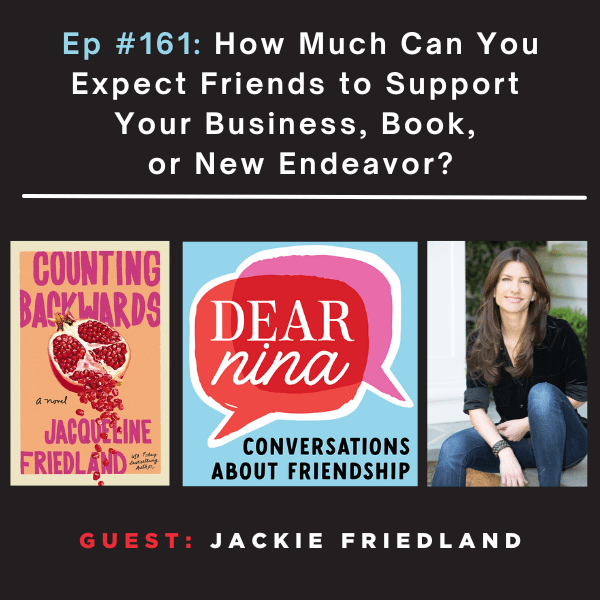
The guest I have is Jackie Friedland. She’s A USA today and Amazon bestselling author of Historical and Contemporary Women’s Fiction. She has five books out now and her latest came out in March of 2025. we really talk about what it was like with her first book versus their fifth book. And then there was Covid in the middle, which of course complicated everything.
Although in some ways it should have been [00:03:00] easier to show up remotely for people. And still it was hard to get, friend support sometimes. We really analyze why that might be and what a person who is out there selling something can do about it. Should they do anything about it? We don’t really come to one right answer, and so I will really be curious to hear listeners’ thoughts.
There are many ways to get in touch with me. I am going to share them all in the show notes, but other than social media, there’s the Facebook group, Dear Nina, the group, and I always have ways in the show notes that you can email me directly or email me anonymously if you want to share your thoughts and you don’t want me to know it’s you.
Without further ado, welcome to Jackie. Hi Jackie. Welcome to Dear Nina.
Jackie: Hi Nina. Thank you for having me.
Nina: I really am grateful that you are going to discuss this topic with me. It’s a brave topic because it’s a little uncomfortable to talk about what we might hope from our friends and expect from our friends, and an even more uncomfortable topic of sometimes having disappointment I would love to start by understanding your experience with [00:04:00] being out there, having books that you hope people will read and buy and support you with. And what, what has that been like?
Jackie: So it’s been pretty crazy. so much of the writer’s life is sitting alone in a room, and then once the book comes out, you have to go out and talk to people and publicize. I have to say that so many people from within my community and different parts of my life have shown up and come to events or posted online or invited me to come to their book club and done all these things.
And it’s been great, but also really interesting to see certain friends who I would have expected to come to, you know, four events and post every day online and say, what else can I do? And let me write a review on Amazon or what kind of event can I throw for you or something have done very little. And other friends who I haven’t seen or spoken to in a decade have shown up and done really supportive, awesome things and it’s been just kind of interesting to see.
I actually have been giving it a lot of thought, and I just said to one of my [00:05:00] older children the other day that I think it’s very similar. It’s a horrible way to look at it, but putting a book out in terms of what you expect from your friends in return is very similar to a death in the family. who’s going to show up for the funeral? Who’s going to bring you meals and make sure your family is eating? I feel, on some level, it’s those same friends who are coming to the book events or maybe not, but it’s different than inviting friends to a party where everybody wants to come. They kind of get something out of it for themselves when they come to a party. Having them come to an event for your book. Like maybe they’re not big readers, maybe they hate fiction, whatever it may be. a lot of it is really just doing something for their friend. In much the same way that you show up for a death.
Nina: I understand what you’re saying. the word you’re not using, but it’s the underlying word is obligation. Like there’s a certain bit of friend obligation that we many of us, when we’re trying to show up for friends, step up to, even if we don’t feel like it, even if it’s inconvenient. And so I’m thinking of a death, a funeral.
And you and I are both Jewish, so a Shiva, which you know, in a traditional community, [00:06:00] this is my listeners, I’m not telling you would be seven days. And in a lot of the American Jewish community, that’s not traditional, it’s very rare that people do it for seven days. And so actually you have to get yourself there the first couple days because kind of sadly, if this is my 2 cents, my opinion, kind of sadly, most people have done away with the full thing.
And that’s sort of beyond our topic. But if you think about what that full seven days does is it gives people an opportunity to show up and not on day one doesn’t you have an opportunity to show up. So anyway, the book. It’s not just a book. Made this clear in the intro, but I just want to reiterate it.
Jackie and I are talking about, in her case, being an author and in my case being a podcaster. And for many years before that, a writer with articles out there but it could be that you’re starting a new business and it has all this online presence and you’re trying to build up the numbers.
Like let’s say you’re starting a new business. You don’t really want to see that it has 200 followers, right? You’re like asking friends to, oh, can you follow this page? I mean, I’ve been recipient of many emails like that. People are asking favors a lot and it’s very easy to just press, like some of the stuff you’re talking about can be a little harder. Have you [00:07:00] seen a big difference from your first book to now your fifth?
Jackie: So it’s been a very interesting trajectory from Book one through five. When my first book came out, none of my friends even knew I had been working on a book. And then one day I was like, surprise, you know, I have a book coming out. Because I feel like I. So many people say, I’m writing my novel and nothing ever comes of it.
And I didn’t want to be another one of those people, so I, I just dropped the bomb, when it was done and on its way. I had something like 150 people show up to our local Barnes and Noble. everyone I knew was there and it was amazing. and I had other author friends see pictures of it online, in the days afterwards saying oh my goodness, my book events, two people show up and that’s just for the snacks, so, but I thought like, oh, this is amazing. This is how it’s going to go. then my second book came out a few weeks after lockdown started. . And it was also so early in the Covid situation that people weren’t even really doing things on Zoom yet. . When my third book came out and we were kind of emerging from Covid Lockdowns, I thought it would be like at that first one and it was like nobody showed up. I really just, [00:08:00] the, my core, core crew came. And I figured okay, I guess that’s what happens after they show up for the first one.
Everybody rallies behind that and then going forward not so much. But I will say that most of my closest people did still show up for me. But it was disheartening. And so when my fourth book came out, I said, I’m not even doing any local events. I’m just going to go to places where I don’t know people.
And that way I won’t be offended when people don’t come. so I went and did events out of Town and that was lovely. And now with book five. I just , sort of like, let me just see, I’ll do something local. Again, it’s my first book with a really big publisher. And I had two local events and so many people showed up. And then two different friends threw book parties at their apartments.
Another one in, Greenwich, Connecticut. So it’s actually been this book, I can’t say why. I’ve gotten a lot of friend attention, which I really do appreciate, and I said to my husband, I think I’m a little bit unfair with my attitude towards all of it in that for the friends who show up, I am [00:09:00] enormously appreciative.
I don’t feel I’m entitled to that time and attention. I really do feel grateful and I understand that they have inconvenience to themselves to be there for me and to prioritize me, and it really makes me feel good. But I am equally upset with the friends who don’t show up. There is no in between for me, like I cannot justify it, and that’s how I am.
Nina: This is like actually amazing for me because I kind of want to, it’s not what we planned, but it’s like I, and I’m not a therapist by the way, at all. I, and I never bill myself as one I, I often open the episodes reminding people I’m not. But I have been writing about friendship for 10 years and I’ve heard a lot of things and read a lot of things.
This is a topic that comes up a ton in different forms. And it could be even a small as why is it that strangers and people I’ve only ever met online will comment, or like my social media posts, people talk about this a lot, but you never can get your friends to, and people can see that their friends are seeing stuff.
There’s ways, if you have a certain kind of account on Instagram, you can see that your friends have seen it, but don’t heart it and it can hurt your feelings and this is sort of a bigger [00:10:00] version of that with an actual book in the world. The social media pieces, a smaller version of it, but the same feelings come to it.
my first question is, how have you expressed to friends that it means something to you? when you had an event in town recently for Book five? Did an email go out with just like a regular, this is the event. Like was it the, not the flyer. We don’t say flyer sounds so old fashioned, but you know, the, the graphic, whatever.
Or did you explicitly say, it would mean so much to me if you came? I’m curious how you handled that.
Jackie: I did not say it will mean so much to me if you come, but I, I learned from this and I actually was just talking with a very good friend of mine who was deciding whether or not to go to somebody’s a friend of hers had a parent died and she was deciding whether or not to go to the funeral. And I was thinking about all of these issues of friendship and I called her and I said to her and this friend has not come to as many or events in throughout the years as I might have liked. I called her and I said to her, I’m just telling you now, when God forbid something happens to one of my parents, [00:11:00] I want you around a lot at all of it. I’m not going to tell you then, I’m telling you now. And she was like, oh, of course, of course.
And I said to my husband we’ll see, that’s as much as I can do. I think it’s important to tell people when it matters to you. The only person I did say I have, my sister is a very busy, she’s always has more work than she knows what to do with. And I did say to her, I really want you to come. she came. but I made a point of saying, this is important to me because I didn’t want to be angry at my sister.
Nina: Smart.
Jackie: else I can I’ll be angry and then eventually I get over it. because I don’t hold a grudge,
Nina: I do wish you had said to your friends and I think you should do it the next time. I don’t normally get like so prescriptive but I think it would be healthy for you, Jackie and you listeners to be more direct. Have the cute Instagram graphic that you’re attaching to the email or to the text or whatever you’re doing, and say, it would mean so much to me if you were here.
I’m concerned that people aren’t going to show up, just be vulnerable and say, I have a lot of anxiety about standing at a Barnes Noble event or wherever the event is, and talking to myself or having it just be my husband and [00:12:00] kids and my sister, It would mean so much to me if some of you came. I bet more people would come.
I’ll give a caveat. I don’t think you can do that every time for every book. What you said about a death in the family, for example. That is true, but it doesn’t happen constantly. we each have a few parents and unfortunately, as we get older siblings and other people who we might want our friends to show up about.
But if you’re in a creative business, whether it’s a book, a podcast, any other creative thing, even a new business, like you opened a new restaurant like we were saying, or new businesses, well, there’s always business to be done at this restaurant. If you own a retail shop, that store is going to be open a long time.
I think if you want friends to come to certain stuff, it’s like you gotta pick and choose. That’s what I’m trying to tease out for both of us in this episode. What’s reasonable to expect and hope and what’s too much. So if you have a book that’s coming out every couple years, it maybe doesn’t sound like a lot, but I could imagine some friends being like, okay, you know, here we go again.
You know, Jackie has another book out and we, you know, gotta go to the city or we have to like, go to the event. [00:13:00] And if they’re not big readers and they’re not big, small talk meet and greet type people, it could feel kind of like a lot.
Jackie: For sure. I agree. But as you were saying it, like I think there’s a lot of authors where the goal is a book a year, which is sort of like a birthday. And feel like I’d be willing to trade birthday celebrations. Forget it. We are doing nothing for my birthday, but come to my book event each year.
And maybe it’s that same set of friends that if you were having dinner with just a smaller group, those are the only ones you could, Expect it from. I find I actually really hate to ask people for things. It’s like a flaw with me. I hate to borrow anything. I always say, no, I’ll just get my own.
I’ll get my own. The one thing I do that I guess maybe is passive aggressive is in the back of my books when I acknowledge who have shown up, and I try to make sure anyone who’s gone outta their way from me, I try to include them in the acknowledgements, but I also try to make very clear in the acknowledgements why I have included these people so that other friends who are not in the acknowledgements can see oh, it’s because they went to the book events and they [00:14:00] posted online and I didn’t do any of those things.
And even though she loves me I don’t belong in the back of the book. and then they know oh, if I want to be I, here’s what I have to do next time, which I know is not, that’s my own like psychosis.
Nina: Yeah, I’m like nervous that your friends are going to be upset with you. if I’m your friend and I’m listening to this, I’m like, Jackie, give me a chance. , Why didn’t you say to me? I really want you to come to this event. I wonder if they would feel that way and I think it would maybe be fair for them to say, you didn’t even give me the chance, because they may feel like they’re one of a hundred people on a list. You have four kids. I have four kids. Right. So I know, you know, a lot of people, like when you have that many kids, it’s that many more parents, you know, and other people in the community, they’re involved in sports and theater and different things.
It’s like, you know, those families. Your close friends may think that they are on a BCC list with 200 other people, you know, in town. So they may not realize that it really means that much to you. I understand why it means that much to you. I get it. So I’ll tell you what I’ve had to sort of contend with is I’ve been writing a long time publicly when it’s not a book, when it’s something that’s [00:15:00] constant content.
So I have a weekly podcast. Sometimes I have like a big thing, I recorded an episode on NPR R’S Life Kit. I was really excited about it. That is one I’m going to put in the group text. I already did when I interviewed though, and I said, you guys, I’m interviewing on NPR R’S Life Kit. This was a big deal for me.
But you know, I’ve been on a lot of other podcasts. I have my own episodes that go out every week. I cannot put those in the group text. I just cannot because that would be beyond annoying. and I know that a lot of my friends see stuff online and they don’t interact with it at all.
First, I used to be upset about it, but I really have accepted they’re not really online people. Regular people our normal friends, our regular friends who aren’t content people who aren’t selling anything, aren’t putting anything out. They don’t use the internet and social media the way that those of us who constantly have to promote ourselves use it.
I think they use it much more passively. Like entertainment. I think they use it like they use Netflix. they’re just kind of watching and seeing, but they don’t feel like they have to interact with it the way I think [00:16:00] probably you, I mean I’m speaking for you, but I assume that you, when you see author friends or other creatives that you know who you’re connected with online, you see they have stuff, you’re just going to like it.
You maybe didn’t even listen to it. You’re just going to like it because we know that that’s a currency that’s important and it helps each other. Regular people even if you tell them I could see them being like, okay, wait endlessly till the end of time. Every time I see your stuff, I have to like it.
It’s probably exhausting, where does it end? Do they ever get to just use Instagram as a user and not have to be fans and audience members? It probably is a stretch at a certain point. but it’s hard to know because I also like to show up for people. Right. But sometimes you want to look at something else or read something else that I don’t know.
Jackie: Although the, at the, at the level of liking a post, I feel like that’s so easy. It’s so easy to just, if you’re already on Instagram and you’re scrolling and you see something just put a heart it’s less than one second to just tap the heart.
Nina: But you agree. People don’t like, I assume in your life they don’t. [00:17:00] Yeah.
Jackie: I mean, my author friends are great at commenting and engaging with all my social media. My non author friends on the other hand, if it’s something personal, they’ll comment on it. But the book stuff like every 30 posts or something one of them will chime in.
because I, I also feel like that on some level they think I’m not speaking to them in those posts. I’m speaking to my audience
Nina: Yeah.
Jackie: you know, and they’re not a member of that audience.
Nina: Yeah, that’s kind of what I’m getting at that, that’s like work stuff. I very rarely will put a picture of my kids on my Dear Nina friendship account. They’re teenagers. They need to approve everything. And to get four people to say yes, I like the way I look in that pictures pretty difficult.
Once in a blue moon, I get one. I did do one on my professional account and my personal account’s private, so they’re less worried about that one.
This one’s public and the number’s growing and all that, so that probably got I mean more hearts and whatnot than anything professional I’ve ever put on there. And by people I know in real life. I noticed that on Facebook too, by the way. And Facebook’s just personal. So my personal Facebook account, [00:18:00] if I put a picture of the kids, which again, I don’t do very often, you would think it was the most exciting thing ever.
If I put that I was on NPR will probably get five likes. People don’t like to see self-promotion. There’s some block that personal friends and family have. I even once had a family member say to me, oh my gosh, you’re so always, you know, promoting yourself. And I said to her, you know, I don’t have a publicist, right?
I don’t, so who else is, if not me, who, I have an episode out, let’s say, that I’m excited about. If I’m not talking about it, some other random angel out there going to promote my no, it starts with me. That’s how it is.
Jackie: I actually just had a conversation with family last night about how frequently I post on Instagram and I said I actually am trying to post more. I don’t love to post. but I feel like it’s important because what you said, it’s the only way to reach your audience really. So I have to force myself to be like, oh, by the way, I’m doing an event. If you live in Connecticut, you should come. it kills me a little bit each [00:19:00] time. the advice that I’ve been given repeatedly is that I should be posting every day to keep my audience engaged , I don’t want to alienate people.
I I agree with you. A lot of people don’t want to see that. They don’t want to see all the self-promotion, and yet it’s sort of our only choice.
Nina: I’ve almost have been tempted to remove my real friends and family from my professional accounts. I haven’t done it. That feels kind of like an aggressive thing to do, but I have been tempted before for that reason.
So I want to feel a little freer. I do TikTok, which I have a lot of fun with, and I think I have more fun with it because if they’re seeing it, it’s probably on accident. Like it shows up if, if some of them are on it passively, in an entertainment way, but they don’t make content, I am a lot more loose on there because
I feel like I’m not having to apologize for my existence on it. Sort of an interesting mental exercise. I know we’ve talked about social media a lot, but it’s a real part of our lives and it’s a small window into maybe how much support you can expect from your friends.
I’ll make tiktoks about this a lot, about this topic, and I [00:20:00] do tell people when I’m brave, but then people yell at me. I will say, it’s not a good idea to measure your friendships from whether they’re liking your posts, because most people won’t, and they probably are good friends in other ways. So that’s like one thing I guess I would think about is, are these friends who aren’t coming to the events and aren’t liking the post? Are they good friends in other ways or not?
And maybe, I don’t know if you’re comfortable answering that. Are there other ways you can think of that they are good friends and if not, why are they in your life?
Jackie: I can tell you I have a close friend who I’ve been friends with for years who I don’t think has come to a single book event. And I had actually mentioned it to my husband because I, was disappointed that if there’s been opportunity after opportunity and where are they? I was chatting with her recently and she was asking how things were going with my newest book and I was saying, oh, you know, I thought counting backwards was going to be really my real breakout, but I haven’t been getting quite as much publicity as I would have wished. she’s like, oh, well I know this woman in [00:21:00] Atlanta who runs this event, and why don’t I get you in touch? And you know, she’s like texting me within 20 minutes all the information of this woman who I should talk to. her husband happened to have been with her at the time and was saying we didn’t know you needed this. He literally said that. and it was so to me and my soul about this relationship that they care, they want to help me. They just didn’t know what I needed.
Nina: you just answered your own question from earlier, but you, there’s another piece of your story that actually we cannot gloss over. The fact that she even said to you, how’s it going? That in its own might be worth a thousand hearts on a post because she actually asked you, she doesn’t even have to have read your book or come to an event or liked a post to be curious about your work.
I try to encourage people to do that with their friends. you don’t have to be the consumer of somebody’s work. You don’t have to visit their restaurants. You don’t have to show up at their store that they own. it’d be nice if you did, but let’s say you can’t, or you have your reasons not to.
You can still say to your friend, how’s work going? I can see you’re working really [00:22:00] hard. How’s the book going? I can see that you’re out there doing events. Are people coming? Maybe that would be awkward if they haven’t come, but you know, there’s a way to ask about someone’s work, I feel in my thing. Like, you don’t have to listen to my podcast to be my good friend and say to me, how’s that going?
Do you have any interviews you’re excited about coming up? Who’s on the show this week? You don’t have to be my podcast listener to ask me, Nina, your friend, how it’s going. Just good social skills. It’s important for creative people to remember that in reverse. It’s very important to remember to ask about people’s works that might not be as glossy and exciting and public. I know you were an attorney, right? I wonder if people would ask about your work then. But we all have friends with jobs that are less shiny. But it’s important to ask about those too. And sometimes people don’t want to talk about it because they don’t want to talk about work.
Jackie: I find that’s very true and I also, I shy away, especially with my lawyer friends, about asking how work is, because I’ve been very vocal about how much I hated being a lawyer, and now I feel like for me to turn around and be like, but how is it for you? I feel awkward in that. and then I try to say it like, and [00:23:00] I do, I mean this, I understand why other people might love it. it was just so completely not for me. but I agree with you. It’s important to remember and to push yourself even when you feel it might be awkward to ask what’s going on in other people’s professional lives. It’s such a big part of so many of our lives.
Nina: and if they don’t want to talk about their professional life, but you do want to talk about yours, then I would make sure to push and inquire about other parts of their life because it can feel uneven. I think when you are a creative person and you have something out in the world and you want people to attend to it in some way.
I think you have to be very careful. And again, not you, Jackie, all the yous and including myself. The public parts of ourselves can get in the way of a real personal, regular friendship where people just want to be friends with Jackie, the person and not always Jackie the author.
I think sometimes people don’t ask me about the podcast because they are feeling funny about the fact that they don’t listen and they don’t either want me to know. And I wonder if people sometimes don’t ask about the book, let’s say, because they haven’t read it yet. And so they’re worried that they’re going to be like, well, what’d [00:24:00] you think?
Jackie: Yeah, no, I, I think that that’s absolutely right and I, what I often tell friends is like, I almost don’t even care if you read it, just put it on your shelf, or tell your friend about it, Anything. Or heart my post on Instagram, I don’t read memoir and if a very good friend wrote a memoir, I really wouldn’t want to read it. I probably would do it because it’s like my field and I, I get it, but I understand that not every genre or every entertaining item is for everybody.
Nina: So my assignment for you is when you have your next event, when it’s near where anyone lives, or some sort of online situation, or even just you wanting people to buy the book and write a review, even if they haven’t read it, you could say that.
You could say, I totally understand that everybody has a ton of books on their bookshelf. It would mean so much to me. You have to say those words. That is my assignment for you. What? Whatever the thing is, whether it’s an event or a review, the words are, it would mean so much to me if you would leave a review. It could be two sentences. This is where you click. I’m sure you’ve done that a little bit.
Jackie: let me ask you a question on the flip side. Here’s why I, don’t do more of that. [00:25:00] I’m very reluctant to become pushy. I don’t want to annoy people. I don’t want them to be like, Ugh, it’s Jackie asking again for me to come to something I understand what it’s like, you’re busy every night you have something and on the night that you finally have a night to be at home and then your friend says like, oh, I opened a store and we’re doing our opening event, and it’s like the last thing you want to do.
I completely get that. And I don’t want to be the friend constantly pushing and bugging people. And so that’s, sort of what holds me back
Nina: One time per book. I hear you. because I, I understand it and it’s actually smart and socially ept to be aware of what could be pushy. I think it would be a better way to express what your hopes are with these friends than the acknowledgement thing at the end of the book.
just being honest. And you could then still do the acknowledgements, but at least you’ve asked directly and it’s like a one-time email. It’s, here’s the event. And I absolutely understand if you can’t come, we’re all so busy. It would still be so helpful if you [00:26:00] left an Amazon review after buying the book, and you don’t have to read the book, give it to a friend, give it as a gift, and I have no expectation of you reading it.
I would never tell someone what to read, but I worked so hard in this book. It would mean a lot. Maybe just a one time email. One time per book. Kinda like I try to be judicious about when I put a link to something I’ve done in the group text. It’s gotta really mean a lot to me because I constantly have stuff that I technically would love people to hear.
I mean, I’ve been talking about friendship for 10 years. I’m sure a lot of my friends are like, oh my God, I, they’ve heard it all, heard it all. They’ve seen it, they’ve heard it. They’re tired of it.
I’m actually, I wanted to tell you, doing an event out of town in Chicago where I’m from, in Highland Park, and it’s going to going to be my first live event ever. My first live to Nina. I do think there’s a reason I’m doing it in Chicago and not Minneapolis where I live. And it has some of this in mind. First of all, I’ve never done a live event and it feels less scary to do it in a place where I have a couple of friends left, plenty of acquaintances and listeners and my family family’s different.
Mom, you’re coming to this event. My sister, you’re coming like you did with your sister. [00:27:00] Here in Minneapolis where I’ve lived for 25 years and I know a lot of people, I. I’m not quite ready for that experience to have to decide how much do I want to push people. How disappointed am I ready to feel, you know, that kind of stuff. So I, I’m in it with you. I mean, I get it.
Jackie: Would you be comfortable asking your parents to bring their friends and ask their friends? Friends, because what, what is that? Then there’s that other layer of, come to my family member’s thing and be a friend to me and to your, your mom’s friends, for example.
Nina: with my mom, yes. I would, and actually when I sent her the save the date, I put her two best friends on it . So I mean, I’ve known them forever and I’m like, will you guys come? And they were actually touched to be included on that email. both of them said, so they said, thank you for including me.
We will be there. It’s in the calendar. it takes some vulnerability to ask somebody for something you want. And I think it actually creates a closeness and not a sense of annoyance unless it’s constant. So if it’s every two weeks, can you like this post? Can you share this review? Can you, that would be a lot. It’s like everybody has to find their [00:28:00] line.
Jackie: I once read that When you’re having company for dinner and you’re in the kitchen and a friend comes in and says, can I help? You’re supposed to let them help. my inclination is to be like, no, I’ve got it. Go, sit, enjoy, relax. But apparently if you let another woman into your kitchen, so to speak, it’s opening yourself up to them in a way that makes them feel closer to you,
Nina: Yes, no, this is true and this is true about favors as well. So asking someone a favor makes the person who has asked feel closer. course, the person who receives the favor feels a sense of relief and closeness when that favor was granted. the study shows that it’s the person who was asked we all know it takes a lot to ask for help, and it sounds like something you definitely are going to work on asking for help.
And you could start by, you know, letting somebody, help clear the dishes. I always let people help, you know, I host Shabbat dinner every Friday night. Anyone who wants to help, they say, what can I bring? I give them an assignment. They say, how can I help? I say, collect the plates, whatever. I’ll ask for help even before people ask. Like I’ll be like, Hey, can you help me clear? I dunno, it’s a lot of work.
Jackie: It is a lot of work.
Nina: I’ll take all the [00:29:00] help I could get I think it would be healthier for everybody out there who’s listening to probably let go of the social media piece of this. ‘ cause it’s just so constant. It’s universal. I hear it all the time that people get support from strangers and acquaintances and not from friends. And I think maybe we just all let it go. But an event where people, you need people to actually show up once in a while when it means something I think we have to ask directly.
That’s my conclusion. I don’t know if you have a different conclusion.
Jackie: I think it also gets dicey when there’s money at play when you’re asking people to buy something versus just asking them to show up or tell their friends, about your book or your new store or whatever it is. It’s asking for more when there’s money involved, and it creates a strange dynamic in some situations.
Nina: I think that’s a really good point. And you, you gotta be careful. Yeah. I wouldn’t push your friends to come to an event that’s a hundred dollars ticket. you gotta be really sensitive. Right? Everybody has a different number in mind and Yeah buying a book, that’s where you could bring in, in this one email that you’re writing where you say you understand if they’re [00:30:00] busy.
But here’s another way that’s also supportive, and it’s so easy. It’s free. Even when you see my posts on social media every so often, you could give it a, like, it helps it in the algorithm, explain it to people. People don’t always understand why it matters.
Jackie: I agree. It is helpful to be told. I have a lot of friends who have sub stacks. One of them recently asked me to like her sub stacks and she said, I didn’t even know you could like a substack until she told me and she said, yeah, you know, it helps like with the algorithm on the Substack website and gets in more people’s feeds and suggestions and so now every it comes, I think every week, but it’s just, it takes me 10 seconds. I put a little heart and I think if I put a comment, it’s even better. So I’ve been doing that too, because I just didn’t know.
Nina: It’s nice of you to be willing to do that. And I think she probably shouldn’t send that to too many people. writer friends. Yes. But her regular friends, people don’t like to be public.
A lot of people don’t even like other people to know that they spent any time on Instagram. We forgot to cover that, but, or even on a substack. I’ve had people on a local Facebook group I’m in, sometimes I’ll ask a question like anyone know a good curly [00:31:00] hair, hairstylist for my daughter?
And then someone will tell me in person or text me, oh, it’s such and such. This is a great recommendation and I’ll say, oh, why didn’t you write it on there? They’re like, oh, well I don’t write. I would never write something publicly. And people really feel that way. It’s like they don’t want people to know that they read anything in that group, even though they’re clearly in the group and they’re clearly lurking in the group because they saw my post. But they don’t want anyone to know. It’s a certain mentality. It get it because it’s scary to be public.
Jackie: I actually have some people in my life who, because my Instagram account is public have asked me not to post anything referencing them because they’re very private people which I totally get and respect, but , there are very different ways of approaching social media, so I think your, your point is a good one.
Nina: when I put this in the Facebook group, which is Dear Nina, the group. I know there’ll be a lot of conversation about it. because what I love about that group is I’ll hear from other writers and creative types in there, but there’s also a lot of just regular people in there.
I’m excited to share this in there and get conversation going about it, and I’ll end up doing a substack post about this [00:32:00] too. when it comes out, you’ll see it and I’m sure there’ll be feelings. People have a lot of writers on Substack, so people will have feelings.
Jackie, thank you so much for being here and, and touching this touchy one. There’s no one right answer, but I think we it’s kind of turned over a lot of issues around it and gave people something to think about.
Jackie: I agree. Thank you for having me. And I will say I do feel very lucky to just have friends, you know, it’s like a blessing in life and. My grandmother always used to say, if you have one true friend, you’re blessed. So there’s that.
Nina: thank you so much everybody, come back next week when our friendships are going well. We are happier all around. Bye.