Jonah: [00:00:00] Enrich yourself with other people’s experiences and learn from them about what they can share with you, because that’s how you grow as a person. I really feel that your most meaningful relationships and your most meaningful friendships and companionships are those that challenge you intellectually, challenge you emotionally. Not because they’re trying to antagonize you, but because they want to help you grow, because you’re doing the same for them.
Nina: Welcome to Dear Nina, conversations about friendship. I am your host, Nina Badin. I have been writing about friendship for over 10 years, podcasting about it for over four years. Today’s conversation is all about really conversation, how to have deeper ones, how to get
away from those surface conversations you might be having with friends, and this is a way to help you make friends, but also a way to help you maintain quality friendships to go below the [00:01:00] surface. Once you get to know someone better, if it doesn’t move beyond the very surface, the catching up that catchup loop or what are the kids up to, how’s work in like the very surface way? I don’t necessarily mean that the surface is always silly or unimportant. Sure you do wanna know how someone’s doing in their regular life, but if you could never really get to a deeper level, it will keep your friendships stuck in a way.
I have a wonderful guest to help us deal with this issue.
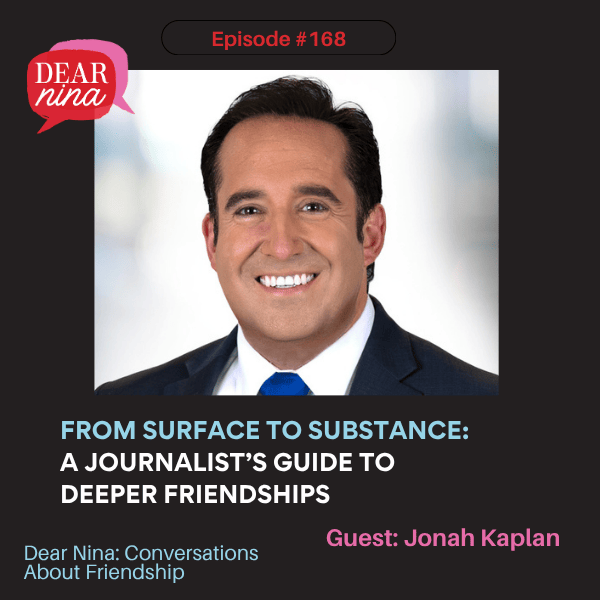
Jonah Kaplan is an award-winning journalist. His work appears on WCCO in the Twin Cities, and he’s often featured on CBS news programs and platforms including CBS evening news, CBS mornings and CBS 24 7. There is not much that Jonah has not covered in 20 years.
He gives some examples in the show today that are so varied and difficult. I mean, he’s really witnessed some difficult moments in people’s lives, for whole communities, for individuals. that is a huge part of his job and I think it has helped him also be [00:02:00] uniquely able to take what could possibly just be a surface conversation about work or a trip and take it to another level and it’s maybe more than the average person’s able to do, but if we could even take just a little bit of his advice from his journalist eye, that would be so helpful to everyone. So I hope you enjoy my conversation with Jonah. Like you’ll hear, he is a friend of mine. He lives in Minneapolis like I do. He has Three girls. I’m friends with his wife, I’m friends with him, we’re lucky to have, Jonah and Grace in the Twin Cities. You will hear that they have not been here very long, and I’m so impressed with the social life they have built. It is not on accident. It is through skill and effort.
Hello, Jonah Kaplan. Welcome to Dear Nina.
Jonah: Oh, what a great honor to be here. Thank you for having me.
Nina: As you know, I don’t get a lot of male guests and so when I do, I’m very excited about it. But I do need to let people know that we are also friends and you fall into a couple different topics I’ve talked about on the show before. You’re a younger friend, That’s been a whole episode I’ve done of the importance of [00:03:00] having
Jonah: I don’t wanna age anybody. It’s just a number. And especially with what we’re talking about today, age, it’s really about experience, right? and you could be young, but have a depth of experience and that could age you in maturity and yeah, please.
Nina: Yes. I know, but you’re my husband’s friend too, which is great. And you are even further apart than you and I are. Then your wife is one of my youngest friends. I just had to mention this ’cause it comes up on the podcast a lot. When people are looking for different kinds of friends, they feel stuck in their friendships. I often advise, look older and look younger. You are too much in your little bubble of life stage and it can get stale. Grace I think might be my youngest friend. I have other young friends, but I think she’s the youngest and you might be my husband’s youngest friend, so I love that for us.
Jonah: It could be, but yes, I would agree.
Nina: I said a little bit in the intro, but I want you to say in your own words what exactly what brought you to Minneapolis. ’cause you’re not from here.
Jonah: Right. No, I’m, I am a thousand percent transplant like, no, Minnesota, no, Midwest. I am [00:04:00] northeast to the core. Grew up in Philadelphia, New Jersey. Family in New York, Connecticut. Um, when I used to live in Texas, I mean, they called me Yankee. Don’t know if I’m allowed to curse on this show, but they
Nina: I’m glad you asked. No, we
Jonah: yeah. Okay.
Nina: rating here.
Jonah: Okay. So, well, they called me a Yankee expletive, with affection. but that’s really what it was. I’m a TV news reporter. I’m a journalist I was six years in Raleigh, North Carolina before this, and so when we were looking around, this is a very small business and actually I was an intern in ESPN, and I worked there outta college.
And the person who an executive at ESPN is now an executive at CBS News. And so when I was leaving Raleigh, I called her and said, I’m really looking for the next step. And she says, well, where do you wanna go? And I said, well, look, my family’s in Philadelphia. My family’s in New York, and my wife, who’s from Milwaukee and has extended family in the Twin Cities, she kind of yells in the background, ask about the Twin Cities. And I said, okay, Lori, how, how about the Twin Cities? And she says, actually, we have a senior reporter [00:05:00] position there. I think would be a really good opportunity and, and kind of lead for to get you into the network. So we moved here about three and a half years ago. It’s been a wonderful transition. My wife and, and our daughters, they’re thriving and work has been, I mean, look, we don’t have to talk about the news of Minnesota, right? It’s, it’s been, For better or worse, a big news market, big opportunities for me personally to tell really, enriching and challenging stories that I think have really resonated with national audiences
Nina: I can’t believe the two of you have only been here three and a half years. It seems so much longer and, and we’re not doing this topic, I’m about to say, but it is something to note. Just moving to a new town. It’s something I’ve done several times on the show already, but you guys know a lot of people for three and a half years.
Jonah: We’ve met a lot of people. We really didn’t know people here, that’s the thing, and I think it does connect to our topic today. How do you build connections and how do you build relationships? And even in such short time, it’s because there’s real substance to it. [00:06:00] It’s because there’s deep meaning to it.
we jump right in. And I know, you know, we have maybe a, you know, regional, national and then national audience, maybe international audience for
Nina: We do. We have an international audience here. We do.
Jonah: Fantastic. I think one of the ways for people to go out and to take initiative. And that’s what we do. the stereotype of Minnesota was, we’ll tell you everywhere you need to go, except our home.
Right? We’re Minnesota nice, not kind. And hey, they’re kind of cliquey, you know? They stick with their own. But we never found that. But that was also because we weren’t gonna wait for an invitation, you know, and, and in my
Nina: Amen. Thank you.
Jonah: Right. We’re not gonna sit and wait for people to call us. In my job, I’m certainly not gonna wait for the stories to come to me. I’m gonna raise my hand. I’m gonna sign up to play ice hockey. We’re gonna sign up for, extracurricular activities for the kids and just go up to people and say hello and build connections that way. And that’s why people say, wow, you’ve only been here three and a half years.
Yeah, but we’ve been busy in those three and a half years. We’ve done a lot and that was purposeful.[00:07:00]
Nina: Getting out there, not waiting for people, not being shy is the first step. But then you’re getting into these conversations with people, and I want us to get into our topic now of getting away from shallow surface conversations to actually have substantive, that’s a very hard word to say.
Jonah: substantive, yes. You don’t have to use it in your conversation. I’m just saying it’s gotta have some depth. How about that? Let’s have deep conversations
Nina: So yeah, tell me some of your, your tricks and how you came to realize this is something that is the key to all kinds of friendships. And I love that you’re a guy having this conversation with me too. ’cause the stereotype is sometimes that guys only need to do things together, that women talk and guys do, sit at a sports game, pickleball, these kinds of things.
And I think that’s too simple. There’s a reason you’ve made close friends Jonah, not just from playing pickleball.
Jonah: Right. And also, by the way, if you’re talking about sports, usually the conversations go deep into statistics and it’s kind of a proxy for something else, right? ’cause you’re talking about hobbies, you’re talking about something that [00:08:00] connects to your childhood. And when you start to talk about the athletes and maybe the plays, then you start to think about when you were growing up and when you were watching sports with your dad or with your other friends, and it brings you back to a time and a place where you felt really good about yourself. And it’s kind of that inner joy. And I think when we talk about substantive conversations, what you’re really doing is you are peeling the onion back on your own emotions to find some sort of self-fulfillment.
You wanna have a friendship, you wanna have an interaction that leads to some sort of growth, to some sort of experience that leads you somewhere. If you’re just talking about a television show, what are you watching? And if you’re only talking about the characters and not even asking about, well, what do you like about it?
what is the character that appeals to you? what was the show that we were watching recently, which could very easily be a shallow conversation? The, the Hunting Wives. Okay.
Nina: that’s fun. Yep.
Jonah: The hunting wives. Okay. Fantastic
Nina: that with Grace?
Jonah: Absolutely.
Nina: I can never get Brian to watch it. [00:09:00] Brian won’t watch anything with any violence whatsoever. anytime a little drama happens, it’s kind of funny. He always says, oh, like, let’s say it’s going along well. Like, even like Ste Soul, like it’s very, uh, pleasant show
Jonah: I didn’t, I didn’t do, I didn’t do it. That was
Nina: It too slow So he liked that it was slow, and then the tiniest little drama would happen. He’d be like, see, now they have to, you know, break up. And I’m like, brain, there has to be some drama. Anyway,
Jonah: Yes. But, but, instead of just asking like, oh my God, isn’t it ridiculous? Could you imagine this happened? No, my questions about the show would, you know, we’re talking about, for instance, the accents. Have you ever been there before? What did you think about these complex families? It’s how do you take these things to the next level to just add some substance to it. A lot of it, I would say, comes from my own personal experience of where I learned this. And I would say two factors. One is I was a camp counselor. one of my favorite parts of camp was at night as a counselor, we were on what’s called OD on duty.
We had to watch, the kids were [00:10:00] going to bed, but your job was to sit there, you and another counselor to make sure that they didn’t burn the place down or eventually they would get to sleep. my very best friend, uh, one of my best friends, Aaron Taylor, and I would sit on the porch . It was like two rocking chairs, two guys. And we would have like our greatest favorite snacks and we would sit on the porch for three hours.
How do you fill time for three hours? The conversations went from everything to our favorite meals, why we liked those meals, to again, those old sports times, the old nineties, Michael Jordan, Charles Barkley years, to our ideas for the future, where we’re gonna go. And to me that was kind of like my favorite time. And that also where I love a porch. I love in the summer sitting out on a porch. I love a fire pit. I love having a cigar. Brian and I, I love our times because we sit and we talk. I don’t love playing golf for the golf.
I love that because you’re out there talking with people. You’re not on a phone scrolling. [00:11:00] You can’t fill three hours no matter how hard you try talking about influencers or social media posts, it’s not gonna happen. It’s just not. You’re gonna run out of things. You conversations are gonna go dull. It has to go deeper because otherwise, how do you keep that time going? it’s gonna be like skinning your teeth. It’s gonna be brutal. Brutal. It’s gonna be a drill.
Sitting on the porch with Aaron then led to even a radio show, which we had in college called On the Porch, and we would welcome people to the porch and. And it would be, it would be talking about our classes. What did we like about our professor? How did that professor challenge us? What was it about him or her that really resonated with us? What is it about this topic that really spoke to us? Why did we like it? How could it apply to what we wanna do in life?
How could it apply to our goals? Have you ever been to these places? What was it about that experience that you really remember? Why that place? Why that mountain? Why that color? What was it that appealed to your senses? What did you hear? What did you smell? What did you see? What did it remind you [00:12:00] of?
They’re not interrogations, they’re probing questions because you wanna keep the conversation going. And these are very much the interview skills I have in my own job, and by the way, you can pick out, when you’re looking at journalists, what are the ones that you find are the most effective at their jobs?
Which are the ones that are pushing and moving the story forward versus the ones, what kind of question is that? What, what, what, what did he think the president was gonna say? What, what, what, what, what do you mean? How did he feel? What, what’s he gonna say? Oh, I’m thrilled there was a shooting. Come on. What, what, what is that? you’re trying to find ways to really bring meaning and depth to the conversation. You can do that with your friends and it will add so much to that and that relationship because you will connect on a deeper level. And so that was the first part. Camp is sitting on the porch.
The second part was in my job. So I grew up in the Northeast, right? many people in the Northeast, they go right to New York, they go right to la or maybe once in a while they go to Chicago, but they go to the big city. [00:13:00] And look, people in the Midwest, maybe stay in the Midwest. They have their kind of life . In my job, and I’ve lived in a lot of places. I mean, grew up in the Northeast, but I’ve lived in Texas, I’ve lived in Missouri, I’ve lived in Wisconsin, I lived in North Carolina and now I’ve lived in Minnesota. I don’t see a red and blue divide.
I see an urban and rural, and I see two separate, basically two separate stages of existence. One is not right, one is not wrong, one is not better, one is not worse. They’re just different. They each need to be validated and acknowledged, and if they could each be understood and learned from, it would improve our society in so many ways.
So I’ve lived that experience. I am son of two rabbis, an observant Jew who grew up in the suburbs of Philadelphia and New York City. And then I lived a town of a hundred thousand people in northwest Texas between Dallas and Oklahoma City. And then I lived in southwest Missouri, Springfield and I went to Branson and I spent time in Arkansas.
I’ve met people [00:14:00] and ranchers and farmers and inner city families and I’ve lived through the trauma of a EF five tornado and been on the ground and interviewed survivors of a storm that killed 158 people. And then I’ve interviewed gold star families. I’ve had these experiences that are incredibly traumatic.
Or how about, let’s bring it to current events. I just interviewed survivors of the Annunciation Church shooting. When I go out with friends, you could say, don’t you want a distraction? Don’t you want something completely mindless? Actually, no, I don’t. I want to talk with people who recognize not the trauma that I went through, because it’s not trauma, but the substance and the challenge of what I just lived through. I wanna talk to them about something deep in their life because I’ve now had depth of experience.
Nina: You able to draw people out? with these journalistic skills, like, so let’s say you’re just meeting somebody and you’re trying to figure out is this someone I wanna be closer to? What might seem like a surface [00:15:00] conversation or a person who’s only able to have a surface conversation at first, someone like you may uniquely be able to draw the other person out.
Do you find that you give people more of a chance, first, maybe you’ll ask some questions and see is this person able to go deeper before you kind of go, eh, this person’s gonna be like, we’re only gonna talk about tv.
Jonah: well, I’ll tell you. I, if they don’t ask any questions of me, I’m just gonna keep asking questions about them and I’ll just keep the conversation going.
Nina: But does that get to you? I also maybe, ’cause I have been doing a podcast for a long time, I’m just a very conversational person. I’ll do that to a point. But if I find they never ask questions back, I really get I irritated
Jonah: I, I will, of course, there’s a point. I’m not gonna sit with you for an hour, especially if I’m not doing a story on you. You know, or you I mean, look, everybody does have a story, Everybody does have something. and the question is, how willing are they to go there? How open are they in, in sharing of themselves?
You need to be in a time and a space. If I’m at a restaurant and we’re out with a bunch of couples and I just [00:16:00] happenstance have to be sitting next to this person, this is not necessarily a safe space to open up about the most traumatic experience of their life.
And I’m not gonna ask them unless they volunteer that information., And I can tell when someone only wants to talk about themselves and doesn’t ask a return question. But I would say for people, sometimes it’s also difficult for them to open up, depending on where they are, they’re not necessarily in a safe space. You do have to read the room. And that is a real thing to be vulnerable. and I could totally get why, they don’t want to be that. They don’t know me from nothing. Why would they open up? And by the way, that’s related to my job, for instance. A tornado just destroyed this man’s house. A stranger with a camera comes up. This is what we talk about in journalism school. And when I talk with students, how do you earn the trust of someone to tell their story?
So yes, I’m
Nina: you’ve done some really hard stories and I’ve seen your stories and really difficult times in people’s lives. That’s like a whole nother skillset would help in friendship. But yeah, you don’t need to go quick that quickly into it with
Jonah: You don’t have to go that quickly, but it, I would say for our [00:17:00] listeners today, just think about different ways to ask the same questions. Instead of, how’s your job, Or what do you do for a living? What’s your day like? What are the different tasks that you have? Tell me about the people you work with and what you like about them. As you work now on this project, what could it possibly lead to in your career? Ask different questions about, just try to move the conversation forward and even think to yourself maybe if I’m gonna ask this question, what do I think their answer is going to be? You went to Italy, how was it? they could say it’s terrible and I hated it. But instead of asking, how was Italy, how about, oh, tell me your three favorite things. Tell me about your favorite restaurant and what was that wine? How did it taste different when you sipped it there than when you sip it at an Italian restaurant in downtown Chicago or wherever you are.
Ask different things that are just gonna give you more detail in the question, and then all of a sudden the conversation is longer, You have more to talk about. You can then ask follow up questions. [00:18:00] Oh, no way. you were on the gondola. I was on a gondola when I studied abroad in London. Oh, get outta here.
I studied abroad in London too, and then all of a sudden you just never know where these things are gonna go and new tangents that can just lead to all new, different places for your conversations and your friendship.
Nina: Do you ever find that somebody responds, negatively to asking a question in a different way? Do they kinda look at you like, why are you asking that? And I guess you would have a lot of information if they did
Jonah: no, I do get a lot of. Ha. That’s a good question. I’m
Nina: That’s great. That’s
Jonah: Well, right, because it makes them think. It makes them think. when you make people think, you’re digging into their memories, you’re digging into their emotions, and it adds to their life experience and the richness of that experience.
And when we’re on social media and when we are just in these pictures and these kind of, I don’t wanna call ’em fake existence, but they are very shallow. Right? All you’re seeing is a picture. Yes. , You’re just scratching the [00:19:00] surface, You really need to peel the onion back because when you peel the onion, it’s not just a metaphor, it makes you tear a little bit because it’s reaching you. what is the purpose of a friendship? It’s companionship. It’s growth, it’s meaning it’s existence. It’s like why Adam didn’t wanna be alone. He wanted companionship.
So God created Eve. Because we were never meant to be alone. And it’s not because we want someone to lessen the burden of whatever work we have, it’s because you want to add to the richness of your life and your significant other.
That, of course, is gonna be your closest relationship, but your friendships can add in so many other ways. maybe it’s someone that connects you and keeps alive those college years, and maybe it’s someone that keeps your connection to when you were a kid. Or maybe it’s someone who is older and is gonna help challenge you grow as a parent or help you grow as an adult.
Or maybe it’s someone younger to help you remember what it’s like to be younger how to [00:20:00] stay fresh and keep laughing and keep being adventurous and not just stay in your house. You want the yin and the yang because you’re trying to find that balance in life, and that’s what Friendship is about.
Nina: It is so important that you get beyond your significant other because you chose that person at one point in life, even if it’s a newer relationship. and I guess I’m assuming in this case and in my life, this is the case. It’s just one person. you get the one person. I know nowadays not always the case, but that’s where friendship is, the way you can enrich your life. It’s the place that you can still continue to grow as you get older. Not that you couldn’t grow together with your significant other, but you can have any number of friends. That’s why, you know, people write me a lot of anonymous letters. That’s a big part of what goes on here and not so much for the podcast, but in the written form of what I do, a lot of those questions, what they’re really getting at is that there’s some major issue in the friendship. The friendship is impossible. The person never texts back. The person never reaches out. All these things on and on, and my answer is [00:21:00] often you don’t have to stay friends with this person. This is the opportunity. It’s opportunity. Friendship is opportunity to, you get to make as many as you want.
Jonah: the principles of a friendship are the same principles, by the way, or the same foundational principles of a marriage. Why do you have a romantic relationship? Because you want the intimacy, because you want that special connection. The friendship, it’s still the foundational principle of enriching yourself in just some other form. Maybe it’s professional, Maybe it’s social, maybe it’s athletic, maybe it’s political, Maybe you do want someone like-minded. Maybe it’s economical, you have a friend to help you in investing, maybe someone in your business. A friendship is just a different kind of companionship. It’s not gonna be as close as intimate as a marriage because the marriage or that romantic relationship is in its own category. But the friendship is what’s the point of the companionship? why do you want to be around someone else?
[00:22:00] ask yourself that question. Why do you want to hear from this? Maybe that person at the time gave you that, and when you grow out of it, just like you grow out of a pair of pants get a new pair of pants, it doesn’t mean that old pair of pants wasn’t good, It just, they don’t fit anymore. The pants haven’t changed. You’ve changed, that is totally fine. And you don’t have to hold onto something that doesn’t give you meaning or that doesn’t give you fulfillment anymore.
And so when we talk about substantive relationships and growth and learning you have to think about how is this person adding to my life in the way that I want and need? if I want a guy to go watch a sports, my dear friend Brad, a blessed memory, he was my college roommate. He died a tragically about a year and a half ago. We really bonded over Philadelphia sports.
We both grew up in the Philadelphia area. We met in college, and we dreamed of having a college dorm as a shrine to Philadelphia sports. that kept us going, until the day he died. And now that’s a void, right?
I’m not gonna watch with [00:23:00] sports with somebody just so someone else is watching the tv, If he’s not talking to me. I could do that at home. it’s to bounce off ideas. It’s to bounce off strategies. It’s to say, wow, he gave me a new perspective on that coach or player that I didn’t think about that before.
he’s now giving me a deeper understanding of the game or he’s giving me a deeper understanding of the team, or he’s giving me new meaning to the memories I had with my dad or my brother or whatever, or my, my sister. it’s, how is that adding, if you’re learning from somebody, this person has experience in this field, he or she works in childcare, he or she works in medicine. I wanna learn from him or her about a perspective on healthcare because they know, and maybe that can shed new light for me on some of the issues in our country.
what is it like to be working in the service industry and tax on tips? You know, it’s something we learn about, but gimme that firsthand perspective. What does that mean to you what does it mean to you, your parents maybe are first [00:24:00] generation Americans, or that you work in an office where there are dreamers?
Tell me about their experiences. What have you learned from that person? Enrich yourself with other people’s experiences and learn from them about what they can share with you, because that’s how you grow as a person. I really feel that your most meaningful relationships and your most meaningful friendships and companionships are those that challenge you intellectually, challenge you emotionally. Not because they’re trying to antagonize you, but because they want to help you grow because you’re doing the same for them.
Nina: That is beautifully said. I will give you a real life example. Um, well, a way to think of it. I wonder if this is true for guys or for you. It’s definitely true for me. Somebody who I’ve had a conflict with. I can think of any friendship where we’ve had some sort of issue. It usually, it’s not gonna be about the topic itself.
It’s gonna be, maybe you thought you should have been invited to something you weren’t, or you don’t like the way they talked to you, or you feel like you were making all the effort. These kind of [00:25:00] conflicts. when I’ve been brave enough to bring up the conflict with the friend, we are always closer after. I mean, almost always.
if there’s actually been a time we’ve discussed something hard, just hard between us. Again, not that the topic itself like politics is, can be hard, I’m talking about it, is just hard to tell someone you’re disappointed with them or upset with them. That is not an easy thing to do.
If you can get to the other side of that, you’re almost always closer than the people that you’re treating, like with kid gloves that you don’t have the hard conversations with. it is just another reason to be a little braver to get a little deeper with people and be more honest.
Jonah: I’ll put the question to you. I’m sure there’s been a time in your life where after you go out with a certain number of people, if it’s just the same thing over and over again, aren’t you just like to, Brian, do we have to go out with them again? Like nothing really happens. We just, I don’t know. It’s kind of dry. Like how many more times can we talk about the same thing about the kids,
right?
Nina: what I’m loop loop
Jonah: , you know, when you outgrow something. Because you want more. You do.
And especially in this moment when [00:26:00] there’s been so much happening in the world and you’re trying to make sense of it. Is there a time and place to ,Yes, shut your mind off and to try and do something mindless? Sure. But you know, that is not what’s gonna feed your soul. And you know that’s not sustainable.
it is much harder, of course, to not choose that. It’s harder to affirm that you need something more, and it’s harder to challenge that comfort zone, but it’s so rewarding.
Nina: What do you think keeps people from having the more serious conversations. I mean, I have my own theories, but I’m curious what yours are and I’ll share mine.
Jonah: I think one of ’em is that they’re unsure of their own skills in it. They don’t know how. They haven’t been nurtured in that way. Or they certainly haven’t done it in a long time. and I think that they’re also nervous about the reaction of the other person. They don’t wanna offend, they don’t want it to be taken the wrong way.
I will say this. I learned this from a wonderful, uh, a wonderful mentor of mine, Randy, Nathan. what are the laws of attraction? What [00:27:00] you emulate is what you’re gonna attract to you. So if you’re afraid, well, you’re certainly not gonna get confidence from the other side, if you are going into something, this is gonna be horrible. This is gonna be horrible. You think it’s gonna go great, n no.
Nina: Right.
Jonah: Right? But if you have faith and you have trust in that individual and you communicate that whatever that person’s reaction is, it says more about them than it does about you. You can’t control how others are going to react. You can only control about what you’re doing and your initiatives and your motives and your things.
But I, I really think that when you lead with heart, you’re gonna get that back. Now yes, are there guys, who may, you know, say something derogatory and may say something like, oh, come on. That’s what will you, you getting all sensitive on me, or, that’s not gonna be macho. Or, I know, well, maybe that’s not the guy I wanna hang out with. I don’t know. just, you know. Go ahead. That’s them. that’s on you.
Nina: So there’s that piece of it. And then I do think, there’s a lot of fear that you kind of mentioned this too, and the, but the fear is the word I would use fear of, like you said, I, this is one of [00:28:00] the things I was gonna say is offending. People are so used to really only tuning into sound bites. It’s like the attention span is so low.
so they may just heard the first thing part you said, but don’t take in your explanation of why you feel that way? It’s just the fear of offending being misunderstood, and trust that it’s not gonna be repeated out of context.
Jonah: Yes. But I also think the fear stems from, well, I don’t know if I’m gonna do this right. Maybe I don’t know how to do this. Right. And that’s maybe when, look, go into it thoughtfully. maybe prepare for your dinner like you would prepare for an interview. This is what I want to ask about.
Think
Nina: Brian and I go out to dinner,
the way to dinner, like on the
drive the We do that we do on the drive to dinner with people. not always, but sometimes we’ll we’ll just have had a. You know, kind of a busy, crazy day and it’s like, I need to change my focus. And I’m like, wait, okay, who are we going?
What are we doing? Who are we going? what do we wanna talk about? Let’s come up with some things. I
Jonah: C come, you know, it’s not very often that a band or a singer will just go up on stage and wing it, right? They have a set list, [00:29:00] they pick their songs. Go in, write it down. You don’t have to keep it in your pocket, but when you see things, it’ll resonate with you. Give yourself a set list, give yourself a list of topics or a list of things you want to talk about
where I think something comes up over the course of the week and I say, oh, I’m gonna write this down ’cause the next time I talk with, know, Aaron Taylor, might not be for six weeks, but next time I talk with Aaron Taylor, I wanna bring this up. a baked potato is not a meal.
It’s a side dish. No matter how many fixins you put on it, it’s not a meal. It’s not a meal. It’s a side dish. we’ll go off and, and I’ll just remember that conversation and I want to have more of that. And then it’s gonna get us back into camp, but it’s gonna back in maybe to relationships and, and different things.
but go into it or say, they just went to France. Here are the questions I wanna ask them. Here’s what I wanna know. If you haven’t seen him in a while, you know what you wanna talk with or this is another couple. Their, their kids are in our same class.
let’s ask them about this pre-plan.
Nina: Mm-hmm.
Jonah: wrong with that.
Nina: I wanna ask one final personal question before we wrap it up. You would’ve made such a great rabbi. I’m sure everybody tells you that. I’m sure [00:30:00] everybody tell. I mean it. How many people have told you that? Like once a day? Do you hear it?
I mean, once a week. It, it must come up. And not just that they know you personally, but the facts, your parents are rabbis. It’s not that common. I mean, obviously there are people who, or both parents are rabbis, but probably not a ton because that’s a hard job. Were they both pulpit rabbis? Or are they both pulpit ribs?
Jonah: Uh, they, they were, they just retired.
Nina: Okay. So that, that’s like a huge, for people who don’t know, I mean, having, I assume it’s the same in a lot of faith communities, but synagogues don’t have 10 rabbis on staff. There’s a few, you know, there’s a few, a lot
of synagogues have, right? Maybe there’s a co, uh, couple other staff members or clergy.
So when someone’s in the hospital, someone’s born, somebody is having a funeral, I mean, it’s, it’s like you’re on call 24 7. So to have. Both your parents in that position. That’s what I’m getting at. That’s a unique thing. but you’re such a good orator and so educated, Jewishly and otherwise, were you ever tempted to go that way or did you look at it and say, no thanks.
Jonah: I [00:31:00] think at the time we can do a whole podcast on this. I think at the time, because everyone assumes you’re gonna, my parents never pressured me, but like the whole outside world pressured me into it and. You know, I was, I, I don’t wanna say it was rebelling against that, but I guess maybe I was, or I was resisting it.
I, I thought naively at the time that being on TV and doing, I started in sports, um, and then moved into news that that was gonna be more socially acceptable, Than being a rabbi that I’d be, I’d be cooler if I was on TV than, you know, being, being a rabbi. When I think actually now maybe the opposite is true.
Yeah, I still think about it. You know, it’s, it’s, it’s possible. but that’s a whole deeper thing,
right? Like, where would I go to seminary? What, what kind of synagogue would I even fit into theologically? does the current model of synagogues in America even work? yeah. That, that’s a whole separate issue.
Uh, I will say I don’t fall far from the tree. yeah, I still play guitar. I’m still a song leader. I do toddler music classes at the [00:32:00] preschools. and I lead services at an area synagogue for, for kids and families. And I have a Rosh Hashanah gig. I’ve been doing it for almost 20
years. in in Connecticut? Yeah.
A a, a congregation. We got usually about a hundred, 150 people. yeah, so I’m there, quote unquote rabbi. I do think about getting ordained. now in addition to being a TV news reporter and, uh, we’ll see.
Nina: You definitely have the skills. The
question The question is
Jonah: time,
The question is time. And it’s not about finding time.
It’s making time.
Nina: That’s right. That’s true. Jonah, thank you so much for being here with me. This was so fantastic. I knew I’d love talking to you. I like talking to you off the camera. I but on camera was really fun too. I.
Jonah: I loved it. I hope you’re writing down topics for our next dinner, by the way.
Nina: Right, exactly. Well, I know it’s, and I see I’ve seen grace a lot more than I’ve seen you, so the four of us need to get together. That would be a lot of fun. All right. I say to my listeners, I know you’ll agree, Jonah, based on what we talked about today, but I end every episode saying, come back next week when our friendships are going well, we are happier all [00:33:00] around. And that’s how I end it. So thank you.
Jonah: Thank you for having me.