Nina: Welcome to Dear Nina: Conversations About Friendship. I am your host, Nina Badzin. I have been writing about friendship for over a decade, podcasting about it for over four years, and today we are tackling the idea of planning a salon for either friends you already have and want to get to know better or for making new friends.
Maybe there’s people out there that you’ve kind of had your eye on. You have a feeling that you would have a lot to talk about if you had the opportunity. And this is a different kind of way of getting together with people. This is not a book club, it is not a cooking club. It is not mahjong.
It is not pickleball. It is something completely different. It is discussing a topic in an organized way. What topic? That’s up to you. If you’re the one planning it, that is up to you. We get into the nitty gritty of what is a salon, why you might want to try one. How you could think about organizing one with [00:01:00] the most sensible person to have this topic with me.
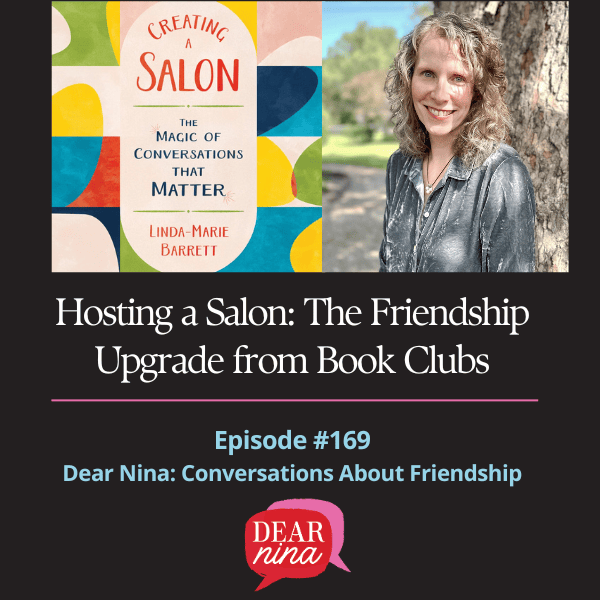
Linda-Marie Barrett is the author of Creating a Salon, the Magic of Conversations That Matter. She is a writer, editor, and executive director of the Southern Independent Booksellers Alliance pronounced siba. Before that, she was at Malaprops Bookstore Cafe where she wore many hats, including events manager, and you’ll see that Linda-Marie really understands events and that’s what makes her such a good leader of something like a salon. And she had a lot to teach in this book, A lot of good tips. She’s been hosting her own salon since 2017 and she lives in Asheville, North Carolina with her husband. hi, Linda-Marie, welcome to Dear Nina.
Linda-Marie: Hi. It’s great to be here.
Nina: Your book fits so perfectly with every mission I have on this podcast because finding ways to get together with our friends is so essential to deepen the relationship, continue the relationship, but also these creative discussion groups, [00:02:00] clubs, groups, salons, whatever we want to call them also is another way to make friends.
So , it solves two problems I hear about a lot on Dear Nina, which is, how do I make friends? How do I keep friends, maintain these friendships? I would love a chance for you to lead us up to that actually. tell us how you got into the, it’s not, I don’t want to say business, business isn’t the right word, but how you got into leading salons and how you define them. Just all of that. I’m going to turn it over to you.
Linda-Marie: well, I decided to start a salon, when I was recently divorced and I was starting a new job I was feeling a bit untethered and needed to expand my friend circle. I’d been in a salon many years earlier at a bookstore that I worked at. I’d also been hosting a book club for about 20 years.
So I was really familiar with hosting groups, but I didn’t have really close friends and I, saw that big void in my life, I just started researching salons, [00:03:00] how they’re practiced today, and also support groups. some best practices, things that work, things that don’t work. And I, thought about what I wanted to do with my salon because I decided I wanted to do a salon.
And so I kind of created a, mission for it. And then I invited a group of women. Some of them I didn’t know that well, but I wanted to know them more. And then there were some that I was, you know, kind of emerging friends so I sent out invitations and to my delight, everyone accepted. and a few of them, over time have either relocated or decided it wasn’t for them. But in general, the core group has remained, and we’ve been an active salon since 2017.
Nina: If you think about getting an invitation like that, it’s so different than even a book club, which is you need to prepare something before you come, you know, extensively. A lot of people don’t these days, which is why I’ve never successfully been able to stay in a book club, whether I was a member or a leader of it because, and I’ve done both.
I’m such an English nerd type. I was an English [00:04:00] teacher before I was a parent, before I was a writer, and I like to discuss the book. That never quite worked for me. But other things people get invited to sometimes is an event, a fundraiser, come hear this person who’s running for office, or come give to this person who’s running for office or even, A movie club or a podcast club, there is some sort of work ahead of time. The idea of the salon is so cool because it’s really just show up I think. Right. Did I get that right?
Linda-Marie: It is, I think it may be more work for the host because you’re the sure. You’re thinking of the theme that you want to discuss. With my salon, I like to kind of tease out the subject ahead of time so that people aren’t coming into it cold. in the book, I call it Salon Foreplay, where I will, um, let them know what the theme is and send them maybe some links to articles or give them questions to think about.
But yes, in general it’s less work than a book club. and it’s more just thinking about a subject and how that might affect you personally and maybe what you’d like to share with a group of [00:05:00] people in discussion.
Nina: Such a different kind of thing. I’m part of a very casual, and by casual I mean we just don’t get together that often, cooking group, maybe there’s five of us and we’ve only gotten together a few times. I would like to do it more, but it is a bit more work. It’s, and again, for the hosts, it’s more work of having all the supplies there and having thought through like, what recipes do you want to make? There isn’t a lot of ability to talk. You can talk a little while you’re doing, but there’s also a lot of instruction going on and, making sure you’re not burning things or handling raw meat in the incorrect way, or, you know, there’s a lot to pay attention to.
There’s something very unique and special about the idea of people sitting around and discussing an idea. And I hear what you’re saying that, you send out some stuff ahead of time so that maybe people have had a time to put a little thought into it, but , just a little.
Linda-Marie: I think people are really craving those kind of opportunities to talk about these ideas or things that are going on outside of like a current crisis. when we meet with people, we catch them up on what’s going on in our lives and we hear about their lives. But the idea of, in our [00:06:00] salon, for example, we talked about regret.
Having seven or nine women talking about regret in different ways, it was fascinating people have shared that they brought that discussion into their lives in really interesting ways. You know, talking with their partners or talking with colleagues about regret. it doesn’t take a lot of preparation, but I think the after effects of a salon will echo out or vibrate out into the rest of your life.
Nina: Let’s talk about the history of salons for a moment, and you touch on this in the book. I love that section.
Linda-Marie: so I do do a little bit about the history of salons, because I think it’s. Important to think about where you fit into that tradition. salons take place across the world, but the word salon is French. The kind of salons that we think about when we think about maybe Gertrude Stein’s salon or the salons of Vienna or Paris, started in France in the early 16 hundreds.
they were usually hosted by women called Solanaires, they were held in the homes of prominent people. [00:07:00] And the women hosts of Solanaires, they invited the guests. They decided what would be talked about. They directed conversation. from that time, salons grew in popularity and spread into, Vienna and London, Dublin and over into the United States, into Washington dc, New York, and Boston. And even today, I think there’s growing popularity of salons that are like a modern version of salons where people workshop music or, use it as a platform for poetry readings, or, just talk about philosophy or other ideas. Like even books like literary salons are very popular as well Still.
Nina: Would a literary slum be different than a book club?
Linda-Marie: it would be, I actually host a book club. I think you mentioned that you go to a book club,
Nina: Not anymore. I’m like fired from every book club I’ve ever been part of. I’m the no fun book club member. I’m like, are we going to talk about the book? Nobody wants me in a book club.
Linda-Marie: a literary salon, I would say, would be a deeper dive into a book than your traditional book club. And it may also [00:08:00] involve having a touring author visit where you would take the author out to dinner and then listen to the author speak about their book, and then, talk about how the book affected you.
So I think it’ll be like a more of An adaptation, uh, or an enhanced book club and I, that’s very possible for people to do in their communities. If you have authors in your community or authors that come through and visit your local bookstore to do that.
Nina: I would love us to talk about what goes into creating a salon and this can be true for any group, a book club, a cooking club, anything. We’ll keep it to salons generally, but I want people to know that certain issues, who to invite, where to meet. These are things you have to think about in any kind of event planning, especially an ongoing event that you want people to keep coming to. where does a person start?
Linda-Marie: well, I think one of the things to think about with your salon is what are your goals? What are you hoping to accomplish with your salon? Some people might have salons to bridge differences, to talk about [00:09:00] issues that might be where there’s two groups perceived to be at war with each other, or maybe your mission is to talk about important themes or literary as we talked about.
So I think for the salon host, you would think about what do I want to do with my salon in my group of people? I would recommend creating, even if it’s just for yourself, a kind of mission statement about, this is what I hope to achieve. Then as far as inviting people, it gets really awkward to uninvite people if you realize, like, you know, you said you, I know you were joking, but you were joking about being uninvited from book clubs. I would definitely start small and think about the personalities of the people you want to invite, because a salon is generally a moderated discussion and there are some people who just resist being moderated.
I would think about. The personalities of people you know, who you enjoy being in conversation with and who don’t try to like, dominate conversations, but seem to be more, you know, open and to a give and take. as far as [00:10:00] setting, if you are the person creating the salon, then thinking about where you would like to host it, would you like to host it in your home because that’s really comfortable and familiar to you and you have a lot of control.
Or would you like to do it in a, a restaurant or some restaurants have a, a separate room that you can use, so it’s a little quieter and more private, but you have the fun experience of enjoying a meal together.
Nina: . Let’s stay with a goal for a moment. it’s almost like no thing is more important than the other. They’re all important. It’s like, let’s say you have a certain goal.
Well, if your goal is to make friends, I would say a restaurant, unless there’s a private room, is really too noisy, you’re not really going to be able to hear, like it might not help you with your goal. And if your goal is to make friends as the host or to deepen friendships, then yeah, you don’t want to invite people who are already in a group of friends that you’re not part of.
Let’s say, I mean, I’m really getting granular here, but I think I so agree with you that you as a host should really be clear on what is the purpose of this thing and then everything else that you have to think about where, [00:11:00] when, how many people, what the topics are that should feed the goal.
Linda-Marie: I agree. with my book club. We have a really large number of people in the book club, but I notice when it gets over 10 people or 12 people at one meeting, it’s really hard for everyone to have a chance to contribute. salons are not passive. They are, an engaged discussion. People can choose not to speak.
For some reason, like if the topic is something they’re not resonating with or they just don’t feel comfortable talking about, but in general, that’s a very important thing to think about is the size of the group and making sure that everyone would have an opportunity to, to discuss it and beforehand when you’re inviting people, as I mentioned before, if you’ve noticed someone tends to always dominate, that’s probably someone that you don’t want to invite right away until you have already achieved a kind of groove with the other members. For my salon, I came up with a kind of like a rules of conversation. just that we don’t interrupt each other, we’re very respectful and not judgmental. We’re not there [00:12:00] to fix each other. by laying out these ground rules ahead of time with my invitation, then people know what they’re getting into. And if it doesn’t sound like it’s for them, then they know ahead of time that this. Might not work for them.
Nina: Yeah, like the kind of person who would receive that invitation. And I don’t mean this in a negative way, what I’m about to say. If they received the invitation, they think. That’s too formal. Like I don’t want it to be so structured That’s okay. It’s actually good that you said what it is because this is the thing you’re creating.
And it may not be for them, it’d be like someone coming to a cooking club who hates cooking they’re not going to have an enjoyable time. If you don’t want to have those kind of conversations, which are different than just regular friend conversations. I think there’s something really cool about it, about having a conversation that is structured that does give everybody an opportunity to speak.
Because in a regular hangout with friends, it isn’t so formal, it isn’t so structured, and it’s not uncommon for there to be always someone who does all the talking and always someone who never shares. Resentment kind of can build over time, but it would be odd in a group of friends to be like, Hey, we’re going to [00:13:00] establish some ground rules.
The only way you can really do it is when you are starting a thing yourself, like you establish it. It’s actually an opportunity. It’s a great opportunity to create something with order. I love it.
Linda-Marie: I think so. I tend to like that when I’m a guest as well. I like unstructured sometimes, but if it’s something like this where it really is, you’re talking about a theme, uh, it, it allows the guest to not have to scan or just to, relax more, because you know, someone else is moderating it.
Nina: Absolutely. No. Linda Maria. I think it is very important to also always think about if you’re creating something, what is the guest experience? So what is your goal as the host? But yes, what’s it going to be like for the guest? And I also love, as a guest, anything with structure. I’m going to an event tonight, a cooking event that’s for our synagogue that’s going to have 320 people.
I’m comfortable to go because there are table assignments. I would not want to walk into a situation with 320 people where it was like, okay, find somewhere to sit. And it’s not like I lack confidence. I have plenty of confidence.
I know a [00:14:00] lot of people, I’ve been going to this place forever and ever. I belong there. It’s not an issue in every way. I literally belong there, like as a membership, and I feel I belong. And yet I wouldn’t want to walk into a thing that didn’t have structure. It’s clear who’s in charge.
It’s clear where to sit. You don’t have to make decisions. And then on a much smaller scale, a smaller group, um, I lead writing groups. It’s not something I talk about that often on the podcast because it’s not really a friend thing. I mean, that’s a, it’s like a work thing. Although we’ve really become friends.
The people in the group, a lot of them have been there. For almost 10 years, and it wasn’t designed to be that way. My friend Julie and I started them and we designed them in theory at first, assuming we would have new people every semester, people stayed and and bonded, and we did have to figure out with some growing pains, how to make sure everybody has a chance to speak.
I’ve learned through that how to be a moderator. I didn’t start thinking that that’s what we would be doing, but that’s what we’re doing. We use a timer. Everyone’s paying to be there. So everybody needs to have a chance to speak. It makes it so when I am [00:15:00] a guest at something, whether it’s a class, uh, some kind of networking group, I’m in a few networking groups. When the person in charge doesn’t moderate the conversation, I really struggle.
Because that’s their job. That is, you have to take that job. So I’m paying to be there. I don’t want to listen to someone ask a five minute question. That’s really not a question, that’s really a comment. This is the kind of stuff that the moderator has to think about.
Linda-Marie: I agree. I you are the steward of the situation and I agree with you about if you’ve invited people to be part of this, they are depending on you to make sure it goes well. If you see the moderator not Leading well, it can make you stressed out because you would love that person to stop talking, and yet you don’t have the authority to really interrupt, or if you do, it would feel weird and rude.
I think that’s something that can be intimidating with hosting or moderating. It’s nice when you have a, a co-host, you know, like if, if that’s something that intimidates you, then maybe you could have a friend help you with this, who’s less worried. You use the [00:16:00] timer, I now use a little bell sometimes, like if I want to move to the next section of the salon, because it can be awkward to interrupt people or to be the rule enforcer.
That is part of your role if you are the moderator that is your role. And even if you’re awkward, if the, you just do the best you can.
Nina: I think more often than not, people will appreciate it if you do it, but I agree it is, awkward at first , especially if it’s friends of yours, like you’ve invited friends to be part of this thing and now all of a sudden you are in kind of in a position of authority, but somebody truly has to be.
I guess it’s funny, as we’re talking, I’m realizing how much I really like structure. I don’t like being at a birthday party where there’s no toast. I mean an adult party. So you’re invited to somebody’s 50th, somebody’s 40th, and it’s just total chaos. I mean, in the chaos, obviously it could be fun for people like we’re at a bar or we’re at, even if it’s like a more of a sit down dinner kind of thing, if at no point in the evening at least, the guest of honor, the person whose birthdays it, it is, or whoever threw the party if it wasn’t [00:17:00] that person, herself or himself. If someone doesn’t get up and like, acknowledge the reason we’re here. I’m sort of like, oh, we just at a restaurant, are we just like randomly at a restaurant, I want to hear a toast to honor the person who I came here for. And sometimes there’s nothing. And I’m like, that was poor planning. That’s my opinion. it only has to be five minutes, not even, but it just gives the evening a little bit of like, this is what we’re here for.
And I think that’s what the moderator of a salon is probably for. It’s how I feel my class to remind you like, oh, this is what we’re here for, and move us on to the next person. And then it’s not personal. If you, if you moderate and move it around enough, it’s not personal. That’s interesting. With the bell.
Linda-Marie: Yeah, I use the bell, to move us along from one section to another, or in the case that someone might be going on longer and I want to shift away from the train of thought that they’re on. I just kind of gently ring my little bell because I think that we use tools that will serve us.
You figure it out. And I’ve been doing this now since 2017, and I don’t like to get overly structured, but I learned that, oh, I should reserve my chair. I do this [00:18:00] salon in my living room and there’s a certain chair that has the best view of all the guests.
Sometimes I wouldn’t do that, but now I just put a little reserved on my chair and everyone knows that’s my chair. I think that that repeated structure can also be comforting because everyone knows the way in and they know the way the evening’s going to roll out. And within the structure, we have ability to go off on tangents if we have time or have back and forth conversation between salon members.
If we get into some really cool, insight on what we’re talking about. So I wouldn’t want to be so structured that I don’t allow people to have those creative moments. But, I think that just having the framework is really helpful and it’s something that as a salon host, you can think about what you’ve enjoyed as a guest and what you think your friends would enjoy.
Nina: You use the expression in your book that I liked a lot, and I guess it’s really what we’re talking about, which is generous authority, and I think that’s what you’re describing. How would you describe that in your words?
Linda-Marie: the idea of generous authority is from Priya Parker, who wrote The Art of [00:19:00] Gathering, she calls it imposing in a way that serves your guests. Yes, I think that generous authority is really important to establish and develop. It might not be a skill you have right away, but as you and I both talked about, the more you host, the more you moderate conversations, it’s like a muscle that you train really well and it becomes less difficult. It allows the guests to relax and know that they’re being taken care of and for so many people, the rest of our life is not like that, and we’re creating structures for ourselves and creating to-do lists and figuring things out, and it’s really nice, or at least my friends in my salon feel to come into that space and know that someone else is leading the evening and taking care of them.
Nina: I guess the, not everybody can be the moderator or not everybody could be a guest. I’m actually starting a new group, also at that same synagogue, we haven’t quite decided what the structure’s going to be yet. But it’s funny coincidence that I am thinking about this as I was reading your book and it was [00:20:00] perfect timing.
It’s like you came into my life and that book came into my life right at the perfect time and sometimes I would love to just show up and not be the leader, but I’m also of the attitude of don’t wait for the thing you wish existed.
You sort of have to create it if it doesn’t exist yet. But it really is nice to just show up and be a guest at something that you’ve been invited to as long as you feel that you’re in good hands. I, I obviously have a lot of control issues. I can hear myself as I’m speaking and, you bring up something in your advice about how to start these groups and more on the conversation style, not just, um, how to start the group from the beginning, but how to begin an evening and how to end an evening. I mean, you really put a lot of thought into these groups and can you talk about that a little bit? It’s so important. I.
Linda-Marie: the structure in my salon when people arrive, we have our potluck first. When you arrive at parties often you feel the energy’s a little frenetic. You, you need to settle down. I think [00:21:00] about the potluck as a way for us to disperse some of that wonderful social energy we have before we get into the discussion.
Since this happens at my home, I think about when people enter my home, what’s the vibe that they’re getting when they come in? I try to make my house look particularly beautiful for the salons so that they walk into a space that feels really curated and relaxing. And I’ve created over time a kind of basic structure for the salon where they anticipate that they’ll come in, be greeted, and then we’ll have this potluck dinner before we transition into the conversation.
Nina: How does that get decided? Like who’s bringing what? Is there emails ahead of time? Texts a signup genius.
Linda-Marie: I tend to like that part being unstructured. So I just tell people to bring whatever they like. Usually works out just fine, but people are open to the possibility that we’ll have mostly desserts and very little food. You know, very little savory.
But you could do what you’re saying, like some people have thought, oh, well we should maybe have a [00:22:00] Google doc or something and people let us each know what they’re going to bring. . I think it depends on you as host. I do ahead of time with the invitation, remind them that There’s a potluck at the beginning and we also at the end, we have a clothing swap, so if people are cleaning out their closets, we will trade clothes at the end.
Nina: That’s so great. I love that.
Linda-Marie: But the framing of it, so with the ending I learned was really important too, is to have a for my group, because we can discuss subjects that can be kind of intense we have a formal closing of the event to kind of close the space energetically. Ahead of time I’ve asked people to share quotations on the subject. Quotations from people who are writers or prominent people who have spoken on the theme in some way. And then at the end of my salon, we will pass a list around of the quotes and we all read them.
And then we know that we’ve stopped the discussion and we will move on to the clothing swap. I’ve also done that at my [00:23:00] book club. I have always have a definite beginning and a definite end on time to respect the people who show up on time and the people who need to leave at the usual time.
And then people can hang out afterwards. Like at my salon, you can hang out as long as you’d like afterwards, but I just want them to know we’ve stopped that discussion. We’ve closed the salon itself and now it’s just friend time.
Nina: I love everything about all of these ideas and that potluck at the beginning first is so smart. I hear what you’re saying and I agree about that settling in time. That is one thing that’s a little hard with my writing group when I think about it, is because we’re in a space that’s not someone’s house.
We’re in a co-working space with a meeting room that people use up until the point we’re there and people need when we leave. there’s that challenge of we get there and people have gotten so close and they want to see each other, and there is a lot of that frenetic energy. And then we go right into the catch up where everyone gets two minutes and I always have to, and, and that’s my job. I’m happy to do it. I’m being paid to do it. settle everyone in. I’m like, okay, we have to get started. I know everybody’s catching up and it’s kind of a [00:24:00] loud echoey space. there are built in challenges sometimes to the space, and that is something to think about
When you’re planning a thing, if you can avoid that. Like I wouldn’t host something at your house if you have a lot of teenagers who are always in and out and you don’t have a space where you can close a door, maybe someone else needs to be the host or what that is when you go to a restaurant, I mean, these are all things to think about and I, live out thorough you are in the book like parking, whereas everyone parking is there enough parking?
Linda-Marie: I think about accessibility. People might have, hidden issues you don’t know about. They might have hearing issues or mobility issues. So I try to figure that out ahead of time. My home happens to be that very accessible and as you like, I, do turn off all the music and my husband is not there. Or if he’s there he is in a back room, behind a closed door. cause it really does feel important to our group anyway, to have privacy. I think because I’m also an event planner professionally, that I do think about a lot of things around accessibility.
Nina: Let’s talk about trouble spots and um, [00:25:00] then we’ll wrap it up with what I, what I want to do at the end is have you, you know, take us through like a typical salon discussion and we’ll use the topic of friendship as an example because I know it’s one in your book and it’s obviously one that’s applicable here. But let’s do trouble spots and then we will do that.
Linda-Marie: the number one trouble spot that I’ve run into is someone dominating the conversation. I have those ground rules. As I told you I shared the ground rules and then I noticed that, there were a couple people that have a really hard time sharing space and conversation. I learned that the best way to address that was not by giving the whole group another talk about sharing space, but being really direct with that person and just letting them know gently that, that they need to, when their instinct is to speak, they need to hold back because more introverted people they need space. They need quiet to speak. they’re often waiting until there’s quiet. And if there’s never quiet, then they’ll never speak.
Nina: That’s really hard. I just want to pause on that for a second. Like, we cannot overstate and it is [00:26:00] tempting to do exactly what you said and I, I think about my, just my kids, That’s the first thing that upsets them about a teacher. That’s the first thing they will complain about is when the teacher gets mad at the whole class for something one kid did. And we’re talking about kids, but same idea, yeah, why should everybody endure the same talk again and again when it’s just one person. And then on the adult level though, especially if it’s someone you’re friendly with, friends or friendly or have gotten to become friendly with.
You can mean very well. You know that their intentions aren’t bad too. Your intentions are for the integrity of the whole group, you’re trying to protect the whole group, and yet it’s so hard the person not to feel shame. Maybe it’s something that they’ve been told before. Probably it is. Oh, that’s hard. It almost makes you not want to start something. I hate to say that, but that’s the kind of stuff that holds people back, I think. is like, They don’t want to deal with these things.
Linda-Marie: It’s a very common problem. I think part of having ground rules is helpful because you can point to the rules in a gentle way without shame. But you know, in my group it’s not a therapy group, so sometimes the theme will lend someone to talking [00:27:00] extremely personally, and that can feel really awkward because you don’t want to shut them down.
maybe in your group you don’t want to shut them down. But, It can sometimes be triggering for other people or it could monopolize the conversation or bring the conversation into a realm that you didn’t plan on, talking about that night. I think when someone is kind of working against your ground rules and is likely unconsciously, just reminding them individually of what you’re seeing and what you need to do in your role as the moderator. You hope to say it’s, this is not personal, but this is what I’m tasked to do. my little bell, I use my little bell sometimes to help me with that. Another thing that groups can run into is, if people are late, you might wait until the, you know, be like, oh, Sue’s going to be here any minute, so we’re going to wait for her.
I don’t do that because I want to respect the people who really made an effort to be here on time. But I also have told people, if you’re late, don’t worry about it. You know, just come in quietly and join our group. If you don’t have a potluck [00:28:00] and your salon is kind of like, we’re going to have a salon from eight to nine 30. then you’re going to be strictly conversation. Then someone coming in late could throw it off. I also let people know, of course, if they need to leave early, just let me know. But just they can just like quietly leave so that it doesn’t throw off the rhythm that you start to establish around conversation.
Nina: so important that, especially the lateness part, which is more disruptive, I think, than leaving early. Although leaving early could be late if the person makes the whole scene about, okay, bye. Thanks so much. You know, we’re in the middle of a conversation here, but the coming in late It is hard as a moderator because you’re like, should I catch this person up?
Are they going to now be in the dark for the next hour and a half? If we don’t sort of say, oh we already started talking about X, Y, Z, so and so shared that. But yeah, it may be once in a while, but you wouldn’t want to make a habit of it because it does
Linda-Marie: Yeah.
Nina: people to get there on time.
Linda-Marie: and if someone was late a lot, then I would talk to them and find out what’s going on. It does throw things off. Like you had said, I wouldn’t catch them up necessarily, but I would let them know where we are in the discussion. And [00:29:00] things happen.
I’m so, I’m not trying to be like so authoritative, and unyielding but you’re kind of trying to deal with the whole group and treat the whole group in a certain way.
Nina: was there another one you were going to add? And then I kind of got, uh, over excited about the lateness.
Linda-Marie: Oh, well, you had mentioned phones and the presence of phones. Just having a phone out on a table has been proven in studies to affect conversation. People notice it, they get distracted. They can have their phone in their pocket on vibrate, but we don’t have any phones out. Beause it just inadvertently, people might be looking at them. It hasn’t been an issue for our group, but I have heard that it can be an issue that people will be checking their phones and, it’s just so common today to kind of have it out. It’s something, as a host you might watch out for.
Nina: I think that’s an extremely reasonable rule to have it in your pocket. That way if somebody really needs to get in touch with you, they know they can. but not having it out. because it is absolutely true that seeing a phone, I feel it. Like if I see someone else’s phone it just makes me think about my phone. It really does, [00:30:00] and it’s so hard to put it away. So if you’ve gone to the trouble of putting it away, but someone else has it out, it complicates the whole conversation, even just one on one, just when you’re out with a friend, when you’re on a walk with a friend. Awareness of how much our phones are. I’ve done a whole episode just on that, but it’s, important.
So on our last note here, a typical salon discussion. You meet once a month.
Linda-Marie: We meet every few months, actually like four,
Nina: That makes sense because so that, that’s interesting. You’re not, taking on a tremendous amount month to month. It’s, but over the course of, of a year, you’ve met three or four times and then over years. You said you started in 2017, you really get to know people. So what would a typical meeting look like? We said already, we start with the, potluck that was just loosely organized. Not, you know, people know to bring food, but they bring what they bring and then that’s about 45 minutes. And then what?
Linda-Marie: The next thing that I like to do, I don’t do these always, but I like to do it, is I create a questionnaire around the topic. I have questionnaires with a number of questions that we’re [00:31:00] going to dig into later, and I have ’em on little clipboards and I pass them out.
And for about 10 minutes, people fill out this questionnaire. It really studies the energy in the room that they get focused, they fill it out. This is the questionnaire for them to bring home. I’m not going to look at their answers, it’s just to like Spark thought about the topic. after the questionnaire, I may divide us up into small groups of two or three or four people to talk about the topic.
And that is really nice for people who tend to be more introverted. And it’s also nice if you’re talking about a subject that’s very personal, because sometimes talking about something personal, in the larger group right away can be intimidating. And then I’ll bring us all into the big group to, talk about the theme.
And there are a number of conversation formats that you can use, which I mentioned in the book. The one I tend to use is called a round robin discussion where I’ll ask a question of the group and then one by one we’ll go around and answer the question. We’ll all have a, you know, a few minutes to [00:32:00] answer it and sometimes they’ll be back and forth between salon members, but generally we go all the way around so everyone has time to talk about it.
and so we’ll do that for several questions. and at that point we’re getting close to the end of the salon, I will then use the quotations that have been contributed by the salon members. I’ll pass around the quotations and everyone will read one of the quotes. this is sounds very type A and intimidating, but I like to do little gifts for them to take with them that are usually related to the Salon theme.
So I’ll make little bookmarks. have candles or something for them. So then I’ll pass that out and officially end the salon. After that we have a new element the last couple years where we have the clothing swap. So people have brought clothing in a pile and we share. The clothing swap has turned out to be this really sweet element because now not only have, we become really good friends, we’re actually wearing each other’s clothes,
Nina: I could not love this more. Yes. The people would [00:33:00] probably show up in something remember when you gave this to me? what if two people want the same thing? Is there a way to
Linda-Marie: I step away from the whole clothing swap as the host. I just like let it happen. If I do I something I want, I have to like work on myself to let it go. It’s kind of nice we added this element several years in. We’re all really good friends now at this point, so there’s no arguing over it.
But we do know certain people, are very, very stylish in our salon. So if I see them come in with a pile of clothes, I will immediately have desire, but I again, I stay to the back.
Nina: That’s probably nice for you to have one part of the evening that you’re just like, I’m out. You guys handle it. Like I’m not dealing with that. Linda-Marie, this was so fun to be able to, talk to especially because I just so recently read the book. I read the book for my listeners, but I also read it for my own use. The group I’m doing might have some journaling aspect to it. And this isn’t like a class I’m teaching. no one’s paying for this one. This is different. This is more of a community synagogue kind of thing. This isn’t in the writing world, but [00:34:00] because what part of what I bring to it is my history as a writing teacher, we might do some journaling with it.
I’m not quite sure. I am figuring it out still, but I am really thinking about a lot how everyone will have a chance to speak or not. What if people don’t want to talk? there may be new people each time, so there may always be someone new. So that’s different than something people sign up for and continue to come. So I got all that. I’ve gotta really think through, you know, different than a salon, but there’s some overlap in group dynamics that I gotta think about.
Linda-Marie: I have felt that the more I think about it ahead of time, the easier the event itself goes. You’ve built the structure, you know what to anticipate. Of course things can always not work out as you wish, but I think that the planning always helps a lot.
Nina: That’s a great tip. Well, thank you again for being here. I love that you did a topic on friendship in the book. So I’ll have the link to the show notes where everyone can find you, including buy the book. As I say at the end of every episode, come back next week everyone, when our friendships are going. ah, hello. Well, this has never happened to me [00:35:00] before, but in the middle of editing this episode, I realized the last one minute was totally silent. I could see Linda-Marie’s mouth moving. I could see my mouth moving.
And as you know, if you’ve been listening to this podcast for a while, that is the end of the episode where I say, come back next week when our friendships are going well, we are happier all around. And Linda-Marie said goodbye and thanks for having her. So that’s all that you missed. But as long as I had to pop back on here in a totally different outfit on the day I was editing this with no makeup on, you can always come onto YouTube @dearninafriendship on YouTube to see these episodes on video and see this moment.
This is an opportunity now to say something I didn’t say at the time, which is if you have a discussion group, a salon of some kind of any kind of topic, or you’re thinking of starting one now. After hearing this episode, I’d love to hear from you. Come and say hi.
Nina: You could email me anytime at ninabadzin@gmail.com You can come to the Facebook group at Dear Nina, the group on Facebook. You can find me through my substack@dearnina.substack.com. That’s a newsletter.
Substack is just [00:36:00] a website that hosts a lot of newsletters. Those of us who are on there throw around the word substack a lot. If you’re not, accustomed to that website, you’re like, what are they talking about these people who say that it’s really just a site that houses the newsletters. It functions as more than just a hosting site, which is really just technical, and I won’t bore you with all of that. And there’s messages through, there are on my social media sites @dearninafriendship.
Lots of ways to let me know. Did you start a group? Are you thinking of starting a group? A salon. Okay. So different than a. Book club, as we’ve been saying, different than a cooking group or any of those other examples. I am so appreciative of Linda-Marie being with me here today. And like I was saying, you’ll find her info in the show notes and come back next week. Looking forward to the next one too. See you soon. Bye.




2 Responses
Great episode. We host a weekly salon (via zoom) so no clothing swap, but it does sound like we are hitting many of the other notes.
Hi Barbara! Is there any talk of doing things in person now? I led a zoom writing class (only because we had to move to zoom for covid) that was going great for a few years but by 2023 the local crew really wanted to stop being on the screen (which I absolutely understood) so we moved back to in person. It was hard to let go of our out-of-towners, but it did feel like the right move (for us) to be in person again.