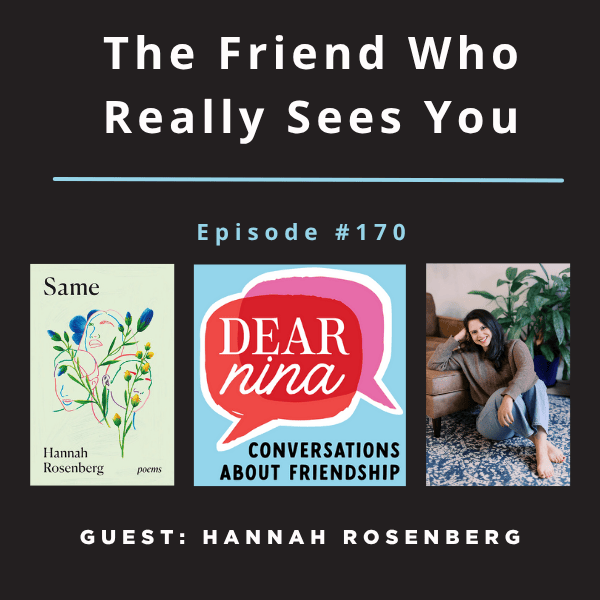
Hannah: [00:00:00] so my book, same, one of the things that I hope this book will do is, help inspire people to reach out to new friends, old friends, Bridge the gap if there is something that came between friendship, help say in in words what you wanna say to someone.
Nina: Welcome to Dear Nina, conversations about friendship. I am your host, Nina Badzin. I have been writing about friendship for over a decade and podcasting about it for over four years. Today’s guest understands the essence of friendship in a way I’ve not quite seen before.
And she is an instagram sensation. Huge, huge hit with a topic that you don’t see so often being so wildly shared. And that is poetry. It’s so refreshing to see Hannah Rosenberg’s success. For those on YouTube, I’m gonna hold up the book. It is called Same. Poems by Hannah Rosenberg. For [00:01:00] everyone else, you can click on my show notes and see the cover.
You can also see a link, even if you’re not an Instagram user, you can just click onto Hannah’s profile from my show notes and just see how major her account is. At the time of this recording. She has over 120,000 followers, started from a just tiny account with 50 or so followers, you know, friends and family.
She grew it through heartfelt words about marriage, motherhood, just life in general is a whole chapter on friendship. And when she shares her original work, people tend to react and say same. There’s even a poem by that name.
There is a quality to Hannah’s work and just her whole way about her. You can feel that she takes in the feelings of others, understands them, and is able to articulate her own feelings in such a way that others relate and say, same. Same. Me too. And I love how she described in our interview what she means by the word same. It’s not exactly what you might think. I don’t [00:02:00] even wanna give it too much more preamble, except that, I’ll tell you that Hannah lives in the Philly area. She lives with her husband and daughter. She has another child on the way. She can be found on Instagram at @HannahRO, which stands for Rosenberg. @HannahRoWrites and her website and Instagram again will be in the show notes. I hope you will enjoy this interview as much as I did. Hannah cried a little bit. So here we go. Welcome to Hannah.
Hannah: Hi Nina. I’m so happy to be here. Thank you for having me.
Nina: It feels surreal to talk to you ’cause you’re basically a writer, Instagram poet, celebrity, you can write a poem and it can be shared 5,000 times within a couple hours. That’s correct. Right.
Hannah: Sometimes yes, sometimes it’s shared very widely, sometimes not. And so I never know,
Nina: Right, and you can’t even read too much into that because social media is such, a bizarre planet, the wild west. We never can understand the algorithm. And I think I like the [00:03:00] pace I see that you, turn out work anyway. And it doesn’t matter if it was shared a hundred times or 5,000 times, you do what feels good to you.
Hannah: Oh yeah, totally. I think I had to learn that early on. people sometimes ask me like, what’s your strategy? And honestly, I don’t really have one. I I write and I share regularly. And, sometimes the, algorithm gods will help me and sometimes not. And I really have no idea when that’s gonna happen.
It helps you just write for yourself and share, what you wanna share. So in that way, it’s helpful. then the downside is like, I have no idea. Like I had no control over it.
Nina: Yeah, that would be cool if you could, you know, monetize your strategy, meaning teach others how to
Hannah: Yeah. Tell, give people advice.
Nina: you can’t. You’re writing from the heart. I know you are. And anyone who’s read your work understands that. So to catch listeners up who may not understand exactly what you do and how you got there, I think it’s important because your work is so, relatable, I feel like we need to understand who you are, that people can relate to it so much.
Hannah: I’m someone who has always loved writing. [00:04:00] always loved poetry, loved reading poetry, loved writing it. But. Kind of had this idea that it was something, especially poetry was something that I just had to write for myself. and felt really vulnerable about sharing it. I mean, even, you know, sharing it with loved ones.
But, in kind of early 2020 when COVID happened and turned all of our worlds upside down and, you know, we were, what felt like normal life became, very different in the, you know, matter of week. I decided like I needed a creative project to work on. And so I had been writing and my writing had been poems not because I like made that decision just ’cause that was what made me feel good and I decided to start sharing it. And I think it was just kind of the confidence of life feeling so different at that point.
I had listened to a podcast with an artist. She goes by Amy Tandrine and she’s like a beautiful visual artist. She had talked about how when she was developing her craft, she started posting art [00:05:00] that she did every Monday. And just kind of growing her audience that way and growing a community of people who related to her artwork.
so I made a goal to start an Instagram page and share a new poem for every Monday for a year. She was like, Mondays are blah. And so I was like, I, I really resonate with that. in 2020 I started that and I never picked the topic I was gonna write about ahead of time. I just wrote what I was feeling and forced myself to share something once a week. And have been doing it ever since.
Nina: makes so much sense to me. ’cause it’s like you had a deadline. I, I’m a writing teacher too, by the way. I was an English teacher before I had kids and then I became a freelance writer, but during my writing time of doing a lot of articles about parenting and other things, I started leading writing groups in Minneapolis with my friend Julie and there is something to a deadline. Without a deadline, you are just floating. I’ve never wrote more than when I actually had an editor waiting for my stuff. But this works too. It’s a self-induced deadline, but it’s still a deadline. I have that for the [00:06:00] podcast. I have an episode every week.
I can decide to slow it down when I’m really feeling exhausted, but I don’t let myself, so far, I still put ’em out every single week and it just keeps you working.
Hannah: Yes, totally. I think that some people, and I, I have the same thought, like creativity can really be dampened by deadlines, but I actually find that it really motivates you to, I mean, ’cause any, any sort of art and anything creative that you’re doing, you could edit it forever. Like you could never put it out into the world.
So giving yourself that deadline helps you you know, not say like, this is final, but this is something that I’m sharing.
Nina: I once put out a survey for my podcast. I’m just thinking about this as we’re talking about creativity. One person wrote kind of a very personal sounding she actually is a fan of the podcast though, so she’s like, I like the podcast, but you really strike me as a perfectionist.
And she used the word a few times I probably do have some perfectionist tendencies. However, I would like to defend myself in saying that I wouldn’t be able to put out stuff once a week on the newsletter, on the podcast if I [00:07:00] was, because I think true perfectionist actually they cannot put it out there. ’cause of course it’s not perfect. It’s never
Hannah: Yeah. It’s never perfect. you strike me as someone who’s like very competent, who like says that you wanna do something and like, does it, but that’s, yeah. That’s different than perfectionism
Nina: Thank you. I’m gonna take that compliment because I think that’s a nice thing you could say about somebody. Okay. So first you were doing it on Mondays. Did you start an entirely new account from your personal account?
Hannah: I had had a blog the year before, and so this is kind of like going back into my history. I’ve always had it in my mind. It’s like I want my career to be something with writing. The way I made money was totally different. I worked in healthcare.
I was always like working on a novel or working on essays. And the year before I had done a year long blog where I interviewed people about interesting ways that they met someone in their life. They changed the course of their life, like whether it was a romantic partner or a business partner or a friendship.
so I had this Instagram page where I I would share that story every month. I think those stories are still the bottom of Hannah Rowe writes, I changed the handle. I came up with Hannah Rowe write. With my name and then [00:08:00] started posting and I think when I started posting, I think I had 30 or 50 followers and they were 95% my friends and family who were following. I told like my husband, I didn’t make an announcement to my friends. I just started sharing these poems.
Nina: That’s the way to do it. And now, so listeners know, like as we are recording this and it will be bigger by the time this episode comes out, I think it’s 120 something thousand, right?
Hannah: yeah,
Nina: That’s okay. I, I need listeners to understand, especially if you’re not on social media, to go from even 1000 to 2000 followers can take years. Okay. I understand that. Like I am at like 12,600. It took a really long time just to get there. Hannah is at 120 something thousand. People share your stuff so much. And the title of your book is Perfection. Same. . It is perfect because you write about such simple and relatable things, but you say in such a way that I have to imagine almost every person who connects with it goes same. Do people write [00:09:00] that in the comments is they do I know, I’ve seen it. Is that why it’s called that?
Hannah: yes, so I feel like the title poem of my book comes from. a poem it’s called Same that I wrote several years ago and it had a different title. at the beginning. It was called Revised Resolutions when I first shared it in early 2021. Part of my, promise to myself was like, I would share every week, but it would be a draft so I could take it down and revise it.
And most of my poems I do. I’ll share something and then edit it and re-share it. I think the second or third iteration of this poem was same. The opening line of that poem is I still haven’t figured out how to keep my shower floor clean or make morning smoothies or respond to stress calmly. Same, same, same. My friends tell me a love note of sorts, I think that,
Nina: Sorry, I had to react. That’s how I react when I read your stuff. But it’s not even just that poem, all your stuff makes me say that. But continue with your thought. I apologize. So that poem comes out.
Hannah: I guess that one was the first one that kind of went mini viral. Like, I don’t remember how many people shared it, but it was where I [00:10:00] noticed , oh, this is getting more shares than just the, you know, normal number of people that share or comment.
And I think that it’s because, it’s not about the shower floor or the smoothies or the responding to stress. ’cause we all have our different things and, Just because these were my things, doesn’t mean those are your things, but I think the feeling of not having everything together and feeling like this pool of oh, actually underneath the surface I have a lot of things that stress me out and that I’m struggling with and that someone sees that and is like, that feeling of vulnerability makes them wanna say me too, instead of, I think so often when someone presents a version of themself that is perfect and that they can do everything. And that, there’s nothing that they struggle with it. Instead of someone wanting to respond with vulnerability, you wanna respond with, you wanna put up a barrier. ’cause that feels scary. because I don’t think that’s really any of us.
I actually do think we all have things that we feel that are hard for us. That theme then kind of is present [00:11:00] in almost everything I write not everything.
Nina: I have some theories about why your friendship ones. So you write about a lot of different topics and I can relate to all of them, but the friendship one for my show makes the most sense to focus on. I have some personal theories having written about friendship for over a decade. Why they resonate so much. Maybe you first tell me , what it is that you think makes people go bananas and go same.
Hannah: From my experience I’ve always been someone who has leaned into friendship and who has relied on friendship and who has found such joy in friendship since I was a little kid. I have parents who are very supportive of friendship and also parents who never pushed me to feel like I needed a romantic relationship to make me feel, you know, full.
And all that being said, I still feel like society puts this idea in our minds that friendship, especially female friendships, are nice and sweet and cute, but really [00:12:00] they’re just a waiting room for us to find a partner and get married and focus on our marriage and our children. That is something that also very much fulfills me.
I’m happily married. I have a child and another one on the way who, you know, I would say are my whole life, but also my friendships are my whole life and my friendships have not been, I’ve not felt like they have faded away as I’ve gotten older. They’ve certainly with, competing priorities with raising little kids.
It’s hard. just because you don’t have as much face time with your friends during certain phases of life doesn’t mean that those friendships aren’t as incredibly, if not more incredibly valuable and important and life saving during every phase of life. And. I think being able to put words to that and making people feel like they are worth celebrating and worth commemorating and worth, like the time that you put into it. I think that that is people [00:13:00] resonate with that.
Nina: You’re not wrong, it’s your work. I’m just saying I bring another, i’m bringing something else to it. I would love if you would read the one that I want us to discuss . It’s on page 53 when I needed my friends.
Hannah: When I needed my friends, when I was younger, on every birthday, when I was in school, when I took a job, quit a job, moved cities, moved to another country, moved back home, went on dates, started a relationship, ended a relationship. When I sought out a therapist, went to a doctor’s appointment, looked for a dress to wear.
When I moved in with a boyfriend, got engaged, got married, had a baby when I healed, when I mothered, when I thought of something funny, when I thought of something sad, when I worried, when I wanted to celebrate, when I had a question, when I needed to make a decision, when I needed to cry. On every day of the week, week of the year, year of my life.[00:14:00] When I was younger, as I got older, every day I have needed my friends.
Nina: I relate to this so much, I feel exactly this way. Basically, the point of this is at every moment in life you have needed your friends and, and those moments wouldn’t have been quite as rich or as helpful, as wonderful as everything without your friends, and I feel exactly the same way. My parents were a lot like yours.
Friendship was really important to them. People ask me a lot, I’m a guest on a lot of podcasts, and people ask me a lot, why friendship? Why are you focusing on this? I say some similar things to what you said that, you know, I just can’t imagine my life without my friends by my side, old friends. I didn’t grow up in Minnesota.
I still keep in touch with the friends I grew up with in Chicago. A lot of them I’ve made, I’ve been here 25 years. I’ve made wonderful friends, raised my kids with people. Still continue to meet new friends. I mean, I. Spend a lot of time trying to help people and tell people it’s never too late and you should work.
We change so much as we get older. And you want new friends too to meet you where you are now. I think people who [00:15:00] comment on your Instagram posts, on the poems and who really feel them and share them feel they have those friendships and they agree, they agree with you. I agree with you. They’re worth celebrating. And it gives them a way to tag friends or just share it and let their friends know. Even sharing it is a way of letting friends know, I see you, I have friends just like you, and I appreciate you and this is someone who got that, and I’m gonna celebrate it too. And I feel like I hear from people who don’t necessarily have that, or they are struggling with it. They think they had a friend, but that friend doesn’t really reach out much. Or there was a childhood friend who they were really close to and was there for a time, but then that friend has kind of disappeared or they’ve just outgrown each other and people don’t know how to separate.
I think I’m hearing more from those pain points, and it’s refreshing for me to be able to dive into work of yours and be able to remember all the positive things, the reason I’d rather doing this, which is to help people get to these points so they can say you were there for me. Thank
Hannah: Yeah. And I think that, I, again, I try to talk about [00:16:00] this too when I talk about my writing. I think what writing does for me is it helps me celebrate things that are good and hard, because I think most things are good and hard. And friendships, like all relationships, they’re not perfect.
they’re hard. there’s life dynamics that make things challenging. my goal is not to sugarcoat things., you know, I, I I write a lot about things that I struggle with and things that are hard for me in all relationships, but what I’ve loved being able to do through writing what I call friendship love poems, is just to give people the words and the space to celebrate relationships that I think are absolutely lifesaving and life giving and give people an opportunity to celebrate. the poem, marriage of Friends, That’s, Shared quite a bit. I think that the reason that people, do share it is because it gives them a way to tell a friend, like you said, I see you, like [00:17:00] I see this relationship. This isn’t just silly or something that we take for granted. When we get married, we have weddings, we have anniversaries. Like we don’t have things like that with friends. And so, I think that people use kind of the words to make it feel like the meaningful thing that it is,
Nina: Yeah. And something to reach for. So that’s what I’m relating it to in my work. I don’t see it as sugarcoating at all either. It’s, this is the goal and I agree with you, this is a worthy goal. This is something that’s worth spending your time on. sometimes it takes a lot of introspection to say if I don’t have a friendship like this, if I don’t have the kind of friendship where I have anybody that I would even send a poem like this to it’s something worth working on. This is a part of life, and it’s a whole chapter of your book. There’s, you know, marriage and motherhood and family. I love that friendship is its own section. It’s not just like a throwaway part that went in with growing up or something. It’s its own section. okay, let’s do group text, page 43.
Hannah: Group text. Remember when you would send a group text on [00:18:00] Wednesdays at 4:00 PM. Anyone wanna get drinks, dinner, yoga, see a comedy show? Or on Saturday mornings, I’d write who’s free for coffee? A walk lunch to hang out and watch movies on the couch all day. Now we say, how are you? I miss you. Let’s catch up soon.
Girls Trip this fall trip with our families this winter. I think I’ll be in town for work in the spring. Our lives look so different. I miss the old one and still I’m so happy you get it. I know you’re the same, but in case you forgot, I wanted to say that time was the best. How lucky we were. I love you.
Nina: Oh, did that make you tear up? Oh my God,
Hannah: I did.
Nina: it. I love a little emotion. Well, I I, flagged this one too. Tell me, tell me what hit you there as you were reading your own words.
Hannah: so everything I write is , [00:19:00] obviously very personal to me. And I mean, like I said, , I think specifically this is written about a time in my life before I got married, before I had kids, and I, I had a period of my life where I lived in very close proximity to extremely good friends. They were my family. I didn’t have a partner at that time. I didn’t have kids. I lived with them. They lived around me, so I ate dinner with them. They were the ones I called when I had a stressful day. Talk about being seen.
If something bad happened, they knew what to do to cheer me up And to make me feel good. Like they truly saw me in a way that I think every person sees another person in a very unique way. So it’s not like it could totally be replaced by something else. When you move on with your life, you do trade one thing for another and, I think like the line at the end’s, I’m happy now. I know you are, but I still miss that.
Nina: Yeah. No, it’s So true.
Hannah: it does make me emotional to think
Nina: It’s true. Proximity is I’ve, I’ve done whole episodes on that. It is such a powerful [00:20:00] tool for friendship and when people, like I told you, they come to me in a pain point. They feel they don’t have friends. They wanna make new friends. I always push proximity, like to be, you should focus on exactly where you are.
Because even if you are married with kids or you have an extremely full job, whatever it is, those wanna meet in 10 minutes. I’m going out for a walk. I, I have a, a newer ish neighbor friend who we’d never planned to get together, but that’s how we see each other. I literally be putting my shoes on and I’m like.
I’m gonna be walking and she may not be able to reach me for another 30 minutes ’cause she’s still busy doing something. But, so I’ll just do my route so that I can swing by and grab her. We may only walk for 20 minutes, that is such an important way ’cause those hours can add up so much quicker.
You can get closer, but it’s hard when you feel like all your closest friends are long distance. Several of my very close friends are long distance and it is a lot of phone and a lot of texts and a lot of, like you said, let’s plan a trip. But not that easy. It’s not that easy to just up and leave your
[00:21:00] life.
Hannah: And it’s, it’s such a wonderful, I mean, technology has its ups and downs, but the fact that you can feel connected to friends. One of my best friends lives in across the country, California. She’s actually visiting me right now. We haven’t seen each other in three years. I get to feel so connected to her because I pick up the phone all the time and call her. there is nothing that replaces sharing space with someone, being with them. it is beautiful that we have these wonderful relationships that last lifetimes.
And it’s also hard that you can’t live in the same place as all of your friends, or most people do not live in the same
Nina: Most people, yeah, right. Jobs, take us places and relationships and school, grad school, all the different things. Take us different places. I wanna make sure that we hit on this piece it’s funny that we barely talked about, we’ve talked around it and we’re getting there, but how can a friend let their friend know that they are seen that they’re appreciated for who they are. How do you feel like you’re doing that in your life? [00:22:00] Obviously, you’re doing it with your work, but what, what are other ways?
Hannah: I’ve thought about this how to verbalize it from my perspective. what I would say in the way that I feel seen is someone giving me space to have. The range of feelings and emotions and helping me say whatever you feel, and whatever you think is okay, and I’m okay to hold it and I want to hold it with you.
I think so often the mistake that’s made is people think same means oh, I’ve had that exact same experience, I’ve had that same feeling as you. The way you’re feeling about this is exactly how I felt. And that’s not really what I mean. I, I mean more that someone says, oh, I recognize in you this human emotion that’s hard and I’m a human too, and I’ve also had those feelings.
And I also understand what it feels like to feel something that doesn’t feel like perfect [00:23:00] or wonderful or great. the times that I feel most seen and heard and held is when I tell a friend something and, response to me is it’s okay for you to feel however you feel.
I’ve also had these experiences where I felt certain ways and, I can see myself in how you’re feeling. For me to feel like, okay, I, I’m not being judged, I’m being understood and I can just share it. I have a lot of really good friends who have very different life paths than me.
Like it’s not like we all have the same experiences. It’s not like we all have the same anxieties or the same things that bring us joy, but for someone to give you that space and understand you in a way that’s just letting you be yourself is I think, the best thing to have.
Nina: That’s magical. You used a word, which I was thinking the whole time you were talking, that you were describing, but then you actually did use it, which is not feeling judged. I think feeling seen means, I love how you said it, it’s not that you had the same exact experience, is that you can hear [00:24:00] what your friend has to say and hold it for them and not judge.
Hannah: Yes. I was talking to a good friend about this, that so often it’s like anything else, like we project how we wanna be responded to, to other people. And that’s not always how other people want to get the response. So I have a really specific example. Is it okay if I share it?
Nina: a specific example. Thank you.
Hannah: so I have one of my best friends who, you know, she and I are so comfortable around each other talk all the time. She was going through a little bit of a challenging time with one of her children and was talking about it a lot. and at one point I was having a conversation with her and said to her Basically the reassurance I gave her was oh, I don’t really think it’s that big of a deal. Like I actually based on my last visit with you, like I think everything seems fine and like it’s so normal you’ll get through it. People go through this all the time, and her response to me was that’s actually like really dismissive.
it’s been really hard for me to go through this. And the fact that you’re just saying it’s fine, it’s so [00:25:00] common, makes me feel like I’m not being seen.
Nina: I get why you responded that way though. I makes sense. Like such you had noble intent of trying to help her not be overly worried about something that maybe she didn’t need to be.
Hannah: Yes. that was how I responded because that’s how I like to be comforted. then like a year later, something kind of, same thing like but flipped on. I was having a little bit of a challenging time and her response to me was like, oh my God, that’s so hard. I don’t know anybody else who’s had that exact What I heard was you have it harder than anyone else I know in this particular one example. It felt like a gut punch. ’cause to me, I like when people say you are fine, it’s okay. I know so many people who have this experience, it will be okay.
It’s so normal. And to me that feels so comforting and that makes me feel like held what that taught me was like we were both giving each other what we wanted to hear, like projecting. And actually it wasn’t what either of us wanted to hear. What would’ve been better would’ve been for both of us to just hold that space for each other to share and like say, like, It’s okay to feel however you [00:26:00] feel. How can I help you? Like, what do you want from me? Or how can I help you feel feel better by sharing this with me. and so I think that a lot of the time, it’s not something really specific that someone needs. It’s just that space to be whoever you are and whatever you bring.
Nina: That example, I have one just like that in my life. And, and then I’m gonna put some friendship advice on top of that. , I’ve actually done a whole episode on this, but I never assume listeners will have heard them all. The title was something like, do you know how your friends wanna be comforted?
She had something going on. I mean it might have been something like a delayed plane and then the plane got canceled again. And my reaction via text was very much how I just, like you’re saying, how I would want someone to respond, which is sort of just commiserate with me.
If I’m complaining, I want my friend to be like, oh, that’s the worst. I hate that. That’s just me. She called me on it and was like, I really don’t like it when you respond that way. She wants something a little more optimistic, it’s gonna be fine and something like that. Gave me the chance to say, I hear you. But just so you know, don’t do [00:27:00] that to me. Like I, if I’m having a crap day, I want you to be like, that’s the worst day I agree. I don’t want you to be like, it will be fine. That would
Hannah: Yeah. Yeah. See, I’m the opposite of you. I want someone to be like, you’re fine. Everything’s okay. like
Nina: friend.Neither of us is right or wrong. That’s what’s the beautiful, I’m glad we’re talking about this. You and I are both good friends to people. People seek our friendships, think we’re good friends and we’re different. Neither is right or wrong. The friendship advice piece to put on that is yes, if you’re good friends with somebody, it’s good to learn through experience and learn how they like to be comforted. And then also when you’re someone who is not exactly thrilled with how your friend is comforting you. Most of my episodes really focus on, well, what can you do? I’m always like, assume the best.
There may be a place for you to tell your friend. There also may be a place for you to be like, you know, they mean it in the best way possible and to just ride it out and move on from it. Not that you shouldn’t be honest if it’s a really huge problem, but if it’s like once in a while and the friend doesn’t respond exactly how you want to do, maybe what you would want someone to do for you, which is [00:28:00] assume they don’t mean to hurt your feelings.
Most friends don’t mean to hurt your feelings. my final question for you as we wrap up in terms of especially feeling seen, like your friends must recognize themselves in your work. How have they responded?
Hannah: I think that it feels special to feel like someone sees you and feeds that back to you. One example I’ll share is I have a series on Instagram that’s not in the book, but I call it like my month friend series. So every month I write if the month of
Nina: Uh, I love Those Those are some of my favorite. I’ve, I share those a lot. I use so many followers. You probably can’t tell, but I really have shared your stuff a
Hannah: yes. yes. No, I know. I do know and I, I appreciate it so much. so I love to see people tag their friends and comment and say, like, this reminded me so much of you. because I think the other part of being seen is somebody noticing little things about you and feeding them back to you.
It just makes you feel so special. Somebody knows you. [00:29:00] if we have time for one more poem, there’s one not in the friendship section that I would love to read. It’s about childhood friendship, but I think When I write something about my friends and share them personally with them it’s like a way of that I’m sending them, something that I love about them.
Nina: They’re friendship, love poems, like I love that. Okay, so what page are we on?
Hannah: this is in the first section. this is called home for Katie. So it’s page 25. the first section is for our younger selves. It’s about friendship, but it’s also about childhood. Poem for Katie. We drew our dream weddings circled. Boys in the yearbook we thought were cute. Dev devised plans to make them fall in love with us. Stared out the window to wait for the handsome neighbor to appear. Wrote notes back and forth.
What did he say? What does that mean? What should I do? And all the while we laughed at each other’s jokes, wrote our own language, collected details about the other, and memorized them like you do when something matters. Now we have daughters of our [00:30:00] own and the only love I wish for them as they grow is the kind that comes with a friend like you.
Nina: It’s beautiful. why is it in this section and not the friendship section?
Hannah: So I feel like so many of the poems could be like overlapping sections, I think because it’s specifically, like I’m kind of talking to my younger self and also like younger people in this poem and just reflecting on that teenage pre-teen, I’m a girl so I only have the girl perspective, but you know, like pining after boys and thinking I remember Katie is, my best friend from childhood.
Making it he said this to me, he said this to me, and, oh, he really likes you. But like, really it’s us falling into this like, friendship love . We know so much about each other. it’s so special in a way that, you know, young girls only do. If you talk to, you know, a teenage girl about their friends, they know everything about their friends and it’s such a beautiful thing.
I hope that in some way this can inspire, young girls to be like, wow, that really matters. that’s not just me being silly or, [00:31:00] ‘
Nina: cause you’re so vulnerable, like when you’re telling a friend. You like a boy or you like a girl, whatever. there’s so much vulnerability and yeah, it builds, it builds over time, trust builds over time. And yeah, we don’t take those kind of things for granted in the friendship space.
That doesn’t just happen magically. the yearning that, you and others and I have sometimes for our old friends, it’s like, ’cause those relationships that we put so much time into those, they’re special. They’re their own thing.
Hannah: yes. A hundred percent. Yeah.
Nina: Is there any last, thing you wanna say to my listeners who love the topic of friendship, who are working on their friendships, who are big fans of the topic of friendship?
Hannah: so my book, same, one of the things that I hope this book will do is, help inspire people to reach out to new friends. old friends, help Bridge the gap if there is something that came between friendship, help say in in words what you wanna say to someone. there’s a bunch of people who, follow along my work who are throwing what we’re calling same parties, around [00:32:00] the book. but it’s just celebrating different types of relationships One of the things that I’ve loved hearing from people is how they’re planning a marriage of friends party to actually celebrate friendship.
Or like, a book club where they’re reading poems to each other that remind them of one another. I really hope that this book can be that for a lot of people. that would be so meaningful to me and really get to the point of why I love sharing my work so much.
Nina: That’s what a writer does. That’s what a poet does. give words to feelings that other people might find hard to express, and then they’re able to use them to bridge connections with other people. Isn’t that the dream? That’s why you do it. Hannah, thank you so much for coming here to talk to me.
I know you’re about to be in a major book Blitz all over the place, and I’m honored to have any of your time here on Dear
Hannah: Oh, well thank you so much, Nina. I’m very honored to be here. I so admire your work and what you do and I think one of the amazing things about writing this book is being able to connect in person as much as possible with, people. So [00:33:00] thank you so much for having me.
Nina: Oh, thank you. And listeners, come back next week when our friendships are going well. I know Hannah agrees with this. We are happier all around. Bye.