[00:00:00]
Ben: that kind of thing happens in in friendships where you, you get together with someone and you’re kind of scared to be overly vulnerable, you don’t want to over commit.
And especially if they’re not reciprocating. please if you’re dating, if you’re making friends, if you like somebody, be vulnerable enough to show it and to, just open up and try to achieve that inter brain synchrony. ’cause that might also be a major factor driving that. Sometimes you meet someone and you just click. It might just be that you’re both going in with, an open mind and, willing to make a close friend.
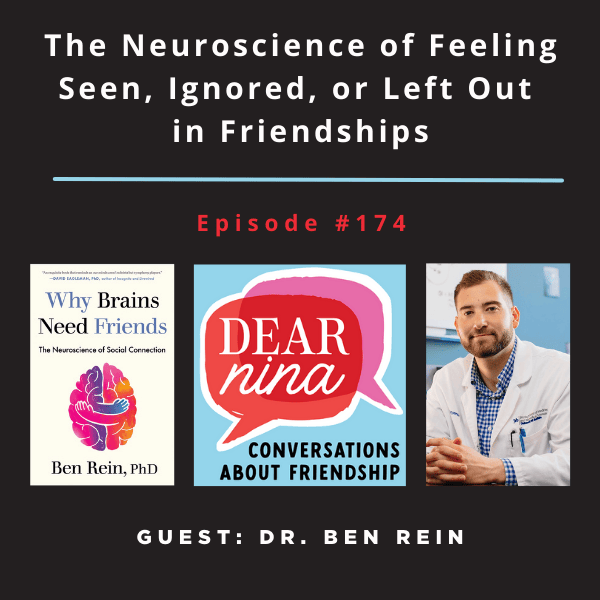
Nina: Welcome to Dear Nina, conversations about Friendship. I am your host, Nina Badzin. I have been writing about friendship for over 10 years, podcasting about it for over four. I’m delighted to be joined by Dr. Ben Rein. He is an award-winning neuroscientist and science communicator. His book, why Brains Need Friends. The Neuroscience of Social Connection was recently released. I listened to the entire audio with him reading it.
So when [00:01:00] I went to interview him, I sort of felt like we already spoke, which is not true ’cause I didn’t get to ask him the questions when I’m listening to the book. it’s so wonderful to be able to have these authors on the show and be able to talk to them. It’s a really good book. You will get a lot out of it if you are interested in the topic of friendship, but from a different point of view than is normally discussed on this show. We do get into a lot of social issues that I normally would talk about such as why ghosting hurts our feelings so much, why jealousy is such an issue in friendships, why people find it so hard to cheer their friends on both online and in person.
We cover the neuroscience of friendship Chemistry and of course we talk about loneliness and the dangers it has on the brain. Dr. Ben serves as the Chief Science Officer of the Mind Science Foundation. He’s an adjunct lecturer at Stanford University and a clinical assistant professor at SUNY Buffalo.
He also shares his educational neuroscience videos on social media to an [00:02:00] audience of more than a million followers. He really is fun to talk to and listen to about science. In layman’s terms, he gives you the science, but he explains it in a way that any person can understand it.
So if sometimes you hear. Everybody talking about, oh, loneliness is an epidemic and it’s so bad for you, and you kind of roll your eyes and you go, oh, is that really true? No, it really is true. And he explains what is happening in your brain and in your body when you are lacking social connections over the years.
We also do talk about right away, right at the beginning, so I, hear the introverts out there being like, wait, but I’m really happier when I’m alone. That’s okay too. To an extent. We do talk about introverts and extroverts. I’m going to give you Dr. Ben right now.
Hi Ben. Welcome to Dear Nina.
Ben: Thanks so much for having me. It’s nice to meet you.
Nina: What I wanna skip right to, because I have listeners who are more introverted and they are going to say, but I really get drained when I’m with people or I prefer to be alone. I’m much more charged up when I’m alone. and I know that you have a very good scientific answer to that that also takes those [00:03:00] people into an account. So I wanna start there and then we’ll go into a bunch of other things.
Ben: Yeah. So social interaction is something that’s important for everybody. if you are a human being, then your brain likes interaction. And I know the introverts are screaming immediately, I don’t like this guy. it’s because of kind of where we come from, our origins. Let’s step out of social interaction for a second, and lemme just explain for instance, why does sugar taste good? The reason sugar tastes good, it doesn’t have to, is because it’s it’s a fuel source and when your body receives it, it tells you, oh, okay, I can use this immediately. It’s gonna go right to my bloodstream.
It’s gonna fuel my brain cells. This is good. So you perceive it as tasting good. And similarly, you know, on the opposite end, like, why does poop smell bad? Well, it’s because poop is covered in bacteria in a full of all sorts of stuff that you don’t want to eat. And so your body naturally knows, stay away from that.
It’s gonna smell bad. Poop doesn’t objectively smell bad in the universe. We detect it’s smelling bad ’cause it’s unhealthy for us. So why are social interactions good for us? Why do we enjoy them? Because they are good for us. In an ancient world, [00:04:00] millennia ago, humans survived best in groups.
Just like our brains know, oh, sugar is a power source for our body, our brains know being around others is supportive for our survival. if you are a human, your brain generally appreciates being around others, and we actually have systems in our brain that drive reward signals, like dopamine, serotonin. These neurotransmitters are released when we interact with others. Just wanted to get that outta the way first before I actually answer your question. with that said, of course, everybody is different. we all exist somewhere on this continuum from very introverted to very extroverted.
I happen to be very extroverted, and so I, recognize that. I understand that. And by the way, if you’re wondering where you are, there are, scientific assessments that you can take. There’s one in the book. It’s also on my website. It’s 20 questions, and it’ll give you a general gauge of how extroverted or introverted are you?
What it turns out is that the science suggests everybody benefits from some level of social interaction, but for extroverts, the higher you are up on that scale, the more [00:05:00] interaction you can tolerate before you pretty much start getting annoyed. For introverts at the bottom end of this continuum who really don’t enjoy interaction quite as much, some level of interaction is still valuable, but it’s like a medicine that the side effects start to come on at a much smaller dose for introverts. and that’s how I describe it in the book. It’s like social interaction is a medicine, it does make us feel better, but the dosage for introverts is way, way smaller. One of the misconceptions about my book that I worry about is people thinking, oh, okay, I should just socialize 24 7 after every day after work, I should go meet friends.
No, that’s not the case, especially if you’re an introvert. Everybody should try to figure out where they fall on that continuum and how much interaction is, right for them. Then just try to make sure that you’re meeting that need. ’cause what I think happens a lot is we fail to meet that need.
And especially for introverts, when people don’t really feel the motivation to interact, they don’t get that small dose that might be better for their brain because it just doesn’t feel, like something that they’re very interested in. I really encourage everybody to think about like, what’s the right dose for you? Even if it’s small, some is [00:06:00] better than none.
Nina: That’s a great answer, and you give some really concrete advice in the book that would address a situation. For example, we all do this, whether you’re an introvert or an extrovert, we tend to do this because we’re always multitasking, which is you see a phone call, come in. People argue with me, Ben, on this all the time.
I’ll get on TikTok or Instagram, you know, midlife lady that I am. I still do that and I’ll get on there and be like. Call your friends and answer the phone, and you talk a lot about answering the phone. I love that. I take on usually the call your friend part. In the book you really emphasize, it comes up several times, answer the phone. Someone is trying to connect with you and reach out, and we all tend to kind of do the lowest hanging fruit thing, which is just continue to scroll on our phone or whatever we’re doing.
And when we actually tend to stop and answer the phone and have, even if it’s a short phone call. But this is, I think what you’re saying, just these short doses. That’s a small dose, small dose of a connection.
Ben: Yeah. And that’s actually how I opened the book is imagine you’re working, your phone rings, it’s an old friend. You’re like, oh my gosh, what the heck is this gonna be [00:07:00] about? Right? and you kind of hesitate with the decision. And I actually asked the reader would you answer the phone realistically?
Would you pick it up? And I think for a lot of people the answer is like, um, to be honest, not that sure pick it up. While I do en encourage that people should pick up the phone. I, that’s also sort of a metaphor throughout the book for like, everything, right? Because this, this happens a lot and I even as a, extrovert, as a neuroscientist who understands and studies the importance of social connection, I get a phone call sometimes that I’m like, oh, I don’t really wanna answer the phone right now.
You know, it’s, it’s tough. That situation, it extends to so many other scenarios, like it’s a Friday night and you made plans to go to dinner with friends and you get home from work and you’ve kind of been looking forward to it all week. And then, push comes to shove time to get in the shower or get dressed, whatever, and actually go and you’re like, oh my gosh, I kind of wish I didn’t make these plans right now.
You know, it happens so much, but it’s so important that we overcome that hurdle. Because there’s a lot of data saying that, one, you will feel better after. You know, people do feel better after social interactions. And two, those predictions are often completely wrong. And we’ve also [00:08:00] like lived through this, right?
If you’ve ever had that scenario where you’re like, I don’t really wanna go to dinner, and then you go to dinner and on the way home, you’re like, I’m so glad I did that. That was so much better than I expected.
Nina: it like exercise, like physical exercise. We don’t usually regret going for a walk, right? It usually is a good thing, a better thing to have done than anything you were gonna be doing sitting down and that that is how I feel about the social interactions. So part of what keeps people who listen to this show from feeling good about their social interactions is some of the stuff I really wanted to get into today.
It’s that, this is not a scientific word, but like that icky part of getting along with people. Some of the ones I wanna cover are ghosting. One of the biggest, biggest issues that comes up on this podcast is what I sometimes we’ll call mismatched expectations, but the other word that comes up is a lack of reciprocity people are really struggling with.
Well, I always reach out. My friend doesn’t text me first. I have tons of episodes about that, but I, not from a neuroscience perspective of why it feels so bad. Then we’ll get to [00:09:00] jealousy and I just wanna talk to you about what is happening in our heads and why it feels so bad. Then I’m gonna push people to move past it anyway. Of course, that’s the, you know, spoiler alert, life feels bad sometimes. You still have to push past it.
Ben: Yeah, totally. Oh, I’m excited to get into it.
Nina: Let’s start with ghosting, so you’re friends with somebody. That’s the term that really started in the dating world, of course, but it applies to friends too, ghosting would literally mean they completely stop answering any communications, but it happens in a much lesser way most of the time, which we call quiet quitting, which also started in the work environment, but has made its way to the social world, which is okay
they text back less often. They kick the can down the road, always, oh, I can get together, but not for two months from now, which is probably a kinder way to end a friendship. I’m not suggesting that people need to stay friends forever, but it does keep people from making new friends because they are wounded.
Ben: there’s a whole brand new thing happening to the human race that we can ghost people kind of because of the way we interact digitally, right? You don’t ghost somebody in person where you’re like, oh, I’m [00:10:00] never going to really see you again. Like if you see them, you’re gonna interact with them in a normal way. We ghost people through text messages and ignoring text messages or letting phone calls go to voicemail, things like that.
So my perspective on this is probably kind of unique and maybe a little complicated, so I wanna explain it as clearly as possible. When we interact in virtual environments, uh, I have a theory about this. I call it the virtual disengagement hypothesis. And what this hypothesis is referring to is that I think the brain areas that drive empathy, disengage the reason for that is when we interact face-to-face with a real person in real life, you know, they’re making facial expressions, they have a tone of voice, you know, you could see their body language and it’s very easy to tell what emotions they’re expressing and your brain just automatically kind of soaks that up like a sponge.
And it’s because of those social cues, , someone’s crying, it’s a very obvious one. They’re upset. even more minute things like you can see a sort of slight downturn of the corners of their mouth. And maybe that means they’re upset too, or a little bit of reflection in their eyes.
We’re so good at this and when we experience that, when we see someone else experiencing an emotion, we take on some of that [00:11:00] emotion. That is what empathy is. And these, these brain areas, they do that because they detect those social cues. So when we go to a virtual environment, it’s much, easier to basically deliver bad news or say something mean or in this case, ghost somebody. You are hurting their feelings.
Someone texts you, Hey, can we get together? And you just kind of don’t answer it. If you were to do that in person, someone walked up to you, Hey, good to see you, we should get a coffee. And you just looked at them blankly and walked away and didn’t answer them. I mean, imagine how hurt they would be and imagine how bad you would feel ’cause you would absorb those emotions. But in these virtual environments, we don’t have any of those social cues to tell our brain. You just hurt somebody. And so it’s so much easier. It’s so much
Nina: such a good point. You’re right. Who would do that? Who would just about face and walk away? Like you just would not do that. You would at least make up some sort of an excuse, but you would have a conversation.
Ben: Right, exactly. And, and, probably if we’re being honest, if that happened in real life, you’d probably be actually be much more likely to be like, Hey, you know what? Actually this isn’t so bad. I’ll, I probably will get together with you. Right. But it’s, there’s just so many reasons why these virtual interactions [00:12:00] are different.
But I think that, this whole concept of, of reduced empathy. I think it plays out in that type of scenario in a ghosting or the ending of a friendship. I think it also plays out often in the delivery of bad news, right? you have something awful to tell somebody or, or you kinda have to give them negative feedback about something where it’s like, I really didn’t like when you did this last time we saw each other so much easier to do over text again, because you don’t have to absorb it. Also, I think this is really rampant on social media. I think this is probably a key factor underlying why our virtual environments, these social media environments are so hostile because it’s so easy to, I refer to it in, in the book as like placing a attack.
You put attack down face up to hurt someone. So they step on it. if you do that in real life and a child steps on the tack, I’m picturing this in like an elementary school setting. child steps on the tack, they start crying, they start wailing. You feel horrible ’cause you’re thinking, oh my gosh, I just hurt that child.
Nina: feel guilt. Yeah.
Ben: Right? But if you leave the room and you’re 20 miles away driving home in your car and a child steps on the tack, same exact scenario. You are responsible, but you’re not there to witness it. Do you [00:13:00] feel empathy? Do you feel bad? No, you don’t you have no idea what’s going on.
Your brain is not getting those social cues to tell you you hurt somebody. It’s like, if it does a tree in the woods, that falls alone. Make a sound right. Does an emotion expressed with no observer drive empathy? It does not. And I think that’s what’s happening when we interact online, is we’re just leaving tacks replacing all over the place.
We’re leaving negative mean comments on people’s posts on Instagram, whatever social media we’re replying to each other on Twitter and arguing and. we just kind of don’t care. We’re just sort of disengaged. And so I actually, um, I have plans in the next few years to test that hypothesis in a laboratory setting.
Nina: Oh, so interesting. I’ll look forward to eventually learning about those results because we do need to overcome this as a society, this lack of empathy because we feel it towards strangers for sure, all the anonymous stuff online. But I think it does creep in even to our everyday relationships where like the canceling, all the canceling that people are doing.
And we were talking before about not answering the phone. I feel like canceling is sort of in the same bucket of, I’ll deal with it later. I’ll deal with it later. And there’s so [00:14:00] many memes out there, of course, about, you know, ha ha can’t wait for someone to cancel. Like everyone’s waiting for the next person to cancel.
And they’re so funny, funny, funny. From where I stand and I’m sure from where you stand, it’s not so funny. That adds up to a lonely life. It’s those little decisions all the time that create the situation that you’re writing about in the book of there really being. Physical and emotional problems of being alone, it gets that much harder to restart your social life.
Just like exercise, right? It’s so hard to start over. It really is. Okay. So another thing that I think keeps people in some sort of difficult status with their friends is when you feel your friend is jealous of you, you feel your friend isn’t rooting for you. They don’t cheer you on in some way. Maybe it’s from jealousy or maybe people like honestly don’t know how to be kind to each other anymore publicly or privately. What are your thoughts on just jealousy, envy, and what’s going on in our heads? I.
Ben: Well, I, you know, I think this is really common. In fact, I actually believe that it is the, default state to be [00:15:00] envious and to be jealous. I think it’s actually much more rare that when something good happens to you, people in your life are genuinely happy for you. Right? Which is kind of sad. Um. But that, that’s at least been my lived experience.
You know, something, I just had a kid three weeks ago. I mean, it’s not, that’s kinda different. People are always happy for you when you have a kid, but let’s say you win a prestigious award, right? Do you really think that your colleagues in your professional setting are applauding for you and saying, oh my gosh, I’m so genuinely proud for you.
I, it’s, my dream that you would win this award and not me. Right? Of course not. There’s a competitive nature to humanity. I always happen to think about our existence and our brains and our relationships in the context of like, what was, what, what did humans look like a really, really long time ago?
Because you can usually find the answer there. in this case, you know, we, we come from a very tribal background. again, I said we exist very well in groups. Well, that’s not one gigantic group. We existed in tribes long time ago. Of course you’re competing with other tribes constantly, but there’s [00:16:00] also competition within tribes.
And you know, if you look at, uh, research in primates like monkeys, it, it’s so interesting ’cause they also have politics like we do, they have hierarchies like we do. and they have certain players who are much more powerful than others and they’re constantly challenging each other, There’s the alpha ape. They’re constantly being challenged by the beta ape or whatever, the next line in line. I think that that’s kind of what’s happening in these situations it’s natural, it’s inherent for us to not want to be the beta. when you see somebody really succeeding and, you feel jealousy, I think that’s, natural.
But I think what’s what makes you a good friend and a unique person is to override that manually. I think that’s the key, is that the people who are genuinely happy for you. Are doing that and feeling that because they’re choosing to feel that, not because that they just naturally feel that, you know, and there, and there may be other scenarios where like family members, for instance, or like your parents are more prone to just feeling genuine, uh, happiness and joy for you and not jealousy, because they also benefit from your [00:17:00] success.
Right. They have like a personal stake
Nina: Yeah. They take pride in it. Yeah.
Ben: right? Right. So I think, for the average person who’s looking to be, A good person and a maybe a better person or a better friend try to override that impulse cause it does feel good to actually put that aside and, and stop feeling jealous and say, yeah, you know what, I, I actually am genuinely happy for them and I’m just gonna let it be that emotion. And that’s all. ’cause it makes you a better friend and it’s obviously appreciated.
Nina: Yeah. I think one way to manually overwrite it is this would be one benefit of social media. So if you’re going to be on your phone, okay, we’ve accepted that, let’s say this point in society. Unfortunately, I’m not saying it’s good, but it is what it is. We do use social media a lot. We’re on the phone a lot.
I would like to propose, and I’ve said it before, but I haven’t said it in a while, on this podcast listeners, so take this to heart. I always say, why not be the first person to, you know, clap for your friend online. I’m not saying it’s, you have to constantly text or call and be like, great job on that thing you won that I saw that you posted on Facebook or wherever.
I think [00:18:00] people withhold a lot actually of congratulations and it may be coming from jealousy deep down. It may be coming from even not wanting people to know you’re online. I think that’s sometimes the source. I hear a lot from people who are very upset that their friends do not sort of recognize their online life.
They’re like, I have this going on. I have this going on. I post it and it’s crickets, and I wish that people wouldn’t measure their friendships that way. But I’m telling you guys out there, people do whether they should or not. it looks like you’re withholding for no reason, just be the first.
So that’s my advice. If you wanna manually override what might look like jealousy or feel like envy, uh, sometimes those are interchangeable. I know they’re slightly different, we’re just using that interchangeably here. Be the first to like your friend’s posts, like cheer ’em on. Why not?
Ben: It’s so funny because two things. One, if you withhold that, that joy and that celebration, it doesn’t change the reality of the other person. You know, the, someone posts, they bought a big magnificent new house and you’re like, oh man, I’m a little bit jealous of that. I’m not gonna like that post.
Cause if I like [00:19:00] that, I’m giving them something more or something, you know? It’s like, it doesn’t change the reality you not liking the post isn’t gonna make the house go away. It’s still the reality. and by celebrating them, you’re doing something nice, obviously.
But the other thing here is that kindness is actually supportive for our brains. And I talk about this in the book, this idea of, selfish selflessness. So when we do something selfless, we do something good for someone else, we actually benefit. It makes you feel good when you do things for others, it’s been shown that that’s, positive for the brain.
And so in that moment too, you have the choice of either sitting there in sour emotions and, thinking, gosh, I, kind of hate this person right now. Or being a good friend. And I’m sure that probably after, if you leave a nice comment or you send them a nice message, you’re probably gonna feel a lot better right after that.
Nina: I think people withhold for all the reasons we are talking about and to show their disapproval that you posted it in the first place. There’s a little bit of that. It’s like judgment. So it’s a withholding and a scolding at the same time. Like, oh, that was. maybe too much. I agree with you that just doing the kind thing, and I’m glad to hear that it’s from a [00:20:00] neuroscience perspective, that it actually is good for your brain. that makes me happy because I just think it’s a good idea in order to get along with people. ’cause remember here we’re always just trying to help people get along so that your friendships can be more successful because for all the reasons you talk about in the book, it is better for you, it’s better for your life.
Ben: The argument I make in the book, is that friendship, yes, it’s good. It’s important. It’s valuable for us. But it’s also much more necessary than we even realize. Nurturing your relationships and trying to be a good friend is not just something good to do reputationally, or from an outward perspective.
It’s also very good for your brain. and there’s plenty of data that I cite throughout the book showing that, people who are more socialized, they live longer, they’re at lower risk of diseases, they’re at lower risk of anxiety and depression. Building healthy, positive relationships into your life is one of the best things you can do for your health.
throughout the book, I make a lot of these same sort of points that you’re making of if you have broken or tattered or fractured friendships, it’s actually important to repair them, not just for the friendship, but for your health and to [00:21:00] rebuild your social community, especially coming out of COVID. The change that we all went through and the constant Technological changes we’re facing where you can do just about anything without interacting with another human. Instead, you can interact with a screen. Not to mention ai, chat bot friends. I mean, we are,
Nina: You’re gonna have to, that’s your next book. I know you touch on it and you touch on your work on social media already. I think your next book, would you mind if I just like outline your next book?
Ben: I don’t mind.
Nina: you’re gonna have to attack this. it’s really a problem. And the way people use the word friends so loosely, it’s not good.
Will you tell the stroke example? I think that’s a great illustration with science behind it of people who’ve had positive social connections and what it does for your health. And I know it’s just one example, but it’s a really good one.
Ben: So there’s evidence in humans that basically if you have a stroke or like a heart attack, similarly, any major health insult. If you survive the event you’re discharged from the hospital, you go home to a, a house where you live by yourself, you’re at a much higher risk of complications of, not recovering as well, of dying, of [00:22:00] having a second event like that.
And there’s an interesting question there of like, why, like how is social connection truly influencing our biology? Well, so there’s this study that a friend of mine worked with where they were studying recovery from stroke. And they were studying this in mice? They were trying to figure out biologically what’s going on in the brain to these mice.
That’s why it was in mice. they were inducing a stroke in these mice very scientifically, you know, they’re blocking this artery for a certain amount of time. It’s so scientific that every single mouse should have the exact same stroke. They should all look the same. But it turns out that some of the mice didn’t.
They had much larger strokes where even though they had the blood flow was blocked for the same amount of time. There were more dead cells, they had a worse recovery. They just did much worse. And it turns out that those mice happen to be living in single housing environments. They thought that it might have something to do with the fact that isolation can drive inflammation in the brain.
And so when you have inflammation built up in the brain and then you have a stroke, there’s all this inflammation in the way that’s preventing your cells from recovering well, and, that could [00:23:00] be why they’re having larger strokes. So when they suppressed inflammation, they drove it down In those mice that were living alone, the strokes were much smaller.
They were the same size as the other mice. what it shows us is that being lonely, actually makes us much more vulnerable to basically negative life events. It can completely alter the outcome of what happens to you in your daily life? And the same thing also goes for like stressful events.
You know, having community around can buffer that stress. And so, you know, I think of the example of a 80-year-old at home by themselves, very isolated. They get a phone call from, a loved one and, and it sounds like bad news. Their cortisol levels drive up and they have a heart attack because they’re so stressed, their body’s not resilient, whereas being around others maybe can calm that down reduce the likelihood of that type of event. And so I think that when, you know, these different types of examples explain this really alarming statistic that studies have found that people who are isolated are up to 50% more likely to die by any cause. it’s like, [00:24:00] well, what are those causes?
It could be kind of everything. It’s sort of, it’s, getting in the way of our daily health and our ability to manage situations, whether they’re a phone call or a stroke.
Nina: it’s having something to live for too. Right? there’s , the physical stuff you’re talking about all the years of stress and isolation and then possibly, right, the inflammation and the different physical causes that might come from that. And then I have to imagine
having a heart attack or stroke or anything, and then having something to live for, somebody who will miss you, and it doesn’t just have to be a romantic partner. That’s why I love focusing on friendship so much. You can be single your whole life and still have wonderful deep friendships that will give you something to live for and people who will miss you and care if you are hurt and not around.
Ben: and there’s another similar example there in, chapter seven about romantic relationships. There are many forms of cancer, that when you look at what predicts how likely the person is to survive the cancer. Being married is a stronger predictor of survival than getting chemotherapy.
It’s simply having that social support can increase your likelihood of, of [00:25:00] surviving the cancer more than whether you get treatment. But that’s not to say chemotherapy is, is not effective. Obviously it’s the gold standard, and in fact, it turns out that the chemotherapy is kind of wrapped into that because when you are married, when you have someone you really care about, you have more to live for, you’re much more likely to opt for chemotherapy because you want to get the leading treatment to save your life, they’re kind of together.
But yeah, it’s, it’s multifactorial there that, that having a a, a strong community and loved ones not only gives you more to live for, but also more to fight for. And so you might choose routes that that increase your likelihood of survival.
Nina: I do hear from a lot of people who are single and, because I am married I always really try to make sure to represent that point of view too. And I really do believe you can. It’s not gonna be the same. It’s, it’s different, but it’s either way, when these studies are done, like all the Wal Digger stuff and uh, you know, from the Good Life, all these different studies.
It isn’t just your romantic life, you know, it’s, it’s your whole social world that needs fixing. You need to work on it. it’s funny, right before this interview, I had a tennis match that I won. I just wanna [00:26:00] say by one game. Yay. We did it. Thank you. Doubles.
Tennis has been such a great addition to my life and it’s a lifetime sport. There’s a reason they call it that. my partner and I played two women who, you know, were in our late forties. They were probably in their early seventies. And they gave us a run for our money. Those people know like exactly where to place the ball.
They’ve seen everything, but they just were having so much fun and I thought to myself that is goals. There’s a reason to be involved in stuff like that when you’re younger, so that when you’re these two ladies, you already have this going on. It’s why we play card games and Mahjong is so big now and men should be doing all that stuff too.
My parents played bridge forever. When my dad had Parkinson’s, he died about four years ago this winter. Thank God he had bridge . He was diagnosed in his late fifties. By the time he died around 80, he couldn’t do much physical, but the bridge he could get together with people.
I mean, We have to invest. I, I didn’t mean to go off on such a tangent. Sorry
Ben: I mean, that’s a, a beautiful tangent and such a great point. I mean, especially when you think about, all people, [00:27:00] but especially men, how do men spend time with others? You know, when it comes to Most of the men I know if we wanna get together, it’s like, Hey, do you wanna go grab a beer, watch a football game or something, or just grab a beer and talk.
we may not be centering our social interactions around the most, healthy activity, ’cause when I’m 75, am I really gonna wanna go drink a beer? I can’t imagine how that’s gonna influence my body at that age. whereas like something like tennis or, or cards, I mean, that is such a great idea to think about. How are we gathering, cause another thing that I do is we like to play board games, my friends and I, um, more like strategic, not like a, not like yazi kind of monopoly, but you know, more like modern strategic games. And that’s a great one because I’m thinking, gosh, when I’m 70, if I can play that game and, hold my own and still do those high level cognitive processes of strategizing and defeating my friends, that’s gonna be really good for my brain.
Nina: Yeah, every time I play Mahjong and you get a new card every year, so , there’s no mastering it. It’s always just continues to stay difficult. I’m always like, yes it is one point for me against, , brain rot okay.
Last topic that I wanna [00:28:00] cover with you. It’s a more positive one. ’cause you know, we’ve had to deal with some of these negative ones. Not negative, but just real life reality. Chemistry, friendship, chemistry, that thing that happens when you are talking to somebody for the first time and you’re like, we could be friends.
What is happening in their brain in that moment? It feels like it’s a physical difference between when you talk to someone who you probably is perfectly nice, and if you get to know them over time, I’m sure you would get along and care for them, but it’s not necessarily that instant chemistry.
What is chemistry?
Ben: there’s two things that come to mind immediately. one, there’s some really interesting research that shows that friends have more similar brains. So if you throw you and that person in a brain scanner, just looking at the structure of your brain and kind of how it’s laid out, which doesn’t really differ that much from person to person, but there’s small changes that can be detected.
people who have more similar brains tend to like each other more, they tend to be more close friends. And there’s this, this concept of homophily, HOMO, homo, like same Philly like, attraction to that we are attracted to people who are like us naturally. and it’s [00:29:00] fascinating to me to think that our brains may somehow be able to know that the other person has a similar brain, but I, I think it’s more likely to be that
because you have similar brains, you, you tend to think alike and so you’re more likely to kind of sync up and connect and understand each other very easily. and similarly, the other point that comes to mind is inter brainin synchrony there’s this sort of sci-fi concept that’s very real, that when two people are interacting and having a really Intense shared experience, whether that’s, you know, a deep conversation or a lot of the studies on this, show it in the context of like working together or, you know, collaborating in some way. some of the really cool studies in this, they looked at the brain activity of, piano players while they’re playing a duet and they show that during that intense coordinated social process, there’s a lot of synchrony.
it is what it sounds like, this inter brain synchrony. It’s that your brain, the activity, not the way it looks this time, but actually looking at the activity and the electrical signals, they look very similar. They start to kind of synchronize up and it actually seems that synchrony between two people is helpful for working together, which makes [00:30:00] sense.
You would think that if your brains are synced up, you’re gonna be much more effective at collaborating. that process, that inter brain synchrony is more likely to happen in friends than strangers. It’s also more likely to happen in romantic partners or parents and their children than friends even.
But I think that when you have that moment where you’re really connecting and you you’re literally feel in sync and there’s like something you just on the same page, you literally may be quote on the same wavelength. your brains may actually be synchronizing more readily, which could also be related to my first point, that your brains are more similar, so they’re more likely to synchronize. So there’s a lot of really cool neuroscience there.
Nina: I love that. We’re not imagining it when you feel like you’re really clicking with somebody. There is something happening there.
Ben: and another thing to consider on this though is the funny thing about inter brainin Synchrony is that it’s, it’s dependent on the context. it’s much more likely to happen when you’re on the same team as somebody . For instance, there’s studies where parents and children who inter brain synchrony happens a lot in parents and children.
It’s very, very accessible. They’ll be paired up they’ll be doing some task [00:31:00] where they’re working together, like they’re trying to solve a puzzle or something like that. You know, there’s a lot of funny games they play in science where let’s say you’re, you’re given an et of sketch and each person is controlling one arm and you’re trying to draw a picture together.
You know, things like that where you have to work together and understand what each other is thinking. that synchrony happens a ton. But when they flip the game and they make it a competition where suddenly the parent and the child are competing in this same game, that inter brainin synchrony just vanishes completely goes away.
If you’re in a setting where you really want to work together, you have to work together with someone, you’re much more likely to experience that then if you’re opposing each other.
Nina: Oh, that’s cool. and the hope I wanna give to people is that I don’t think it’s common to feel that all the time, and we still have to make friends anyway, time and repetition and proximity and all the things I talk about in this podcast all the time can still form a very close friendship. there’s a lot of reason to make the time to create those connections, even if you don’t feel that instant chemistry. But when you feel it, it’s special and, and it’s okay to recognize it too.
Ben: also you know, it takes two to tango, right? It takes two people to feel that we are, they’re [00:32:00] both working together. They’re both interested in this interaction to get to that point of that vulnerability to connect, right? And I think what happens a lot, I see this in dating so often where two people, you connect some friends of yours, right?
They start dating. You talk to one of them and you’re like, yeah. They’re like, yeah, I really don’t think that, that they like me that much. But I like them a lot. And then you talk to the other person and, and they’re like, yeah, I don’t think they like me, but I like them a lot. And it’s like, why aren’t you talking to each other about the fact that you both like each other?
’cause you do, but you’re not communicating. It fizzles out and they don’t see each other and it breaks off and it’s like, that’s such a horrible lost opportunity. You both liked each other. And I think that kind of thing happens in in friendships too, where you, you get together with someone and you’re kind of scared to be overly vulnerable, you know, you don’t want to over commit.
And especially if they’re not reciprocating. please if you’re dating, if you’re making friends, if you like somebody, be vulnerable enough to show it and to, just open up and try to achieve that inter brain synchrony. ’cause that might also be a major factor driving that. Sometimes you meet someone and you just click. It might just be [00:33:00] that you’re both going in with, an open mind and, willing to make a close friend.
Nina: That makes a really big difference. Ben, I said that was the last thing, but I actually had one other part of your book that I really wanted to talk about. I think it’s important for people, ’cause again, trying to help people be more vulnerable to your last point, to make it clear that they’re interested. The science of likability, you spend a lot of time on that in the book, I think that really could help people have more confidence.
Ben: Yeah. So there’s whole chapter on it in the book about, you know, kind of it’s, the chapter starts off talking a little bit about how the brain forms these judgments of people and what brain areas need to be tickled in order to like somebody. and then I spend most of the chapter talking about the factors that influence how much we like others.
What it turns out is that this has been very well studied scientifically. Those factors can be binned into two bins. One bin is, uncontrollable things. generally uncontrollable things like your appearance, your name, you know, things like that, Are kind of just assigned to you, and people make judgements unfortunately based on those traits.
And then there’s a lot that is controllable. it’s really interesting because [00:34:00] some of these things are very simple adjustments for a lot of people. eye contact, for instance. Very, very supportive. It can be very uncomfortable and so luckily I do provide a cheat code in the book that there’s some, some evidence that if you just look at someone’s mouth, as long as you’re like three plus feet away, which most of the time when we interact with someone we are, they won’t even notice that you’re not looking at their eyes.
They’ll actually think they’ll look that you’re looking at their eyes. and even if they do notice that you’re looking at their mouth, it’s fine because we often look at each other’s mouths to decipher what someone is saying while we’re talking. Much better to try to maintain that, focus on their face, because it builds respect, it builds likability.
There’s a lot here. And a chapter is actually better at, at explaining it than my brain because there’s not infinite space
Nina: What I loved about that chapter is I felt like I gave, first of all, I such a good point on things you can’t control, Your name, you don’t get to control that. your appearance to a certain level, but yeah, you could control if you’re looking at someone and paying attention and not being on your phone or things like that, like be engaged.
Also going in with the [00:35:00] attitude after reading that chapter. And I’ve heard studies like this before too, that people like us more than we worry they’re not going to, uh, that’s not stated as well as, as you say it in the book, but, we’re more prone actually to like each other. I think that’s my interpretation.
Ben: Yeah. Well, or I guess, the flip side of that is we’re more prone to think others don’t like us than they, than they really are. And it’s called the liking gap. This idea that, yeah, if you leave an interaction you’re thinking to yourself, gosh. I really don’t think that was my best work. I don’t think they really liked me that much.
You know, it was kind of uncomfortable. And of course, this happens to everybody. You leave an interaction and all you’re thinking about is every awkward moment. , Every weird thing that you said, uh, you know, oh my gosh, I can’t believe I, made that weird grunt in the middle of that sentence. Like, they’re definitely thinking about that. They’re not, right. Everybody leaves the interaction and they’re thinking about what they did. They’re thinking about their awkward grunts, not your awkward
Nina: Or what they wish they said.
Ben: exactly. And, it turns out people do actually like us a lot more than we expect them to.
Nina: I think it’s a good thing for people to think about. not to worry so much. I, we tell [00:36:00] our kids that all the time too. Like, no one’s thinking about you as much as you think. That’s the bottom line. Ben, thank you so much. I really appreciate you being here. I feel like we did a lot of good takeaways.
I’ll have some good bullet points in the show notes and of course, where everybody can find you will be in there. I’m gonna tell you how I end every episode. I know you’ll agree. I get excited when I have someone like you on, ’cause I know you will stand behind me. I end every single episode saying, come back next week. When our friendships are going well, we are happier all around.
Ben: Absolutely. genuinely, scientifically
Nina: Yes. Thank you. I’m gonna be using that all right. Thank you and I appreciate you being here.
Ben: Yeah. Thanks so much again for having me.