Shelby: [00:00:00] Our friends are the people who are here with us through life’s greatest achievements and life’s hardest losses. And to know that we have the words to say, not just when we’re celebrating, but when we’re deeply mourning together. ’cause a lot of times our grieving friend’s heart breaks our heart as well to have words for times when both of our hearts are broken and when we’re in comforter. Griever roles, it guarantees we live in a world where nobody has to grieve or do life’s hard stuff alone, and that’s a world I’m really invested in building.
Nina: Welcome to Dear Nina: Conversations About Friendship. I’m your host, Nina Badzin. I’ve been writing about friendship for over 10 years. Podcasting about it for over four, and today’s episode is going to give you real tools to help the people in your life who are going through grief of any kind.
We focus a lot today on friends who are going through the loss of someone they’ve loved, but also other kinds of grief [00:01:00] come into play here in the conversation and in your lives, I’m sure, which is the grief that comes along with a divorce, with having some kind of diagnosis, losing a friendship and not to death, but to the many different elements that cause a friendship to break up and any other kind of loss.
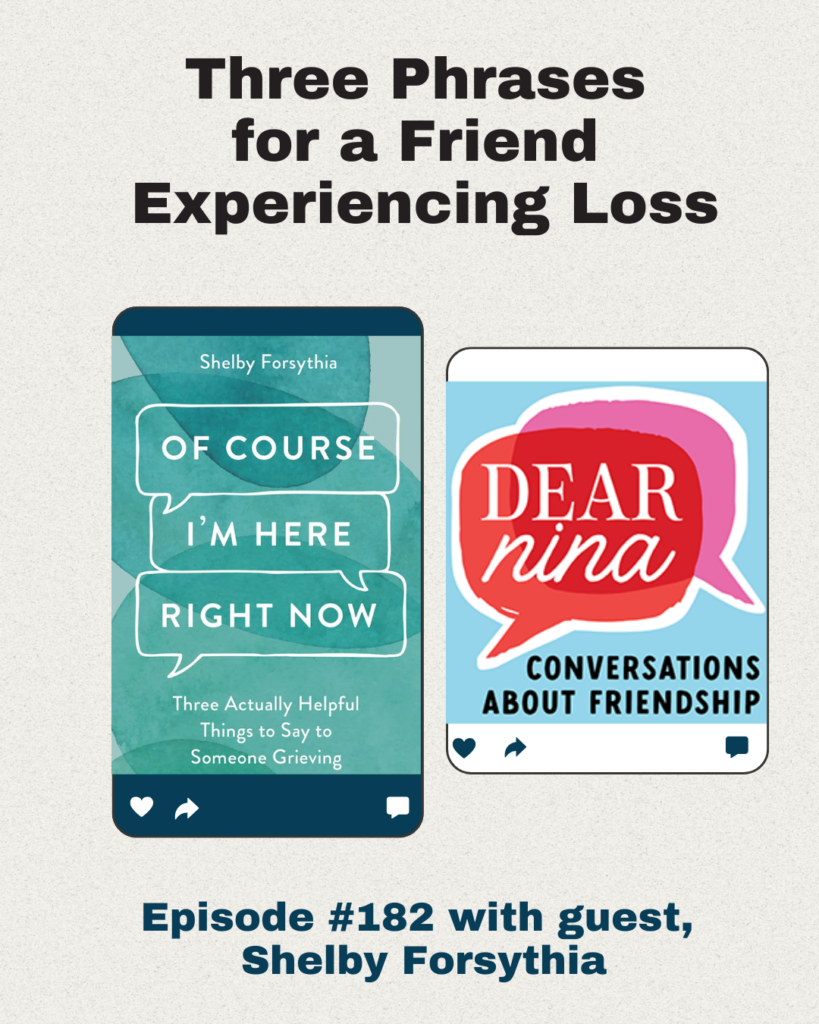
And today’s guest, Shelby Forsythia, is the perfect person to give really concrete tools and ideas for how you know what to say? The two of us both really do not like framing conversations around what not to say, and therefore, Shelby has a book coming out not until March, but she gives you a lot of really great elements of it here in this episode. The book tells you what you can say, what might be helpful and how you know which of these three statements, I’m not gonna tell you, you have to listen to the episode.
Which of the three statements or framing of conversations would be most helpful to the person in your life who is grieving, who Shelby calls your griever? And we talk about that expression she uses [00:02:00] and why I found it so endearing and really perfect for how friends help each other through these hard moments in life.
Shelby Forsythia is a grief coach, a three time author, a podcast host in 2020. She found a life after loss academy and online course in community that has helped dozens of Grievers grow and find their way after death, divorce, diagnosis, and other major life transitions. Following her mother’s death in 2013, Shelby began calling herself a student of grief and now devotes her days to reading, writing, and speaking about loss.
A reminder that we can always continue these conversations on my Facebook group at Dear Nina, the group. And I am always on all kinds of social media, really more than I should be. at Dear Nina, friendship. Instagram and TikTok, and there’s a newsletter at Dear Nina, do substack.com where I will certainly be writing about this topic. I found this conversation personally so valuable and I have no doubt that you will as [00:03:00] well.
Let’s welcome Shelby to the show. Hi Shelby, Welcome to Dear Nina.
Shelby: I am so glad to be here today.
Nina: I talked a little bit in the intro about what you do, but I would like to understand more in your own words, in the grief work you do, what does that look like?
Shelby: I think it’s funny with any job or any profession, you kind of start out thinking you know what you are and you know what you’re doing. But something I’ve found in almost, well, yes, almost 10 years working with grieving people is the ultimate role that I hold is as a witness to people in grief and a guide to people in grief.
I did a survey a few years ago of what’s the biggest or number one word you would use to describe yourself in grief? And I was expecting things like sad or exhausted or overwhelmed or depressed or lonely. And the number one word I got was stuck. I feel so stuck in grief and I’m not sure how to move through this experience or get out of this experience or feel like I am a part of the world again, and a lot of what I do as a grief coach is companioning people in those places where they feel [00:04:00] stuck. And just asking questions about what exactly does stuck mean to you? What makes you feel stuck now that maybe you didn’t feel stuck then? Or what is it about grief that you think keeps you stuck?
And we’re like untangling the stories we tell ourselves in grief. also many, many clients have told me, they’re like, oh, you helped me find words for this. So a lot of the training that I’ve gone through and the books I read, I try and read like 20 to 30 new grief books to me a year. Whether they’re old or new, doesn’t really matter.
But continuously helping people wrap words around or language around the experience they’re having. They’re like, oh, not only do words exist, but I’m not the only one who feels that way. ’cause those words, if they didn’t come from me, they came from somewhere else. there’s a lot, a lot of comfort in that.
And so many of my students and clients now. They say you don’t really need to bring necessarily a toolkit of all these, mindfulness tools to use in the moment, or you don’t have to write another book or publish another podcast episode. The thing that helps the most is continuing to talk about grief and [00:05:00] to find words for it and even that act of trying is comforting in and of itself. I don’t coach for a specific type of loss or for the first year out, or the first five years or the first 10 years, I have clients, spanning from death, divorce, diagnosis. I call it the three Ds, life’s biggest loss experiences, all the way from, I lost my person three months ago to, I experienced five losses back to back 20 years ago. And they’re all coming to me to find the words, to wrap language around the experience and to ultimately be seen in their grief in a world that very much, does not want to see or recognize grievers or grief as a part of who we are.
Nina: I relate to that so much in the friendship space. It’s called Dear Nina. ’cause people write to me and I’ve been doing that piece of it for about 10 years It’s not even that they necessarily need an immediate solution or a how to at all times. It’s like they want to be heard and it is so hard to make friends, or I’ve been having a hard time maintaining friendships.
I’ve had all these friendship breakups and I’m starting to realize, I’m playing a part in it and they, they just want to be able to know [00:06:00] they’re not alone and be heard and, There’s a commonality there, and I think friendship loss, by the way, is another thing I assume you deal with in terms of grief.
Not that somebody passed away necessarily, although that too, but also the loss of a friendship. I know you’ve written about it. I really think it’s interesting that your work in grief isn’t just about death. , Like you said, divorce diagnosis. Are there any other kind of, losses that you would put in that bucket? I know those were the big three.
Shelby: Sure. I call them the three Ds. ’cause that kind of a cute way of remembering. The three biggest losses that, that people come to me with is, someone died, I’m going through a divorce or a major breakup. You don’t necessarily have to have been married or I got diagnosed with something and that diagnosis has changed my life.
But especially lately with the political state of the United States and kind of the larger world, estrangement has been a huge one. So my person is still alive, but we are not talking anymore or we are very low or no contact. Um, and then also a lot, of pet loss, which is a death.
And so that is kind of, um. I [00:07:00] hesitate to say, but sort of like a welcome mat that I lay out if you, yep. That grief is also welcome here.
Nina: I just, your voice, like, I love hearing your voice. I can see how you’re really, I can see how you’re so So, moving into the meat of our episode, I wanna talk about those three stories most grieving people tell themselves, like that will be our first part. And then three phrases they most want to hear from friends, family, and coworkers. that is going to be so wonderfully helpful to my listeners. ’cause most of us have been on both sides of this. We’ve had a loss of some kind and certainly we are part of people’s lives who are experienced a loss that we wanna do our best by them. Most people, I do say this a lot to my listeners and people who write to me, most people do wanna be a good friend. They are not trying, of course, to say the wrong thing, so I’m approaching this episode and I know you approach your work with, how can we best be here for people knowing that that’s what we want?
Most people do want to do that.
Shelby: Yeah, absolutely. Well, I’ll kind of preface all of this by saying I’ve been working with grieving people for almost 10 [00:08:00] years. But one of the questions I get the most is from people who would consider themselves, not grievers, people who are adjacent to the grieving, whether that is friends, family, coworkers, neighbors, spiritual professionals, counselors, therapists, school counselors, people who are just present in the community.
They’re like, I see people grieving and I don’t know what to say. What do I say to comfort someone who’s grieving? And so the first two books that I wrote were all directed towards grievers of like, here’s how to survive a devastating loss. And there’s tools and there’s mindfulness reframes and there’s questions and journaling prompts and things that get you from the stuck in grief place to moving through grief.
But the third book, and that’s the one that’s in this frame behind me, it’s called, of Course, I’m Here right now. It is entirely intended for people who are adjacent to grieving people, whether you a friend, family, coworker, neighbor, helping profession, any sort of person who is alongside of a griever.
And I always argue, I’m like All of us are grievers and we are also all alongside Grievers. And so in the book I kind of clarify these roles of you are a comforter, comforting a griever, so there’s grievers and comforters. [00:09:00] I also say in the book, we are all at different times in our lives, grievers, and we are all at different times in our lives comforters.
And for a lot of us, especially if we have lost someone, in the case of like a friend group or a family group, we are grievers and comforters at the same time. How are we grieving someone or something that we’ve lost. And then also comforting other people who are in the same boat or grieving the same person such as a parent who is comforting their children while they’re also grieving a spouse at the same time.
It’s very much a book that’s intended for anyone who’s alongside a grieving person. That’s kind of everybody. My publishing house is like, isn’t that a little broad to be writing a book for everyone? And I’m like, everyone’s gonna be next to somebody grieving at some point in their life, whether that’s a person in the back of your Lyft car or you’re a Lyft driver, or I’ve served at many tables in, uh, Chicago.
I was a server for many years. Somebody comes to your restaurant fresh off a recent loss. I’m a florist right now. People come in and order sympathy arrangements. You are alongside people who are grieving every single day of your life, whether or not you know it. To your point, one of people’s, I was gonna say [00:10:00] grievers, but one of people in General’s greatest fears is losing friendships, and yet one of the biggest secondary losses that follows a primary loss such as the death of a loved one, or major diagnosis or a divorce is friendship loss. Friends pull away, things get awkward. They say things like, look at the bright side, or God never gives you anything you can’t handle. Or, you think that’s bad. I had to grieve uphill in the snow both ways, and they play grief Olympics and suffering Olympics with each other. There’s a lot, a lot, a lot of talk in the world about what not to say.
And this is to my knowledge, one of the first books it’s like, here’s what to say
Nina: Oh, such a such a breath of fresh air. There was a big period of time, I don’t know if we would say between 2009 to the next 10 years.
I feel like so many articles were headlines. Literally that said that what not to say to someone who just got divorced, what not to say to someone who just was diagnosed with cancer so much so that a huge friendship loss that happens is fear of saying the wrong thing so the person [00:11:00] disappears.
It’s like, okay, you’re gonna write an article about me, is it so bad that I said the wrong thing, isn’t it better that I showed up at all. I do push people, don’t be so fearful of saying the wrong thing. It is great to have a tool like yours. I’m glad this is why you’re on the show, to help us say the right thing.
But I would still rather someone say the wrong thing than completely disappear. It’s like the worst thing you can do, I think is completely disappear on your friend.
Shelby: those are the heartbreaks I hear the most from grieving people is not, they said this or they said that, it’s that they said nothing. Or, I remember a client very distinctly whose parent died and she said, my best friend of 20 years came to the funeral and I never saw her again. And she’s like, I see her active on social media.
I know she’s alive. I see her friends and family in the grocery store. I don’t know what I said or what I did, or is it just the fact that my parent died? ’cause that’s the story you tell yourself. It must be me. But she no longer wants to be my friend. She sent her snail mail, she sent her texts, she sent her emails, and this friend never.
Rekindled the relationship. And so it became another thing to grieve on top of the death of her parent. And so a very big fear. Um, I’m gonna go on a [00:12:00] quick tangent, but to your point of saying the wrong thing or fear of saying the wrong thing keeps a lot of people from talking. It reminds me very much of, language around queerness and queer culture.
L-G-B-T-Q folks in particular, I’m a queer person. I’m married to, somebody who was born a woman, a lot of people don’t know what to call us. and there is a fear I think in larger society that if I say the wrong thing, I’m gonna be canceled or I’m gonna be strung up on some fence as a pariah or a bigot or somebody who doesn’t get it.
And I think this similar fear of saying the wrong thing, so I’ll just say nothing, echoes into the grief space as well. And I never want to come on here and be like, well, queer people are too sensitive, grievers are too sensitive, because I don’t think they are. I think language is so deeply important in how we communicate with each other and for people who are afraid to say the wrong thing, I’m like educate yourself first, and then speak is one of the best, easiest ways. And, the reason I wrote this book, and the reason I’m so passionate about words in Generous is that words are free.
You do not have to make a casserole, which is time, [00:13:00] energy, and money. You do not have to send dollars that you don’t have for somebody to get DoorDash meals for a week. You do not have to donate to a company pool at work trying to support somebody who’s buying a new car after their dad died. You do not have to contribute financial, energetic, spiritual, physical, labor or energy towards comforting someone who’s grieving
when you have words at your disposal, and this is very much inspired by the COVID Pandemic, when all we had was words to comfort each other when we could not show up and mow each other’s lawns or walk each other’s dogs or do carpool with each other’s kids. When a grief event happened, when all we had to comfort each other, especially from long distances or cross time zones, or over FaceTime, when we said goodbye to people we loved or tried to comfort, those who were grieving is language.
And so I, I stress so much in this book the importance of words can build us up and make us feel held and supported and loved. And words can take us out at the knees and make us feel like we are the only ones having this devastating experience. And so the words that we choose, they do have great weight.[00:14:00]
That’s why people are afraid to say the wrong thing. But that’s why it’s so impactful for grieving people to hear from those who maybe even if you don’t get it, you are still there. You are still showing up. You are still, to your point. trying to be a friend and to be a witness to them. In that moment.
Nina: beautifully said. Seriously. Okay, so the three stories most grieving people tell themselves, let’s start with that.
Shelby: Absolutely. And this came out of a, um, conversation I was having with a grieving client, I’d say probably in 2020 or 2021. This was a person who was grieving multiple miscarriages and then the medical termination of a pregnancy where she found about three quarters of the way through the pregnancy that her child would not survive outside of her body.
So she’s like, we have been trying and trying and trying to have babies, and I just keep grieving babies over and over again, and an acquaintance in her life was pregnant and had just announced her pregnancy on social media, and we were sitting in session and she was like, try as I might, I cannot figure out a way to be happy for her.
I cannot get to a path in my mind where I can [00:15:00] congratulate her because I’m just so devastated by my own loss. And I remember watching her and listening to her sort of work herself up into this frenzy of like, I have to be happy for her. She’s my brother’s friend. Like she’s been in our family forever and it’s just a close connection, whatever.
And she’s just shaming herself, heaping on shame and judgment and shame and judgment over and over again of why can’t I be happy for her? And I remember saying to her kind of quietly, ’cause I, I felt her ramping herself up and I was like, of course you’d be upset that someone in your circle got pregnant so easily when it’s been so hard for you.
And the silence that came after that from her where I could almost hear the gears turning in her head and like rearranging the story. She was like, I’d never thought about it that way. I never thought it would be okay to struggle to be happy for somebody else’s success and joy when I have tried so hard to have those same things for myself and haven’t been able to. That singular phrase, of course, as a validating phrase was the key that sort of unlocked that door.
And so [00:16:00] that was the moment I was like, there’s something to words about unlocking stories and grief. as I’ve been working for grieving people for more than 10 years, I went back and combed through, I write paper notes for all of my clients. I have them in like a little cabinet lockbox in my house. And I started going through them and I was like, oh, people keep telling the same three stories over and over and over again when they’re grieving. And it doesn’t matter the loss, and it doesn’t matter how long it’s been, they are, I’m crazy or I’m crazy for feeling this way, or I’m not normal.
Any iteration of that. I’m alone and it’s gonna be like this forever. These are the three stories. when I was craving my mother, my mother was, I call it my first and my worst loss in my life. I was 21 when she died from breast cancer. Very suddenly. And also when my best friend died from COVID in 2022, she was 29.
I told these three stories to myself even after I became a grief professional of I’m crazy for feeling this way, or I’m not normal, or something’s wrong with me, or I’m caught up in this and, and I’m not okay. I’m alone. No one wants me around. I’m a burden. No one’s reaching out because they don’t want to, and they genuinely don’t like me anymore.
Those are all variations of that, and it’s gonna be like this forever. And this is my favorite [00:17:00] one because for a lot of people, especially when it comes to death, the death is true forever. Your person’s not coming back for a divorce, your relationship’s not coming back together. Your diagnosis, if it is a terminal or a chronic one is true forever.
And so to assume our brains rightly so, that how I feel right now is how I’m gonna feel forever. That makes a lot of sense to people who are grieving. in the book, of course, I’m here right now. I tell people who are adjacent to the grieving or I guide them, I don’t scold or come at you with a pointed finger.
I guide people who are adjacent to the grieving. Here’s how you can determine which story your griever is telling themselves because you can hear it in the way that they speak. If your grieving person is saying, you know, I feel like I had so many friends before this and now nobody’s reaching out, it’s probably a story of I’m alone.
If they’re telling a story of other people don’t feel this way, I don’t understand why I can’t just be happy for her or my emotional experience is not matching what other people want of me. It’s probably I’m crazy. if people are saying, I just can’t see a way out of this. I have never felt so hopeless.
I’m so [00:18:00] exhausted by grieving, it’s probably, it’s gonna be like this forever. And if you can match what story your grieving person is telling in your head, then you have the phrase to comfort them. So if somebody’s like, I cannot be happy for this person. I don’t know how to, to cheer her on in her pregnancy when I’ve lost so many.
Of course, you would be upset that someone in your friend and family circle is pregnant when you cannot be, or when it’s been so hard for you. And then they get to respond to that. That’s a validating statement for I feel so alone. Nobody’s reached out in six months. The grief anniversary’s coming up, and I feel like I’m gonna be doing this all by myself.
To say, not only I’m here for you. ’cause I think a lot of grieving people can feel like that’s trite. Or I’m here, or you’re not alone, or whatever the case may be. I’m here, I’ll check in on you again next week. Or I’m here, I’ll give you a call after your corporate party so we can see how it went. Or, I have not forgotten the fact that you are grieving during the holiday season, for example. That’s a beautiful text message to send somebody. Hey, I know Christmas is coming up. I haven’t forgotten that you’re grieving.
Nina: I love that. I haven’t forgotten.
Shelby: I [00:19:00] haven’t forgotten you because the story under I’m alone is I have been forgotten or abandoned, or left alone to metaphorically die. Or the story of I feel so hopeless I’ll never see a way out of this. My world is ending all around me and I don’t know where to go from here. Right now I can see how you see there’s no way out. The cool thing about these phrases is that Grievers do not and will not know that you are using them because they are not cliches, they are not look on the bright side, or you should just try lavender essential oils to sleep.
Or you think that’s bad. I grieved uphill in the snow both ways. Or, you just need to get over it. Because they’re not cliches or platitudes or cruel statements. They are comforting through the back door of conversations you’re probably already having. you could be at brunch with somebody and you know that, for example, they’re at the tail end of going through a divorce.
Say, Hey, I know right now, right now, it’s not gonna be like this forever. Right now you are doing a lot of paperwork and you’re probably on a lot of phone calls about legal [00:20:00] stuff. What would be the most helpful to you? Do you want me to, after brunch come and do your dishes for you or your laundry if you live in physical proximity to them.
If you don’t live in physical proximity, you could say, of course you’re overwhelmed in this moment. I’ll check in on you next week, which is, I’m here. And of course, sandwiched together in the same sentence. Of course you’re overwhelmed. I’ll check in on you soon. you can do different combinations of these altogether, but thinking of any example in your life, someone you know is grieving and you can use these phrases with them to offer covert comfort and consistent relationship nurturing and then a guarantee that your relationship will not die or can survive. The alternative to that is can survive major losses like deaths, like divorces, like political upheaval, like estrangement, that other people are going through with their friends and their family members, or like major diagnoses.
Because we’re all gonna grieve at some point. Having these three phrases in your back pocket and watching over and over again how your friends speak, how people talk in the media. Even in this conversation that you and I are having right now. I [00:21:00] teach people in the book here’s how to spot grief stories everywhere.
And then think about what you might say to comfort them.
Nina: I am just blown away by the simplicity and yet the importance of those three phrases and how helpful they would’ve been even for me to hear at different times how helpful it would’ve been for me to give those to other people at certain times. I always think I do a pretty good job being there for people.
We could always do better. And one other tip I wanna give people from my point of view, I think there’s this unnecessary pressure people put on each other to always be. authentic, quote unquote all the time. Meaning like they’ll always know what to do at the right time, and it is okay to have help knowing how to help people and also just schedule things in your calendar. I’m just being really practical right now. When you say to a friend, I’m going to check on you next week, put that in your calendar.
Shelby: Yep.
Nina: and let’s not be afraid for real. Let’s not be afraid to, it’s, it’s not inauthentic to be there for someone and have it be scheduled. We’re all busy. We may have several people in our lives we’re trying to be there for, we usually do. put it in your calendar that somebody, who’s [00:22:00] important to you had a big loss exactly a year ago. when it happens. Even put it, put it in for the year ahead. I’ve done that for, people for like a sober anniversary.
That’s not a loss so much as like, almost the opposite of a loss, like a gain in a way. But it’s such an important date to just check on and celebrate and, you know, it, it could just be a text. I’m so proud of you. I know this is an important day. we have to schedule these things though because how, how else would you keep track of it all?
It seems obvious, but it isn’t for everyone. And I would also urge people who know their friend might be putting it in their calendar. that’s okay. They’re still a good friend. surgeries that someone’s having, This expectation that everyone’s just gonna remember our stuff magically without writing it down is, not necessary.
We don’t need to measure our friendships that way, as long as they do the thing. Check on you when they said they were going to, it doesn’t matter how they remembered.
Shelby: Yes, I feel that way very much too. And it’s funny, I’ve never felt bad about being in someone’s calendar. I’m almost like honored when I am. I’m like, oh, I’m as important to you as that business meeting, or I’m as important to you as your kid going to [00:23:00] soccer practice, That’s exciting to me to be remembered in that way and I’ll, tack onto that too. I am a person with a DHD, uh, neurodivergent and so I often think about friends and family members at really weird hours of the day. disclaimer many of my friendships with, like, if you get a text from me at.
Don’t feel like you need to text me back. It’s not an emergency. I’m just thinking of you. I’m just asking how your life is. I asked a friend the other day, I said, do not respond to this right away. ’cause it was like nine 30 at night. I saw a pair of earrings on Instagram that reminded me of her.
And I said, if I were to buy you a pair of earrings, would you prefer gold or silver medal? And I said it, this is not important. This does not need to be responded to right now, but I’m having a question and you can answer when you want. And then I have this a joyful agreement with all my friends. I have a core group of about nine friends, and we all understand that we’ll text back when we text back. Every now and then people will check into the group chat with like a little heart emoji or something like that.
And that’s how we know we’re all still alive. participating in the chat or catching up on the chat, there’s no expectation of you need to participate in this. And if there [00:24:00] is. You will receive a text that says, I need a response by Friday, or I need a respon, like a headcount or something like that.
We, take one group vacation together every year, and that one has a separate group chat that is considered more urgent.
Nina: that’s smart. That’s so practical. It’s
Shelby: even negotiating these rules with your friends around your grief can be really helpful too. I, I say often in my podcast and in my books, that grief changes your rules of engagement with everyone around you.
And so even as the griever or as the comforter to say, Hey, my sister just died. I’m gonna need our friendship to look a little bit different or for you as the friend to say, Hey, your sister just died. It’s okay if our friendship looks a little different right now in this season for the time being until further notice these prepositional phrases of temporary right now in this season for the time being at this moment, are really beautiful door openers to your friend of like, I see that your life has changed in a big way and I can have this conversation with you of would you like more check-ins or less? I tell comforters, if you can avoid inviting grievers to things that are ticketed, there’s a dress code.
You [00:25:00] must be there by a certain time, or you have to stay for the whole thing. Walk in the park. Great for grieving people. You can wear sweatpants, bring your dog, whatever. But like a ticketed sit down event that’s $300. I’m thinking like a concert or something like that where you have to wear certain clothes or it’s expected that you do.
You’re taking lots of pictures, there’s lots of stimuli, maybe ease up on those for the first I don’t know, however long, however long your griever tells you. but so much of the book, including in the right now section or, and the I’m here section is like how do you show up and how do you keep showing up into the future?
Is a lot about understanding grief or loss or some sort of event, especially for people who are actively caregiving for someone who is dying. Maybe your friend hasn’t experienced a loss yet, but they’re caregiving for someone who is about to die. That changes your rules of engagement as a friend as well.
Nina: Your expression. You’ve been using your griever. It’s endearing to me because it invokes this idea there’s now kind of a new status that it was previously your friend or your coworker or your family member, whatever it is. Now, we’ve added a new title to it, which is your griever, which is a different status because a different [00:26:00] status has happened and it really acknowledges that difference and it reminds you as the comforter that you have now, this new responsibility you have a new person under your wing, you have a griever.
Shelby: That’s Beau. I love that you said that. ’cause my editor was like, are you gonna keep referring to them as your griever throughout the whole book? And I flip flop between your griever and your grieving person. Um. I said yes, because in the work that I do as a grief coach, and so many of my clients have reflected this back to me, they say once I’ve experienced a loss.
I’m a griever forever. I may not be sad forever. I may not be devastated forever. I may not be stuck forever, but I will remember my loss. Remember my person know this date as one that sticks out in the calendar. Be activated by their favorite cereal in the grocery store, or have a hard time with Christmas for the rest of my life.
There are things that linger. The pain may not linger, but the status of griever, the identity change of griever is something that as a grief coach, help people sort of fold it and integrate into their lives as an identity. It’s like it’s, you don’t have an [00:27:00] identity as a griever or someone who’s bereaved, and then you’re done with that, in my perspective, and from what many clients reflect back to me, and so I have this section in the book of I refer to people as grievers for the rest of their lives.
It’s a lifelong griever model, and it doesn’t mean lifelong broken model or lifelong suffering model. It is once you have grieved though, I talk about wearing grief glasses. Once you see, you can’t unsee, you will never know a world without this kind of loss or pain or grief Again.
Griever gets added to your multitude. Of identities that you carry. And so for the purpose of this book, yes, you are a comforter and a griever. but yes, your griever is a person who is grieving and they, belong to you. We belong to each other.
Nina: that’s the word I was reaching for belonging. it’s like possessive, but in such a positive way. It is Unreal how much, when you’ve lost somebody they, so now I’m thinking more of a death loss, you know, not the other losses we’ve been talking about, but how.
A memory can come randomly to you, but it really is special when somebody brings a memory to you. And so my dad died over three years ago. It still means so [00:28:00] much to me if somebody invokes him in some way. A lot of times it’s my husband who knew him very well he called my dad the chief.
So did my high school friends. They called them the chief. It’s like a long list of reasons why. By the way, I’m from Chicago, drew and my dad, looked like Mike Ditka, the Saturday Night Live in the nineties. He had big white hair and he was a huge Chicago sports fan and including a Bears fan, and he didn’t have that accent. But he looked like that a little bit. And when I went to college and all my friends met my dad, I went to college in St. Louis, so we were not so far from Chicago, so sometimes they would come to Chicago, they’re like, oh my God, he’s my, my God. I’m like, I know
Shelby: You are Nina Ditka.
Nina: right? So anyway, for a lot of different reasons, my dad had a certain kind of personality, my high school friends and. Eventually a husband who I met later in college called him the chief, long story to tell you, when he sees something that makes him think of my dad, he’ll be like, oh, the chief would’ve loved that.
Or, oh, this reminds me of the chief. And that’s such a gift to give to somebody I don’t have the only responsibility of remembering my [00:29:00] dad or knowing things he would’ve liked. It’s so nice when people in your life sort of take on that responsibility too, and help you remember as years goes on.
And I don’t know, it’s a, it’s a nice thing to do for somebody to not be afraid to bring up the person who died. I heard you say in an episode of yours, and I agree with this advice, that to use the name of the person that someone lost is so special and important, not just to say I’m sorry for your loss.
If, if you’re gonna reach for that statement, which you, you and I both agree, isn’t probably enough, but if that’s going to be something you go to at least use someone’s name, the very least, there’s something to that.
Shelby: I’m sorry. Your best friend’s not here anymore. Especially when my best friend died from COVID in 2022. refer to her as who she was to me. Not just sorry for your loss. ’cause that could be fricking anything. Lost my wallet, lost my keys, lost my favorite sweater. This is more important. And to your point too, If your friends or your coworkers or your neighbors are close enough to you, they asked and or talked about your dad in life, don’t change that because he died. Keep asking about him. Keep talking about him. [00:30:00] And you’re like, well, there’s nothing new.
He’s dead. What would your dad think of insert media, pop culture thing here? What would your dad think of the fact that your kid’s accomplished insert thing here there’s always something about them to talk about. and I think this is true for a lot of people, it’s getting into the practice of it’s okay to speak of the dead
and there’s no way, I think so many comforters and supporters of Grievers will say things like, well, why don’t Ron remind them of their sadness or their loss? I’m like, I’m never not thinking about it. I am always extremely hyper aware. I’m living in a world where my mom is dead. My best friend is dead.
I had an engagement breakup in 2017. My cat died last year. I have a chronic illness, like I am never not aware of all the losses that I carry. I’m never not aware of my identity as a griever and that as a continuing reality there’s no way to bring it up to me and for me to feel worse.
I have a very dear friend who was friends with my best friend Tammy, who died from COVID in 2022, and she texted me recently. she had a major heart surgery in her thirties that [00:31:00] was related to a, a birth defect. And Tammy was by her side for the whole thing. And it was a major, major surgery.
It basically guaranteed that she would now be able to play sports and to run and, and to do things she had never been able to do in her thirties. And so she was like getting a new lease on life. And the year after that major surgery tammy died. Now every major milestone she has with this heart that she has her new heart, she goes for a checkup, her medication changes, she’s having palpitations, and she doesn’t know why, and she’s scared.
I am now one of the receivers of those texts. And she’s like, I just miss Tammy so much. she would know what to say. And I’ll say this too, grief can be really freaking funny too.
It doesn’t have to be I’m buttoning up my shirt and putting on a tie. But like I’m not comforting you from a very formal therapeutic funeral director sort of place. I think a lot of people think that’s who they need to be sort of comfort, a grieving friend. But one of the best exchanges I saw on threads or Reddit or Instagram. Some social media platform was two men, one of whom had just lost his son, and they were texting back and forth and one was saying, it is [00:32:00] so surreal that I am planning my dead son’s memorial. And his friend texted back to him, this pardon my French effing socks. And he was like, yeah, really?
Effing sucks. I’m so sick and tired of people telling me. So silver lining, God needed another angel. All these cliches and stuff, he really needed someone to just say, this effing sucks and I can’t believe it either. And to just reflect that validation back to him of like, you’re not crazy for feeling like that.
It really does suck. You don’t need to find a meaning or a silver lining. I hate that you’re having to do paperwork for your dead child.
Nina: it’s
Shelby: does, what is this? What does this mean? Yes, it’s an of course inaction. And I loved, especially to this example of, I imagine you’ve had episodes on this before, but like male friendships especially.
Guys are often, like, I’m not a touchy feely person. And I talk a lot in the book about you do not have to be an emotions or feelings person to comfort someone who’s grieving, reflecting back, this sucks or this is garbage. Or right now I can see how you got there, of having this feeling or of having this experience or of just being exhausted.
those are normal things you would say to anybody that do not require a degree in feelings.
Nina: [00:33:00] that’s perfectly said. Shelby, I have one last question for you.
We’ve been talking a little bit about bringing up the name of somebody who died and not being afraid to bring ’em up, and I loved your suggestion of what do you think your, in your case, what do you think your mom would, think about, X, Y, and Z, what about bringing up a friendship, loss, a friendship breakup or a divorce or a breakup of any kind of romantic partnership, bringing up a name in that scenario, does that feel different? Would you also suggest, let’s acknowledge that this person is still a loss, but it’s different. That’s maybe feels like more of a rejection kind of loss in some way?
Possibly depending on the situation. do you think people want to hear those names as much, do we avoid talking about it? How do you console people through that?
Shelby: Oh, that’s interesting. I’ve never gotten this question before and I’m really glad you asked it. I’ll tell you where I am with it today, and that might change in the future, but I think my go-to in this case is how does the GRIEVER refer to them and take their lead? So if they refer to their ex-wife or ex-husband in the case of a divorce as their ex, you use [00:34:00] that language.
If they refer to it as. That toxic a-hole, you go right ahead and use that language as long as you’re not in a corporate setting or somewhere else where that, or like maybe in front of the kids or something where that might get frowned upon. But if they refer to them as like Frank or Beverly or whatever the case may be, you can use their name too.
Or if you don’t know, you can always ask. You’re like, now that the divorce papers are final, how should we refer to that guy? would you ever want to bring him up in conversation? Or you can say. Just generally, I know it’s been six months since the divorce, how are you feeling about your ex?
And see how they start referring to them and, and follow their lead. that’s also a case too, I think, where grieving people don’t get consulted. And so people say nothing. It’s like, I’m, well, I’m just not gonna bring ’em up the relationship’s dead and buried and over and they were hurtful to each other.
Or maybe they weren’t. But like, it’s still a painful topic to talk about. So saying, Hey, I know this is a weird thing to talk about, but it’s a reality of your life and I wanna make sure we include it as a part of our friendship. So to use that language, I wanna make sure we include this part of your life as a [00:35:00] part of our friendship as well.
I don’t wanna pretend like our friendship exists outside of that ’cause nothing exists outside of that. It is your life. How do you wanna refer to them? And I will follow your lead. to really position your grieving person and like, oh, I am empowered in how I wanna talk about this. It happened. I may not have had control about how it happened or what unfolded or what the consequences were, or even if they did, but now I get some say and some preference in how I wanna talk about it going forward.
I think a lot of times, especially in our individualist society of like, you gotta figure it out yourself. There is community building and friendship strengthening in us asking each other how we would like to proceed from here, especially now that a loss has happened. A loss of any kind.
Nina: That’s a beautiful place to end. It’s like you just know exactly how to wrap it up. I appreciate that. I told Shelby at the beginning that I love having a fellow podcaster on, ‘they do know how to. Make it an episode. So thank you so much,
Shelby: And there you go.
Nina: Yes, exactly. So the book comes out March 31st. I’ll have it in the show notes for [00:36:00] people to pre-order, and I’m really just truly grateful that you took this time to be with me today. I know it will help listeners.
Shelby: I’m so thrilled. I think that, friendships are one Our most valuable. I hesitate to say commodities or assets ’cause that makes it sound like I’m trading them on the market, but they’re some of our most precious possessions. that’s how I wanna phrase that our friends are the people who are here with us through life’s greatest achievements and life’s hardest losses and to know that we have the words to say, not just when we’re celebrating, but when we’re deeply mourning together. ’cause a lot of times our grieving friend’s, heart breaks our heart as well to have words for times when both of our hearts are broken.
And when we’re in comforter, griever rolls, it guarantees we live in a world where nobody has to grieve or do life’s hard stuff alone, and that’s a world I’m really invested in building.
Nina: Oh, thank you. And I end every episode this way. I think you will agree. I say come back next week when our friendships are going well. We are happier all around.
Shelby: exactly.
Nina: All right, thank you. [00:37:00]