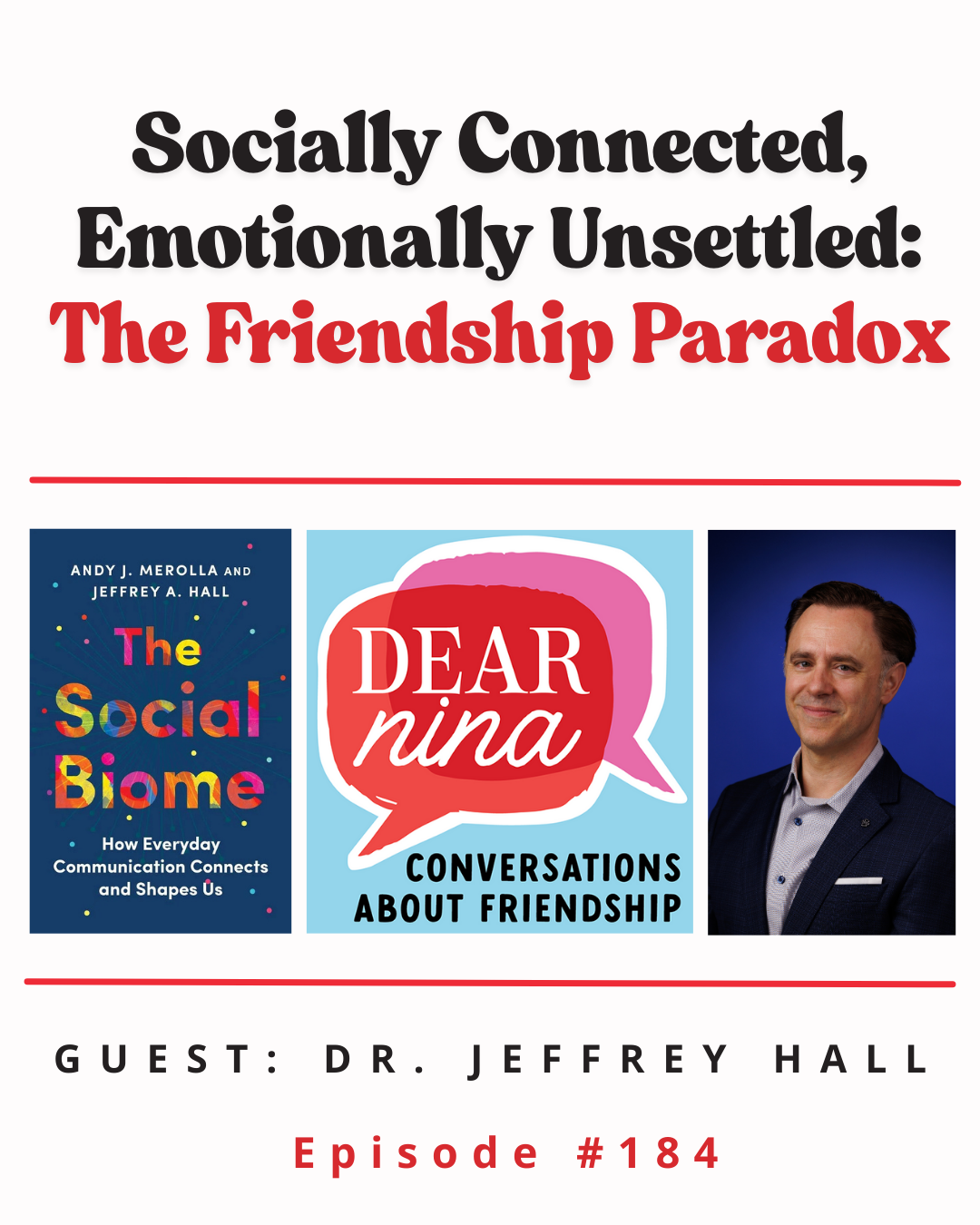
Nina: [00:00:00] . Welcome to Dear Nina, conversations about friendship. I am your host, Nina Badzin. I have been writing about friendship for over a decade, and in that decade I have quoted today’s guest probably a dozen times.
That guest is none other than Jeffrey Hall, who is a professor and department chair of communication studies at the University of Kansas, where he is the Director of the Relationships and Technology Lab.
He’s the author of Relating Through Technology and the Social Biome, and he has been quoted mentioned in more articles than you could possibly imagine. If you have ever read an article in the Atlantic or the New York Times or any number of places about friendship, especially in the past, I’d say five or six years, specifically about how long it takes to make friends.
You hear me talk about it all the time here on the podcast. That research is by Jeff Hall and his team. our topic today is not directly about the research about how long it takes to make friends, but it is woven [00:01:00] throughout our discussion. So I thought I should mention it here since we don’t give the exact numbers in the episode. According to Jeff Hall’s research, they found that it takes 200 hours of shared time and interaction to become close friends.
That’s a significant amount of time, which is actually good news. It means that if you are spending time with people and you don’t feel deeply connected, you’re not imagining it. It takes a long time. About 80 to a hundred hours for a good friendship, and then 40 to 60 hours for a casual friendship.
I really could do a different episode about that. It’s just that I mention it so much in the 180 plus episodes I’ve done here in 10 years of writing.
I wanted to focus on something else with Jeff, and that is on his newer work, research on emerging adults, that category is really 18 to 30, although of course, like all friendship topics, you can take lessons from that no matter what age you are. In this conversation, Jeff shares new research from the American Friendship Project on something he called the [00:02:00] Loneliness and Connection Paradox. Jeff found in this newest research in that age group especially, it is very normal to feel socially competent, but also emotionally unsettled and lonely. Meaning you can have a lot of friends and you could feel that you have a lot of connections, but you can also feel lonely or feel something is not quite right in your social life.
We talk about why big life transitions can make you feel disconnected even when you’re technically doing everything right, and why women may feel this more intensely than men,
and we get into a couple other friendship topics too. ’cause we are two people really interested in this topic. I was very much a fan girl in this one.
I don’t know how many people can put professors in their list of people they are fans of, but I’m definitely one of those people, and Jeff Hall was definitely one of those professors.
I think you’ll enjoy him a lot. If you are someone who is interested in building relationships from the research side of things as well,
let’s finally welcome Jeff to the show and you’ll hear me declare myself his number one fan, and I hope that [00:03:00] wasn’t too weird.
Hello and welcome to you Dr. Jeffrey Hall, who I’m going to call Jeff.
Jeff: It sounds great. I’m glad to be here.
Nina: You have to know, and I’m sure other people who write about friendship and interview you say this, you’re kind of a superstar to me. I’ve been quoting you, I’ve been quoting you for almost 10 years. How many times have I written according to Dr.
Jeffrey Hall? I can’t believe it. So it’s so funny to be talking to you.
Jeff: It’s my pleasure.
Nina: Your work on how many hours it really takes to become close friends has been such a relief to give people a sense of, it’s okay, it does take time.
Jeff: time. Yeah. That’s actually probably the strongest response to that paper, I think of any responses I’ve gotten, which was, oh my gosh, that’s loads of time. That’s a lot of time you have to put with someone before you can become a friend.
Nina: And instead of it being an overwhelming piece of news, I do think people find that to be like, oh, okay. That would explain why even though I’ve been at this school for a year, or I’ve lived in this city for two years, or I’ve been at this job for a year, I still don’t really know what my place is [00:04:00] because yeah, why would you know?
Jeff: Yeah, It takes time. Absolutely.
Nina: Okay. But you have a newer work. You have a newer study, and it’s like, all right, we’re moving on from the hours it takes to become close friends, to look at a specific generation. would you explain to the listeners what your new research is, that it’s already been written up and why? Why did you go to that topic?
Jeff: so the first thing is, is that, I would say that this all began because about six years ago, during the pandemic, some two coauthors of mine, Amanda Holstrom and Natalie Pennington, we got together on a project during the pandemic ’cause people were locked down and we’re like, we should do something with our time.
So we looked at people’s kind of lockdown experiences around how connected they felt, but also about the technologies they used to communicate who they were locked down with. And from that, we had such a great collaborative experience. We launched what’s called the American Friendship Project. So the American Friendship Project has three years of data that we’ve been collecting that looks at all the different aspects of friendships.
, How many friends do people have? How connected do they feel to one another? And [00:05:00] these are really high quality data sets that came from 2020 2023, and then we just collected another one last summer. So this particular project uses the data from the American Friendship Project, but it focuses on the experience of what it means to feel both simultaneously, somewhat lonely and also very connected.
Because one of the things that we found over and over again. This conversation about loneliness broadly is that there was a real big focus on this idea that young people are lonely and the data do support the idea that they are, but also young people are also super connected. They have more friends than they ever will at another time of their life.
They’re experiencing all of these different ways of connection from face to face to social media, from texting and video. They’re doing all of these ways to feel connected, yet they also feel lonely. So this project really kind of started with the presumption that what happens when you feel both lonely and connected at the same time?
Nina: So when you say young people, I think actually it’s important to put a number to that.
What are we talking about?
Jeff: So there’s a concept that’s called Emerging Adulthood, and basically it says that there’s a specific [00:06:00] developmental period of our lives that lasts between roughly 18 years old to about 30, where we answer the big questions in our lives. What are we gonna do? Who are we gonna be with? Are we gonna have children?
Are we gonna have some sort of career? And are we even gonna be a person who works or stays at home? All these kind of big questions about your identity. We sort out. That time of our lives. So when I talk about young people in this particular study, we are focused on that 18 to 30-year-old range.
Nina: Yeah, that’s a big range in that particular time of life. It feels like a bigger, 18 to 30 feels bigger than 48 to 60 in terms of life stage. It does. It, doesn’t it? It’s ‘ so much. Can happen in that time. this speaks to me, this idea that you can be lonely and well connected because I think those are the kind of people I’m hearing from no matter their age
by the way. It’s not that they have no friends, it’s not that they do no activities, people seem to know like, yes, you have to leave the house. It’s like beyond the obvious. So they may be going to some sort of regular exercise class.
They may be taking a class for fun where they actually [00:07:00] engage with people, which I always recommend. Like yoga isn’t necessarily a place you’re going to interact with people. It might not scratch the itch that you need. And they have some friends in their life and they may work and see people, but they still feel lonely.
what is the conclusion from that?
Jeff: so what we wanted to do is we wanted to understand how these things come together at different times of your life. And so what we hypothesized was that people who were completing this survey, so we had roughly about 5,000 people over those two years, they were focused on, between 18, but I think we had people all the way to 92 or 93 years old.
So we had a huge range in terms of age. And the first section, they really completed measures of their, their friendships, their social connection, other things in their life. But we had a specific section that we were focused on. ’cause we hypothesized it had to do with those changes you were talking about.
So we had a list of 15 different things that a person could go through in that time of their life, including things like start a degree program or completed one. Um, things that were more typical of young adults, such as started a new romantic relationship, but [00:08:00] also things more typical of older adults.
So things such as lost someone to um. Divorce or perhaps someone moved out of the house, your kids moving out is something that I’m thinking about in a few years. So we try to balance it in terms of these sort of life changes. And what we said was, have you experienced any of these in the last year?
So those two parts of the survey, what we did is we created a group of people who were high in terms of their overall connection. They had lots of friends. They reported a high degree of connection. They had high friendship support, but also people who said that they were often very lonely or they felt disconnected from others.
And then we said, how do these things come together? And essentially what we found is not only do you have these trends where people who are young are more likely to both be lonely and they’re more likely to be connected. But we also found what particularly, you know, predicted being in that. Ambivalent group, right?
Feeling both ways was all of those life changes, and as you said, that can happen at any time in your life. I think when anyone really kind of goes to that process of rapid change where they’re moving across the country and starting a new [00:09:00] job, or perhaps they’ve been divorced and they moved out and their kids move out and they start a new job, all of these kind of changes that compound make people feel really disconnected.
They lose a sense of orientation in terms of what their life is all about, and a lot of times they’re having to regrow new friendships from start. They have to keep in touch with people who are far away now, who used to live maybe in their very dorm room or maybe in the same house. So all of these demands on them to maintain their relationships is part of kinda the process that we were studying.
And this happens the most frequently with young adults.
Nina: I feel like the message is not that dissimilar to your other research about the amount of time it takes, meaning it’s normal and it’s a process and there’s not much you can do to fast forward it.
Jeff: That’s right. And actually one of the things that I’ve been thinking about is the best way to explain how you can fill both of these things at the same time is to think of something like very similar to what it feels to fill melancholy, right? That sort of wistfulness, that longingness for something that was once really beautiful, something really wonderful in your life.
Um, [00:10:00] melancholy is really common, like a graduation ceremony or, or even a wedding. These are not negative feelings. They’re mixed feelings, right? And sometimes very strong mixed feelings. So kind of the idea that I’m going with here is, is a lot of young adults have these strong mixed feelings about their connection over and over and over again as they start a new relationship and lose an old one as they move across the country for a job.
All these little changes that they endure have that kind of constant sort of nagging. Feeling of loneliness ’cause of the losses and the, or the impending loss of somebody, but also a recognition of the specialness and the connectedness that they experience in that moment in their life.
Nina: I wonder if the difference between somebody who experiences really deep loneliness later in life and somebody who doesn’t. This is my hypothesis. Your team can study it. I’m not the social scientist.
Jeff: We may have the data so we could actually follow
Nina: yes the people who’d experienced the deep loneliness weren’t able to weather.
the melancholy, the instability, they weren’t able to stop being [00:11:00] wistful about, oh, this college was such a great time. Which by the way is not a great time for everybody. But for the people that it was, it’s easy to get stuck in. Oh, it was so easy. ’cause as you know, and I know proximity is so strong and keeping strong friendships and very hard outside of that college campus to have such proximity and convenience.
So after that, it could always seem much harder. And if you’re able to push past the discomfort, which is true in so much in life, right? But in friendship and specifically maybe that’s what differentiates the emerging adult who never gets over this unstable period and the ones who in their forties and fifties are able to build a real social foundation.
That’s my hypothesis.
Jeff: well, we have to look into it. I wanted to say something actually, I think, kind of supports what you’re getting at here is one of the questions we asked in the American Friendship Project was whether or not it was easier to make friends at another time of life. What’s very funny is it doesn’t matter how old you are, people score about the same across the board,
Nina: does not surprise me. Yes.
Jeff: because there’s always a [00:12:00] time in life that you can imagine it was better, it was easier. And I do think you’re right that that feeling of kind of dwelling on the sense in which that you know now is not as good as it used to be, that there’s sort of a glory days that have passed that really can get you stuck in a very sort of backwards mindset when it comes to building new relationships or accepting the present as it is.
Nina: I feel really validated. people sometimes will ask me how could you be writing about the same thing for 10 years? I’m like, ’cause it’s ageless and timeless. I hear from people all ages. I mean, it really supports your work and your work supports my work. It’s ageless, it’s timeless.
It’s wanting to belong, wanting to feel, appreciated and included wanting people to reach out to you. Everyone wants to be reached out to, no one wants to do the reaching out the human need to feel accepted and not rejected.
I mean, that is just ageless and timeless.
Jeff: Yeah, and I, I would completely agree. You know, one of the things I start with, every conversation, every paper that I write starts with an assertion that says, we all have a fundamental need to belong, and this motivates me personally, but it also motivates my research work, is that I’m constantly looking to [00:13:00] understand how do we get that need to belong met?
What kind of activities do we engage in that are better for that? And how do we cope with those feelings when they arise?
Nina: Now tell me about the piece about women in your study. I found that obviously interesting personally, and I have two sons and two daughters, and so I’m always thinking about things from not just my own kids, but listeners too. Your study did find something specific about women.
Jeff: . So I think it’s a good idea to start with describing what is this ambivalent group all about and who are these people who both experience medium to high levels of loneliness and also a great deal of connection.
So we mentioned that they’re already young adults and we also mentioned the idea that they’re going through a lot of life changes, but there’s some other things that kind of flesh out exactly who these folks are. What’s interesting is, is there are people who generally feel pretty good about the kinds of friends that they’ve got.
They feel like they have friends to celebrate their good news. They’re satisfied with their friends, but one big clue is they’re not satisfied with how much time they get to spend with their friends. They’re feeling that kind of sense in which that their life has been maybe disorganized or kind of come, created a disruption where the time isn’t as abundant as they used to be.
They’re [00:14:00] also more likely to be dating. Less likely to be in a married relationship. And they’re also typically have lost a friend in the last year. And you can imagine the circumstances of people sort of going through that churn of new relationships. So all of these kind of pieces come together.
And there’s one other one that was important is that, as you said, women more so than men, more likely to experience this ambivalence. And we have two thoughts on why this might be. One thought has to do with friendship expectations. So I mentioned to you before we start the show that some of my very first publications were about.
Sex differences in friendship. And I looked at how men and women’s standards of friendship differ. And one of the things we know is, although men and women tend to have kind of broadly a same kind of sense of what a good friend looks like, they’re loyal. Uh, they’re someone who genuinely accepts you, that they’ll be there when you need them, that they provide support.
Women typically study after study, different age groups, different countries find that women have a higher expectation of what’s called communion or communal relationship. They want more self-disclosure. They want more intimacy, and they seek that. So part of the reason that we think it could be the fact that women are experienced more of this ambivalence is that they [00:15:00] have friends, they feel connected, but they also feel disconnected ’cause their standards are just so high.
In that early research I was describing, I also found that women were more likely than men to have high expectations, which they say were unmet by their friends. So they had set such high expectations, it was hard for their friends to meet them. Men, on the other hand, had set expectations that were low and their friends failed to meet them.
So what was interesting is they have very different profiles of what’s risky about their expectations in terms of friendship. The other reasons we thought that maybe it was the case that women were experiencing it more than men is women tend to also be very much alert and aware to the degree to which that their social relationships are either flourishing or not.
They tend to be kind of tuned into it. So the feeling that something might be off might be very preoccupying or a sense in which that someone is really not fully understanding me. And because of that kind of awareness of what it feels like to feel like you’re disconnected, they may be experiencing more loneliness simply because that they’re much more attuned to what it feels like to be lonely.
Nina: I am going to add they’re not right a lot of the time, [00:16:00] unfortunately, we’re hard on each other in a way. that sometimes the guys are more forgiving. And if we could adopt a little bit more of that forgiving aspect, I think women would be a lot more satisfied with their friendships.
’cause half the time when you think someone’s upset with you, they’re really not. I watch people, I’ve done it myself too. Of course. Create a situation where you act a little put out because you think the other person’s upset, but you don’t think they should be. And so now you’re not gonna text back as much.
You’re gonna take, a little, just a slight attitude. And now that person’s perceiving something, oh wait, Nina’s a little off. And it’s becomes a self-fulfilling prophecy. Like, yeah. Now some, now there is an issue because you’re acting like there’s an issue. I just don’t feel like the guys do that as much.
I.
Jeff: Yeah. One of my favorite actually findings was I did a lot of work early on in cross-sex friendships, so heterosexual men and women being friends with one another, and what men would say that they appreciated when they had women friends was what I described before, someone I can confide in, someone, I can talk to, someone who really listens, right?
When women describe what they liked about their men friends, they were like, it’s so low key, low expectations, and non-complicated. These are just kind of, it’s simple or simpler to [00:17:00] be in those relationships. And I would just say in general, people who can maintain high quality friendships, whether in, you know, same sex or different sex tend to be happier folks.
But cross-sex friendships specifically offer you a perspective about how friendship can be. So you learn a little bit more about how you can have a deep and meaningful friendship, perhaps without some of the gender specific kind of dynamics and stereotypes that come along with it.
Nina: Oh, that would be ideal. Um, there’s a term in your paper that think is the goal. I think that’s what we’re talking about here that we hope people get to eventually ontological security. Did I say it
Jeff: You did indeed.
Nina: So why don’t you describe it.
Jeff: Yeah, so this is an old concept from sociology and ontological security is essentially the feeling of things settling into a routine. It’s the feeling that all is sort of right with the world, or I have a clear sense of my purpose and what I’m doing, and a lot of ontological security can be thought of as the difference between settling.
And being settled in. So when we think about what it means to be in young adulthood, we think about settling as giving up on your [00:18:00] goals. It means about maybe stopping that kind of pursuit of the most important thing. And then we’re like, oh, you’re just settling. You’re not really trying any harder. But we also know that settling in is really nice, right?
When you settle into a relationship, when you get really comfortable around a person, when you settle into a job and you really don’t feel like you’re anxious about losing the job and you know you want to keep it, it’s something really great about that. What I love about the concept of ontological securities, it says you can’t have one without the other.
If you fully settle, You actually lose a lot of that sense of newness and change and all that churn, but you gain this sense of purpose and clarity in your life. So one way to think about this is if we compare those ambivalent folks to what people who are the highest in terms of their connection and low and loneliness, we’re seeing middle age adults who typically have a job are more likely to be married and less likely to be dating people who have a whole, like one and a half fewer friends.
They have less friends. But they’re also not losing their friends. The friends they’ve got are kind of where [00:19:00] they’re at with their life and they’re not experiencing that change and instability that comes along with things. So what I like to think about this is that our social lives tell us a lot about where we stand in the world.
And when we have those big picture questions resolved, we have a sense of ontological security. And we might, as young adults either see that in two ways. We might either see that as somewhere we want to go. I want to get to that point where things are secure with me. I know where I stand.
Or we might be like, Ugh, I can’t imagine giving up. I’m totally settling and I don’t wanna live that boring life. And what I’m trying to say is, what’s tricky about that is you can’t really have that sense of clarity, of purpose and calmness about where you stand unless it’s some level, you kind of settle, you settle into the life that you’ve gotten and you’ve gained.
Nina: That’s something that I really feel is true for men and women more than people wanna accept. It’s not just a women thing. People always said it about women. You have to choose, like you can’t have the full romantic relationship, the full career, the full kid thing, and all of the stuff. I think that’s true for men too.
you cannot be off traveling and [00:20:00] doing all these things and having a family and having a serious career where you’re spending a lot of time on it. we all have to make choices and I guess I’m always pushing for people to include their social life in those choices.
Jeff: totally. I’m nodding over here as you’re talking ’cause I’m like, I completely agree with what you’re getting at. And I think what’s interesting is it’s very gendered in how it’s talked about, but it’s really, the tensions are very similar. one thing that I’ve been thinking about in relation to this is we wouldn’t think of a young person who says, I’m not gonna go after that big job.
Or I’m not gonna go into that really, challenging degree program because I’m gonna stay put and enjoying my friendships. We would look down at our nose at them, we would be like, How could you sacrifice yourself for your friendships or your, strong relationships? What’s strange is that’s exactly the place that we want to arrive at at some point in our life.
Nina: that’s really true. I remember there was an article, in the past couple years, I think in the Atlantic about moving close to your friends. You know, that was a big one, That makes sense. flipping it, like you were saying, maybe you don’t take a certain opportunity because it would take you away from your social foundation.
conversely, you maybe make a choice to put you closer to people [00:21:00] that would make you feel ontological security.
Jeff: Yeah, and this is also true for even retirement. There’s some good evidence that when people retire to places that they know lots of people, they’re, they’re locked into a community or a community they can reconnect with. Now these are actually people who tend to be very, much, much more happy with their retirement choices.
Nina: It’s a different way of looking at the world. I’m much more inclined to also wanna retire where I know people. I live in Minnesota, so this is something we think about here. a lot of people strive to eventually live part of the year somewhere warmer. We don’t wanna fall. I mean, I’m already worried about falling all the time, so I can only imagine how I’m gonna feel in 10, 20 years.
I’ve noted that some people will go, Ugh, I don’t wanna go to, an example might be Naples. I don’t wanna go to Naples, I would know too many people so they might wanna go somewhere else, and I just don’t think that way. I’m gonna start all over when I’m 70.
Who is the energy for
Jeff: that? seems impossible.
Nina: yes, I wanna go where I know a lot of people and I actually feel a lot of confidence that I will make friends elsewhere, good connections and have people to do stuff with. But oh my God, I wanna start [00:22:00] from zero.
Jeff: It is very hard to start from zero, and people who have to start from zero over and over again, I think get to the point where they’re just overwhelmed. So I’ve really gotten from, you know, very comfortable with the idea. The longer I’ve been teaching this is that young folks, when I talk to them in my undergraduate classes, can’t imagine that one day all of the things that they’re enjoying in college, in terms of all the people around and the free time that they have is gonna come to an end.
And not only are they gonna be trying to maintain their high school relationships, which they keenly feel when they’re in college. But they’re also gonna have to maintain all those college relationships. And it’s hard. It’s extremely difficult throughout your life to continue to carry those relationships with you.
And so the less you move, the less you make these big changes, the more you benefit by the relationships you’ve invested in. But that’s a very difficult thing to manage when you’re a young person.
Nina: Yeah, it, it’s, it’s, uh, it almost feels like an old fashioned message, but I agree with it to kind of stay put sometimes, like, not constantly be moving around and starting over. And, I’ Curious. in your work, not just in this study, but partially in [00:23:00] this study, because you studied this age group of, 18 to 30, where does the phone and social media fit into all this?
do you do some work on studying that?
Jeff: one of my major areas of research is on loneliness and social media use. I’ve done tons of work on all the different modalities of communication that people have used. Uh, I wrote the book, , relating through technology, which focused on how relationships are built through this. In this particular study, we looked at the data that we had related to that, and we didn’t find any of the particular factors related to your media choices, your media use, playing a role in this one.
But it also really wasn’t the focus. We are much more looking kind of at a lifespan perspective, different ages and different things that are encountered at different points of your life. So we didn’t focus on it as much, but we also didn’t find any obvious connections that we would’ve included in the paper had we found them.
Nina: I wonder if that age group is so native to having maybe closer to 30, not social media as much, but certainly having some sort of personal device on them. I wonder if an older age group you would see more of an effect on their social life
Jeff: [00:24:00] Sure.
Nina: they had a before time and an after time.
I’m seeing again, with no actual data,
Jeff: It’s really okay. You don’t have to have data for all the things that you’re speculating.
Nina: But I hear from so many. I have my own, like you, you, I should download everything that I, that
Jeff: Yeah. I’m sure you have great data. In fact, you have great
Nina: actually do in a way, if you think about it. ’cause it’s over a decade The reason it’s called Dear Nina, I’ve never really told you this in our emails, is ’cause people write me anonymous
Jeff: Yeah. There you go.
Nina: 10 years of letters. And so I see patterns, of,
of what I’m seeing and I’m starting to see people move away from social media a little bit. That there’s become a exhaustion with it. And that’s probably like related to politics too. .
Jeff: Whenever I’m asked about social media, like if I was to imagine. And what social media would look like if it was best built for connection. A lot of it is about these ideas of being reminded of the people in our lives, finding small opportunities to see what’s going on in their, you know, their pets or their vacation or, or things that are just happening in their life.
, Sharing jokes and all that. And some of that is kind of like what Facebook I think offered, , [00:25:00] circa 2013 to 2015 or so. Also it would have a very robust messaging system, so it would be able to accommodate all of the uh, group texts that we use now and the one-on-one text messages.
So there would be all these sort of interfaces that would allow us to continue to maintain our relationships and be aware of them and maybe even nudge us to try and to say happy birthday, I think, which is a good thing that Facebook asked us to do all those years ago. I think what’s difficult right now is that system would need to be existing while at the same time not having to make, I think all the sacrifices we’re making when it comes to having our data used for advertising purposes and otherwise, and that’s a varied, expensive proposition. I think that there’s lots and lots of great thing about social networking sites or social networking, uh, online social networks. I’m not convinced what we have currently is the best form we could have for social connection Action.
Nina: how old are your kids?
Jeff: I have a, a 12-year-old and a 15-year-old son and daughter.
Nina: So does having them in your life now bring up new things you are interested in studying.
Jeff: Sure. Absolutely. Yeah.
Nina: Because 12 and [00:26:00] 15. for any new listeners, my kids are 21, 19, 16, and 14. So I mean, we, there’s some similarity there. I’ve been through some things and then I’m seeing them again. And one thing I, I found fascinating, my 21-year-old versus my 14-year-old, they’re in a different generation, even though I think they are technically in the same generation, the 21 year olds and his
phone, social media, all of that is just quite different from other way around from my 14-year-old, it’s like it was different from my 21-year-old, . People are slowing down, like I said earlier on the social media stuff.
So whereas when my 20 and 1-year-old was coming up, everyone’s like, oh, they have to have a phone in sixth grade. I’m noticing. people are going later, so it’s opposite of what you might think, where it’s like my 21-year-old, did everything later. No, he might have gotten stuff earlier in some ways.
Jeff: Yeah, I’m coming of the opinion that there may be a developmental process here that we’re having a hard time mapping, researchers are really, really consumed with the question of is it harmful? Um, and I’m part of that conversation. I’ve done research on whether or not people taking social media breaks, if there’s any [00:27:00] change in their wellbeing.
And, and the studies that I did, there wasn’t,
Nina: Really, I’m shocked.
Jeff: know everyone is. there’s better evidence that people seek out social media when they’re not doing very well. Then there’s evidence that social media causes us to do poorly.
Nina: that makes sense.
Jeff: it’s also good evidence. It’s not a great coping mechanism.
as a person who treasures interpersonal relationships, basically anything you can do to strengthen and build your relationships is a better coping mechanism than turning to social media, period. There just isn’t any question. But that doesn’t mean it’s necessarily harmful.
It’s not necessarily just a terribly good use of your time. So when I talk about the developmental change, because we’ve been consumed with these questions of harm, we haven’t really thought about this idea that at different developmental points, it’s possible that people get over certain things that come along with social media.
One thing that doesn’t seem to change, and I think this is the direction we’re going in right now, is that adults of all ages and young people, I mean, I mean like adolescents too. Everyone likes to watch TV or TV type stuff. Programs, videos, [00:28:00] video content. Everyone does. it’s something that shows very little.
Variance between ages. retirees spend more time watching television than they do anything else except for sleeping. That’s true for a lot of folks who are not working too. So working adults spend the most time working and sleeping, as you might guess, but they also spend a lot of time watching streaming and all that.
So the argument right now is that things like YouTube and TikTok and Instagram are competing actually with Netflix and broadcast television. They’re not competing with basically what we would call social media just five, six years ago, which were social networking services. So they’re just fundamentally different things.
what’s tricky here is, is that on one hand, I think that the process of figuring out where consuming content will fit into your life is a lifelong balance. more than ever you’re gonna have to decide for yourself, when is it time to quit?
How do I stop watching? Is this the best use of my time?
That’s where the developmental part comes in, is I think a lot of young people have to go through a process where they look and go, Ugh, this isn’t what I want. But I [00:29:00] think that framing it as a digital detox because of dopamine hits, I think is misleading. more accurately it’s about figuring out the priorities in your life.
And deciding whether spending the amount of time you are is a good use of your time personally, and frankly, for a lot of that time, it’s not necessarily bad. You spend hours as I did when we had a terrible cold streak in Kansas watching movies. So what? it’s not necessarily worst use of my time.
There’s little else to do. So the question isn’t really is is there like a specific amount of time that makes it bad or is watching it in itself bad? It’s a more of a question of is it consistent with your goals and what you else you wanna be accomplishing in your life? And if it is no problem and it’s not harming you, then it’s probably no big deal for your overall wellbeing, depression, anxiety, and all of that.
Nina: Oh my gosh. I’m excited for my husband to hear that. Who thinks I’m like a screenager? Because like I’m a podcaster. I’m much more plugged into social media. He has his internet used down on his phone, so this is separate from work down to 15 minutes. He has it like, I know he’s not normal, that’s extreme and [00:30:00] he knows because it turns off
Jeff: But it sounds like that’s consistent with his goals.
Nina: Oh, for sure.
Jeff: He wanted to get there and you work in the industry. How could you pull yourself away from it? It’s your job.
Nina: Thank you. Oh my God, I feel so affirmed. Um, okay. Question that I really should have started with, but I wanted to get straight into the study. How did you get into this business? Obviously in the academia, you could have gone in a lot of different directions.
How did you end up in the social connections? Is that what you would call it?
Jeff: Personal relationships is kind of broadly how they describe it. You know, there are journals with that title. they’re in psychology and communication, sociology, . that’s a great question. I think what happened was, there were two moments that really got me here.
One was I was an undergraduate student and I was, undecided. And I took a class in nonverbal communication and I loved it so much because I thought, wait, you can study this. this is a thing you could study as a profession. And I was so obsessed with the idea that all these different things, whether it was your vocal X or your, you know, your use of your hands when you talk or
different kind of cultural differences in how we express [00:31:00] emotion. All these things are so fascinating to me. So that made me kind of go, I think I wanna study communication. But the second time that I think really had a turning point for me was that I realized that I really wanted to go back to a question I’ve always been asking myself, which is, what role does relationships play in our wellbeing?
I’ve always been thinking to myself what is really worth my time? If I only have a limited amount of time on Earth, if I only have a limited amount of time on any given day, how do I want to spend it? And I was already kind of relationally inclined as a person, but knowing that I can devote my study, my research onto this question for now, I guess it’s been oof 20 some years.
it opened my eyes to the possibility that this is something that I could stay with for a long time. I started out with questions on men’s friendships and sex differences in friendships, and then I moved into questions about flirting and attraction.
And then I moved into research on, computer mediated communication and social networking service and communication. And my current research is really about the way that we blend of all of these different mechanisms of communication into our day-to-day habits. [00:32:00] how do we compose our days?
So what’s been amazing about this whole process is that over and over again, I’ve realized with academia, the world is your oyster. if you say, I wanna know more about this particular topic, as long as you do the research to know where people have written about before, what they’ve studied before, you can really, really develop it.
I feel lucky to have come this far.
Nina: Yeah, and then your work really ends up in so much normal media that or regular. Person would read. It’s not just stuck in a journal somewhere. You get quoted a lot. People are interested in, I mean obviously I’m interested in it, but I think other people are interested in how you relate to people.
Jeff: All right, Nina, I have a question for you.
Nina: , Let’s hear.
Jeff: I’ve been curious, ’cause I’ve been, thinking a lot about the idea that there are generational differences in friendship. And one thing I’ve been trying to sort out is whether or not, gen Z, so people who are college age right now in their early twenties, are they more, likely to be lonely?
Are they more disconnected? Are they having more difficulties with friendship? Or is it possible that they’re actually experiencing kind of similar levels of loneliness and disconnection [00:33:00] of everyone else, gen X and Millennials, it’s just that they’re much more alert to it or much more told that they are experiencing loneliness.
What do you think?
Nina: that’s such a good question, what I think Gen Z might be experiencing is the expectation. It really speaks to your work. I wish they would all know about it, that things are going to be fast and easy because what they See on social media are groups of people out. Snapchat is an interesting one we haven’t talked about where they are able to see groups of people together on those maps.
Snapchat is so different than the other social media, things. They are interacting. So there are some positives. They are actually texting and making plans and doing all those things on there, but they’re
seeing people together. And seeing people together doesn’t mean that you know anything about the actual relationship. And so I think there can be this assumption it’s worthless to try because there’s already these groups that exist. There seems to be like a lot of chatter about groups, friend groups. it’s all ages as we know.
It’s like you have to have a group it feels like, they think so. we both know that you don’t have to have [00:34:00] a group to have a positive social life, but the message seems to be that you have to, because so many people do and they see it It’s very exact on those text groups. You are in or you are out.
There is no gray whatsoever.
Jeff: what I’ve been thinking about, one of the questions that I’ve got in relation to this study that I did was, well, how do we wanna think about loneliness in a different way than maybe saying everybody’s lonely or, or telling young folks that they’re eng, you know, having the midst of a, epidemic of loneliness.
And I have been very, very clear over and over again that loneliness is actually a sign that you’re functioning healthily. If I feel lonely. And I respond to that in the ways that have to do with the fact that I’m longing for connection or I want a greater sense of connection. That is a healthy response to a sense of disconnect in your life.
It’s what you do with that loneliness that really matters. But now I’ve been wondering what happens is if we tell people, no matter what they do, they have lots of friends, like my studies suggest they have lots of connection. They’re doing a great job maintaining their friendships, but they’re still lonely.
Is there a consequence to us constantly inundating with ’em, with messages that they’re deficient in some ways?
Nina: I think so. I [00:35:00] think you’re really onto something. When is it enough? when have you had enough hours with people? when, aren’t you connected enough?
Jeff: to your point, if you see it around you. So Snapchat makes you alert to it. If you see media representations like friends and when how I Met your mother, being constantly friends groups. If you’re being told by the surgeon General that you’re experiencing a high degree of loneliness, if you’re told when you’re 14 to 18 that you’re all experiencing great loneliness, ’cause you’re social media use, it’s starting to make me wonder whether or not there are consequences to telling people that they’re constantly lonely, even if they’re not.
Because everyone is lonely sometimes. But if you say that loneliness is indicative of a greater sort of epidemic or something diagnostically wrong with you, I’ve just been thinking a lot about, we may be going a little too far if we problematize or diagnose loneliness as the problem.
Rather than say loneliness is part of the solution to becoming more connected. It’s what you do with those feelings that matter so that everyone feels lonely and some people feel lonely more than others. But it doesn’t mean you’re necessarily wrong or deficient or a bad friend [00:36:00] or don’t have enough friends.
It’s about the kind of creating that drive towards meaningful action. So I’ve been thinking about this a lot because I’m trying to have more care and sympathy and concern for young folks because I think it’s a tough time of life already. We don’t need to make it harder.
Nina: I think that’s very, very astute and something your team should get on to think, to study and publish.
Jeff: Yeah. I need to do some experiments where people would be like randomly assigned to whether or not. Let’s say like loneliness or something else was something that had happened a lot with youth, and if people felt like it was lonely, would they respond to a normal circumstance? and you only have 4.5 friends, that means you’re lonely.
And then another one would be you have 4.5 friends, which means you’re highly connected. And would you internalize those messages that you’re bad because you’re told how many is the appropriate amount or how much loneliness is the appropriate amount? Yeah, that’d be a pretty cool study.
Nina: There might be some personality too, though, if you’re the kind of person who already naturally sees, it’s like glass half full, glass, half empty, you
Jeff: Yeah, you add that to the, um, constant barrage with messages, and then people who are already prone [00:37:00] or, you know, have a proclivity towards feeling isolated, feel even more isolated. Maybe, I don’t know.
Nina: All right. And finally, what’s next? What are you working on
next?
Jeff: I am working right now on a study I’m very excited about. It’s almost ready to submit to a journal. it is a study that finds that on days that we get our need to belong satisfied. So on days that we feel more connected to one another, we have more energy than next day.
Nina: It makes sense to me. It makes sense.
Jeff: But what’s so cool about the way that the study is designed is that it’s not just because that you are a person who’s generally social. It’s not because you’re well rested, it’s not because you had a good night’s sleep. It’s not because that the day before you were had more vitality or less fatigue. It carries over into the next day controlling for all of those other things.
So this feeling of connection makes us want to go on, and I think about this in the sense of, kind of very similar to what I was talking about. What motivates me about this work when we feel like nothing matters or that our life or our existence is not important to another person, we feel demotivated, we feel defeated.
We don’t wanna try. And I think that when we [00:38:00] take the time and our effort and our focus to make sure we’re planning meaningful interactions with one another. Making time for the people that matter the most in our lives and reaching out to the people who are far away from us but we wanna keep in touch with, these are the kind of things we can do to sustain not only our relationships, but our overall sense of vitality and energy.
And I’m super excited about that study.
Nina: boom, we cannot end at a better spot. That is perfect Dr. Jeffrey Hall, thank you so much for taking the time to come and I might be your number one fan. I don’t know. It’s possible.
Jeff: my pleasure. Thank you so much.
Nina: and I’m ending the episode how I end every episode, and I know you will agree, so I’m extra confident about saying it.
Sometimes I feel funny saying it. Listeners, come back next week when our friendships are going well, we are happier all
around.
Jeff: There you go.