Jessica: [00:00:00] the earlier that parents can start talking to their kids about not everybody’s gonna like you, you’re not always gonna be included. And not every friendship is gonna feel like a fit, But you are perfectly okay as you are, but keeping those things in mind is really important. ’cause I, do think we put a lot of expectations on other people’s kids and it often happens to be, those much more, gentle souls, lower key, highly sensitive kids that get to a point where they, just can’t take anymore on their shoulders.
Nina: Welcome to Dear Nina, conversations about friendship. I am your host, Nina Badin. I have been writing about friendship for over a decade, podcasting about it for over four years. You are listening to episode 1 59. fresh off my live event in Chicago in my hometown.
Well, I guess my hometown is Minneapolis now. I’ve lived in Minneapolis for 25 years, but when I say hometown, in that sense, I mean the place I grew up, which was Highland Park, Illinois, [00:01:00] and that is where I did my live event. I will have that recording from the event out in, I believe a week. Should be episode 160. That topic was about friend groups, which is closely related to what I’m going to be talking about today. Today’s episode, the interview part of the episode is going to be a encore version of an episode I had way back in 2021 in episode 10.
It is just as relevant. The title of the original one was, my Kid Is Not Interested in Pursuing This Friendship, which was a great title frankly, ’cause it described what it is because I’m gonna talk about a couple more things in the intro here. I’ll be retitling it. I’m focusing on this really tricky thing in parenting of teaching your kids to be kind without forcing friendships on them. It is a dilemma. It is a parenting dilemma. We want our kids to have agency in who they’re friends with. I don’t think it is right to force friendships on your [00:02:00] kids.
Kids do have a right to acknowledge the real thing that is chemistry. We do get along better with some people than others, but acknowledging that and also encouraging your kids to be inclusive, kind, not to leave people out, not to drop people. That is a very difficult thing to balance.
Jessica Spear, who is the guest in the interview, makes such a good point in there, which is in the dating arena when our kids, even in middle school, they start to have crushes on people and maybe have little dates, not dates, where they go out on a date, where they consider somebody, the person they’re quote unquote talking to. I’m sure many of you with teens or tweens are aware that there’s so many different levels and labels of relationships out there that I barely understand.
There’s talking, there’s dating, there’s being exclusive and those are all different things. I get how talking is different than dating and being exclusive? I do not get how dating and being exclusive are different. Even though my kids [00:03:00] who are, teenagers, all of them, well, one’s 21 now, so he’s aged out of being a teenager.
All of them actually, including the 13-year-old, have tried to explain to me the difference between being exclusive and dating, and I still don’t get it, but that’s really not the topic of today.
The point that Jessica was making is we would never tell our kids that they have to keep talking to or dating or being exclusive with somebody who had a romantic interest in them.
If our child did not have that interest, right, we would never be like, well, you know, it’s really kind and inclusive to make sure that you keep letting this person talk to you and send you messages. We wouldn’t do that, but we do often do it with friends. And I understand why. We’re doing it in the name of being inclusive, being kind.
But it is possibly sending a message to our kids that they don’t really know where their heart is in terms of who they connect with and who they don’t. And it doesn’t really teach ’em an important skill that they’re going to need all through their lives, which is how to be kind, open, and warm to [00:04:00] people without necessarily having to be everyone’s best friend.
That’s hard if we teach our kids constantly that they’re mean and they’re bullies and they’re horrible people because they wanna only be close with a few people that they really feel most comfortable with, that they have to be everybody’s close friend. I don’t think that’s a great lesson.
And yet nobody wants to raise the mean kid. Of course not. it is a dilemma, this teaching kindness without forcing friendships on our kids. And it also relates to a question that I just recently posted on my substack, which is @dearnina.substack.com. On my newsletter, just to be clear, almost everything on the newsletter about friendship is free. You don’t need to pay for it.
I put the anonymous questions that I get and the answers that I spend a lot of time writing behind a paywall, because I do spend a lot of extra time on that. That’s the way I’ve chosen to do it. The people who are reading those questions and reading those answers are really interested in this topic. They’re not there to be trolls or [00:05:00] to leave really harsh comments for no reason. Constructive comments are great, and I do get those sometimes. People who pay for those extra topics are coming at it I think with the right point of view, which is an open-mindedness and wanting to be part of a deeper conversations about these tricky parts of friendships.
I do mostly focus on adults. In a way, this episode, even though it’s somewhat about teens and tweens, is still about adults. It’s about the parents. How do we as parents continue to teach our kids inclusivity, but also teach them to know who they are and who they connect with.
The Substack newsletter that is currently just out on Dear nina.substack.com, that is from a parent who is struggling with the knowledge that her daughter and their friends just dropped a girl from the friend group.
I get the sense that her daughter is the ringleader and having decided that girl number five is no longer in this group. The letter that is answered in the episode you’re about to hear is also from a parent who is worried about her daughter leaving people out. It’s a slightly different angle. [00:06:00] This is not a daughter who has dropped somebody in today’s episode.
It is more that the daughter doesn’t necessarily wanna get together with the people who are reaching out to her. That is not a situation where they’re already friends and then your kid dropped that kid. Subtle difference, but an important difference, which is people are reaching out to your kid and your kid is just not that into it happens to us as adults too, right?
Sometimes the chemistry is just not there. you also don’t wanna be labeled mean or a bully. The letter writer for today’s episode also reflects on the fact that she has a son who was not included. He was the kid people weren’t interested in when her son would reach out for plans, and so she’s been on both sides of it. I would say most of us have.
Your kid is not included. Your kid doesn’t want to hang out with everyone that reaches out to your kid or as adults, we all tend to face this one way or another. There’s people who are not interested in us. I’ve done whole episodes on that, there are people that are interested in us that we aren’t sure what to do about.
I actually did one of my favorite episodes. I’ll [00:07:00] include it in the show notes, is dealing with that. You wanna be kind as an adult, you do not wanna hurt people’s feelings and yet you don’t wanna spend all of your social time making sure people aren’t saying you’re not nice.
You have to be able to spend time with people you really click with and enjoy. I think a lot of people deserve at least one or two chances, but you don’t owe anybody endless years of friendship when the chemistry is not there. How to do that with kindness and sympathy and with an open heart is the subject of an episode I did with Ruhi Koval.
It’s One of my favorites. It’s one of my husband’s favorites too. He listens to them all and we love them all. They’re like our kids. We love them all. But some of the episodes do have a major standout, meaning that we end up quoting them to each other, to other people.
So I will definitely include that in the show notes. If you’re an adult dealing with kind of a similar situation that we’re gonna be talking about in the episode today where you want to help your kid be kind to others, but you also don’t want to give them the message that they don’t get [00:08:00] to decide who they’re friends with.
It is not easy this stuff.
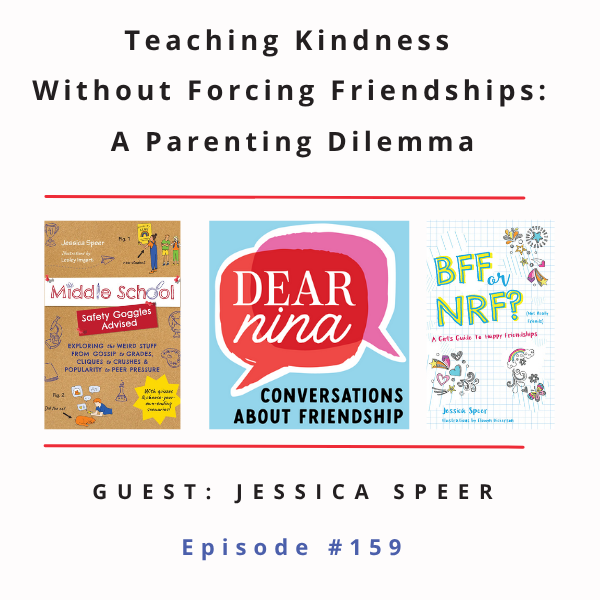
Thank goodness I don’t have to do it alone. Joining me on that discussion was Jessica Spear, who is an award-winning author of Books for Kids and tweens, including one called The Phone Book. Stay safe, be smart, and make the world better with the powerful device in your hand.
Her other book that really was the focus of this episode was BFF or NRF, not Really Friends, A Girl’s Guide to Happy Friendships. And by the way, this applies to boys too. I made a big deal about that in my live event last week, all of this applies to boys too.
This idea that this is just for girls and only girls or only women have issues with how we treat people, how we are treated. That’s just not true. It’s across the board and her newest book is called Middle School Safety Goggles, advised, and she’s working on a follow up to BFF or NRF right now for slightly older kids.
Jessica has a master’s degree in social sciences and has a knack for writing about complex topics in a way that really connects [00:09:00] with kids and teens. She is wonderful and I’m so appreciative that she was one of my very early guests, episode 10. I mean, if this is 1 59, episode 10 was a long, long time ago. I hope you get as much out of this conversation with Jessica Spear as I did. Here she is.
Welcome, Jessica.
Jessica: Thanks so much for having me Nina I’m so excited to be here with you.
Nina: to let listeners know who might not have seen the book BFF or NRF, not really friends, really gets into the nitty gritty of friendship skills. that’s my takeaway. I mean, you might describe it differently, but I’m gonna tell you as someone who thinks a lot about friendship you explain things that might seem like they should be obvious. not only are they not obvious, they’re not even obvious to a lot of adults. I’m gonna give a couple examples.
How to listen. To think before they speak, handle feelings of jealousy, allowing friends to be with other friends, how to be reliable, how to give a sincere apology, how to navigate conflict. [00:10:00] these are all parts of your book that when you hear, they’re like, yeah, of course if you’re a good friend, you’re gonna be reliable. You’re gonna know how to apologize. You’re gonna think before you talk. How many adults follow that? Yeah,
Jessica: you’re so right. I mean, we’re not really, taught this in any regimented way, part of the inspiration for the book is we kind of learn this on the fly and sometimes we learn it in a way that isn’t helpful or isn’t, actually pointing us in the right direction.
Nina: I’m gonna get right to the letter and read it for us, and then we will dissect it. Dear Nina, I want my 11-year-old daughter to make her own decisions about her friendships, but I also want her to be kind and inclusive. There are a few girls her age who have reached out to her with texts for hangouts, but my daughter isn’t interested.
Her reasons when I push her on it vary from, I don’t like her to, she’s annoying to, Ugh, mom. It’s clear that she and four other girls are a clique and have little interest in including anyone else. How do I balance encouraging my kids’ independent decisions with my even bigger [00:11:00] desire to demand kindness out of her?
I have an older son. Who was often left out when he was that age, so I know what it’s like to see your kid not included. I don’t want my daughter to be the cause of hurt feelings, but now that I’m on this side of things, I see it’s really more complicated than I thought I used to say when my son was going through this stuff.
Oh, I’d never let my kid act that way. we can only control so much, I guess. I’d love any thoughts. Thanks Nicole. Jessica, I’m gonna push it to you first, just your reaction as somebody who has spent a lot of time with girls this age.
Jessica: And I love this question ’cause I see this all the time, and not just in the pre-teen years, I mean even, through adult life.
So how do we handle a situation where we really don’t wanna, have a friendship with somebody? How do we treat that person, with dignity and kindness? So this is really tricky. So I love this. So one thing that I think is helpful is to help kids and preteens and teens understand that [00:12:00] there are some shared spaces that we have as humans and in these shared spaces
It’s really important to treat people with dignity, to be accepting, to be kind. So let’s take the school lunchroom, for example. And so there’s a lot of things going on in the school lunchroom. We all have those wonderful and those not so great memories of middle school, elementary school lunchroom.
So ideally in the perfect world, which we’re not in, but in the perfect world, everybody would feel safe and comfortable in that space. so a lot of schools do a lot of work to try to create that. However, it lands differently with different kids. It lands differently from grade to grade.
But I think as parents, we can help our kids understand there are places where this is a shared space and it’s really important to make sure everyone feels comfortable there. You know, that might be the Boy Scout troop, that might be the team. So when we’re in these shared spaces with groups, how can we behave in a way that doesn’t make people feel less than or not worthy. [00:13:00] So allowing them to sit at our table, allowing them to connect with the group. But I do feel on the flip side of that coin, it’s also really important, especially as girls enter the pre-teen in the teen years, that they get to choose where they really wanna develop closeness with people.
So in starting in the preteens. Girls and boys are looking for something more in friendship. You know, they’re looking for a little more intimacy. they’re pulling away from their families. They wanna share about themselves, maybe things they don’t feel comfortable sharing with everybody. it is important, especially for girls to be able to choose who they’re doing that with.
When I fast forward to future romantic relationships, we wouldn’t want girls to stay in relationships because they feel bad, because they, yeah, that’s a good one. Because they’re hurting that person. they don’t wanna hurt that person’s feeling. So there is the balance. How do we treat people with respect in these shared spaces and dignity, and make them feel welcome, but also how do we choose where we’re putting our energy and our [00:14:00] friendships, where do we wanna spend our personal time with people?
Nina: I love all of that. This point about shared spaces versus maybe something different like a sleepover is more of a private, you don’t have to have everybody at your sleepover, but you can still be decent to people at school.
I sometimes think people are scared to be too nice in a shared space ’cause they’re afraid that they’re giving someone the wrong idea, like leading a friend on, kind of. But that takes some maturity to realize you can be pleasant and friendly and stay happy birthday to someone at school and, invite them to do stuff in a something in school.
It doesn’t mean that you’re obligated to have them at your birthday party from now until the end of time. Right. But it is tricky and you do sometimes get these parents that do push. I wondered when I read the question if part of Nicole’s concern, and I get it and I share it, I’ve shared Nicole’s concern if this is it. Is as much about her not wanting other parents to think she’s being a bad mom or a bad community member or a bad person by allowing her daughter to not invite someone [00:15:00] over.
So Nicole’s daughter has these couple of girls who have reached out for plans. doesn’t Nicole’s daughter have the right to not be interested? I think we agree she does. but I get Nicole’s discomfort with knowing that there’s probably some other mom out there saying, Hey, did you reach out to so and so?
And that kid’s saying, yeah, but she didn’t respond or she said she’s busy. Oh. Did you ask her if she’s busy next weekend? Oh yeah. She said she’s busy every weekend. Do you think there is a piece of that, of the mom pressure of worrying that the other moms are thinking what a bad mom she is.
Jessica: absolutely. Absolutely. ’cause we, do sometimes make these judgment calls without quite understanding the whole story. there’s a lot of pressure. I see it all the time. Memes and posts be the parent that encourag your kid to sit with the, kid that’s, and I love, I love that, I love the, the love behind those things.
But I also see that there’s a lot more complexity there. I even personally have had this [00:16:00] backfire on me. one of my daughters, my oldest daughter, who is a really empathic girl, and she really wants to do good. she came out of the womb wanting to do no harm. So this is a gentle soul.
And so one of her birthdays, this is pre COVID, they’re trying to have that accepting lunchroom table where anybody could sit there. what happened was that ended up being a massive table. There’s like 16 kids now because they were so accepting and so welcoming, which is beautiful. But then comes the birthday party and she does not know what to do.
She’s like, I like have actual anxiety listening to it. I don’t invite everybody what happened. So, we, and I, I’m, I’m at a loss. Too, you know, ’cause I’m, I’m also like, I, I don’t know what to do either. I really want you to do what you feel is right. And so what she chose to do was invite a lot more people than she would have.
that gets hard. As it turns out, we have the party and there’s some girls within that group that don’t really like each other that much. So the more kids you have, the more chances there are for drama. So I would love to say [00:17:00] that that was a drama free party. But no, there was drama in that party.
So had she really tried not to please everybody and not hurt anybody feeling she might’ve invited just four girls over a much more peaceful party and instead of 10 or more, and then there was conflict ensu. There is no easy way to navigate this.
Nina: No, there just isn’t. I actually got a comment that relates to what you’re saying from my Facebook group. I have a private Facebook group called Dear Nina, the group, and sometimes I’ll preview the questions on there just so that people in my group can comment if they want to it’s been a fun way to get other opinions . It says, my daughter 17 years old, know someone who’s very nice but is essentially socially awkward and has some major emotional issues that come out often. They’re both on a team where my daughter was the captain her senior year.
The mother is very nice and rightfully is a strong advocate for her daughter’s social life. She encouraged social interaction between our daughters when oftentimes [00:18:00] my daughter was reluctant and did so. begrudgingly. For example, her mother called me and put me on the spot to include her daughter in my daughter’s group of friends’ last day of school activity.
So we’re talking seniors in high school. So it’s a little beyond the age of your book, but still, you could see how some of these actions never really end. so she forced the daughter to do something with her daughter on the last day of school. It worked out because my daughter is very good natured and I told her that while they don’t have to be best friends, she should be kind.
I’m just wondering at what point, so your daughter, in the case of the birthday party, this commenter’s daughter, in the case of the last day of school activity, were both really empathetic and kind gentle souls, I still also wanna advocate for it would be okay for this senior in high school, it would be okay for your daughter to not want to have every single person at their birthday party or not wanna have every single person at the last day of school.
Well, maybe a last day of school activity is a more of a shared space example, but not if it was a private thing. It sounds like this was not a [00:19:00] actual school activity, it was a, at home private thing. I don’t know if we do people a disservice by always including them when they’re not really wanted.
Do we keep them from actually meeting their friends. I wanna speak to the couple of girls in our original question who are trying to get in with this click of four. I wish I could take them aside and be like, girls, these aren’t your people and you are barking up the wrong tree by trying to continue to have plans with someone who’s not even responding on text.
Yeah, maybe their mom’s gonna make ’em respond, but is that a real friend?
Jessica: I mean, ideally everybody has a friend that really wants to be their friend. So I think the earlier that parents can start talking to their kids about not everybody’s gonna like you, you’re not always gonna be included. And not every friendship is gonna feel like a fit, But you are perfectly okay as you are, but keeping those things in mind is really important. ’cause I, I do think we put a lot of expectations on other people’s kids and it often [00:20:00] happens to be, those much more, you know, gentle souls, lower key, highly sensitive kids that get to a point where they, just can’t take anymore on their shoulders.
I know my daughter felt that way, in fact, for her COVID. Was kind of a blessing. For her that was such a relief to have a break from that. And when things were safe, but we were still not fully back in school. She got to hang out with just the people she wanted to, kind of guilt free.
So I, I think that’s a really great science example of what happens if there’s not all this pressure on kids that they can maybe just really pursue the relationships they want to pursue. But again, that’s a balance. I think there are kids that are not giving kids a chance that really deserve a chance, though it might start in that safe space that, that that shared space, giving kids a chance and you never know, there will be friendships that grow out of that into deeper levels.
Nina: it is so tricky and it’s like each situation is different. I like what you said about the pressure that we parents put on other people’s [00:21:00] kids to like, make our kids feel okay. I have four kids. I, I’ve seen a lot of things and. Gosh, it would be easier if, my kids are, you know, were always included on the group text, we’re always included in the outing. It just would make life easier. But they wouldn’t learn anything. They wouldn’t learn those resiliency skills. They wouldn’t know the difference.
I think between like what you described really well in the book as a healthy friendship and accepting friendship or friendship that feels good versus something that’s not, you know, if you’re trying too hard. I mean, there some that says something. Yes. What would we say to Nicole so her kid has, now it sounds to me like ignored these uh, these couple of girls are trying to like, get in on the group or at least to make plans with her daughter.
Her daughter’s basically not answering the text. how should her daughter handle these texts?
Jessica: And this is never easy. Kids will, will ask you. Say she just does a No thanks, no thank you on the text. Respond. There’s a good chance at that other kid is gonna ask why. In adult world, [00:22:00] we know that, no is no, and you could say no thanks and let’s move on. in the preteen and the kid world, you could say, no thanks as kindly as you can. But there’s a chance that that other kid is gonna be like, well, why not?
Could see why her daughter might be a little hesitant to go there. however, I think it’s a great skill to learn, no thanks is no thanks. I think that’s worth the first try. If she really doesn’t really, truly does not want to, you know, enter this relationship, saying no thank you, is a good place to start. But even that isn’t simple.
Nina: Sometimes so hard. I would probably soften it with it. It, maybe it’s a white lie, but it’s, I I’m so busy right now. I just, I can’t make any plans right now. I mean, just, and so it’s not like a hard no. Yes, but it’s maybe just. A not right now. Oh, I just can’t, book anything right now or my, you know, or I’ll ask my mom and then maybe mom says we’re so busy right now.
It’s easier if it’s kid to kids. It’s a little harder when the mom gets involved. You know, I’ve made that mistake before. Somebody did me a huge favor. And sometimes you don’t know. I’m better about it with my younger [00:23:00] kids, but with my, one of my kids, I was still the one reaching out for plans.
Like, I didn’t know it was time yet. sometimes you need someone to. To tell you, I reached out to a fellow mom, oh, is so and so free Saturday night? My kid wants to hang out with your kid. the mom said to me really nicely, I, I would advise as anyone, I will have my kid reach out to your kid.
Sounds great. I’ll have my kid reach out to your kid. Her kid never reached out to my kid. I didn’t tell my kid that. I, I think, I don’t even think I told my kid this conversation ensued, but when her kid didn’t reach out to my kid, that was cue to me. This kid is not interested in my kid. It was the most gentle.
It worked out nicely ’cause my kid didn’t even know about it. But I was able to not continue to encourage my kid, oh, hey, you should reach out to, this one. see if this kid’s free. Because I had gotten the cue from the mom. Number one, we’re not making plans for our kids anymore. It’s time for the kids to do this themselves.
Number two, if my kid’s interested, your kid will hear from mine and we didn’t hear from them, that was okay. Point taken. They’re not interested. you can’t force a friendship.
Jessica: [00:24:00] No. And there is that funny period of time where it goes from parents coordinating things to the kids, and that doesn’t happen like at the same time for everybody. So I loved how you handled that. Just kind of realizing, oh, okay, we’re there. ’cause you don’t know sometimes whether you’re there or not.
And you’re there with. Some kids and you’re not there with other kids. But yet at some point there is that shift where it’s the kids communicating directly with the kids, um, which is a relief to so many parents in so many ways. It’s usually when they say, and I love that you, I love the idea of softening that you said.
So there is a way to soften that. And my kids often when they’re stuck with what to say, in a text, you know, we will kind of, we’ll, we’ll talk that through together. And I encourage, you know, my kids and other parents to encourage their kids if they don’t ever quite know how to respond. That’s a great teaching moment.
Let’s connect about how to maybe respond to that. And you know, text has many downsides, but one of the good sides is it gives you a chance to think about your response where all this used to happen, like live face-to-face. It doesn’t as much anymore, but we have a moment before we [00:25:00] respond to think about, what can we say and how might that come across to the person getting this message.
Nina: And another huge thing that text brings to the social plan making is who’s included on the group text and who isn’t? Oh, yes. Being put on the group text is like a gateway to plans. And if you’re not on the group text, whether it’s a group on Snap, as the kids get older, I, I’ve learned, at least with my kids, I know it’s different for in every community, but the kids, they barely text, like regular text.
They have snap groups, and if you’re in the SNAP group, well then you know what the plan is for sunday afternoon, if you’re not in the text or the SNAP group, you don’t know what the plan, no one’s asking each other directly per se. If you’re on it, you know about it. And if you’re not, you don’t. And it’s, oh gosh. So getting on that group text might be a key that a lot of parents don’t even realize is happening.
Jessica: Oh, and it’s stressful. Like if you, you really wanna be included, but you’re not, I mean, this, is all, much more intense than it was when we were growing up. And it was, it was simplified and face-to-face and we didn’t know about the things we weren’t invited to. [00:26:00] So I, I feel a lot of empathy for kids today. ’cause this is so tricky. They’re bombarded with this, 24 7, there’s a handful of kids that make two or three good friends in elementary, and that lasts all the way through middle school.
But the majority, there’s huge changes all the time. Just a constantly in a state of flux. I mean, there is this awesome study that came outta UCLA. They followed 6006th graders through, in middle school Two thirds of ’em in their first year of middle school and kind of jumped friend groups and changed friendships.
So the, instability is the norm and as parents are watching this, it breaks our hearts sometimes. ’cause we’ll see those times where our kids is kind of floundering in between groups and spaces and, they’re finding their way. And that’s exactly what they’re doing is that they’re trying to find their way, they’re trying to learn these skills that we started on.
You know, the beginning of this call, they’re trying to figure out, wait, who am I? And, and where do I actually feel like I fit, how do I connect? And, and it’s not [00:27:00] easy, you know? And, and there’s lots of ups and downs in that process.
Nina: We’ve spent a lot of actually this call thinking about the kids who might be leaving others out and all that, but How do you learn to recognize true friendship if you haven’t gone through that experience? We as parents cannot save our kids from every hurt feeling, from every birthday party they were invited to. I have learned that the hard way. I’m saying that with a smile on my face because I’ve had some couple ugly experiences where I got too involved.
I literally shudder an embarrassment thinking about it because I would never do that now. I mean, I’ve been a parent for a long time. I’ve made some mistakes. those mistakes probably robbed my kids of, and they learned it eventually once I realized I’ve overstepped. But there is such a thing.
And your book, it’s like, I wish every kid would read this book I know you used, she a lot in the book just to make it easier to write. But you point out in the book, it’s really for all kids to learn skills they might otherwise skip if their parents don’t let them experience it.
Jessica: Right. And I’ve done too Nina.
I’ve totally [00:28:00] overstepped sometimes and assumed I knew the whole story. And there’s always more to the story, you know? So when we see something that we feel is a slight on our kid or something, there’s always more going on there, So I think it’s important. Realize there’s two sides to everything and things are always more complex than they first appear.
It’s just buckle up. Let’s sail through these years together and keep loving your kids. Keep helping them if they’re lacking in a certain area, you, Say they haven’t learned the simple thing of space bubbles, you know, that someone needs a little bit of space or say, yeah, they struggle with jealousy or they, they’re not very trustworthy.
They tell a lot of lies. So all these little things, at some point, you have leak into their friendships and, and cause all sorts of interesting things to go on. So, so we can just help ’em learn that they’re kids, they’re preteens, they’re learning these things and even those most painful things, even you and I overstepping our role as parents.
We clearly learn from that. We learned some great lessons from that, and we’re gonna do it differently next [00:29:00] time.
Nina: And you know, I think Nicole, our letter writer, can hopefully feel better knowing that her daughter making her own choices and sometimes not, maybe doing it as nicely as she should is something she will also, she the daughter will also have to learn from.
If you leave out enough people over time, if you are too cliquey over time the universe answers and people not wanting to hang out with you. So sometimes you learn the hard way and the parents can’t always direct that either. Like she asks how, can I really demand my daughter be inclusive of and kind?
I mean, I think you can try as best you can, but can’t really control how your kids act all the time. Jessica mentions nine Friendship truths, I picked my favorite and it’s friendship truth number nine and it’s, you choose which of your friendships to grow. Grow the healthy ones. I think that is so beautiful. It’s what I would say to these two girls who are texting Nicole’s daughter, if I could talk to them, right, I would say pay attention to the people who wanna hang out with you, grow the healthy ones. You choose which of your [00:30:00] friendships to grow. Grow the healthy ones.
Jessica: Yes, absolutely.
Nina: That is all for today. I wanna thank you, Jessica, so much for being here.
Jessica: Thank you so much for having me. This is such a great conversation. I love this question and I love all the work you’re doing. I mean, this, friendship stuff is tricky, you know, and we’re all learning as we go. So thank you for all your work
Nina: you could find a form to ask your own anonymous question for a future episode on nina I’d love for you to join my Facebook group. Dear Nina, the group, if you have time to rate and review the podcast or even better tell a friend, I’d be so grateful. Remember, when our friendships are going well, we’re happier.
All [00:31:00] around.