Nina: [00:00:00] welcome to Dear Nina, conversations about friendship. I am your host, Nina Badin. I’ve been writing about friendship for over a decade, podcasting about it for over four years. You have reached. Episode 1 67, which is the October Friendship Challenge, and as usual, it doesn’t matter if it’s October when you’re listening to this, because this challenge, especially this October challenge, is really great for the entire year.
If you happen to be listening to this in March of 2026, welcome, happy to have you, and you can still do this challenge because it is going to help your friendships forever. It will help it in the month that you’re doing it and forever more if you keep it in mind.
It is time for the October Friendship Challenge. We only have three left, this one, November and December. I’m not going to do the challenges in 2026 just ’cause it’s nice to mix it up by the end of 2025. I will have done [00:01:00] 12 friendship challenges.
I think each one is worth revisiting. Before you even think about October’s challenge and throughout next year, who knows? Maybe you will find reason to dip into one of those challenges again, if you found that one helped you and got a little kickstart for some of the friendship issues you might be working on.
Really quickly, I’m going to review what those other challenges were. In January. We had to see a friend in person that month in February, we had to, uh. Put the plans in place. It didn’t have to take place in February the plan, but the putting the plan in place to start some sort of friendship, ritual, or tradition with a friend. March was a hyper-local friendship challenge to do something with somebody in your neighborhood not necessarily right in your neighborhood, but really close by hyper-local, as close as possible. And that’s ’cause proximity is such an important part of friendship.
April was to acknowledge friends birthdays, and I had brought up in that [00:02:00] episode, I still need to do an episode on it, that we really all have a lot of complicated feelings about birthdays, do we? Feel our birthdays are celebrated as much as others, all the different kinds of birthday things. Who to invite when you’re not invited?
It goes on and on. but the simple challenge for April was to remember your friend’s birthdays, and I talked about how a lot of people are using social media less now, which is really wonderful. But we did rely on social media for birthdays. So if you don’t put those in your calendar, you’re going to forget your friend’s birthdays, most likely May, was to switch the setting of where you.
Hang out with friends. I called it change the venue. So if you have a friend who you always walk with, it would be interesting to just switch it up sometime, have a meal. The June challenge was a hard one. It was to ask a friend for a favor. July was really just more of a reflection to think about where your friendships are at that midpoint, a little over midpoint of the year, and that was more of a personal challenge to take the time to answer three questions.
[00:03:00] I asked three very specific questions about your friendships. August was about older and younger friends, and if all of your friends are exactly the same age as you to really think about what you might be missing if you don’t have a friend who is older or younger or really ideally some of each.
I do have some of each, and I think it has been a huge benefit to my adult life. last month’s challenge was to stop listening to your bully brain. I had guest Leslie Randolph, and we talked about self-confidence, and it was not only about friendships, of course, it was about listening to yourself, the way you would listen to your nicest friend or your most encouraging friend as opposed to the most critical one.
All of those are worth thinking about, and if you haven’t heard them, I also have them in my newsletter, which is@dearnina.substack.com. The link will be in the show notes, and I have just a couple paragraphs about each challenge. There’s a new post for every month. I have a [00:04:00] menu tab up on there that is just for the Friendship challenge.
There are nine of them now, there’ll be 10 by the time I get the October one up. , So onto October. I think I blew through those other nine pretty quickly, if I may say so myself.
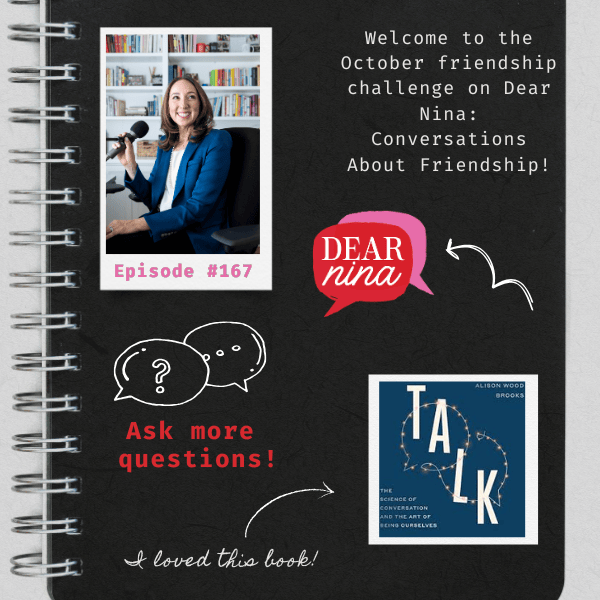
October’s challenge is inspired by a book I read and loved earlier in 2025. I read it in January actually. It’s called Talk The Science of Conversation and The Art of Being Ourselves by Allison Wood Brook.
She is an associate professor at Harvard Business School and she and a team have done tons of research on talking on what makes conversations Go well. Again, the, title of the book is Talk The Science of Conversation and The Art of Being Ourselves.
It’s very clever. The T and the A and the L and the K all stand for something different that helps you with conversation. We are gonna focus on the A of the talk, which is asking questions, and that is our challenge to [00:05:00] ask our friends more questions.
One of my most viral tiktoks, and I think it did well on Instagram too, but things just tend to take off on TikTok in a different way. And my accounts are the same on those. It’s at Dear Nina friendship. And it was about the friend who never asks about you.
I was just kinda reflecting on what it’s like to spend time with somebody and they never ask you a question. They only talk about themselves. They don’t really ask about you. That’s one piece of this talk issue. We all know what it feels like if you don’t, then that’s fantastic that you have never felt that way.
But it’s frustrating when you feel like you’re in a conversation with someone and they don’t ask you questions. Well, if that has frustrated you, then you really have to be careful that when you are spending time with other people that you are asking questions. One of the most fascinating parts about that research is they found that most people do not ask even close to as many questions as they think they’re asking.
So the recorded [00:06:00] conversations people were having and then asked people to reflect on how many questions they had asked, I don’t remember all the percentages. Like I said, I read the book in January, but it was a notable enough number that generally, people asked way fewer questions than they thought. They probably asked some, but not even close to what they thought. Meaning they were doing maybe more of the talking, or they were making comments on things, which is also part of a conversation.
You wanna make observations, but they weren’t necessarily asking questions. that’s number one part of the challenge is to ask more questions even more than you think. Even if you think you’re being annoying and pushing and like you’re conducting an interview. People like to be asked questions. A lot of people leave conversations without asking any questions at all. So just the step one would be to ask questions and ask more questions than you think you are asking, or ask more questions than you think you should ask, I guess is a better way of saying it.
And then next would be to prioritize follow-up questions. That’s another way it’s a trick to [00:07:00] ask more questions, is to just stay on the same topic. Don’t necessarily jump from topic to topic to topic. Just ask more follow-up questions to what you’re already discussing so that you could go deeper. That is a really nice solution to feeling like conversations are really surface.
I hear from people a lot about that, that they do have friends, they do have people to do stuff with, but they don’t feel like it gets below the surface. Well, asking good questions and then even better follow-up questions is the trick to getting below the surface. Another tip from Allison is that open-ended questions are key, so that would mean what questions over why questions, and that’s really more for the other person’s comfort. So if you don’t wanna feel like you’re interrogating somebody sticking more with the what category as opposed to the why they’re doing something they’re doing may be less invasive. But if again, like you’re trying to get below the surface and you’ve gotten to know the person better, maybe in a future conversation bringing in more of those [00:08:00] whys would help feel deeper and closer.
And then of course there is the most important piece, which is to listen. That really would be a different episode on just listening, but I hope the implied thing here is you should not even bother asking good questions or follow up questions. What questions at first and eventually why questions if you’re not going to listen. And that is how you ask good follow up questions, is by listening, really listening for what is being said. Listening for what is not quite being said.
But maybe if you were to ask one or two more good follow up questions would be said and and would be welcomed by your conversation partner. I know when I am in a conversation with somebody, there are things I would say if the person would ask, but I also don’t wanna bore them.
a good example would be if somebody asks about the podcast, it’s just a good example to use because right now you are listening to a podcast. If somebody is interested in the topics themselves, like the friendship [00:09:00] pieces. I’ll know that by the questions they’re asking. Sometimes people ask me about the podcast ’cause they themselves are interested in starting a podcast.
And then that is a different kind of conversation, which I’m also happy to have. But I would answer very differently if we’re talking just about friendship, friendship topics, authors that I’m having on, they, they’re interested in the books I’ve read about friendship. Okay. One area. The other area is microphones and headphones and how long it takes to edit.
Those are two different, you know, forks in the road on a podcast conversation. I only know what the person might be interested in by the types of questions they’re asking, so it really is important to be clear on what you’re asking. And sometimes you’re just asking to be nice to show interest, and that’s great.
That is a good enough reason to ask questions. You don’t actually. Have to be asking for information that’s going to help you in some way. You’re really just trying to get to know the other person, which is wonderful as well.
, One other tip from Professor Brooks, it really starts before this whole business of asking [00:10:00] questions, and that is thinking ahead of time about the conversation you would like to have with somebody and a couple questions you could have before you go.
My husband and I do this often when we are on the way out with another couple. It’s not that we’re coming up with questions per se, which we should I think I’m going to do that for October along with everybody else. And by the way, I always do the challenges with everyone. That’s what I’m gonna think of the challenge, is to think about questions that we could ask other people.
What we do often do is come up with conversation points, like things we would like to discuss. They aren’t necessarily in the form of questions. I guess I’m already one step there. But the next step would be to think of it as a question, but that’s just a great friendship tip in general.
We prepare for a lot of things in life we’re better off for it. Conversations with friends can be that way too. Of course, it doesn’t have to be so formal, but it isn’t a bad idea to spend a minute or two on your way to spend time with a friend, or even if you’re about to get on a phone call with somebody, to think about what are two or three questions I can ask my friends [00:11:00] so that they know I’m interested in their lives? That is reason enough to ask the question even if you aren’t that curious on the answer. Although, I guess being curious is another piece of this challenge.
I challenge you to be more curious about what is going on in your friend’s lives. That will help make the asking of the questions much more natural because then you will be interested. When you are interested. You are interesting. We tell our kids that all the time, be interested in other people and then you will be interesting to other people. It’s a wonderful way to connect. So this is a seemingly simple challenge for October. I think you could accomplish it. And check the box in one hangout with a friend, one phone call. And if you wanna try it more than once this month, you and your friendships will be better off for it.
As usual, this challenge does not need to be done in October. I am going to leave it here for the month. I hope you engage in this one. I hope you use it other times during the year. And since this is a short episode, it gives [00:12:00] me a moment to harken back to the June one, which was to ask a friend a favor.
I’m going to ask you a favor, which is to leave a review. If you haven’t, that would be on Apple or Spotify. also, if you are a YouTube user to follow, to subscribe on YouTube.
And finally, really the most important favor, the one that makes the biggest difference is to share an episode with a friend. If you have a friend who could benefit from any of these episodes, if you have a friend who maybe you feel doesn’t ask you questions, you can send them this one. Although I suppose that’s a little passive aggressive, so I wouldn’t do that, necessarily.
Find a different one, and then maybe they’ll stumble on this one on their own. That would be the better way to do it. Thank you for considering any of those ways to help out the show. I am passionate about my mission to discuss friendships in a way that is real and easy to digest and helps others.
It helps me, hope it helps you. I look forward to next week. We do have some other [00:13:00] episodes that focus on these conversations skills, , you will hear at least one more on that topic and we will go more into it later in the month, come back next week when our friendships are going well
we are happier all around. Bye.