Marjorie: [00:00:00] a good thing about getting older is knowing yourself better and being more willing to take the risk for people you love. Because as you get older, you start losing the people you love. And saying, Hey, you matter to me. I want to apologize to you. I want you to apologize to me can do incredible work in, helping us move forward.
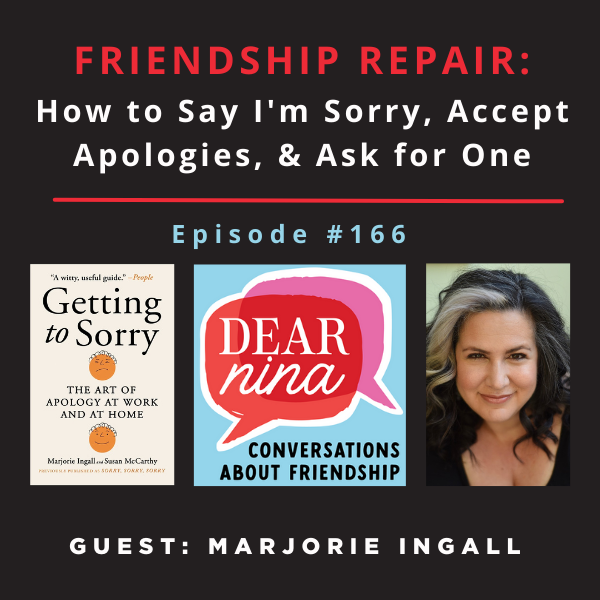
Nina: Welcome to Dear Nina, conversations about friendship. I am your host, Nina Badzin. I have been writing about friendship for over 10 years, podcasting about it for over four. You are listening to episode 1 66, and it is placed here for a very specific reason, although I want to mention that I know people listen to episodes at any time, maybe you just discovered the podcast . I know that there’s plenty of people who start from the very beginning, which I admire because that’s a lot of episodes or people who start at the beginning but also listen to the current one, so they’re listening to a few of my episodes are usually only around 30 minutes, that’s very doable. You could start with the most recent one so that you’re up to date, but [00:01:00] then also go backwards towards the beginning and each episode is different. Occasionally. I do an encore episode and you can note that it always says Encore and then decide to keep going, although I always redo the intro with something more current about what I’m thinking about at that moment.
So back to the timing of this episode about apologies, how to give an apology, and how to accept an apology. They are equally important parts of friendship.
If you are listening to it on the day or week that it came out, it is between the Jewish holidays of Rosh Hashanah and Yom Kippur, and I don’t wanna, go on too long about that at all. I’m gonna put a couple links in the show notes that explains this very important time in the Jewish calendar, especially the 10 days between Rosh Hashanah and Yom Kippur that is a very important ripe time in the Jewish year for issuing apologies and accepting apologies, really both. But the part that’s in your control at first is to issue an apology, although I guess it’s also in your control to accept one if an apology comes your way.
We also talk in this episode [00:02:00] about an apology that does not come your way, When you’re waiting for an apology, which I also wrote about extensively over a decade ago when I was doing a lot more writing for Jewish publications, it’s still one of the favorite things I’ve ever written. It still exists on the internet.
There’s plenty of essays and articles I’ve written for websites that are long gone. But this one is still there. That was for Kveller, I will have that in the show notes. In that piece I was thinking about, you know, there’s some people who owe me an apology and what do you do about that? And my guest today, and I speak about that as well, this idea of how to apologize, how to receive an apology, and how to solicit an apology when you feel your owed one. All really, Difficult, but full of opportunity, friendship issues.
My guest is the wonderful Marjorie Ingall, who I’ve admired for a long time. I invited her on the show because I wanted to talk to her. She, along with her co-author, Susan McCarthy, wrote, Sorry, Sorry, sorry: the case for good apologies. And then it was released as a paperback more recently [00:03:00] with a different title, and that title is Getting to Sorry. They are also the co-creator of a website called sorry watch.com. Marjorie is also the author of a book called Mamaleh Knows Best, what Jewish Mothers Do to Raise successful, creative, empathetic Independent Children. She often writes about children’s books for the New York Times Book Review. We talk about one of her favorite ones here and she’s written for many other magazines and newspapers, and that’s how I know about her.
I’ve read her work for a long time. She’s written for Tablet and the Forward. She’s a columnist for both. She’s written for Town and Country glamor self, Ms. L, New York, Time, and Newsweek,. And back in the day, this is amazing, she was the senior writer and books editor of the Late Great Sassy Magazine.
If you are my age , my age is late forties, you lived by Sassy Magazine? I can’t speak for everyone, but I should say I can speak for myself. I loved Sassy Magazine. Just saying, sassy fills me with nostalgia. I’ll have all the ways you could find Marjorie in the show notes, including her book with Susan. Let’s [00:04:00] get to it. Let’s learn how to apologize. There are six steps that Marjorie’s gonna tell us and how to accept an apology and how to solicit one.
hi Marjorie, welcome to Dear Nina.
Marjorie: Hi, Nina. I’m so glad to be here
Nina: i’ve heard you on various shows. I’ve just always been a fan. You’re a very reasonable, a straightforward thinker. I admire your work
Marjorie: Well, thank you. And I would like to say that your Midwestern accent makes me feel right at home as somebody who married into a family from Milwaukee. So I just feel very comfortable right away.
Nina: I love that. Yeah, you’re out there on the East coast. It’s so interesting ’cause I don’t hear my accent, but people do comment on it and it’s
Marjorie: And I, I feel like my Rhode Island only comes out when I’ve had a couple of drinks.
Nina: Oh, funny. So before we get into how to help listeners apologize Well and receive apologies Well, which are two different skills, actually. We’re gonna have to slice those up. How did you get into this beat? Uh, the, that’s what I tell people. When people ask me how I get into friendship. I’m like, I’m a writer.
I’m not a therapist. [00:05:00] I never pretend I’m a therapist. I quickly tell people when I’m a guest elsewhere. I’m not a therapist. I’m a writer who ended up on a friendship beat over 10 years ago. How did you end up on the apology beat?
Marjorie: Well, let me just quickly respond to what you said. And I think that writers actually make really good, people talking about specific topics because we read so much research and we’re able to see it without bias. ’cause that’s what we’ve been trained to do and we’re really good at synthesizing. so for me, the apology stuff came both because as you, mentioned, we both come from, a Jewish background. Every year, the Art of Apology and thinking about how to apologize well is a thing that is on our radar at the high holidays. when I was writing for the Jewish Press, I was writing about it. I thought about it myself every year and when I had a child, I know everyone says their kid was feral, but my kid was really feral and spent like pretty much all of pre-K in the consequences chair.
so teaching this incredibly fierce little [00:06:00] person how to understand how other people feel and how to reign in your worst self, is really closely tied to apology. And when you think about how to teach kids about something that actually makes you think hard about what are the real steps behind it.
Nina: Oh, that makes a lot of sense. I think I have a very grown up and nuanced concept of apologies, and yet my husband accuses me of being a terrible apologizer. I know it’s really a problem. He is a good apologizer. he does apologize quickly. But I actually sometimes feel it as too quickly.
Marjorie: You are probably correct because there is research on. The timing of apologies. sometimes when people rush to apologize, they’re not processing what they did and they aren’t giving you time to process what they did. there is a researcher at Oberlin named Cynthia Franz, who studies the timing of apologies.
She has [00:07:00] found people need the time to process. You would need time to say, here’s why it upset me. And he needs time to say, oh, I think I understand why it upset her. and when you apologize too quickly, the term we often use is spiritual bypassing.
When you are rushing to get to the resolution without going through the stages of the bad feelings, you’re not really addressing the underlying issue when you’re doing that, bypassing
Nina: Yeah, that’s what I’m feeling. It’s almost like a needle in the balloon. It’s like, it’s not like I wanna walk around angry for a long period of time, but maybe just a little bit, gimme like a little bit of time with my like puffed up and then like he comes along with the little needle to be like, I’m sorry. And he means it. He says it genuinely, but it does feel fast.
Marjorie: I think ultimately at its core being a good apologizer is about both listening and about thinking about what the other person wants as opposed to what you want. and those can be really challenging.
Nina: Oh, that’s a good point. And we’ll mostly focus on friendship here. I just had to bring that up about Brian and he listens to every episode, [00:08:00] so he’ll hear this and he may take it up with you personally.
Marjorie: Uh, hi Brian.
Nina: okay, so let’s get to what do that, we just answered one of ’em, but I was gonna ask you what people generally get wrong about apologies, and that was one, I guess that could be too quick a bypassing, like you said, I like the, the spiritual,
Marjorie: spiritual bypassing. it can be really hard to apologize well. And I think we ought to frame good apologies sometimes in our culture we talk about apologizing as something weak and it’s not, it’s something incredibly strong when it’s done well because it is not in our nature. We function by basically seeing ourselves as good people and being able to go through the world thinking of ourselves as the main character. And sometimes when we have done something that warrants an apology, it means we have to see ourselves as the villain in someone else’s story. And that is really hard to do.
being able to put yourself in the position of the other person is not, As I said with my feral child, it’s not something that we do automatically. it’s something that has to be [00:09:00] learned. and our tendency is to immediately reconcile the disconnect between, well, I’m a good person with, oh, I did a bad thing in favor of, I’m a good person, so, oh, it wasn’t that bad.
Oh, they did something too. oh, they’re not even gonna remember it. all of those are factors that get in the way of apologizing well.
Nina: Oh, that makes sense to me. I know I have felt that way myself, where I. Have done something that nothing major, even just a little thing. But I know it probably hurt someone’s feelings. I do, immediately think to myself, oh, but I did so many good things over the years and doesn’t that count for anything?
’cause we talk a lot in relationships. I’ve talked about it on this show about sort of the deposit and the withdrawal concept of a relationship, a friendship, Being on the other side of it, I, I really do try to urge people not to be so easily offended so that you don’t feel like you’re constantly requiring people to apologize to you.
And if you feel like you are constantly owed an apology from lots of people, I do think it might be sort of a negative way of looking at the world, like you’re looking [00:10:00] for people to offend you. but because I have that belief, I think it does make me a little less sensitive sometimes that like, you know, sometimes I do owe an apology even though I’ve done a lot of good things.
Marjorie: We live in a world that has been so speeded up that our reactions to everything tend to be really knee jerk. I think the notion of taking deep breaths and offering other people and yourself a little bit of grace, a little bit of, most of us are just doing the best we can. really goes a long way and when you really are offended as opposed to like, that was a, I can let that slide In the interest of friendship, you can ask, it’s often hard to say, Hey, I felt really hurt by that. Sort of soliciting an apology can be really difficult, but it’s also, can be such a friendship builder.
Nina: It’s a gift. You’re giving somebody the opportunity to explain themselves. Who hasn’t had a time when years later somebody brings something up and you kind of go, why didn’t you ask me at the time? I would’ve told you I hadn’t sleep the night before, or I didn’t hear it correctly. I didn’t It’s the [00:11:00] opposite of a gift.
it’s like you’re punishing your friend for something. I think if you’re gonna let something go, you have to truly let it go. It’s not fair to let it go, as in, let the moment pass and then carry a grudge.
Marjorie: Yes, that is an old thing from the Talmud that we say, don’t keep berating a child, either punish him or forgive him.
Nina: Oh, I love that.
Marjorie: I also, when you were saying about, when somebody tells you that they’ve been holding onto something for so long, my co-author on this book, Susan McCarthy, came up with this really great example of a turn of the century lithuanian psychologist named Bluma Zeigarnik, after whom the Zeigarnik Effect is named. she found from hanging out in those cafes in Europe, drinking things with schlog on them, she discovered that waiters could remember everything a whole table ordered until they paid their check.
The minute the check was paid, they forgot everything. she came up with this theory that completed tasks are less remembered than incomplete ones. [00:12:00] So if something is weighing on you, a few months ago, somebody came to me to apologize for something that happened in college and that I remembered it after he told me that he had been carrying this for I don’t wanna tell you how many years. When you apologize for the thing that has been weighing on you for such a long time, that can help you forget it.
Nina: So interesting. You could move on,
Marjorie: Yeah.
Nina: In this case, you had forgotten it
Marjorie: I had forgotten it, but it was something he did it. He, was really upset. We were freshmen, we were 18. He wanted to borrow my notes for an exam. I said no, because I needed them. He just hectored me and hectored me and Hector me. And I said, fine, take it. And he threw the notebook at me and it, it cut my lip.
Um, it was bad, but I also forgot I mean, 18 as a kid . I knew he was also going through a hard time. I was so eager and quick to forgive him because again, what a gift. This isn’t somebody I talk to a lot. I don’t want him to feel bad about it, and I hope that he has forgotten about it. A [00:13:00] la the NIK effect completed tasks. Easier to forget than incomplete ones.
Nina: It makes sense that, till you get to the point that you can forget about it, it is gonna weigh on you. the apology might be the only way to get to the forgetting part if you, you can’t
Marjorie: even if you’re worried that you won’t be forgiven, you will still be helped by the attempt.
Nina: that’s very powerful. I, I hope people let that in, it isn’t always for the other person. I mean, it, it, it’d be nice that the other person, obviously, if they can be released, if they’ve been carrying that with them too. But either way, you give the apology for yourself to like unburden yourself a little bit. Is there ever a time when it’s too selfish to do the apology that it would hurt the other person too much to bring up the thing.
Marjorie: There are some things that are unforgivable. people’s definitions of what is unforgivable may differ. but let’s go with Harvey Weinstein. Any kind of apology that he would make toward his victims, How can he make up for what he did for that huge, huge betrayal for that huge [00:14:00] power imbalance? if you have done something that you suspect is unforgivable and you really wanna do the work of apologizing, a letter
is the way to do it. do not force the person to come face to face with you. do not make the person hear your voice and you are going to have to live with not being forgiven, which can be really difficult. ’cause sometimes people pursue and pursue and pursue and pursue. at some point you have become the aggressor when you do that. And you gotta let it go and you gotta just sit with the consequences.
Nina: that’s good advice because I was gonna ask you too, um, in terms of the form of an apology ’cause, and we still will, we’ll get to your six steps of apologies, but the form meaning. In person text letter. there is a place for a letter. Actually I did an episode, one of my most popular ones, I’ve done over 160. And I do have a lot of like known authors and people like you, people that are out in the world.
This was with my own friend, just a regular person and yes, exactly. She is a college friend who is still one of my best friends, [00:15:00] but our episode was about the two or three years. We didn’t speak after college and like she wasn’t at my wedding. I basically ended the friendship I was 22.
I had my reasons, but that was a drastic choice I wouldn’t make today. especially all this work I’ve done on friendship now. I mean, I just wouldn’t do that. It’s so over the top, and I did it in kind of a direct, way. by the way, people ask me all the time, I mean, this comes up in many episodes.
What’s the best way to end a friendship? And I’m telling you the answer is there’s no good way. If you kind of just slowly back away and kind of do what seems like a kinder thing, which is over time you don’t text as often, this and that. I’ve had that done to me. And then what that feels like is a mystery.
You kind of feel like you’re going crazy. Wait, are we not as close? It feels so unkind to have somebody just slowly disappear and not be direct. But nobody likes to be directly told either, I don’t think we should be friends anymore. There’s really no good way is the answer.
I’m sorry to say that there’s no good way, but I did the more direct way. I really regretted it. A few years later, I wrote her a very long letter, handwritten long letter, to your point, she [00:16:00] did not respond for a long time over a year. It’s not that what I did was unforgivable. I had my reasons for doing what I did, but it was
still in her court now, she got to decide whether to respond or not. It was really hard to have to sit with, is she going to, is she not going to? And then we were invited to a wedding together. We had a lot of college friends in common. We were in our mid twenties at this point. We were gonna have to see each other and she did forgive me. She basically emailed me or texted me or, so I don’t even know if we were texting at that point. not just us like anyone. If we might’ve been like, punching things into flip phones anyway, I think she was like, looking forward to seeing you at the wedding. Let’s put it behind us.
So she didn’t quite give me the satisfaction at that point though, of what did I want? I wanted to go through each paragraph. Yes. I wanted her to be like, Nope, this is what I thought at this time and I got why you did this, but this is what I would’ve, yes, I wanted to process. years went on and we really did get close again.
And it’s like this episode I’m talking about is where we actually processed we, we kind of put it behind us, but I got a little bit of a chance to process on the episode and that’s why I [00:17:00] think it’s such a powerful one. And sorry to take so much
Marjorie: No, I’ll either find that on the, episode list or you can tell me after we air which one it is.
Nina: Yeah, and I’ll put it, uh, in the show notes for everyone else. It, it is a good example of a slow burn apology and acceptance of an
Marjorie: Yes. when it comes to sort of the day-to-day apologies, I love that you wrote a letter because that didn’t put her on the spot. you know, apologizing to someone who’s really angry, while you’re in a car, you do not want that person bailing out the side. I once had somebody apologize to me in an office while standing with their arms on either side of the door of the office office and I literally ducked under it was a man and they blocked me in and, um, I literally ducked under his arm and went to the women’s bathroom because I did not want to hear it.
but you also don’t wanna make a bigger deal out of something if it wasn’t that huge a thing to the other person. But you feel bad. I always say, if you misgender someone in a conversation, that can [00:18:00] be either a quick oh, I’m so sorry i’ll get it right next time. you don’t wanna turn it around so that the person has to comfort you and, oh my God, I’m so sorry I got that wrong.
I feel terrible. don’t make an apology all about you, and always an apologies about the other person. if it was a, you know, something small, you accidentally took credit in a meeting for somebody else’s work and it was corrected in the meeting. You can just send a text afterwards saying, I am so sorry I did that.
I wanna make sure moving forward that I give you the credit for this work. but, if you really screwed up. And also if it’s a friend, you know, some of us have some older friends, older people, really appreciate the value of a letter. and there is also research on which I think we can extrapolate to apologies, but a research on how much people love. Thank you notes. People really love thank you notes way more than we expect them to, especially receiving a printed out thank you note. And we are just like, Ugh, I can send a text. Or, Ugh, it’ll sound really awkward. Or like, I’m sucking up. no, people love it. So I think that’s true [00:19:00] of written down apologies too, that you’ve really thought about it enough to go find a frigging stamp.
Nina: You know, it’s funny, my mom is the, and she’s been a guest on the show a lot too. People love her. She’s 80, she’s the queen of the letter. She’s used a letter in two ways, I think, to apologize and also to solicit an apology. I like that expression that you use. I, I got that from you to solicit an apology.
She’s done it with me. She was upset with something I did and wrote me a three page single space typed letter, and I was like, yep. And she was right too. Probably could have been like one paragraph and I would’ve been like, you’re right, mom. But
Marjorie: you know, the fact that she whipped out the typing, I mean, she and Brenda found the, made the printer work, made sure there was ink, you know, she meant it.
Nina: She meant it and, I could see how her sending the letter got it off her chest. I was able to. I really understand where she was coming from and yeah, I’m a fan of the letter. It’s a good thing. I bet people are texting way too often, is what I’m guessing, that there’s a lot of text. Apologies going on.
Marjorie: Probably, but there are also a lot of little tiny sins. if the text apology is for [00:20:00] something small, I think it’s totally fine. and again, if you are the wronged party, you can always solicit a better apology. when you’re bargaining in a market in Europe somewhere, you don’t have to accept the first offer.
You can say, okay, I really appreciate you saying that, but here’s what I’m really upset about. Or Here’s what you didn’t address. And you know, now when we live in such an online, we all watch these horrible influencer and celebrity apologies and we all know exactly the beats of the terribleness of each one.
And a lot of it is they don’t address the thing directly. They never say what they’re apologizing for. It was, That thing that happened, the incident, what happened last week? We all recognize the insincerity and the evasion, but then again, because we need to see ourselves as the hero of our own story when we are the one in the hot seat, the similar evasions start coming out.
Hey, um, you know that thing, I just wanted to tell you that, like, that, that was not me. I, I’m pretty sure it was [00:21:00] you.
Nina: Yes. I like your suggestion to accept it, you know, kind of first level and then say, but it didn’t address, X, Y, Z. Like, you have a chance now. This is your opportunity to have a conversation.
Marjorie: You also, when you do that, here’s what I’m really upset about. That person might not know that that was the thing you were really upset about. So you’re doing the thing to build the friendship on both sides, and it is hard on both sides. It’s hard to apologize and it’s hard to say That doesn’t meet my needs, that isn’t good enough.
If you are committed to the relationship, doing this work can be so gratifying. The asking for more and the accepting of the apology.
Nina: this perfect segue to the six Steps of Apologies, which I know you’ve written about extensively in your book.
Marjorie: my co-author Susan McCarthy and I, have read so many studies on what makes a good apology. We’ve looked from the fields of law and medicine and business. we’ve boiled it down to the absolute essential steps. Number one. Say you are [00:22:00] sorry.
You would be surprised at how many people managed to avoid the phrase, I’m sorry, or I apologize. They may go with I regret. Regret is about how the speaker feels. An apology, as I keep saying, is about how the other person feels. You gotta say you’re sorry or say you apologize. Number two. You have to say what you did, which can be really hard because our brain is doing back flips to make us forget what we did to make us avoid having to name the thing.
But if you can’t name it, you can’t conquer it. I’m sorry for what I did and say it. number three, show that you understand why what you did was hurtful. This is where people start to go off the rails. They talk about, I feel so bad. I feel like a horrible person. I don’t care what you feel. Show me you understand that you hurt the other person. How did it affect them, not you?
Number four, if there’s any explanation that’s relevant you can offer it, but do not make excuses. And this is often where I personally go off the rails [00:23:00] and why when I have real serious apology to make, I practice it on my co-author, Susan, because I start going, but you have to know the backstory about. And she’s like, Nope, nope.
Nina: that’s so
Marjorie: it may, there has to be another conversation about what the other person did, but that’s not for this conversation. explanation would be, I am so sorry I missed the party. The bus was incredibly late. you could have worked that out, an explanation and an excuse often get really close together.
Number five is what steps are you taking to make sure this doesn’t happen again?
Nina: and that feels like the most Jewish piece to me. Is number five. Well, that’s such a, that’s like what we’re doing this time of year is like, is making steps to actually not do it again. That’s the deep work.
Marjorie: the great, Jewish sage Maimonides said apologizing to someone without taking steps to make sure it doesn’t happen again is like walking into a, purifying ritual bath carrying a dead lizard.
Nina: Oh, that’s so good.
Marjorie: You [00:24:00] have to drop that lizard if you’re gonna apologize well. explaining why it won’t happen again, that’s also where we see so many corporate apologies go off the rails where they’ll apologize for the thing, but, okay, how are you going to make sure your employees won’t be racist again? How are you going to make sure you’re not gonna drag an elderly man off your airplane again? you know all of these, we’re so sorry it happened, but not what you’re doing to make sure it doesn’t recur.
Number six, if possible, make reparations. Obviously this isn’t for everything. . But sometimes there are ways to make it up to someone. as I think you and I would probably agree, everybody likes getting flowers.
Everyone likes a donation in their name to a charity that they really believe in. There are various ways to make reparations. If you spilled wine on someone because you were tipsy at a party. Reparations is you pay for the dry cleaning and then there is a half an extra step, the six and a half step. Listen, don’t interrupt.
Nina: I can see that part being, you say all your stuff and then it’s like you, it’s like the emoji with [00:25:00] the zipping, literally zipping the lips. It’s like you have to just zip it, shh,
Marjorie: Yep. but you, no, but you. No, but no, you always Nope, nope, nope. zip it emoji.
Nina: Right. Okay. That’s so helpful. I think that’s really good. And, and I think between friends as opposed business and, and even just little accidents. Like I know we were just using as an example, like the wine, I think we have to appreciate that when someone, has told us that they have felt wronged in some way or you did wrong a friend. It’s deep that we carry that around and, it is important to apologize correctly if you’re gonna go through the trouble of apologizing to literally do it thoughtfully.
Marjorie: another thing that research seems pretty clear on is that a bad apology is worse than no apology. when you look at jury verdicts. it’s unfortunate that, a lot of times, doctors and hospitals are trained to apologize but not take any responsibility. And what people want is to know their pain meant something. when they get a medical apology, they wanna know, [00:26:00] how did this happen? Are you sorry? And what steps are you taking to make sure this doesn’t happen again? usually they only get the, sorry. If they get that, it can, it can also, that can be a bad regret one. and jury verdicts tend to be higher after crappy apologies than after. No apologies.
Which is why unfortunately lawyers tell doctors not to apologize, but. A bad apology is worse than no apology. Tell ’em to apologize. Well, and this won’t happen. And there are countries in Scandinavia where apologizing is part of the curriculum. Nobody teaches doctors how to apologize here. And this isn’t, friendship related.
But I do think, we can extrapolate to friendship that we all know how it feels to get an incredibly grudging defensive apology and it feels terrible. I would rather have someone sit for a really long time and then come to me and say, I’ve thought about it and I feel really bad about what I did, and I wanna talk to you about the fact that I’m sorry and how we can repair this relationship.
Nina: let’s talk about [00:27:00] accepting the apology. Now, what’s the other person’s turn? Now you have gotten the thing maybe you wanted, possibly you’ve been hurt in some way, and your friend actually acknowledged it.
I mean, just being seen in our pain is so huge. you don’t think you’re overreacting or all these things, like you actually got the apology and then, how to receive one well and actually forgive.
Marjorie: Yeah. well, as I’m sure other guests have talked about forgiveness, if you can do it, is good for your immune system. It’s good for your blood pressure, it’s good for your heart rate, it’s good for your cortisol levels, it’s good for your sleep if you can do it. Forcing yourself to feel something you don’t really feel is not a recipe for good health or for genuine forgiveness.
And we are a culture that loves the idea of forgiveness. And often that forgiveness can be really difficult. but we also have to remember I have messed up. They messed up. If they sincerely seem to want to preserve this relationship, can you [00:28:00] take those steps to do it? We are all imperfect people. Your friend is never gonna be a perfect person. I think one of the greatest lessons is from the Great children’s book, A Bargain for Frances. Frances is that Badger. I’ll see if I can show the camera. I have, bread and Jam for Frances tattoos.
My daughter has Frances and I have the bread and jam, but a Bargain for Frances is another one of the books that’s also super deep in which frances’s friend cheats her out of the tea set she really wants, and Frances ends up with the crappy plastic, red and white tea set instead of the beautiful blue and white China one she really wants.
It’s a great story of an imperfect friendship because both of them sort of act deviously. she says to her friend, what her mother says to her is, do you wanna be careful or do you wanna be friends? Do you constantly wanna have to be on guard or do you wanna say, you know what, I know my friend is flawed and I still wanna be friends. Do you wanna be careful or do you wanna be friends?
Nina: It really speaks to me, [00:29:00] and it’s like what I was saying kind of earlier to be careful about not you’re saying careful in a different way, but, always sort of looking to be, when I say offended, I don’t mean by someone used the wrong word or something. I To be careful to not always look for your feelings to be hurt, because we sometimes we can find proof anywhere.
I give it as an example a lot that we have to let our friends hang out without us. because because we sometimes wanna do stuff with just a few people. I think other people also enjoy doing stuff with fewer people. If you can accept that you wanna do stuff with less people, you cannot be expected to be invited to everybody. It’s the same kind of concept to me, to let people off a little more.
Marjorie: Totally and I’ll, you know, and there are times, especially as we get older, where there are people who’ve been in our lives for a really long time, whether they’re family or friends you know what their flaws are. There may be sometimes when you wanna challenge them and sometimes when you wanna be just like, I would rather be friends than careful.
Nina: I love that whole thing, that whole story. You know, I’m never, well, I probably read that book a long time ago, but it’s not familiar to me.
Marjorie: Both [00:30:00] Bread and Jam for Frances and a Bargain for Frances are totally worth putting on your reading list. All kinds of life lessons in there.
Nina: was there anything else about accepting well, we were talking about forgiveness
Marjorie: Yeah. I think there also has to be a level of self-forgiveness when you screw up. that has a role in friendship as well. sometimes we go into avoidance mode like a mole or, I guess Frances is a badger, but we like, we’re so ashamed of what we did that we just do a little, duck and cover and avoid, uh, the other person when we’re embarrassed.
Nina: I have to pause you on that. I think that happens a lot, actually. I mean, that’s not a small thing. I think that is a huge thing people do. I’ve done it myself, so I am not just accusing other people. Yes. You know, that you kind of did a thing and it’s shame, I think, kind of keeps you from owning up to it.
Or it’s like you don’t wanna face the person, even if you’re not ready to apologize yet, then you kind of make it worse, because now, not only have you done a thing, you’re ghosting your friend. You, you’ve started to make steps towards making that friendship not as [00:31:00] communicative as it used to, is. Now you’ve done two things.
Marjorie: Guilt is something we can act on. Guilt is about what we do. Shame is about who we are. So guilt is, oh God, I said something awful. I am gonna, butch the hell up and I’m going to face my friend and say, I’m sorry I screwed up. shame is, oh my God, I suck, I suck, I suck, I suck, I suck. And that is when we hide.
Nina: That’s really well said. it’s an important distinction. another thing my mom always said is, you can talk to a friend about something they did. if you’re kind of soliciting an apology, let’s say, but not about who they are. And she says that in service of, like you were saying, accepting certain flaws and foibles of our friends, like if being in a friendship does mean that you’re not looking for perfection.
Luckily we get to have more than one friend. And not that your spouse is gonna be perfect either, but yeah, you don’t need each friend to check every box and to always do everything right. We have, you know, God willing, lots of friends for those reasons or, or should aim to have more than one or two. It puts too much pressure.I think maybe. That would help is to not [00:32:00] require so much of each person and then not so much is required of us with each
Marjorie: That’s such a good point.
Nina: I think we could wrap up soon unless there’s anything else I’ve missed. any big lessons?
Marjorie: I wanted to say for the record that I really loved the piece that you wrote about hoping for an apology that is not forthcoming.
Nina: I’m gonna explain that a little to the listeners and then we can talk about it for a minute, if you don’t mind. It was fun for me to reread it too. When I asked Marjorie to be on the podcast, everybody, this was a case where I asked the author to be on. It reminded me like, wow, wait, I wrote this piece on Apologies in 2015, I think it was, or 2014.
And 2014 is also the year I started writing about friendship. But I was writing a lot of Jewish pieces back in that day for Kveller, the Forward, all kinds of places. And I chose, ’cause I was curious about it, to write about this idea of not just thinking about who do I own an apology to, which I do try to do in this time of year, but I flipped it and I was like, you know what?
Enough of people who I should say I’m sorry to, what about the people who owe me an apology? Which is [00:33:00] really not the spirit we’re supposed to go into the holiday with, but yeah, that’s what it was about. It was titled Waiting for an Apology that Will Never Come, which happens a lot.
Marjorie: to give another shout out, v the writer, formerly known as Eve Enzler, who, has spoken and written about being terribly abused by her father, who is no longer with us. Wrote a whole book, imagining getting that apology. And sometimes we can do that with friends. if we know that, the person is just not capable, that might be a helpful exercise for us, is imagining what it would be like if they would apologize and if you can actually make yourself hear it in your head, it might be able to make you take a deep breath and go.
We don’t live in that world and I can want that and it’s not happening. And I am choosing to be a friend to this person anyway. And then you can also feel pretty good about yourself, that you’re the bigger person
Nina: Yes. We’re so magnanimous. I think I like that point. Sometimes people don’t apologize because they, just are not the kind of person who’s able to. You said [00:34:00] at the beginning, and I think it’s true, they don’t always know that they’ve done something and I think we have to leave room for that. Most people are not out there trying to be malicious.
Marjorie: No, and it is it’s fine. Better than fine, commendable to solicit an apology because you are doing the work of relationship building when you do that. and you’re doing the work of, protecting your own emotional health by not sucking it down and, pushing down the bad feelings. You’re giving them an opportunity to come out and to improve and for you both your emotional state and your friendship to get healthier.
Nina: This is how we grow. This is how
you, that’s part of what friendship is for, is to develop you as a person and, relationships too. But I focus on friendship. and it never ends. I mean, when, in a good way, in a bad way, some of the issues of friendship never end, no matter your age, but also the opportunity to grow, change and live up to your best self.
Marjorie: Yep. There are things that are crappy about getting older. A good thing about getting older is knowing yourself better and being [00:35:00] more willing to take the risk for people you love. Because as you get older, you start losing the people you love. And saying, Hey, you matter to me. I want to apologize to you. I want you to apologize to me can do incredible work in, helping us move forward.
Nina: what a perfect summary to the end. Marjorie Engel, thank you so much for being here. I will have your book, uh, with Susan McCarthy in the show notes and offline. Actually gonna talk to you for a minute about what it’s like writing with a friend, but that’s like a whole different episode, but I’m curious about that. So, sorry, listeners, you’re gonna have to, maybe I’ll tell you about it in a
Marjorie: Right. If we ever do a, uh, a thing about collaboration.
Nina: Yes, exactly. listeners come back next week when our friendships are going well, we are happier all around. [00:36:00]