Nina: [00:00:00] and I think it’s what we are trying to get across in most episodes is all of these issues, like whether it’s Harlan talking about college friendships, but it’s like not college friendships. It’s ageless. Timeless. It never goes away. The desire to be accepted, the desire to have somebody choose you, not just accept you, like first choose you and then continue to accept you, not reject you.
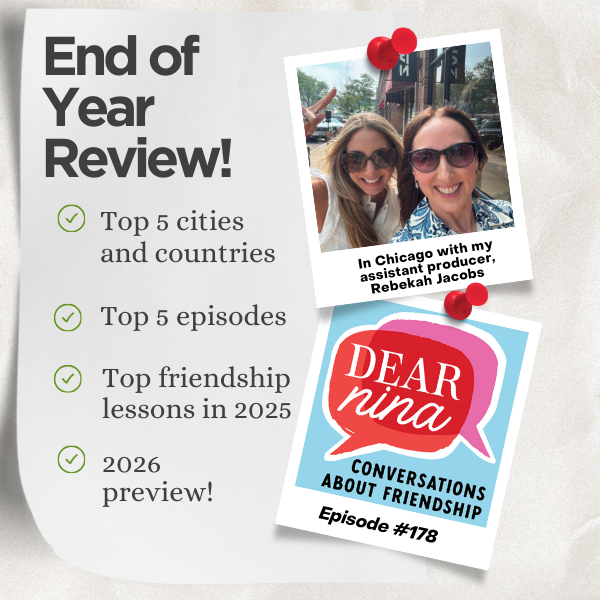
That’s the opposite of the rejection. There’s no age when that doesn’t matter. Maybe it hurts less. Maybe you through age have more experience of it working out in the end, and so you don’t hold on so tight every time, but it is still a human need to connect and to have somebody want to be in your life. We struggle to let go and I think that’s what hit people. Welcome to Dear Nina, conversations about friendship. I am your host, Nina Badzin. I’m here with my assistant producer, Rebekah Jacobs, who has now been on a lot of episodes.
‘we’ve had some really good ones. Welcome, [00:01:00] Rebekah.
Rebekah: Thank you so much and happy upcoming birthday. I think it’s really soon. do you forget what number you’re at
Nina: Okay. So sometimes I do, sometimes
I I’m glad it’s not just me. ‘because sometimes I spend half the year saying I’m going to be such and such age, in this case 49. This happened to me last year. I spent all of 2024 saying I’m gonna be 48. And then December came and I had to actually ask Bryan, Am I turning 49 or turning 48
Rebekah: I also have asked, there is something between am I 46, 47, 48 that I cannot remember? 49 will be easier.
Nina: Quick thing. On birthdays, we’re not gonna say much more about it today because we have an episode coming up in 2026
that really goes into birthdays more ’cause birthdays is a big topic around here. It brings up some serious feelings. So I just want listeners to know that I’m skating over the birthday thing because there’ll be an episode coming. So make sure you are. Following on whatever platform that you listen to the podcast on, Spotify, apple, YouTube, whatever it is, I use [00:02:00] Overcast.
. We have some very juicy episodes coming up in 2026 already. Some planned, we haven’t recorded yet. We are open to some, we have pitching guidelines on the website if you are ever looking for them, and I think I will go ahead and put those in the show notes this year.
But we are choosy. Rebekah, when people write to me, I do write back that we are choosy because we are, we’ve done this for four and a half years in, you really gotta work hard to come up with a topic that we have not covered.
Rebekah: And we want that because we want it to be special and relevant and exciting and not repetitive. So it’s for our listeners.
Nina: Yes, exactly. The listeners want fresh material. What we are doing today in this episode is we’re going to tell you some interesting stats for the year. We think they’re interesting, the top five cities that you live.
We’re gonna tell you the top five episodes and what the takeaways were from those episodes and why we think those might have performed the best, but you may feel differently. So write in and let us know. Also for each of us personally, the top moment of [00:03:00] the year in the podcast and our experience with the friendship challenges.
So we are gonna pack all that in. Lots of interesting and useful information, I think, and reflective information in this episode.
Rebekah: Okay, great. So the top cities where we’ve performed the best are number one, New York City
Nina: it was a far, number one, I want to say. It wasn’t like even the second city was just under it. The other four are kind of comparable. Number one. New York City was way heads and shoulders above, so thank you New York.
Rebekah: Thank you, New York. We love you. number two, Seattle.
Nina: Seattle has been the number two city for years, I want to tell you, I do not know anyone in Seattle.
Rebekah: .
Number three, this will come to no surprise, we are both from chicago, the suburbs of
Nina: of town.
Rebekah: our, that’s our childhood
Nina: That’s our childhood friends. That’s our moms.
Rebekah: Yes. Mom’s
friends.
Nina: They are spreading the word in Chicago, so thank you.
Rebekah: Number four, again, not a surprise. Minnesota.[00:04:00]
Nina: So Minneapolis in particular, they do it by city. I just want to be clear. So it was New York, Seattle, Chicago, and then Minneapolis was number four. Pretty close to Chicago numbers Minneapolis. Thank you for representing my real hometown. I’ve lived here, you know, Chicago’s the hometown as in childhood hometown, but I lived in Minneapolis for 25 years
Rebekah: number five. I also have lived there, but not in years. Number five, Los Angeles. That’s where I, I moved after college. I still do have a lot of friends there, but hopefully they’re passing it around. Do you have friends in la?
Nina: I do have some friends in LA so yeah, maybe they, maybe they’ve told friends too. So thank you to everyone in those five cities and there was lots of other cities. So thank you to all the listeners for tuning in this year, the top five countries were. Obviously United States was number one, Canada was number two, the UK was number three, Australia was number four.
So all of those are not surprising ’cause they’re English speaking countries and that makes sense. I thought this was interesting that number five was Germany and number six was France thanks [00:05:00] to the international audience, there’s also a lot more countries where we are trying to spare you.
’cause not anybody but the two of us is probably interested in the really minutiae weeds of where the listeners are coming from. But those were the highlights of cities.
Rebekah: Okay, so one of the other highlights that you really, I think worked on and really the, with the goal of deepening and strengthening friendships were the monthly friendship challenges. So we’re not going to spend too much time on how they went, but I would like a little reflection. the first question is just gonna be rapid fire.
What was your hardest challenge?
Nina: So I think for me, my hardest challenge was the one for October, which was to ask your friends more questions. And it’s not because I’m not good at asking questions. I think I am. I’m a podcaster. I’m an interviewer., But I get self conscious at a certain point that, am I asking too many?
And the guest was Jonah Kaplan, who is a reporter, a journalist, I think that, he’s exceptional at it, of course. He literally does this on air [00:06:00] all the time for a living, and he feels like there’s just no line where it’s like too much where you can be asking too much and we cover it a lot in the episode, so I won’t regurgitate it all here, but I still, even though I know that technically you almost can’t ask too many, at a certain point you start to feel like, does this person think I’m interviewing them?
What about for you?
Rebekah: For me, you had a challenge about having older and younger friends, and I do have older friends, but I don’t have as many younger friends, and I know, I think you met some of yours through tennis. I’m terribly unathletic, so that is not where I’m gonna find my younger friends. I don’t want to go to a club. so I don’t know.
I don’t even assume younger people are at clubs. That’s like so ridiculous. But I would like to, and I, and I have actually a third grader, so it’s, not improbable that I could have some younger friends.
Nina: you really could. Rebekah’s kids, she has three kids, so I’m gonna say it for you with a, just a bigger spread, your third is a lot younger than your other two, so you totally could have younger friends.
Rebekah: So maybe it’ll be a goal to meet some of Jack’s [00:07:00] parents’, friends.
Nina: Yes. I always, uh, say at the beginning of each of those challenge episodes that no matter when you’re listening to the episode, ’cause people find the episodes through SEO, meaning they might get into Google or chat GBT these days by the way, and Google something that is an issue they’re having. an episode from three years ago, two years ago or this past year, could come up for people and they land on the podcast.
No matter when the episode was. And so those challenges are timeless. But, we are retiring the challenges. We’re not doing them for 2026. if that was something that was helpful to you or you did some and not the other ones, you can always go back and I have them listed really nicely and explained really briefly in my newsletter@dearnina.substack.com.
If you go to the menu at the top it says, friendship Challenges, those will just be there permanently for people to use.
Rebekah: I love that and now what was the most fun? Which one did you just have the most fun with?
Nina: I ended up having the most fun with the Create a Friendship ritual. funny enough, we actually recorded that one. I [00:08:00] recorded with Rachel Steinman and Rachel Winter. It was November of 2024, but I didn’t put it up until February because I wanted to make that one for creative friendship ritual. But because I recorded it before the end of the year, I decided that I was going to make the ritual to take care of the fact that several of us with December or late November birthdays feel that our birthdays are wedged into the same time as Thanksgiving and New Year’s and Christmas and Hanukkah and all the stuff.
I created a new annual tradition and I started it. December, 2024, which is right after we recorded to do a breakfast or brunch or whatever. We can make work for those birthdays that time of year. And we did it. We did it in December and we said, let’s do this every year, and then we just did it a couple weeks ago, we had the December breakfast, so now it has been two years in a row. I was very successful, so not only was it fun, it was a successful assignment
Rebekah: and I guess for me, maybe not the most fun, but one that is less challenging for me or not as hard and I know it’s hard for many listeners, I have an easy time asking for [00:09:00] a favor. And I know that sounds weird, but when you live in a city where you have no family.
You have to get very comfortable with having your friends help you out. It is impossible to do it alone, so I often ask for favors, but I hope I’m also someone who will return a favor and not tit for tat, but I will show up for you. But I would love you to show up for me
Nina: Okay. Rebekah, moving us on to the drum roll moment for the episode. It is the top five episodes of 2025. There are numerous ways to get analytics for episodes.
We’re not gonna bore you with those, but this is what came up as. The top five. What was number one, Rebekah?
Rebekah: Number one was episode 143 with Harlan Cohen, and it was the law of rejection in friendships. And Nina, let me tell you, this one is hard for me because the whole premise is to embrace rejection. Oh, it is. I think it might not be so hard for. Everyone, but it is very hard for [00:10:00] me. I want to be likable. I want people to like me.
I don’t like when I fail. It is rough and he wants us to run towards it,
Nina: He had such a great quote, which we will play for you in a moment, but I just want to tell you that Harlan Cohen is extremely popular on social media. His books are very popular. He is the go-to guy for college kids dealing with their friendships and college and for their parents.
He’s just very relatable. People share his videos all the time, so I’m not surprised that this was the number one. He just speaks directly. He does not mince words here is what he had to say about rejection.
Harlan: I am obsessed with rejection. I’m obsessed with it because when we can be friends with rejection and allow rejection to walk side by side with us, instead of being so worried about what other people think, and getting stuck in the shame cycle of, I’m not enough, we’re really able to use rejection as a [00:11:00] tool.
To reflect and to continue to be thoughtful, present, and the best version of ourselves. And I talk a lot about this in my book, win or Learn, the Risk Taking Framework that includes the law of rejection is a fundamental part of all of our lives. So it’s what I use. I do professional development. I’ll work with, with corporations, I’ll work with students, I work with parents, I work with administrators. That’s kind of framework. So Nina, I wanted to set that up . Really important because the law of rejection, and I just want to give this, the attention it deserves, also referred to as the universal rejection.
Truth says that not everyone and everything will always respond to me the way I always want. Not everybody’s gonna always include me, appreciate me, desire me, date me, hire me, and respect me the way that I would like to be acknowledged. It is a law of natured.
Nina: The second most popular episode of 2025 was number 1 46 with Dr. Jackie Henry, who is a [00:12:00] therapist right here in Minneapolis, that episode title was Tolerate Uncertainty and Stop the Overthinking Spiral. That also, again, if you think about it, we’re Kind of in a similar universe of dealing with rejection or perceived rejection.
In this one, I feel like this one was more about, maybe you weren’t rejected actually. Maybe you are just overthinking something that was a very simple, no big deal moment. And I just want to tell you really fast that I’ve already recorded for 2026, an episode with Meg Josephson, who’s also a therapist who wrote a book called, are You Mad At Me?
And the same people who found this episode with Dr. Jackie Henry helpful will find that helpful because the underlying issue of overthinking and having this whole spiral where you’re not sure what someone thinks about you and you’re thinking about it and did you say something awkward?
Did you do something awkward? Are people talking about it? Is the same reader or listener who would find that book helpful? ’cause what are you doing if you are overthinking? You are assuming someone’s mad at you and you’re trying to fix it.
Rebekah: [00:13:00] Exactly. You’re creating a story in your head and it’s exhausting for you and it’s, it could be exhausting for your friend
Nina: Yes. That’s something Meg and I talk about also is you have to be careful that in your desire to address what we talk about in this episode number 1 46, is the person mad at you, are they not? Do you need to write back and make sure if your friends have to constantly reassure you they’re not mad at you, you may be creating a situation where they’re going to be mad at you eventually, ’cause that can just be a lot.
Rebekah: Yeah. And you know, I remember one other thing that she said that I loved, and I know you love too. She said, it’s my responsibility for people to get to know me. And I feel if that could encompass many of the episodes. And I think one of the things that the podcast does incredibly well is putting us in the driver’s seat. And so we could choose not to make the stories. We can stop the overthinking, the spiraling, and we can be the person to get to know that it’s, it’s not your friend’s job, it’s, it’s my job.
Nina: Yes, I love that. And let’s listen to one of my favorite moments from that episode [00:14:00] right here, and then we’ll move on to the next one.
Jackie: I want everybody to encourage themselves to lower the stakes in some of these interactions. You don’t have to perform a friendship. You can just be in it. Your friend probably isn’t mad at you. You’ve probably just been alone with your brain too long. If there’s ways to kind of move out of your head and into your life, that will only benefit your friendships and other relationships too.
Rebekah: That was so good and I needed to hear it.
Sometimes we know things and we just need a reminder.
Nina: She was so relatable , she’s therapist, but she was feeling all these things too herself. that was part of the beauty of that episode is, Dr. Jackie gave some examples from her life and I did too, and I could think of a hundred more since then. By the way.
Rebekah: Another therapist will bring us to episode number three, a hundred and thirty two, the four types of connection with Adam Dorsey. oh, here we are again. It is the fear of rejection, , I feel it in my stomach, but learning how to handle rejection and failure well and be willing to try new [00:15:00] things Small risk, big risk is so important. Again, it’s that whole idea of if we’re disconnected from people, we’re lonely, or sometimes you could be surrounded by people and still be lonely.
Nina: Yeah. First we’re gonna hear a clip that he words so beautifully about handling failure. Well, which is just another way of saying dealing with rejection. Rejection failure. This could be you reached out to a friend and they never write back or not even a friend, but maybe someone you’re hoping to get to know and you do.
The thing that I am constantly pushing people to do on this podcast, which is reach out, try, say, do you want to meet for coffee? And actually give an actual date. That’s a big thing. I said it when I was a guest on Adam’s podcast too, and I just replayed that episode a few weeks ago on Dear Nina. So if you didn’t catch it, go check that out as well as a bonus episode in December, I spent a lot of time on his podcast saying that when you reach out to someone for plans, you absolutely have to, I think to quote myself, I said, it might be my mission on Earth to get people to do this, give a date. Never just say, Hey, we should get [00:16:00] together.
It’s, I’d love to get together. And you give three dates and if that person wants to bite, they will either accept one of those dates or they will counter with other dates. We talked about it for a long time. I won’t say it all here, but he, in this quote we’re going to play now, is when he was on my podcast talking about, well, what do you do when they don’t bite?
They don’t say, that sounds great. I can’t do those, but what about this day? It will feel like a rejection. It may feel like a failure, and this is what he had to say about that.
Dr. Adam Dorsay: And if I could go back in time, by the way, and I could whisper one little thing to myself, it would be handle rejection well.
Handle failure well. If I was able to do those two things, that would have Cause me to try more things. And people ask me, how do you get these guests on your podcast?
Well, you have no idea how many people say no. I know for a fact, you gotta buy a lottery ticket if you want to win. it’s much lower stakes, you know, reaching out and trying things than buying a lottery ticket. The likelihood of winning on that is it might win 2 after a hundred tries, but getting what you actually want and being willing to fail, [00:17:00] some of them describe mistakes as missed takes. That was Matthew Abrams said. My friend Bonnie calls it tuition. Our mistakes and failures are tuition and, Dory Clark says failure is merely data. And if we’re able to just be super dispassionate in our pursuit and say, oh, I failed. I missed the basket. I’m going to try something else or try again in a different way.
if we could just get over ourselves, quiet the internal monologue that we get from our imaginary audience, and say, you know what, I’m going to cultivate self compassion. Even the Navy SEALs use self compassion, which is, one of the roots is talking to yourself the way you would talk to a friend.
We, we talk to ourselves in a way manners that if we talk to our friends that way, we would have no friends, but if we could talk to ourselves the way we talk to our friends, oh my gosh, and we think that will be tougher. We have this lionized idea. I’m gonna be tough on myself. I’m really hard on myself.
No one’s harder on me than me. Well, maybe that’s not great. Maybe there’s another way. Maybe you are going to get actually better results than the Navy SEALs have been showing that they get better and faster by being kind to [00:18:00] themselves when they’re doing these seemingly impossible things.
Nina: One other quote I want to share from Dr. Adam is his words about disconnection.
So our episode was about the four types of connection, but then he had this to say specifically about the danger of disconnection. And I liked this moment ’cause it just affirmed what we are doing in this podcast, which is putting such a spotlight on friendship and the importance of these social connections and just how to do them and also get through the awkwardness of it all.
Dr. Adam Dorsay: And if you think about it, the DSM, which is the diagnostic and statistical manual that we use for diagnosing people, it’s the American Psychiatric Association, virtually every described mental condition has in it a form of disconnection. Depression, we disconnect with the present because we’re thinking about the past.
Anxiety, we’re disconnecting from the present because we’re thinking We’re, we’re thinking about the future and with trauma, we’re disconnecting from the present because we’re dissociating or having an out of, various out of body experiences depersonalizing and a whole bunch of other things. So if almost [00:19:00] everything we don’t want contains disconnection within it, it seems logical.
And it’s been my experience that virtually everything we want has connection within it. It’s the common denominator for, I think it’s the precursor for happiness and well being.
Rebekah: I love his voice and I love how he, oh, it’s just, but I also love what he has to say, and I know because I Stevie, the letters that you receive . So many are about that pain of losing a friend of that disconnection.
it’s not a surprise that rejection and feeling rejection and that raw pain of losing a best friend, a work friend, a new friend you just made who you thought was your, person. It’s so raw and we hear it so often. It’s a real grief. Even when you’re told to get over it, you can’t, it’s really hard.
And I think he Put words to that feeling.
Nina: Yeah. I forget to remind listeners of this, but yearly subscribers to the podcast can get a personal response from [00:20:00] me, so this is a good time to mention it because it came up in one of the letters I got recently. people can subscribe to read all these anonymous letters and answers@dearnina.substack.com. However, yearly subscribers, so you’re paying up front for the year, in addition to being able to read all the anonymous ones can write me personally one letter and it’s $60 a year and you get the one letter every year.
If you re-up the next year, you can write another one. It’s just between me and the person
Rebekah: yeah, I think what you offer is a listening ear with someone who really gets deep friendship.
Nina: been studying these things, talking about them, writing about them for over 10 years, which is how I usually intro every episode. I. Do that to remind people that I didn’t just stumble into this topic a couple days ago. there’s a lot of patterns that come up. And the patterns are right here in these top five episodes.
It does not surprise me what were the top five? So let us go to episode number four, which was episode 1 48. We called it the tricky friendship etiquette for [00:21:00] the modern digital age. That one was a little lighter. That was with Daniel Post Senning, who is the grandson now. I can’t remember if he’s the great grandson, but it will be in the actual episode 1 48 when you listen of Emily Post, and we took listener questions about modern etiquette issues.
It was really, really a fun episode, even though some of the stuff we talked about is tricky and awkward, but it kind of almost goes with the overthinking one . It was try to help people know what to do in those awkward moments.
Rebekah: So what I loved, we’ve all been in those moments. a high school reunion, holiday party, a school function where you’re talking to someone and it’s great, but. It’s time to be done. What do you do? And I love how he acknowledges that little social moment of how do you get out of a conversation, and it was great
Nina: It was great practical advice and every question was like that. I loved it. We talked about if a work friend wants to be your friend on social media, but you don’t necessarily want to do that. There was a lot of these tiny [00:22:00] social moments that can become bigger issues if they aren’t handled delicately.
Rebekah: So let’s hear what he had to say.
Nina: exiting a conversation gracefully. I know this is right in the Emily Post etiquette wheelhouse, but it’s a question that came up in the group. How do you exit gracefully without being rude? Let’s say you’re at a cocktail party or some sort of school gathering where there’s just a lot of people and you want to talk to other people, but you don’t want to be rude and make the person feel like, I don’t want to talk to you anymore, even though that’s kind of the case.
Dan Post Senning: I get to give the most etiquette answer ever. Yes. It’s an etiquette question. That’s a good one. Magic words are magic. They can get you out of all kinds of difficult, awkward, uncomfortable, or just boring situations. Although something my mother did used to tell me, never say you’re bored. That’s like saying you’re boring.
No one’s responsible for your attention, but you. My mother taught me magic words. I inherited a magic words teaching slide from my mother, the fourth generation of the post family. And on that slide are three words that everybody thinks of, please, and thank you. Then the next set of words on [00:23:00] that slide is your welcome, which is okay.
Can I guess one, take me to the final three. Give me the final three on the slide. Well, is one of ’em. Excuse me. It’s Oh, yes, because I was thinking, I’m like so excited. I love the quiz. I’ll let you do the rest. I was just real excited. It’s a magic word also. Pardon me? And I’m sorry. Please, thank you. You’re welcome.
Don’t always minimize other people’s thanks. It’s not always. It was nothing. It was no trouble. No, I’m trying to thank you for something. I wasn’t worried about it. It’s not a no worries answer. It’s a thank you for X, Y, or Z. You’re welcome. It was no trouble. And whatever. It’s, excuse me, I don’t mean to interrupt, but excuse me.
And then the thing that you were gonna do, and before you say, excuse me, it’s rude, you’re mid-sentence. I just turn, I stop making eye contact and I walk away. Excuse me just a minute. I really need to use the restroom. Turn my eyes, walk away. Not rude. I’ve showed some consideration. I’ve showed some awareness.
I’ve acknowledged the social infraction before I made it. It just shows such consideration, such care for someone else, even [00:24:00] if it’s followed by something that was a little bit difficult or a little awkward, like departing mid-sentence. I, I also like to include, pardon me. ’cause it’s nice to have a little bit of variation, a little room to play.
And, and even though, I’m sorry, not every, I’m sorry, is about expressing deep contrition or regret sometimes just, oh, I’m sorry. I just saw my mom come through the door. I really need to give her this before anyone else sees her and grabs her attention. Whatever it is that, that, those three words, but excuse me and pardon me, are great for exiting conversations.
Rebekah: And number five was episode 1 51. Myths around Adult Friendships with Jasmine Proctor,
Nina: therapist. People liked the therapist this year. Rebekah?
Rebekah: we’ll bring some more, we’ll, we’ll, we’ll bring it to you. I have to brag about you though for a minute because what was interesting for me with this clip is that you had talked about old friends when you were invited on NPR
life kit. I am gonna gold star brag you. That was a huge accomplishment for 2025. I was so proud of you. [00:25:00] It’s not a small deal. It’s, it’s a huge deal you really defended old friendships. She had something else to say. And so it’s a very interesting, there’s no right, there’s no wrong. It was just a very interesting way of looking at old friends.
So I dunno if you want to say what you said
Nina: this was an interesting 2025 moment where there is a lot of space in between when you record a thing and when it gets released. So I had recorded this episode on NPR R’S Life Kit, which by the way, I was very excited later in the year, got sliced up and repeated on all things considered.
So that was like a big deal. . That was about maintaining longstanding friendships and implied in that, I don’t even think we had to say it, implied in discussing the work it takes to maintain longstanding friendships Is that that’s a worthy endeavor. And then I interviewed Jasmine in that in-between time, so we’d already recorded the NPR. I interviewed Jasmine and she had pitched me this idea. It was a great pitch. Again, if you are looking to pitch an episode, it has to be something I’ve not done. I want specific ideas.
Even the title, she’d already had the title and it was the myths [00:26:00] around adult friendships. I asked her not to tell me what those myths were gonna be until she came on the episode. I thought it’d be more fun to do it live so I could react to it in real time. I think number one was, I don’t remember exactly how she worded it, but it was something along the lines of this idea that we need old friends is a myth.
And I just recorded this thing on NPR and I was like, oh no, Jasmine, guess what? I just did. But we probably would both agree Jasmine and I, that there is a value to old friendships and she discusses in the clip what that value is.
she really beautifully expresses what the value is in new friendships. I love how she worded that, and I agree with her. I would just say there’s a value in both for sure and I, I think she would agree. She was defending the new friendship and why it is the most helpful thing, maybe in the present moment.
So let’s hear what Jasmine had to say.
Jazzmyn Proctor: I think history is beautiful to have with people. I think history says a lot of that grace aspect. It says a lot [00:27:00] about you’ve been able to allow this person space to grow and evolve. You have been with them on the journey and it is sometimes so refreshing to not have history with someone. To be able to build a friendship from an authentic place of the present and what’s happening right now and where you are right now.
You’re not dismantling old patterns. You don’t have to process anything. You’re just meeting the person where they are and they’re meeting you and your growth and that that’s unmatched.
Rebekah: Yeah, that was, great. And I think there’s a freshness in someone meeting you as you are now, and there’s a beauty in someone knowing who you were then.
And I know that came up for us in our beaches episode, which we had so much fun recording, uh, episode 1 72. I think in that, one of the things we discussed, which we won’t belabor too much here, but they got into a massive fight and they made up, and I think a lot of the episodes you actually covered this year was also [00:28:00] about making up, letting things go, learning how to apologize, repairing a friendship.
Not everything is toxic and terrible and some things you just let go
Nina: it’s interesting sometimes it’s like the life is short concept can go in both directions. On one hand, life is short. Why would you put up with behavior that isn’t the most perfect friend behavior and on the other end, life is short. Why wouldn’t you let some things go?
This person’s been a good friend most of the time. They’ve put a lot of deposits in the Friendship bank and sometimes you gotta take a withdrawal and I can make an argument for either side, and it’s really a case by case basis. I really don’t think you can make a big, huge deal about everything, but if something is constantly coming up, there’s always an issue.
That’s where I go, okay, life is too short. I agree with Jasmine on this. You don’t need to hold on to every friendship just because they’re old friends. There is a place for letting go of old friends and current friends, but not because they make a mistake once in a while or they have one.
It’s the one [00:29:00] personality quirk that bothers you. We bother people too, and thank goodness. Thank God people let them go I assume
Rebekah: So we also have a moment of reflection. Besides NPR, there was another huge, big, giant gold star that was so exciting and fun and different and really pushed ourselves out of our comfort zone. what was
Nina: that? Was definitely the live show in Chicago in we recorded it too. It’s episode number 160. So Rebekah and I went back to our hometown in the north shore of Chicago and we recorded in front of a live audience. . It was a party, it was a shopping party, it was cocktails.
We had sponsors to, help us make it a majorly festive night.
Rebekah: It was a lot of work, but when I looked down in the audience and people were grinning and then there were moments of quiet, just connecting and friendship, pain, but also then it would turn into laughter. It was so special as you get in a room full of mostly women and a few men were there [00:30:00] as well, but it was, special. You did so much
Nina: And, you did too. And . There were a couple moments. There was a quote from Amy Weatherly and Jess Johnson in there at the end, and people teared up.
So again, another former guest, her name’s Amy Weatherly, and her writing partner Jessica, have beautiful things they write about friendship and she shared one recently that I think is a great place to end . it speaks to the pain point. We talked about this friend group stuff.
There’s no one right answer. There’s no magical way to yourself always feel included, to feel like you’re never excluding people. Because if, again, if you want your friendships to be deep and meaningful, you can’t do everything with 15 people. But if you’re feeling more of the feeling, that’s where my empathy is with right now, with the person who is not being included
she had this to say it’s really a poem. I just think it’s a good message for human connection in general, this is the message that I want to leave you with, which is: go where the [00:31:00] love is. Go where the friendship flows both ways. Go where you appreciate and where you are appreciated. Go where the door is open.
Go where the communication is good and authentic and honest. Go where the energy is uplifting. Go where you see and where you are also seen. Go where there is health. Go where the intentions are pure. Go where the expectations are simply that everyone is just themselves. Go where the spotlight shines on everyone equally.
Go where you forgive and where you are forgiven. Go where you want and where you are wanted. Go where you choose and where you are chosen. Go where you value your time and where your time is valued. Go where the love is and unashamedly, bravely and kindly step away from everything else. Life is too short to stay in rooms, not made for you.
Go where the love is.
I mean, [00:32:00] actual tears the topic was friend groups, but what we really were getting into is being included in a group or not being included in is ageless and timeless.
That’s what we were trying to get across in that episode, and I think it’s what we are trying to get across in most episodes is all of these issues, like whether it’s Harlan talking about college friendships, but it’s like not college friendships. It’s ageless. Timeless. It never goes away. The desire to be accepted, the desire to have somebody choose you, not just accept you, like first choose you and then continue to accept you, not reject you.
That’s the opposite of the rejection. There’s no age when that doesn’t matter. Maybe it hurts less. Maybe you through age have more experience of it working out in the end, and so you don’t hold on so tight every time, but it is still a human need to connect and to have somebody want to be in your life. We struggle to let go and I think that’s what hit people.
Rebekah: And because we had so much fun, we are going, we don’t have the exact date, but [00:33:00] it’s coming to one of our top five cities.
Nina: and I’m gonna be lazy this year and stay put in Minneapolis and make poor Rebekah Travel from Washington
Rebekah: That. Yeah, it’s still, it’s still a lot of work, so there’s not a lazy bone in your body, but it will be a lot of fun. I will only go in the summer right
Nina: course we had to plan this in the summer ‘ we’re very excited about this. It’s going to be a celebration of five years of the podcast. And I have to tell you right now, everybody that’s going to be at the end of July, for sure, end of July in Minneapolis and will not be recorded this time.
So this time you’re gonna really have to be there to be part of the night. It’s gonna be kind of like a dear Nina unplugged.
Rebekah: Ooh,
Nina: not recorded. I am going to close out by, first of all, saying thank you to you, Rebekah.
I don’t often get a chance to do this on air to thank you for all the work you put into helping think through all of the episodes, helping me think through the pitches we get. Rebekah is behind the scenes all the time thinking about the episodes that we are [00:34:00] recording, but also thinking about the episodes, maybe we won’t be recording, For any number of reasons. I need someone to talk that through with, I don’t really make any decisions without you
Rebekah: well thank you because you are an amazing boss and a person I get to call a friend. you are really, you are, giving advice to women and men and you could see it actually is changing their lives. It’s making people happier and healthier and connected, and that is a gift. So I thank you.
It’s
Nina: When I get an email from someone, a listener who’s grateful for the podcast, there’s only two people I share it with if I share it. And that is with Rebekah and with my husband Bryan, because who else could I brag to Once in a while? Maybe my mom, but Rebekah works on it, so she really appreciates it too.
So, listeners and also other guests, I want to thank you as well as an end of the year thank you. We had a lot of great guests. We highlighted these five. But we had some fantastic episodes. I hope you’ll go through your podcast feed and look for topics that speak to you. And there are tons and tons if you miss some. [00:35:00] While you’re on vacation, maybe if you have some time off or you’re going for a walk, listen to another episode. We have lots of good ones too coming up.
listeners, if you’ve been with us this whole time, if you’re new at the end of 2025, welcome. I hope you stay with us and you’ll have lots to listen to good stuff in store for next year.
Rebekah: Happy New Year.
Nina: right. Happy New Year, and thanks for being with me on my birthday guys, or right around my birthday. Come back not only next week. Come back next year. Come back in 2026 when our friendships are going well we are happier all around.