Nina: [00:00:00] Welcome to Dear Nina, conversations about friendship. I am your host, Nina Badzin. I have been writing about friendship for over a decade, podcasting about it for over four years. Today’s episode is for the parents of the college kids is also for the college kids, and really it is for anybody who has struggled to make friends. My guest is Professor Janice McCabe. She has her second book out and it’s called Making, keeping and Losing Friends, how Campuses Shape College Students Networks.
Professor McCabe, has been studying. Yes. Making friends.
Yes, keeping friends, but particularly the structure of the college institution. And it is something to think about if you’re a parent of a younger student who is going to be thinking eventually about where to go to school. ‘Cause some schools have this more in mind than others. They think a lot about what Professor McCabe and I will be talking about, which is the friendship markets that are available to you in college. Some [00:01:00] schools do a better job of directing kids towards those, of having certain kinds of orientation activities.
And this isn’t just about the size of the school even a really large school can be very mindful of how they help students acclimate to an entirely new environment.
either way, whatever the institution does or doesn’t, it is of course still on you as the individual. The student now, not the parent. It is on the student to figure out what, quote unquote friendship markets, which is something that we speak about, quite a bit in the episode. Which ones are open?
Which ones are closed to you, it’s not the right fit. Because the people in that group, whether it’s a group of friends or an activity, just aren’t emotionally open right now to you. There isn’t chemistry. Some of that we don’t necessarily get into the nitty gritty of chemistry. That’s like a whole separate thing.
We are talking here about being aware of when the fit is just not happening. You don’t feel you’re being invited to things. You don’t feel like you can be yourself. You’re not [00:02:00] enjoying yourself in these environments. Maybe you are bumping up against what seemed like an open market and is actually a closed market.
I definitely experienced that in my life. I’ve talked about it many times in the podcast. I mentioned it briefly in the episode. Most people have. I would be shocked if somebody could not think of a single time when they thought they would be a fit somewhere, and it really turned out they weren’t.
And I think what helps people make friends despite that is how quickly they are willing to move on from that. If you are always focused on the people who didn’t like you, the people who didn’t accept you, as opposed to who else is out there. That is what is going to make the difference, because there’s nothing you can do about the ones that have already made it clear they’re not interested.
You have to keep going, and we talk a lot about different students that Professor McCabe has worked with, but the book itself has so many more details and we could only really get into so much in these 30 minute episodes. If you have a kid in your [00:03:00] life who is home whenever you’re listening to this winter break, the summer and the next year of school is going to start, or you have a older high school student who’s thinking about where to go to school, these are things to be thinking about, but they’re also just applicable in your entire life. As we say in the episode, there is no time in life when you do not need to have some sort of friendship muscle that is functioning. Things change your life, circumstances change. You move towns. The people that live in the town that you’ve been living with for a long time no longer feel like a good fit for any number of reasons. You get divorced, you change jobs. so many reasons I couldn’t possibly name them all. Why you might need to make new friends or why you might need to work on keeping the friends you have. Like I said, today we’re focusing on college kids for the most part, but I think the lessons are applicable to everyone.
Dr. Janice McCabe is an associate professor of Sociology at Dartmouth College. The President of the Sociology of Education Association and the author of [00:04:00] two books.
Let’s get to it. Hi Janice. Welcome to Dear Nina.
Dr. McCabe: So wonderful to be with you today.
Nina: We’re talking to parents and their young adult, their, I guess they’re adult students who might be struggling to be making friends in college. And maybe they always heard like, oh, these are gonna be the best four years of your life and you’re gonna love college.
And they spent all of senior year of high school just engrossed in the whole admissions conversation. Where are you going? And now they’re there and maybe it isn’t going like they hoped. Your book focuses on several things, but one big one is friendship markets, and I wonder if we could start there as a place that maybe people are not seeing the potential or not switching when they should. What is a friendship market
Dr. McCabe: .
And other times when it seems quite challenging. Some of that is personality, some is luck, some is skills. But friendship markets really draws attention to the structural aspects to it . So there’s an initial friendship market that opens up in college when first year [00:05:00] students are first arriving, when people are particularly open, to making friends.
And so that’s one of those periods where friendship seems particularly easy for people.
Nina: I’ve even said it a lot of times on the show that college is a time that people make friends more easily. Not everyone I should really remind, the audience more of that, but more so than when you move to a new town and you’re 30 years old.
Sometimes that can be really hard ’cause it’s maybe unclear where the open markets are. Whereas when everyone is in college, I’ve talked about freshman energy and those first couple weeks of school and people are open. It’s like the whole place is a big market. But then what, how do you make it smaller?
Dr. McCabe: First year energy, freshman energy definitely is a good way to capture that idea of the initial friendship market. there are also times later on where friendship markets open up. so I just had a student come to my office because in addition to being a sociology professor, I’m also a residential house professor here at Dartmouth, we call [00:06:00] it.
I have a lot of students, not just in my classes, but in my house community who come and talk to me about friendship. students are doing a lot of comparison to the ideas that they have of other people . And this idea that everyone else has friends except for me, is something I hear quite often and right when it’s something you hear quite often, you know that it can’t quite be true that everyone else.
their friendships are better. so it feels like sometimes to those students that if you don’t make friends right at the beginning, it’s all hope is lost.
So with markets you have buyers and sellers, and that idea is really important. So people are open to both making and being friends in these times when there are markets and it’s often invisible until you go into a setting and you think you’re gonna make friends, and then really you notice
other people aren’t interested in it. I’ve experienced it as an adult going into a PTO meeting, [00:07:00] for example, at a new school and thinking, oh, you know, this could be a good place to make friends. But a lot of people there already have friends. so the market for the most part isn’t open.
versus Right as, uh, I just saw an advertisement in my kids. newsletter for their elementary school that they had an activity for new parents for the PTO. So I thought, oh, there is an idea of what is a friendship market. But back to college, friendship markets are clubs and organizations, classes can also be.
, But not always. So that’s part of the trick is being attentive to when people are open to making friends. So the beginning of certain terms, the beginning of a semester. So coming up, if kids haven’t made good friends it’s not like hope is lost for this fall, but January would be another really good opportunity
when classes are starting again, maybe there’s some [00:08:00] new people in the dorm, clubs are looking for new members again, there’s more of that potential for open markets.
Nina: when somebody is new to school, even new to a city, ’cause as always, like I do try to extrapolate to all listeners, even though we can’t always in every episode. I agree that the market concept and being open to who’s buying, who’s open? That’s the open market. I have the same experience I’ve talked about a thousand times moving to Minneapolis and just assuming right away that people around my age you know, you talk in your book and how do you pronounce the word I, I never say it right.
I would just say in regular English, people who are like you, people who are. Okay. I didn’t wanna say incorrectly. and that is sort of a natural place to start, even though it would be nice in this world if we, started always with people who are different from us. And I do think there’s so much value.
I’ve done whole episodes, on being friends with people who are different from you. obviously if you’re in a whole new place, it is natural. There’s something natural about it. So I move here, I look for people [00:09:00] just like me, and it just didn’t click at first.
I was really bitter about it for a long time and I think I probably missed out on some opportunities at first at what would’ve been other open markets because I was walking around with like a little chip on my shoulder that that one particular market. One group, let’s say, wasn’t as open to me as I’ve grown both in maturity as a person and in my knowledge of understanding how friendships form,
I get that most of those people already had a lot of friends, grew up here, went to camp together. Nobody’s entitled. I was not entitled to their friendship and their time because we’re around the same age and we have some things in common.
When you spend a lot of time being bitter that people weren’t open to you, you are like wasting time and opportunity is how I see it. In a college context. I understand how that would be very difficult ’cause you really see these groups forming quickly. The text groups, they’re just fast.
Do people talk to you about the text groups forming when they come talk to you as an advisor?
Dr. McCabe: they definitely do. the one hard thing about those text groups for [00:10:00] people is it’s really clear who’s in and who’s out.
There’s not that blurriness like there was when, yeah, we were younger and you were unsure whether you were invited to something there. It’s really clear whether you’re part of that group or not.
Nina: So what would you tell someone who comes to you and says They try joining a club? ’cause I assume that would be like the first thing you would say is did you join something else? they didn’t make friends on their freshman floor. Let’s say. I know you guys have like houses in Dartmouth, but I’m thinking about like my college experience , and one of my kids so far, there’s the freshman dorm and a lot of groups get formed there and they start big.
Usually it might be a text of even 20 kids. of course over time it’s gonna get smaller. And I remember telling my son that like, it’s not gonna be 20 kids in three months. It’s just not, that’s not plausible even, to always get together and take Ubers and stuff with 20 kids.
And so it starts to get smaller. But, so let’s say they didn’t make friends in their dorm. The roommate was just okay, they didn’t make friends in the first club. What do you got for them?
Dr. McCabe: Keep trying because [00:11:00] there’s always more clubs, there’s always more classes, there’s always these future opportunities. And it can feel hard because you can take it personally. But to me, one of the really wonderful things about the friendship market idea is that rather than blaming yourself and thinking, right, I’m just awkward, I’m just introverted, or blaming other people for not being open.
Been, you can see that there’s the structural element also at play. You know, so there’s likely some, personality, some skills, some luck and some structure that are all part of what makes friendships work and what makes a particular time, important, So you brought up Homophily before and researchers find the two main drivers of friendship are Homophily and Propinquity are the scientific terms for them.
So Homophily is talking about similarity, Propinquity is talking about proximity and repeated contact. that’s something that [00:12:00] dorm floors get, you’re seeing the same people over and over again, or you’re seeing each other in a weekly club or a class that meets several times a week. Even better if it meets, if you see the same people more than one semester in a row.
And this isn’t just my research, but a lot of people’s research have found, for example, that people are more likely to be friends with the person who has the apartment door across from them. Than they are someone down the hall or certainly than the floor below. They’re more likely to be friends if they share a stairwell, because you’re having those repeated times when you’re passing and maybe over time you’re starting a conversation with people.
You’re noticing something like, oh, right, they have a. Sticker for the same coffee shop that I like, or something like that. Friendship takes persistence.
Nina: Yes. I love that the persistence is so true and, I like what you’re talking about. ’cause it mixes the desire I think a lot of people have for things to just grow [00:13:00] organically, which is wonderful when that happens. And proximity I think is a huge factor in that because you have the opportunity for things to grow organically, but using the structure of the things going on at college campuses. I think what people are talking about when they say college is an opportunity. There’s so much structure in place that if those people that you would more organically see, if it’s not clicking, there’s not chemistry, then students I think should be leaning into the structure that exists.
It may feel contrived, but that is what will provide proximity. So like if you’re a roommate and you’re floor mates, it is not feeling like a good connection, then you gotta join self so that you can force proximity with other people.
Dr. McCabe: That’s right, what I found is that some students would come to college and clinging on to the very first friends that they made because they felt like making friends was urgent and terrifying was one quote I had in my book [00:14:00] that really stuck with me because it’s both of those things. It does feel urgent.
It feels terrifying. It needs to happen, and there’s this perception that everyone else is doing it. Social media plays a role in that too. Not only everyone here on that campus that they’re on, but also their friends who are elsewhere, are making it look like they have a lot of friends. So there can be this tendency to, as I said, stick with that first group.
one trick to the friendship market is to keep your options open for a little bit. Meet people in other clubs and organizations. And it’s not to be insincere about what your interests are. I always tell students, you know, think about the range of interests that you have, join a club or organization related to that.
even if it’s just a little bit of an interest that you have. maybe it’s a way that you can build both, skills in something and build friendships and relationships through something.
Nina: And those are [00:15:00] skills they’re gonna need again anyway after college. Right? When you move to wherever you’re going, even if you move back to your hometown, maybe all the people that you were close with went somewhere else and you still need new friends. Or maybe you have grown beyond those people and you still need new friends.
Like there isn’t a time in life ever when you can never have the ability to connect with other people. It’s a really important skill and for some people, college is the first time that skill is tested.
Dr. McCabe: Yeah, we sometimes think I made a friend like, check that off. But instead, friendship is a process. It’s something that’s never done. If you’ve made a friend, then you need to work on keeping that relationship. It’s also really important to reflect on which friends are most meaningful to us, we can sometimes confuse what feels like an easy friend with being a good friend.
Because again, proximity plays a role. So if someone lives on your floor, um, or you’re in the same class together, or you’re in the same organization, even [00:16:00] extrapolating it outside of college, you might think, oh, that relationship is really important or meaningful or supportive. And then when that structure goes away, when that proximity goes away, it becomes a lot harder.
And you might realize, oh, this friendship that I thought was something else it was still good and useful, but it wasn’t as deep as maybe I thought
Nina: That’s such a good point. And I, I think you make the point in the book about the difference between making friends and spending time with friends. And that really is kind of what you’re talking about. cause you do have to start with the making friends, but Yeah. But you actually had to keep seeing these people just being on the text group It isn’t like, check the box. It might feel like that. I think it must feel like that to young people now. Like, okay, I am in a text group but if you don’t actually go to stuff with these people or spend time, it’s just name’s on a screen.
Dr. McCabe: And in my book and in my broader work, I use network analysis also. So part of what I look at is that there’s not just individual like one-on-one friendships, but instead people are embedded in a [00:17:00] group. but some people have one group of friends, which is the type of friendship that we tend to romanticize.
It’s what a lot of TV shows and movies show. What I call tight knitters. They look like a ball of yarn in their network. compared to the other two types I call com compartmentalizer, which look like a bow tie. If people have two groups of friends, you can have three or four, but people know each other within the groups, but not across ’em.
So for college students, sometimes they’re, they’re friends from their dorm, friends from a class, and friends from their sorority. And then the third group are what I call samplers. And they have as many friends, but they’re mostly one-on-one friends, so their network looks like a daisy.
I bring this up because if you have the same number of friends and you have one group, if we’re talking about, uh, social media, you can just send a message to the group and you’ve checked in with them. Whereas if you have multiple groups, you need to spend [00:18:00] time with all of them, or at least checking in with them in order to maintain those ties.
And if you have a sampler network, each of those are one-on-one friendships, which again, takes a lot more time, especially to get the same level of depth. So those different network types have different strengths and different challenges associated with ’em.
Nina: Did you, have you found in your work that certain personality types, lean towards one of these three? And can you say the three again? The tight knitters.
Dr. McCabe: The com compartmentalizer and the samplers
Nina: I wanna spend a little more time on it. So the personality types that would lend itself towards each one. I would love to hear more about that.
Dr. McCabe: It’s something I, wondered. I’m a social psychologist and a sociologist, so not a psychologist, But to the extent that I could tell, it doesn’t seem to be at least just personality type. That factors in, for example, students who were more introverted, [00:19:00] some of them were samplers, for example, you know, had a good number of friends, and I call them samplers because they meet one friend often in different places, like one friend in class, one friend at a job, then some of the samplers, for example, are like social butterflies in terms of that same thing. And also with tight knitters too. Sometimes people end up in a tight knit group because they’re rather introverted.
And they’re, you know, surrounding themselves by just this one group whereas other people have a lot of other friends because these, these are their closer friends. They have a lot of friends outside of that.
Nina: I think about Gretchen Rubin’s work a little bit on, personality types. I’m thinking about she has like the rebels, is one type, I could see someone who’s more of a rebel or a questioner not wanting to be in a tight knit group.
it could feel too, suffocating or, you know, what, what some people might covet and wish they had when they watch something like friends [00:20:00] or all the social media stuff that they think they want. Not everybody wants that. Some people would see that and just find it like, oh my gosh, maybe I wanna go on spring break this year with not the same six people that I went with last year, or that I’m expected to also live with next year.
I could see how it could be suffocating to always be with the same people, but I could also see how a different person would find that extremely comforting. So there’s no right or wrong. That’s the greater point that I see is these are just different ways of managing a large institution. sometimes you want it to be just one group, and sometimes you want all different kinds of people in your life, but you’re right, the more people. I mean, it does take more effort to, you can’t just disappear on some people half the time.
Dr. McCabe: that’s right. And I interviewed people over time also, and what I was seeing is that some people kept the same network type over. Over time and other people change. So I interviewed them both during college and in the transition afterwards. And what I took from that is that I think some of their [00:21:00] network type is personality.
Some of it is that experience that they had before. Some students had a lot of practice making friends, going to a lot of different schools, a lot of different summer camps. And other people had gone to school with the same people since kindergarten. They didn’t have that practice making friends before college.
Uh, and then another part of it was really the fit with the institution. ’cause one thing we haven’t talked about yet is that I studied multiple institutions and found there were things that colleges did that made it easier or harder for people to make friends. for example, tight knitters had an easier time at UNH at a large public institution.
The University of New Hampshire, , was one that I studied, that was harder. and the fit was different for different network types with different campuses.
Nina: What I would like to hear more about the different things that the schools could do or have done, that you found in your research to help kids out. ‘ cause this actually would be [00:22:00] helpful for current juniors in high school to think about before next year.
Dr. McCabe: Yeah, the, so the three campuses that I studied in my book that just came out called Making, keeping and Losing Friends was Dartmouth College, at University of New Hampshire, and then Manchester Community College.
Which is a two year non-residential, meaning it doesn’t have dorms. I was curious to know what role dorms played, what role clubs and organizations played, another reason I chose Manchester Community College is that they had a lot of clubs and organizations listed on their website.
So I was really curious about that. but some of the things that create a strong initial friendship market are orientation programs. Dartmouth, has a week long outdoor orientation program called Trips that over 90% of students participate in. There are these small groups that students call the other students that are part of it.
They’re tripe, two that [00:23:00] are part of this group, and they get to know each other quite well. they’re living in dorms specifically for first year students, which is another place that this initial friendship market happens. And then there are a lot of clubs and organizations here of different types.
Some quite selective, some less so. even more so, there are particular groups of students that have other targeted orientation programs, like one for first gen, low income students that’s several weeks long. Another for international students. all of these are different friendship markets that students are participating in versus UNH, for example.
Have some optional orientation programs, like an outdoor one. But there’s just a few days when students come to campus, at least at the time that I did my research that they were bonding with each other and then they had the opportunity to live in dorms for first year students or mixed year dorms, which I first thought as did a lot of [00:24:00] students, oh, living in a year dorm could be really neat ’cause you could get to know older students make friends across that difference. back to the friendship market idea that those non first year students already had their friendship set
Nina: Oh yeah. I mean, immediately when you said that, I was like, there’s no way that worked.
Dr. McCabe: No. What sometimes it did is the few first year students who lived in those dorms, if they could find each other, then they were able to form bonds with each other, but they had a smaller number of people in the market,
Nina: I’m thinking back to college and how, the freshman dorm was a huge part of your identity, which dorm you lived in. But not even just the building the floor, First floor that was part of who you were, that became part of your identity quickly. The second you get there, even when you meet people, it was like, oh, where do you live?
I’m on the third floor. Oh, okay, well there’s a little bit of proximity, but it’s still another floor. then there was always that person who didn’t quite click with their own floor in their own dorm they would become a [00:25:00] constant on your own floor. That is hard when you don’t have that initial click, whether it’s where you live or the stuff you join or the classes. Let’s go really micro for a moment and talk about roommates, I know Dartmouth does it differently, right?
Don’t they not let you choose.
Dr. McCabe: that’s right.
Nina: it’s pretty rare. Do you know how many schools are like that? Still?
Dr. McCabe: I don’t, but you’re right that it’s a minority.
Nina: The whole roommate thing. just, from a parent perspective now, it feels really bananas to me the way that there’s this flurry of activity on social media mostly having to figure out who your roommate’s gonna be. And it seems to be based entirely on homophily.
And kind of silly parts of Homophily, not just maybe a similar background, but similar clothing, similar style of videos on TikTok.
Like, oh, you stand in front of the mirror and dance in this particular way. I stand in front of the mirror and dance in this particular way. We’re going to be wonderful roommates. it’s like nobody seems to be talking about [00:26:00] what time do you like to go to bed generally. Are you staying up till three in the morning?
Even studying with a light on like that could be annoying. I don’t even mean parting and stuff, just having the lights on cleanliness, things that actually matter
Dr. McCabe: Those are some of the things that the Dartmouth roommate matching takes into account. So it’s not completely random, but students fill out a survey ahead of time that talks about, studying habits, sleeping habits, cleanliness, and matches people in that way. And, a hundred percent don’t work out, but a good number do.
Research shows that they are more likely to be diverse roommate matches in that way, because, as you mentioned otherwise, there seems to be a stigma of not finding a roommate, and so people are clinging on to something that makes them seem similar, but it doesn’t mean that you’re gonna be compatible as a roommate.
Nina: There is, I would say, like a whiff of desperation that, that I feel among [00:27:00] parents, honestly, because I’m not talking to, other 18 year olds. Usually I’m hearing about it from other parents , and yeah, this worry that everybody’s matching up. And some people don’t even know where they’re going to school yet either ’cause they’re on a waiting list or the school hasn’t come out yet. Maybe they’re waiting to hear from a private school. They may or may not go to that private school, depending on the financial package they get.
Dr. McCabe: Yeah. ’cause we also don’t want to feel not chosen. That feels bad. So I think that’s some of the issue that’s going on here and with friendship more generally. Lisa Wade talks about this in a book about hooking up. And while hooking up is very different than friendship in a lot of ways, those processes of feeling wanted, feeling chosen, certainly apply.
Nina: Oh, that’s such a good point. as we, wind down and we’re thinking about these parents who are worried. I mean my audience is really more the parents. It just is who are worried about their kids. They have a kid who is on the way home and doesn’t [00:28:00] seem that happy.
Like, what are we telling these parents to give them some hope?
Dr. McCabe: Friendships change a lot when you’re having a hard time, that doesn’t always feel good. but I think it’s important for us to keep in mind both as parents and I’m a parent as well, and for our students too, we’re changing all the time. Other people are changing. So even if we happen to find each other at a particular point, things.
may change. So again, there’ll be opportunities ahead of time. So I think some really concrete things are, Not being in your phone all the time and paying attention to your surroundings. I notice it at the cafe on campus. There’s always a line. I’m also often looking at my phone trying to check emails in between.
but if we look up at least occasionally, we might see someone that we know, say [00:29:00] hello. Start up a conversation if. There someone that you think is interesting, inviting them to whatever you do, to coffee, to grab a meal together. That’s definitely something that happens a lot on college campuses for students that have a meal plan.
You know, making a plan to grab a meal after class is pretty low stakes. to do that, you have to be willing to take a little bit of a risk. Too. ’cause it’s possible that someone will say no or give you an answer that you can’t really quite understand, that isn’t the excitement that you would hope for.
back to the friendship market idea is that maybe they’re not in the market for friends. I think not taking it personally and being willing to put yourself out there again, um, where you might get that reward next time is really. And part of resilience.
Nina: That’s right. and rejection is a part of life because that’s like, we haven’t used that word once this episode, but it is what we’re talking about, [00:30:00] there’s these feelings of rejection that happen when you’re not chosen. When you’re not chosen first or immediately. But like you said, you have these students coming to you, like several of them, you know, at all times, telling you everyone else has friends.
And then it’s like. How do we help these people find each other? You don’t have to necessarily answer that. I’m always wondering that too. I hear from so many adults, who feel they don’t have friends and I like, wish I could help them match up. they don’t necessarily live in the same place.
It’s not, how it works. Is there any last thoughts? anything we didn’t cover?
Dr. McCabe: I think, you know, on that point, when I started writing this book or started doing the research, I was planning on talking about making and keeping friends. But I also have a chapter on losing friends because that process of losing friends, whether your friendship. Or fading away or breaking up is also a really natural and important part of life.
Even though it can feel really bad at times, even bad when you’re the person who’s doing that, breaking up with someone else because things [00:31:00] had changed or because someone had let you down. So Coming back to that idea, that friendship really is a process and it is work. you know, it brings us a lot of joy.
It’s a basic need that we have for connection, but there’s also a lot of work involved in it.
Nina: And you brought up something earlier too. I just wanna reiterate that they do change the people you met right away and everyone else who’s looking at these people who clicked right away. It doesn’t always last it, it oftentimes doesn’t and it changes. And your kid who might think, oh, everyone else has this group.
I’m not saying that kid’s wrong. it may be that a lot of people have a group, but it doesn’t mean that’s the group that’s going to stay. And we didn’t even really talk about sororities and fraternities, but, I think that almost goes without saying that that is another market that one could dip into or choose not to.
And I don’t know a percentage of each campus is Greek. It’s different for every campus. You’d have to look that up, but it is a place you could try and it’s a place that you could actively decide not to try. And there’ll be other people just like you who aren’t interested.
Dr. McCabe: Right. There are [00:32:00] times that , a lot of people joined sororities or fraternities to make friends, and sometimes that did happen and there were also a lot of hurt feelings that happened when one friend got in one house and another one didn’t, or someone is spending time because just like friendships take time
joining an organization that’s quite intensive like that also takes time. and so people are deciding where to spend their time in those instances.
Nina: Janice, thank you so much for coming and talking to me about this. I do recommend the book for people who love the academic, research side of friendship. I mean, you have so many interesting examples in there. examples of students who try different ways to make friends, and especially if your kid’s struggling, it will give you hope as a parent that like, oh, okay, there’s all these people out there who do it different ways.
There isn’t just one way to zero in on these different friendship markets and make it work for you.
Dr. McCabe: Yeah, and I end each chapter with [00:33:00] takeaways for students, takeaways for parents, and takeaways for colleges as a way to make it actionable for people. So it’s been wonderful talking with you. Thank you very much.
Nina: All right, you guys come back next week. When our friendships are going well in college or otherwise, we are generally happier all around and there’s always hope for it to get better.
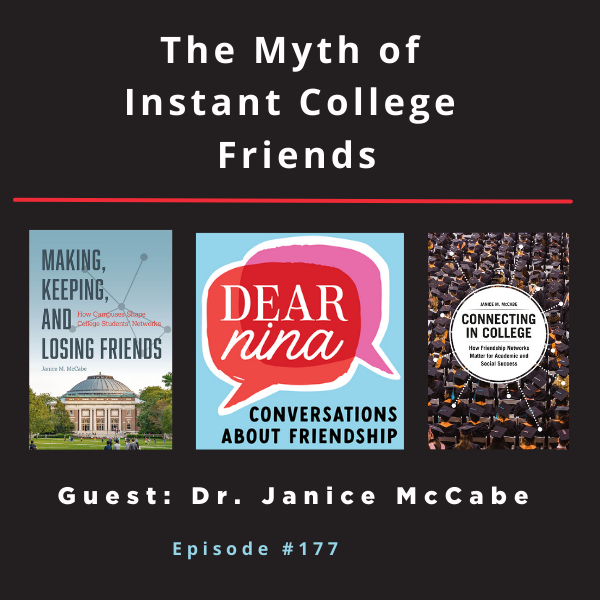
 Dr. Janice McCabe is an associate professor of sociology and women’s, gender, and sexuality studies and the Allen House Professor at Dartmouth College. She teaches courses on the sociology of gender, youth, education, social problems, and research methods at Dartmouth. Dr. McCabe is the President of the Sociology of Education Association (SEA). Her books, Making, Keeping, and Losing Friends: How Campuses Shape College Students Networks (University of Chicago Press, 2025) and Connecting in College: How Friendship Networks Matter for Academic and Social Success (University of Chicago Press, 2016), focus on friendship networks and identities during college and into young adulthood. She is interested in how gender, race/ethnicity, and social class operate as social identities and how they shape social networks. Her research has been covered, among other places, in the Washington Post, Time magazine; NPR, New York Magazine, and the Boston Globe.