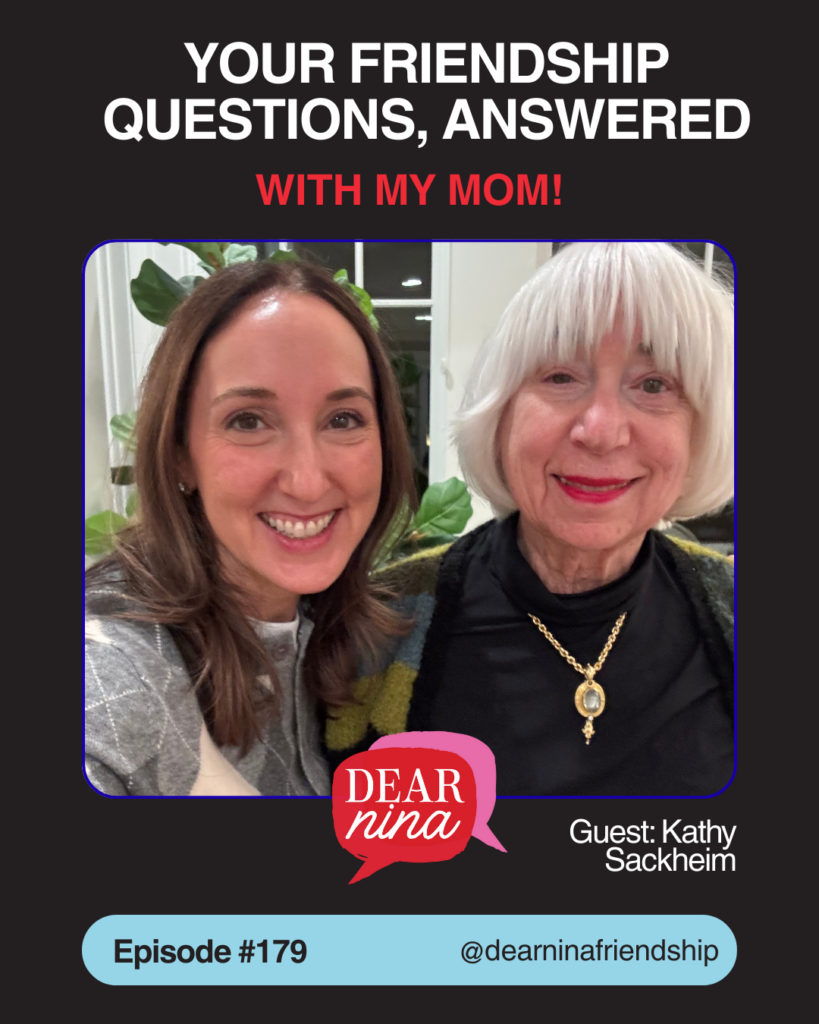
Kathy: [00:00:00] I think I might think about finding some other friends at this point. You know, I often say that I
Nina: was just gonna say, if you’ve never heard my mom on an episode, a lot of times that is her conclusion
Welcome to Dear Nina, conversations about friendship. I am your host, Nina Badin. I have been writing about friendship for over a decade, podcasting about it for over four and a half years. I am here with my mom, Kathy Sackheim, We are in my office in Minneapolis.
My mom is visiting me from Chicago and I’m trying to have us record in the same studio. We’ve done it in the past. But it was a while ago, this is definitely challenging my tech skills, but I’m proud. Mom, are you proud?
Kathy: I’m very proud of you.
Nina: We just did multiple test runs and we think it worked and we’re just hoping for the best.
Normally I record virtually with people, so it records very nicely on its own track and you don’t need to know all that, listeners. But I’m just telling you, when you change up the tech, it’s confusing.
Alright, we are going to do a bunch of [00:01:00] letters today, I have all these letters that have been piling up in the Dear Nina inbox. People write me anonymously to remind you. You can write to me anonymously, and that link is in the show notes. Where you really don’t even need to make up an email address or go to all these links to make sure I don’t know who you are.
The form does not require an email address, so I truly have no way to know who you are. That’s a great way to ask a question that you maybe don’t want your name attached to. People also ask questions in the Facebook group, either under their name or anonymously. And that’s at dear Nina, the group. But these questions are coming from my inbox. I actually don’t use the Facebook questions on the podcast itself.
Mom, here we go. By the way, everyone, she is seeing these for the very first time. I have seen them at least once because I filed them into my inbox at some point knowing that I would do another question and answer, episode, kind of like a rapid fire.
We’re not gonna spend a ton of time on each question, and I have a lot of short questions, which is nice. Those of you who are writing in, I just gotta say the shorter the better. [00:02:00] ’cause if they’re very, very long, it’s very hard for me to use them in the podcast. One last thing before we start. When I get a very long one, if it’s one I think would be applicable to a lot of people, I do use those once a month at @dearnina.substack.com.
Those are the newsletter ones, and I have been quoting my mom in those for at least over a decade, right, mom,
Kathy: right?
Nina: Every so often I’ll send her one and then say, all right, we need another generation’s opinion on this. And I actually think this is a great one for my mom to answer with me.
Dear Nina. I’m planning my 50th birthday party and three of my friends from college live outta town. What are realistic expectations about them flying in? If I’m being honest, I would be disappointed if they don’t come. And I do try to show up to all of their celebrations, but I also know it’s not easy. But we are at a point where our kids are a lot older and don’t need as much help. To be fair, no one has said they’re not coming.
I’m just preparing myself to be realistic.
So mom, what do you think about how much you can expect people to fly in for the big milestone birthdays?
Kathy: It depends on the time of [00:03:00] year. It depends on what else is going on in their lives. the best way I’ve learned through the years to keep friends is to not be too judgmental.
If somebody can’t make it and has a good excuse, you just have to overlook it and figure life interfered. Sometimes life does interfere.
Nina: That’s true. And would you go to their event anyway?
Kathy: Would I go if I were invited?
Nina: if they didn’t come to your stuff, like if you have a friend who didn’t come to your 40th, didn’t come to your 50th, didn’t come to your 60th, okay.
I guess that’s getting excessive. Maybe let’s talk about the same year. if it was within the same year they didn’t come to your big party, you’re invited to theirs. I’m talking out of town. Friends mom, not Chicago friends. Are you making the effort to go if they didn’t come to yours?
Kathy: It depends on what’s going on in my life. If I can go and it’s an old friend, I would certainly try.
Nina: I, I think that’s a good attitude. I, I would probably do the same thing, like I always try to do, what I can do, no matter what the other person did. I’m not measuring what I wanna do by what they did.
Kathy: I was actually invited to an out of town 80th [00:04:00] birthday party this year, and I hadn’t invited those friends to my 80th party.
Oh. But, I was invited to go to, Boston and then somewhere on Cape Cod and I was having some health issues and I frankly couldn’t do it. The friends understood. I called my friend on her birthday. We had a nice, long conversation I think she was okay with it.
Nina: I’m just curious, as a side note, if you are invited to something out of town and you can’t go, do you give an extra nice gift or you just give the same gift you would’ve given?
Kathy: maybe a little extra nicer.
Nina: I tend to do it too ’cause I’m like, I’m not paying for a hotel, I’m not paying for a plane ticket anymore. I can get you an extra nice gift. Okay, next one. Dear Nina, this may be lengthy, but to set the stage, a friend approached me at a birthday celebration that was for another friend. Okay, so we’re back on the birthday.
That’s just a coincidence. It’s from a completely different email. A friend approached me at a birthday celebration for another friend. We were seated next to each other. Suddenly she says to me, we need to be better friends to each other.
So we are going to tell each other one thing that each of us [00:05:00] could do better to be a better friend. I didn’t know how to reply , especially given that we were there to celebrate someone else. She replied, you need to reach out more.
My response was, I do try. You often tell me you’re busy. In the past I really have tried, but even just to call her, that has to be scheduled. Anyway, I was so taken aback by her discussion. I felt this was not the time or place, and also this was something she planned and thought about where I felt blindsided. I answered as best as I could. I feel she’s not a friend who was all in. She’s not always going to be willing to be open. She hates confrontation. Going forward i’m trying to reach out more, but she is always saying how busy she is. Also, she’ll commit to something and then she has to cancel or reschedule. Yet I still feel like I’m the bad friend, even though I’m the one scrambling to make sure that the way I’m a friend meets her approval. Maybe I don’t know how to be the right kind of friend. What are your thoughts?
Kathy: Maybe she needs to write her in the letter. You know, I’m big on writing letters. Yes. I’m trying to be a better friend. You’re always [00:06:00] busy. How can we fix this Put the ball back in her court. How can I be a better friend if you can’t come in and you’re always so busy?
Nina: Yeah, I think that’s fair. And I actually, I wish I knew what she said, what was like her one thing and maybe she did say that. Maybe she said, you’re always busy, but we don’t know.
’cause she didn’t tell us Right what she said back. But that is a really interesting situation. Can you imagine sitting at someone else’s party or really anywhere? Even if you were at a one-on-one coffee with somebody? I think it would be very jarring if someone said, with no notice. think it’s different if someone says, can we get together?
I really wanna talk about our friendship. Okay, now you’re coming mentally prepared that there’s gonna be a hard discussion. But to be blindsided like that, to have someone say, we’re gonna each name one thing that we don’t like about each other,
Kathy: there are many times in life when we’re blindsided, unfortunately, and you always think much later of the rejoinder that would’ve been appropriate. It’s just an example of that.
Nina: Well, something I say to people a lot is, not every friendship is worth saving. She is not required to fix this [00:07:00] friendship. And she asks at the end, maybe, I don’t know how to be the right kind of friend. I mean, it’s possible she doesn’t know how to be the right kind of friend to this person, but we get to have all different kinds of friends. . As you know, mom, I’m not like big on telling people to end friendships. I really think that’s unnecessary.
A lot of the time we can sort of move them to an outer layer a little bit, but especially if you live in the same town. It’s an unnecessary drama to add to your life. But I don’t know that our letter writer needs to turn herself inside out to be the right kind of friend to this person. it sounds like she does the thing the friend’s asking, and if the friend’s never available, I mean, how much is she supposed to reach out?
All right, let’s move on to the next one.
Dear Nina, there’s been a lot of in-group fighting lately in my group of friends. Most of us are in our upper thirties. We’re a group of five, but lately it’s been feeling like Survivor. A lot of alliance. Usually it becomes three and two. I know there are side texts. I’m part of the circle of two. I feel silly even writing this like I’m 13 again, I know groups ebb and flow, and I know we’re all in it. Four of us have [00:08:00] kids, one person doesn’t, but is trying. And I think we are just tired between marriage, kids, jobs.
Do you think it’s normal in a group to have these three that are always doing something and then two are that are doing other things and just, what are your thoughts about that?
Kathy: are people objecting that they’re not doing everything as a fivesome?
That’s what I’m
Nina: gathering. Or it feels not cohesive or something. What I’m gathering is that the three are probably talking about the other two and the two are, that’s something like, that’s what I am reading into it. What about you?
Kathy: Think so. I think I might think about finding some other friends at this point. You know, I often say that I
Nina: was just gonna say, if you’ve never heard my mom on an episode, a lot of times that is her conclusion and it’s at my live show. Uh, she said that. we did in the live show over the summer in July last summer, which was in Chicago.
I was able to quote my mom on one of the questions we answered, which actually was about friend groups as well. Different question, but it was also about a friend group, and I think that was your response, like, time to find new [00:09:00] friends. I think that you’re more willing to say that than I am sometimes. And sometimes you’re right.
Sometimes that is the answer. It’s just I hear from so many people who struggle to make friends and I know it is not that easy. I know, you know, it’s not that easy too. But, I really hear how not easy that is. So I’m not so quick to say give up. But yeah, you also shouldn’t, like we said on the last question, turn yourself inside out to make something work that might not be working. Or she said she’s one of the twosome and maybe she’s feeling like left out from the threesome.
The other choice here is to not worry so much about what those three are up to and just accept that we don’t always have to do everything together.
Kathy: I’m not saying to give up the five, I’m saying maybe she needs to add number six and number seven. Let the fivesome be less important in her life.
Nina: Oh, that’s such good advice.
So you don’t mean six and seven as part of the group, but like have a couple other friendships that are outside this group.
Kathy: Exactly. that’s what I’m trying to say. That’s
Nina: very astute. ’cause I actually think. Oftentimes, even though it’s, again, hard advice to take,
sometimes the answer is you need more friends [00:10:00] or other friends, so you don’t have to depend so much on these couple of people to be everything to you and to meet every need, which is impossible, especially as we get older.
mom, here’s the next one. Dear Nina, I was on a large group chain, like a group chat Mom, you know what that is? You’re on some with the family. Are you on any with friends?
Kathy: No.
Nina: Okay, interesting. I was on a large group chat with some school moms and I shared my opinion about a recent news topic. It was crickets at first. Then one of the acquaintances on the chat basically attacked me. She felt the exact opposite about this current news topic. She went off. The rest of the group chain stayed quiet, and I could feel my pulse beat and my breath quicken. I didn’t need everyone to stand up for me or even agree with me, but one of my closest friends in that chat said nothing, and that really made me sad and angry. I removed myself from the chat. I haven’t said anything since. I don’t care to speak to the text attacker about this. We’re not even good friends. [00:11:00] I’m not interested in that friendship anyway, but I would like to say something to my close friend who didn’t stand up for me, how can I approach this? That’s a sticky situation, isn’t it?
Kathy: Oh my God. I have no idea how to answer this one.
Nina: Well, let’s say it was in person. Okay, let’s pretend it wasn’t a group chat.
Let’s say you were at a dinner party. You said something that you seemed, you know, didn’t seem like it was gonna upset anybody. It was just your opinion on something. Everyone at first was like silent and then somebody at the party, I’m picturing a small party, like eight people around a table.
Somebody there who wasn’t a close friend, but obviously someone you know, really came after you and then your very close friend just kind of sat there and was like, la, la, la. You know, just didn’t say anything. What are the expectations here? It’s kind of similar to that.
Kathy: I think maybe I would say to the first person who attacked me, why don’t we agree to disagree and let’s move on. And then you’re not depending on anybody else to stand up for you,
Nina: so stand up for yourself, number one. Okay. Yes, I like that. what would you do about this good friend who just kind of watched you [00:12:00] suffer even though this is all on text, that is what it feels like.
Kathy: I might ask the friend, how come you didn’t say anything? Or do you agree with the person who attacked me or, boy, I really felt attacked. I wish somebody had said something. maybe the friend will come up with some reason why she didn’t.
Nina: and by the way, I could understand maybe why the friend didn’t. First of all, it’s possible she agreed with the attacker and has up until then, kept politics out of their friendship. or she herself didn’t wanna get attacked, like, I understand. Not wanting to put something in writing. People screenshot and send stuff around all the time. It might’ve been nice if their friend texted our letter writer on the side and said
even that, if that were the case, like, oh God, I’m so sorry. I know that was awful, but I also just do not wanna get in the middle of it. And I’m not saying our letter writer would be happy with that response, but it would at least be some touch point on this whole thing. I think the silence is the worst.
Kathy: I agree with you. That would’ve been another way for the friend to show that she was being a friend.
Nina: Yeah. Like some solidarity. Even if she doesn’t agree, just to [00:13:00] say Yuck. I know that feels awful. Sorry that happened to you. Yeah. We forget sometimes that that’s always an option. you can acknowledge that something felt bad without agreeing with them necessarily, you know? Right, Okay. Let’s see.
Oh, this is good. I wonder what you think of this. Dear Nina, your podcast has got me feeling a little more confident about taking initiative and asking people to hang out. My question is how long since I last saw someone is too weird to reach out? If I text someone or message them on Instagram, but we haven’t actually spent time together in months or even years, is it weird to reach out again? Do I look desperate? What if they’ve forgotten I exist and they’re like, who are you again?
Kathy: Well, I think in a lot of relationships one person does the reaching out more than everybody else.
Nina: Oh, okay guys, you heard it here. How many times do I say that on this podcast? I say that a lot like you, you just have to accept sometimes you have a different skill set and or the relationship’s more important to you and that’s okay. we don’t all have the same priority all the time
Kathy: and so if she wants to see this [00:14:00] friend, she should reach out and not wait for the friend to reach out to her take the risk.
Nina: Yes, I agree. It’s always worth the risk. And I hear her asking like, is it weird? And I totally get that question , and I appreciate her using that word. ’cause I think it’s what a lot of people worry about is coming off weird or needy or too much or all these things and you’ll get the idea. I think if the person says no several times in a row, then it’s probably time to stop reaching out.
But I often say if the person says yes and seems interested in hanging out and is engaging once you’re together, is a good listener and asks questions and seems happy to be there, that’s fine. And you only know if you go, if you try.
Kathy: I agree.
Nina: We’ll just do a few more, mom, and then we’re gonna just check in with your life.
Dear Nina, A lifelong friend has been having an affair for many years. I genuinely support her, but as this continues, I’m struggling on how to perceive her and the situation since it doesn’t seem like she’s living authentically or giving her husband the opportunity to make a choice for himself.
I don’t mean that in a bitter, judgmental way. Just an observation. I guess I’m hoping for some insight or another [00:15:00] lens I might see this through. Thank you for your time. This is, I’m glad I saved this one for you. First of all, I haven’t done an episode like this in a while, I think I was nervous to do it in my newsletter and like commit to writing.
I don’t know how I feel about this one.
Kathy: Well, you were
Nina: married how many? 56 years. Yeah, so my mom was married to my dad for 56 years. They have a lot of friends.
Kathy: I’ve had three friends who I knew were having affairs.
Nina: Wow.
Kathy: Okay. Uh, first time I’ve heard that. Yes. I felt it wasn’t my business. two cases were people who lived out of town. One told me about it over lunch.
She had an affair with a business associate What was I gonna say? and she later got caught. And
Nina: then what happened? Did they get divorced?
Kathy: No. No. Oh, they worked it out? Well, she died, um Oh, okay. Of the disease. I mean,
Nina: okay. I don’t mean to laugh, I just not, that wasn’t what I expected.
Kathy: Okay. And then the third one. was a childhood friend and had a very good marriage had a couple different affairs,
Nina: and they stayed married till the end.
Kathy: I was just sort of [00:16:00] amazed and I listened and. I just figured it wasn’t my business.
Nina: Did you talk to her about it on a regular basis? Like were you a confidant or was it just this one time she wanted to tell you?
Kathy: I think I was a confidant. and she knew I wouldn’t say anything to anyone.
Nina: I understand what this letter writer is asking, like she feels maybe like part of her friend’s life is not real. She used the word she’s not living authentically or giving her husband the opportunity to make a choice for himself. and I imagine she doesn’t wanna ever have it public that she knew. It is a lot to ask of a friend. I mean, that was nice of you, I think, to be a confident for your friend. But I also think it was a lot for your friend to ask of you. In my opinion,
Kathy: I didn’t see it that way. this person who wrote the letter is standing in judgment probably the friendship is just gonna dissolve because the friend having the affair is going to sense.
Your letter writer’s standing in judgment. I suppose she could say, um, your lifestyle is making me uncomfortable. Let’s not discuss this. I I can’t [00:17:00] discuss this with you.
Nina: I think that’s fair. I mean, people avoid all kinds of topics and it’s not right or wrong to be your friend’s confident on this, but it’s also not wrong to not want to be, I know that was a double negative.
Yes. But I think, yeah, I understand that you feel it’s judgmental and I see it more as she doesn’t want the burden of keeping this secret. Um, okay, let’s keep going. That was, by the way, first time I’ve heard about my mom’s three friends. We’ll be talking about that more later.
Okay. Mom, that was so nice to have you here to answer these because sometimes these letters pile up and I start to feel a pressure and I feel bad if people aren’t hearing from me.
I cannot possibly answer them all. But this was a nice way to get through a bunch. And you’re so no nonsense. And to the point that it’s nice to have you here with it. ’cause you say it, your answers in such a definitive way. And I’m like, okay, good. I can add a little bit and we can move on.
Have you always felt like you just know your opinion on something that quickly?
Kathy: I tend to be terse.
Nina: That’s a quotable.
Kathy: Yeah. at this point, I’ve had a lot of friends. As a [00:18:00] teenager I had difficulty learning to be a friend and made a lot of mistakes and I think I learned from them. I find the best way to be a friend is to not be judgmental and just try to go with the flow as much, as much as possible.
Nina: Yeah. You actually are a really nice mix of, you know, what you think, you’re pretty sure about your opinion on stuff, and at the same time, you really do go with the flow. You’re easygoing. You don’t impart your opinion on others. I think that’s what it is.
Like, you know what you think, but you’re not gonna make a big deal about it.
Kathy: Yes.
Nina: mom, we’re gonna go another direction now that I have you here at 80 years old sitting in my studio. Is there anything new about friendship that you feel that you wanna share with my listeners. You’re talking generally to people who are younger than 80.
Kathy: One thing I’ve noticed. Since I’ve turned 80, a number of my friends are older, 83, 84. I have a friend who’s 87. at this age, people are starting to have physical problems that they didn’t have before. thank goodness [00:19:00] for our friends that we can be supportive of one another. Can’t run around the way we used to. Friends are really important. husbands are important too, but that’s different from friends it’s worth working on the friendships so that when you get to be older, you have these, these good friends.
Nina: That’s great advice. Does it surprise you that I have spent over a decade talking about and writing about friendship?
Kathy: Uh, at this point I’m kind of used to it. and it’s a worthwhile topic because, thank goodness for our women friends.
Nina: Yeah, and you’ve always said that like that it’s important.
Mom. The last issue I want to address has to do with something that comes up all the time. , Comes up in topics people pitch me about, but I didn’t feel they were necessarily the right guest. The right guest is my mom, and the topic is. Is your romantic partner, your spouse.
It doesn’t have to be a spouse mom. It could also be a, you know, just a significant other of some kind that you’re dating. What do you think when people refer to that person as their best friend,
Kathy: okay. We’ll start with your [00:20:00] dad.
Nina: Okay.
Kathy: So, um, I got married at 20, he was 24.
In many respects, he was my best friend. However, I was always very careful never to discuss the business of my other friends with him.
Nina: Oh, I love that topic. It’s something, uh, you and I think have answered together before in a newsletter I’ll to find it and dig it up. a couple of my friends didn’t believe me.
They’re like, oh, there’s no way you don’t tell Brian everything, and I’m telling you. First of all, Brian doesn’t wanna know most of it, and I don’t want the pressure of him having to remember what he’s supposed to know.
I really don’t. And I maybe learned that from you.
Kathy: Well, years ago, a friend of mine, It’s sort of a long story that’s not appropriate for this, but she said something at dinner, which your dad had the same, sales rep as her father-in-law. her father-in-law had told her something that your dad heard. He told to the sales rep and it was a whole bruhaha.
Nina: Oh yeah.
Kathy: I learned right then. Don’t tell dad, don’t tell dad. Not things that are issues with friends. [00:21:00] Mm-hmm.
Nina: No. Right. No. Not if like you wanna vent about your own issue with a friend that’s different. I understand you’re talking about not sharing with him other people’s issues.
Kathy: Exactly. Now, certainly we talked about our own issues and. We were certainly open about that, and he was very good sometimes at giving very practical advice or coming up with practical solutions for problems that we were having. at this point, I, I do have a partner since your father died, and I think he and I are kind of best friends at this point.
Nina: I was wondering if you would say that, I think you guys. Do a lot of things together. Yeah, we do a lot of
Kathy: things together. we talk about everything. We talk a lot about our childhoods, which didn’t do so much with your father. I don’t know why, but it’s just, this is something we both discuss. So do I tell him everything? Certainly not about my friends and their issues, but about things that concern us. Yes.
Nina: I would say that Dad was very [00:22:00] encouraging of you, of having your own friends and you of him. Would you agree?
Kathy: Yes. He had a group of men friends, um, that he did things with and it was fine. You know, they talked about sports. It was different than women friends.
Nina: I would say I consider Bryan my best person, like he is the number one person in my life. But I wouldn’t call him my best friend, and I think he would feel the same way. Like he has other people that he calls his best friend, and I, you know, have several people I call my best friend.
Kathy: I’d like to say some more about
this.
Nina: Oh, okay.
Kathy: Great. Go ahead. friends are different from romantic partners. with a romantic partner. There’s a certain level of trust and closeness Things that you would tell the romantic partner that you wouldn’t tell a friend, and yet there are friends that you would tell things that you might not tell to the romantic partner because it’s not their partner’s business.
It doesn’t have to do with the two of you.
Nina: Yes, that’s right. I am very into categories being their own categories. What I mean by that is I also will get pitched a lot from people who’ve written novels and they’ll say, [00:23:00] there’s a mother, daughter and my novel and they’re best friends and I wanna
talk about that on the podcast, and I usually write back and say, my podcast is about friendships and making friendship work and its own intricacies. And a mother-daughter is different. I feel the same way about a husband, wife, or a boyfriend girlfriend. Like meaning those are their own special relationships.
Mother. Daughter is its own relationship. Romantic partner is its own special relationship. Cousins, neighbors, all these things. It doesn’t mean you can’t be friends, but it’s not what I’m doing on this show. I like to keep those separate. ’cause it’s different. You can’t, I mean, people do it, but you can’t break up with your mother or your daughter, people do. I mean, do you, do you see a lot about this now? Right. I know. And we won’t even go into that. ’cause that’s like a whole thing and neither of us are therapists and I do not wanna even opine on, on the no contact stuff. but technically speaking, I mean, you’re born into this relationship or however the family came to be, that’s different than friends where you can have many of them and you [00:24:00] choose them and you can un choose them.
And not that it, that isn’t hard. It is hard when friends break up, but. It’s not as hard to make more friends. You can’t really come up with another mother.
Kathy: Right.
Nina: I just, you know, it’s different.
Kathy: the spouse, partner, romantic. It’s, it’s just a whole I agree with you.
It’s a whole relationship unto itself.
Nina: Yes. And maybe to call it friendship or call that person your best friend. it sort of messes with the definition of romantic partner and messes with the definition of friend. Those are separate things. They’re different. Okay, you’re not on social media. But I see videos sometimes where. Somebody is standing at the, marriage alter.
They’re the groomsmen or the bridesmaid, and they hear someone say to the groom or the bride, you’re my best friend. And then it’s usually a comedy video. It’s like these aren’t serious videos, then it will pan to the bridesmaid or the groomsmen, and then they’re. Oh, thanks. You know, I’m glad I just spent all this money on your bachelorette party and on this dress and on everything, the wedding shower, but [00:25:00] he’s your best friend.
what was I, and I kind of get that because it, it’s messing with definitions of language
Kathy: I feel that the romantic nature of a spouse or partner is a whole deal unto itself. the trust and closeness and intimacy, you wouldn’t necessarily want that with a friend.
Nina: Yeah. Different expectation. yeah. That’s why I say Brian’s my best person.
He’s my best person. He is not my best friend. These are semantics at this point, but people do ask me about it a lot. Like, can your romantic partner be your best friend? And it’s like, I’m not here to tell anyone who can or can’t be anyone’s best friend like you do whatever you want.
I would just advise people to also have close friends in addition to their romantic partner. That’s, I think, the bottom line.
Kathy: I agree.
Nina: We’re in lockstep on that. Yeah. Well that’s no surprise. Um, okay mom, thank you for being here in the studio and I will have all of the other episodes where you can find my mom, Kathy Sackheim on the podcast. This is probably like her fifth appearance, and [00:26:00] she’s been in the newsletter a lot.
I couldn’t possibly link to all of those. But if you ever wanna see, me answer longer, anonymous questions and see my mom’s opinion too, she’s in a lot of them. Those are@dearnina.substack.com and once in a while she pops into the Facebook group, which is at Dear Nina, the group mom. Why don’t you come in that more?
Kathy: I haven’t been on Facebook in a year.
Nina: Oh wow. My mom’s so like, she’s just over it. She’s so much cooler than than anybody else. That’s the truth. You don’t waste your time with that stuff. Uh, okay guys, I guess we can’t get her on the Facebook group, mom, thank you so much for being here. I very much appreciate it. What a joy to have her here. Thank you.
Kathy: You’re welcome. It’s fun to be here.
Nina: Listeners, come back next week when our friendships are going well. We are happier all around. Bye. [00:27:00]