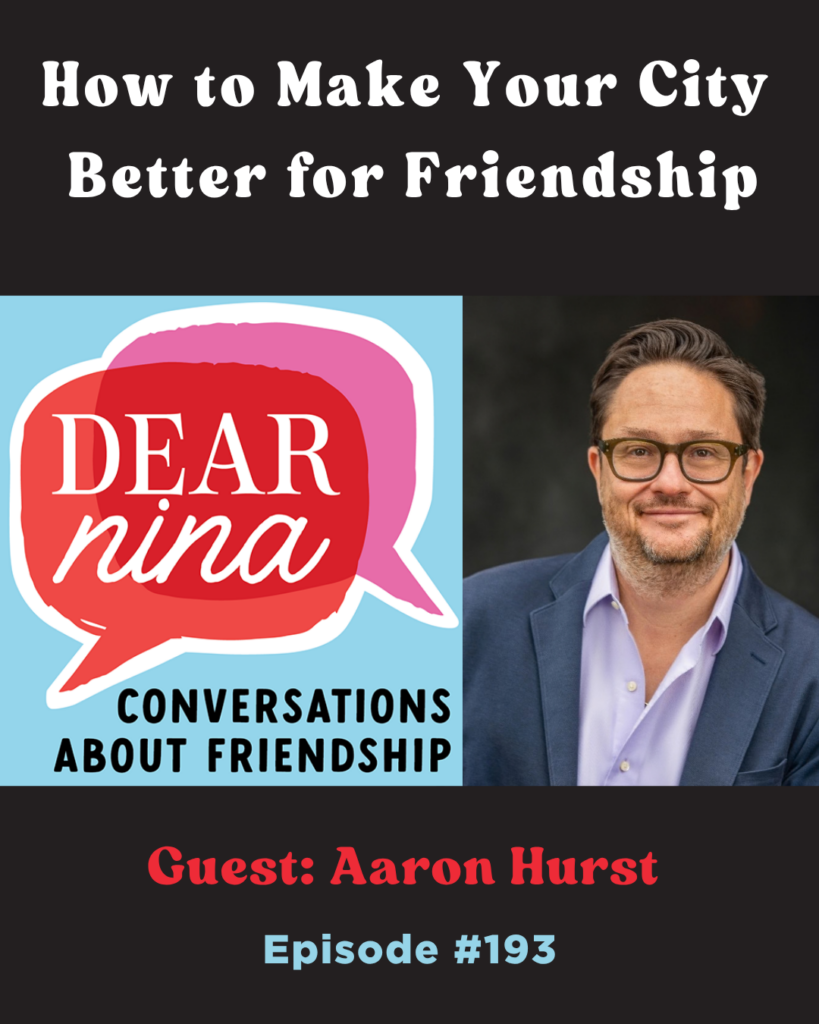
Nina: [00:00:00] , welcome to Dear Nina, conversations about friendship. I am your host, Nina Bason. I mostly focus on friendship on the interpersonal one-to-one or small group kind of friendship issues. Every so often, I like to branch out and talk about connections on a bigger level. It is not the focus of my show most of the time. There are so many people out there doing incredible work in this area, and it’s important to highlight them when I can.
Because not only is one-to-one friendship important in your life, so is the social health of the place you live. I have the absolute most perfect person to talk about this with. We had such a fun conversation, a lot of good back and forth.
Aaron Hurst is an expert in purpose and social connection. He’s the bestselling author of The Purpose Economy. He’s the founder and CEO of the US Chamber of Connection. Do you know we had that? He will explain what that is,
and he uses behavioral science to build [00:01:00] infrastructure for connection in America. He needs our help too. He needs our help in communities across America to make this happen. Aaron is looking for 1 million volunteers across America to do this community building.
We’re talking back to basics. Potlucks. Serving bagels in your driveway for neighbors. We’re not talking massive, fancy events or any major investment. Small investments, but all over the place and for a lot of people to make this a better place to live.
Aaron’s work has been featured all over the place. New York Times, Washington Post Fast Company, Bloomberg.
Plenty more. As a reminder, I always have in the show notes Where you can find the resources you need from an episode in today’s example, that will be where you can sign up to be one of those million volunteers.
Where do you live? Let us know. I’m curious. different cities are known for being more welcoming or less. We get into that a little bit in the episode and I’d be curious to know where you’re listening from and if you find it to be a friendly place. The best place to do that would be [00:02:00] in my Facebook group at Dear Nina, the group.
I always have a thread for each episode where you can make comments, and of course on Instagram and TikTok.
You’ll see this episode on YouTube if you wanna watch us talk, and you can comment there with where you live and how you find that city to be. That’s also at Dear Nina, friendship and YouTube. And finally, I have a newsletter on Substack Dear nina.substack.com.
Where there will be information on this episode where you can sign up to be one of those volunteers and discuss where you live, what could use improvement, and do you wanna be part of that improvement. Let’s get to my discussion with Aaron.
Aaron Hearst, welcome to Dear Nina. I’m so glad to talk to you.
Aaron: I am beyond thrilled to be here with you. I love your, series and love that you’re focused on helping people with this issue. It’s so important.
Nina: And you really look at issues of social connections on a bigger scale. You know, like my podcast oftentimes is more on that one-to-one personal relationships, the stuff that we do to get in the way of our own friendships, and I’m always trying to help people make it easier.
And you’re looking at. Something that I also like to talk [00:03:00] about, but not as often much grander scale. Can you explain before we dive into it, what is the chamber of connection? I think most most of my listeners don’t know that exists.
Aaron: Well, we’re relatively new, so I wouldn’t be surprised. So, about 150 years ago, the US Chamber of Commerce was created to redesign our country around business. They did an amazing job of building a country where businesses have more rights than people do. And when I started the US Chamber of Connection, I was like, that’s what we need to do. But now we need to redesign society to be connection first. We need to bring together all the leaders working on connection, come together to actually fundamentally put connection at the center of how we design our cities, our neighborhoods, our jobs. Et cetera. And in the age of ai, like the consequences of not doing it really is that we lose our humanity.
if we don’t continue to invest in social connection, humanity is gone. The forces against connection are just too great to overcome.
Nina: I agree so much. I mean, it, it, cannot be overstated. The stakes actually are huge.
Aaron: it’s the greatest challenge in our society today. And yet people don’t think of it that way. they don’t think [00:04:00] of it as a cause. They just think of it as a something that’s happening in the water. That’s not the way it should be. But when you look at every social issue, they’re all being affected by the decline in connection and trust.
until we address this, all the symptoms are not gonna be solved for. I believe strongly in it, but I do wanna say Nina, my journey to a large degree was personal. I went to a meditation retreat, down in Baja for the Modern Elder Academy, which is a great program for those of you over 35.
And that’s how they define an elder over 35. and I did a week there and there was a meditation instructor and he asked, you know. What is it you most want in life right now? And I’ve been a CEO entrepreneur, father, traveling nonstop and like, it just struck me, like lightning, friendship. I don’t have enough friendship in my life.
I haven’t cultivated the friendships. I’ve been traveling nonstop. you know, I have friends which are my employees, but that’s not the same thing. I had like a real deficit and I did a practice. one week retirement to see what would it be like to retire right now.
And I was like, I have just totally underinvested in friendship. I’ve [00:05:00] totally underinvested in hobbies, I need to change this. But then he asked a follow up question, which was really powerful, which was, whatever it is you want most in the world right now is what you need to give.
This was really powerful to me. ’cause I thought, okay, this is not just about me making friends, but actually this needs to be my purpose right now is to figure out how to help everyone address that need. How do we build the systems in our cities, in our neighborhoods across the country for everyone to make sure that they have the best chance possible of connecting?
And that really on a personal level, was the impetus for the US Chamber of Connection. I started inviting strangers over to my house for dinner. I have eight to 10 strangers every two weeks came to my house. I made them dinner, served them dinner, and had a couple questions for them, um, about their experience with connection.
Started understanding what their journeys were and then out of that, really came up with what I’m hoping will be an important part of how we address the issue.
Nina: I have so many questions for you. First of all, on what you just said, how did those people know about these dinners?
Aaron: it was a mix. Like I’m super social, so I talk to a [00:06:00] lot of people and everyone I talk to is like, I’m having dinner. I have a whole model for dinners, so they’re Tuesday nights cause people don’t have plans on Tuesday night. And if they say they do, I’m like, well, I’m having another one two weeks from this Tuesday and you’re definitely free on that date.
And I was like, I’m putting you down right now. I’m not asking you like you’re coming to dinner. And like had a very high acceptance and show up rate as a result. and then I would do things like when I would speak at a local conference in Seattle, from the stage, I would just say, here’s my email.
If you wanna come have dinner at my house. you’re all welcome and just a handful of people would have the courage to sort of raise their hand to do it. And then I did one which got a little bit of press attention. I did a dinner only for Aarons.
Nina: Yes, I did see that.
Aaron: uh, which was so fun. So I just went on to LinkedIn, typed in Aaron Seattle, found about 150 Aarons, just started inviting them on LinkedIn and saying, Hey, do you want to come to an Aaron dinner?
Um, and then I had them all come and it was so fun just to all share how many similar experiences we had because of our name.
Nina: Wait, Aaron, I did see that. I remember not even researching for this a while ago. when you’re [00:07:00] saying this, it’s, it’s coming to me and. I am telling you it is a real thing for Nina’s and it’s probably for all names. If I meet another Nina, ’cause it’s a more unusual name, we are immediately connected. And we are from all different backgrounds. And there’s nothing else in common.
Aaron: what I found is there’s a lot of self-hating Aarons as I call ’em. Like it was interesting, one of the questions we asked was, would you hire another Aaron. Quite a few people are like, no, I
Nina: Is it the double A?
Aaron: Yes, they only had double As. Those were the
Nina: No, but I mean, is that why people struggle with their own name is ’cause the people have been misspelling it.
Aaron: It’s misspelling. It’s always being first in line, which is good and bad.
Nina: Yes.
Aaron: it is, uh, being, butt dialed more than anybody else. ’cause we’re the first in people’s phones. I think a big part of it too is like, it’s an Old Testament name, so it’s really interesting. It’s like a Jewish community and a black community where you get a lot of the Aarons from.
The first question we asked was, why did your parents name you, Aaron? And like, the stories were really diverse in terms of why people were named that my mother wanted to call me Acorn. My parents were hippies. That was, her name was Acorn. Uh, my dad was [00:08:00] like, eh, not so much.
Um, and it was, the day after Hank Aaron broke the record for most home runs in a career. So he just happened to see the name on the newspaper at the hospital and that was the source of the name. Told my mother, she gets the A but the rest of it’s gonna be different. so it’s just fun to hear everybody’s stories about why they were named Aaron.
Nina: a great compromise. but okay. It, that was important though because it, it’s just a good example of you can connect on something like this really low hanging fruit. It doesn’t have to be every part of your life is matching an order for a community to come together and create personal connections, but also larger, a larger group kind of thing.
You had a a personal story about your own history, your grandfather, and what even puts you into this kind of social thinking work in the first place.
And I’d love to, tell it here if you don’t mind.
Aaron: Yeah, no, of course. Happy to. So when I was the grade school, middle school, my grandfather took me into his closet. This is not a story about something that was inappropriate, so don’t
worry. Um.
Nina: definitely sounded like it could have gone
Aaron: know, And that would [00:09:00] be its own story if that happened, but thankfully it was not.
and he opened up a box and it was a piece of paper it said Adolf Hitler at the top of it. he had actually, as a naval officer, was one of the first officers in Hitler’s bunk at the end of the war and had stolen it off his desk. And he used That piece of paper to tell the story of what he saw rebuilding Germany after the war and being able to actually bring two enemies that have been killing each other together to actually rebuild a country through shared purpose.
And he realized that if we want to prevent. further conflict. We need to find a way to build shared purpose. So he went on to work for President Kennedy and really proposed this idea that we should have Americans go abroad for a couple of years and do work, not military work, but actually service, work, working side by side and shared purpose with local communities.
And that became the Peace Corps, which to me is one of the most powerful models in our history of sort of doing the Marshall plan on a very tiny scale, being able to actually build, connection. And then he went, and I was the CEO of the Aspen Institute for about 25 years. And the Aspen Institute core idea behind it [00:10:00] was bring top heads of state companies, musicians, athletes, like all these different people together to talk about an issue that they all have a stake in.
And to realize actually, despite all their different disciplines, when it came down to that human level they had so much in common and could start to build towards change. And people often ask me , how did you get to do great work, making an impact. And I’m like, I didn’t know anything different. Like that’s what was expected of me. I started in. College, doing a program, taking University of Michigan students out to teach in prisons that was the best part of my college experience. Like I just love connecting people who are different, helping them figure out that we’re all at the core of the same and also freaky in our own individual ways.
Nina: you’re like the right person for this job.
Aaron: Manifest
destiny.
Nina: I. One thing I hear a lot from my own listeners, people often talk to me about moving to a new city and everybody claims their city is the worst city.
It’s like part of what I want to talk to you about, I know you’re in Seattle and it has that reputation. I’m a Minneapolis also has that reputation and people call it Minnesota. Nice. I you’ve heard that and not all [00:11:00] my listeners will have heard that. So Minnesota nice is. It’s supposed to be sort of sarcastic, somebody will be friendly to you but they’re not gonna invite you into their home, is the idea.
Now, I grew up in Chicago. I moved here at 23 years old, maybe I was 22, and I’ve been here ever since. I’m 49, so I’ve been here a long time. I sort of feel like a local now, even though I didn’t grow up here. And I actually defend Minneapolis. I defend Seattle, I defend cities that have that reputation because I’m really big on
you yourself as an individual. back to this social isolation. You have to get out and go to stuff. Nobody’s coming to your house to be like, do you wanna come to a dinner for Aarons? No. You have to answer the thing that says, yeah, I’m an Aaron. I’ll come, but no one’s gonna drag you out to do it.
And that doesn’t matter if you live in Minneapolis, Seattle, Tampa, New York. LA. You have to take some initiative to get out and do stuff. However, you have actually studied this on a larger scale, and I am curious what you have to say. Maybe I’m not being fair. Maybe there really are cities that are much worse than others.
Aaron: I think [00:12:00] it’s a yes and that’s going on. So. I think there is a real issue around if you have an anti-social narrative or pro-social narrative as a city. ’cause what ends up happening is you start reinforcing the behaviors of that narrative. Seattle’s narrative has been the Seattle freeze, or as one long time resident said, our official tagline is, leave me Alone.
Nina: That’s.
Aaron: Um, that’s been the culture. Like I moved from Brooklyn to Seattle. what I think ends up happening, I think twofold. One is I find about one in five people is an initiator. And that really is regardless of where you are, and those are the people that like invite people over all the time. They’re the ones who are the ones inviting people to go out with them to places.
And I’ve always been that like cruise director, I’ve always been that person who’s initiating. I don’t think in most cases the other four are all gonna initiate. I think probably two of them never will. The other two might if you give in the right support and context, for it. But I think there is just something like some people’s personalities are initiators and we need a lot more of them, and then we need to build infrastructure in cities to make people [00:13:00] feel connected.
So I’ll give you a great example of this. In those dinners I did, a lot of people said, I’ve lived here 5, 10, 15, 20 years, and I still don’t think I can call myself a Seattleite.
And when people say that, it also means they’re not volunteering. They probably aren’t voting, they’re not engaged in their community, and they don’t feel a sense of connection to place, and that’s highly problematic for a lot of different reasons.
So what we’ve built here in Seattle, partnering with the city, is the first city to have an actual onboarding. just like when you join a company and you get Onboarded or an orientation to that company. What we’re doing is helping people when they move, actually come together with other newcomers and do workshops where they start to get to know each other and they start to design the life they want in Seattle.
Through the perspective of connection and identifying people who wanna do similar things, helping ’em realize all the different ways they can get involved. we’re building out social club fairs, like we’re building out all these things just to make it easier, but at the end of the day, your truth is the ultimate truth, which is
if you want something, go after it. Don’t wait for it to come to
Nina: [00:14:00] Yeah. ’cause that, you know, Seattle could have every amazing program in the world and you get a new job and the, HR people tell you about these things. But if you don’t go to them, if you don’t go to the fair, if you don’t go to the stuff, the city can’t do anything magical to make you make friends.
But I hear you on it is a start. That infrastructure does at least need to be there. Have you found that, first of all, people come and how do they know about it?
Aaron: yeah, so people come, I think it’s an ongoing process of building awareness, around it. But we’ve had people come, I think they’re, most excited about the social club fairs. That’s been the biggest hit ’cause it’s just something that they intuitively get from their college or high school days. Like this idea of.
The activities fair, is very intuitive. And the two things in our national study that we found that were the biggest barriers besides being too busy was I don’t know where to start. So we’re trying to help ’em with that. And then the second one is, I’m uncomfortable going to something alone.
So we’re really focused on those two first points of like, how do we help people have a simple place to know how to start.
And part of the reason we’re building out this million person volunteer, movement, which we can talk about in a minute, is we want just a lot of people who are [00:15:00] inviting people. So they can go for that first time with somebody and have that copilot on that first time into a community so that they do feel comfortable.
Because the invitation really is the most powerful thing we can do for each other is just invite people to come to things. You don’t have to commit to being best friends. You don’t have to get married, but just have the grace, have the generosity of just inviting people to go to things that you enjoy and exposing them to it ’cause they’re waiting for that invitation.
Nina: That’s so true. And you know, there’s an irony here where if you came alone, would meet more people. That’s the truth. If everyone came alone though, it’s almost like every single person at this event has to not have come with somebody, and then it opens up the possibility, right? ’cause if a couple people have someone, you’re never gonna talk to anyone but the person you came with most
likely.
Aaron: No, I think that’s exactly on point, and I think what we’ve seen in the events we do for newcomers it’s so powerful is they know everyone’s open to a friend date. Whereas any other environment, you’re like, ah, maybe their dance card’s full. When you have an event that’s focused this way, you know, everyone’s interested in meeting people and that makes such a difference.
[00:16:00] And we found, even in the social clubs, a lot of them weren’t putting the systems in place to make someone coming alone who is new, feel integrated quickly, and they feel like they just joined a clique and they’re on the outside of the clique. So a lot of what we’ve been doing is trying to build systems to train community builders on how to actually help that individual, that newcomer
Accelerate their sense of belonging into that community.
Nina: I don’t know if you have encountered a, a former guest of mine. She’s a Dartmouth sociologist, Dr. Janice McCabe, her researches on friendship markets. That’s exactly what you’re describing and what I’m talking about too, where it becomes very clear to someone who as astute pretty quickly whether a market is open or closed.
And so what you guys are trying to create are open markets in a place where, or all these places where it otherwise would feel like a closed market. Not everybody realizes this is the kind of stuff I deal with more in my show. Not everybody realizes right away it’s a closed market and they’re like banging against a closed door.
And what I try to help people with is. See that sooner so that they can move on and not be so bitter, not be [00:17:00] so bitter about the freeze and the Minnesota nice. And it’s like, listen, once you’ve lived in a place a very long time now I’ve been here a long time. I am not as open to every single new person, even though I’m quite an open person as I used to be. So you need to have these more obvious open markets for people who do have this need, and I love that you’re doing that. It’s so important. Okay, so 1 million volunteers, all these cities. How are we gonna do it?
Aaron: You’re gonna help me now. That’s the most important thing.
and your listeners. So what we’re doing is we’re creating a welcome committee, a million people who are gonna help welcome people in their neighborhood. it means both welcoming newcomers, but we also found 50% of American adults right now are lonely and disconnected, and we want to invite them back and welcome them back into social society, into social life.
So it’s not just about newcomers, it’s really about helping those that need that invite to get out there and to do this. what we’ve built is a program where people can sign up, to be a welcome committee member for their neighborhood. ideally they bring a couple people along with them in that [00:18:00] process.
And we have a three month onboarding where they go through and we help provide them with the training, practice and a cohort of other people around the country who are doing things like. Hosting potlucks, building block parties, doing simple things in their neighborhood just to help people have a space to come together, and they’re raising their hands to do this.
And when one person does it. It can help a block start to actually know who they can count on and to be able to have support. When you get people throughout a neighborhood doing it, you start to change the culture of that neighborhood. Uh, a friend of mine did it in her apartment building and it actually changed the property value because people wanted to live in that building.
So they’re creating the energy and the consistency of that social connection. And what I believe is if we can get a million people, so we have people. In every neighborhood in America doing this, we actually have a chance of shifting our culture as a nation to be pro-social, to be about connection as a priority and that those same people who are doing that can then become experts in what’s going wrong in your neighborhood Like where are there challenges? collectively can also become [00:19:00] lobbyists to the local city to say, we really need these changes made to help with connection. And as a force nationally with a million volunteers, we can have a voice in federal government as well, and with federal policies to say, here’s what we’re seeing across the country with all these amazing volunteers.
We need to change some of these policies. or we need to find resources for X, Y, and Z so that we can actually move forward as a nation with connection at the core. So we’re looking for folks who can, Provide three to five hours a month focused on building connection in their neighborhood. the great news about this is you get value out of it too.
It’s volunteering that’s not just about the other person. It’s actually about making your neighborhood, your block a better place to live. You actually, defacto may make money out of it because it’s gonna cause the value of your home potentially to go up. there’s a lot in it for folks, we see a way to turn this all around.
If we can get one of those inviters on every block engaged.
Nina: This is brilliant. I am so on board. I just want you to know I’m very into this because it does, it helps everyone. And not even just property value of course, but that age group you’re talking. About, I know [00:20:00] you’re looking for all ages, if you’re retired, if you’re in a new period of life, not a new city, You’re in your same town, but you’re in a new stage you find that you, are lonely or in need, and so it’s, you are helping create a solution for yourself and for other people. What cities are you seeing so far? It go, well,
Aaron: I mean, we have a strong roots in Seattle, so we’re seeing that, Pittsburgh and San Diego and Colorado Springs. we’re seeing a lot of engagement, but we’ve got 16 cities so far where we’ve got people starting to come together, but we really want everyone who is an inviter to join it. It’s like a union of inviters where we’re gonna come together and like demand change in our society one block at a time.
we would love anyone who’s a listener, we’d love for you to start in your city or town. If it’s a town of a hundred people, awesome. If it’s New York City, awesome. Like, it doesn’t matter the size. Just be that spark, start to invite other people in. Let’s get a chamber of connections started in your city, and then let’s build from
Nina: What website do they go to? I’ll have it in the show notes, but I just want you to say it
Aaron: chamber of connection.org.
Nina: and then
Aaron: So that’s, [00:21:00] they can sign up on there. There’s, uh, every month we’re doing a new cohort so you can sign up, become part of this, as it grows, it’ll become more and more of a community and we’ll start to be able to create local. chapters where people can actually get together as volunteers, you know, whether that’s once a month, once a quarter, and actually also become a community around this active invitation, uh, and be able to strengthen and build new friendships.
And a lot of the people we’re finding who wanna volunteer, actually lonely people who the only way they feel comfortable working on it is actually to be the one helping others.
this is also an invitation for those of you you don’t have to be mis congeniality, it’s for the people out there that like want to build connection and are most comfortable doing that through actually inviting others and helping organize and host people, in your community.
Nina: It is such a hack for events. If you’re not that comfortable meeting people to have a job, to have a responsibility. It’s the number one
thing. yes. It keeps you busy. Are you getting any pushback? I can’t imagine why or what it could be. Is there anyone who pushes against [00:22:00] you in any way?
Aaron: In Yeah. And this messaging, anything.
not really. I mean, I think once people think about it, they realize it’s the number one challenge in our nation and something needs to happen to make it happen. the biggest. Areas of friction are around gentrification around sort of who’s being served, and especially with newcomers, what is their impact on the place that they live?
but I think no matter who you are building connection in your community, like it needs to happen.
we also need to bring people together across differences. And this is one of the most powerful ways to do that. so, yeah, we’re not seeing a lot of, I think, friction. I think it’s just people trying to figure out what it is, get their head around it, and then they just become evangelically excited about being
part of something positive and hopeful right now, and that directly impacts the wellbeing and happiness of the people that live near them.
Nina: And right at the moment when AI is just like every day of, I know we’ve already mentioned it, it really cannot, as I’d be overstated every day, it feels like people are using AI as a therapist and they’re using it as a friend, which, you know, I find ridiculous. And of course, a machine that never disagrees with you and is always [00:23:00] there and you don’t have to take turns. You know, I, on a different scale, I, do a lot of voice memos with friends sometimes I’ll call the person and be like, we need to have a real phone call.
Because me just having, especially the kind of person I am, a podcaster, me just having a monologue on your WhatsApp voice memos is not the same as me having to take a breath, let you have a turn, and we actually speak at a time that isn’t necessarily convenient. That’s what a phone call is.
. That’s what I see what you’re doing too on, a much bigger concept you have to leave your house and not be on your computer and do things that are in an inconvenient place in an inconvenient time that might cost you a little money and time. Maybe the one piece of friction I could imagine is around budgeting, who’s paying for it, like all
that.
Aaron: there’s so many creative hacks where it doesn’t have to, it can be a potluck, like that doesn’t cost you anything really. a lot of people just start off doing bagels in their driveway and coffee in the morning. that doesn’t have to cost you much. a lot of people just do walks in their neighborhood
Whether you like, have a massive budget and want to do like a blowout block party, or you just want to be able to go on regular walks in your neighborhood. there’s [00:24:00] an approach that fits who you are and what you enjoy. And it should focus on what you enjoy. ’cause that’s what’s gonna draw people to it.
so being authentic to who you are, what you’re able to do and enables you to do that. your point on ai, though, I totally agree and I think I describe AI as porn for friendship,
Nina: Oh, that’s so good.
Aaron: I think when you look at like what porn did around us, like removing friction for people around sex, I think AI is doing something similar for friendship where it’s a synthetic version that is just so much easier, but at the end of the day, not the same thing.
it’s gonna become a massive problem, and we’re seeing it in the workforce. We’re seeing people, like a lot of volunteering is getting replaced by ai, so it’s not just. Jobs are getting lost. Unpaid jobs are getting lost too. I don’t think you can state strongly enough what the impact is on social connection.
Nina: I just read an article over the weekend in the Wall Street Journal, and hopefully I can find it for the show notes that talked about how even extremely bright people, you know, professors, every kind of smart person you can think of sometimes think that the AI is thinking they [00:25:00] cannot, get around the fact that this really is just a machine.
It’s like they know it, but it still feels real and over time. I, I think about the younger generation who won’t know a time without it. It really will feel real ’cause that that’s all they’ve ever known. I’m so depressed
about it.
Aaron: It’s, absolutely, and it’s also, it creates this negative flywheel where. We get busier and busier so we have less time in theory for people. So AI becomes more and more attractive, but AI actually doesn’t take work off, actually causes us defacto to do more work, so we become busier.
So it’s creating this cycle where people are just doing less and less social connection and it’s the monetization of our attention yet again, like it did with social media. the only way we can fight back is building block parties, potlucks, having people over for dinner, joining social clubs.
Like these are the things that are really gonna make the difference.
Nina: really back to basics. I’m seeing this across the board, even in a parenting sense. My kids are a little older, but I have friends with younger kids and they are doing this tin can phone. don’t know
if you
have
Aaron: Yeah, I’ve seen those. Yeah. Yeah. Friends of mine work there.
Nina: This reminds me of just having bagels on your driveway. that [00:26:00] to me is the adult version.
they are reinventing the telephone. If you think about it. We’ve already invented that. We’re reinventing a block party. That is not new. So we have to go back to basics to get people out.
Aaron: Going back to basics and thinking about small towns often have this and it works. I think what happened is we got into bigger and bigger communities and more and more tech. We lost track of it. also I think one of the biggest changes, which we don’t talk a lot about because it’s a challenging just topic, which is when we started having households with both people working for money, the reality is the other person, typically the research shows was doing 10 to 15 hours of social connection work every week. So when you suddenly had both people working, we lost 10 to 15 hours in most cases of work, which in today’s dollars, about $500 billion and social connection work across our country.
we don’t talk about that, but that’s a big part of like, it takes work to build connection and. We need to find ways to make time in our lives. And not to put that all frankly on women, we need to put that on everybody to help build that connection in our neighborhoods.
Nina: you also think, and this will be the final thing and then we will wrap it
up,
are we somewhat [00:27:00] reinventing religion that already existed. I’ve used this example in the podcast before, but you know, my husband, I go not as much as he does, but I mean, he takes the kids to synagogue every single Saturday, and whether he is there or not, I always point out and I point it out to the kids, whether you guys go or not, that lunch is happening on Saturdays that community exists
not for you. You’re part of it, but it exists above you. I don’t just mean. in a religious above you, this lunch is happening, this service is happening, whether you guys are away or not. And it’s important that I think kids and adults see that there are things happening not just individually for them and it’s like it is, but it’s in churches and synagogues and mosques and things and it’s like a half this country I guess, doesn’t want to engage with that and, I don’t know what to do about that.
I guess that’s part of what we’re creating is other alternatives to something that actually already exists.
Aaron: It’s another Yes. And I think none of this is new. Like we as people are biologically wired for connection and trying to find different ways to do that. structured faith-based communities often do an incredible job of [00:28:00] that. They’ve studied it, they know how to do it in a way that’s highly effective.
It’s not always bridging. Between communities, which is another need. So there’s a need for that. we see the same thing with like different diasporas. the Indian immigrant community here often is very tight and there’s like really strong connection. It’s not always around faith, but there’s just, we moved here, we have a different culture.
We create restaurants, we create community, we support each other. So you see it happen there. what’s not happening is a lot of the bridging, but then also for that other, we found it’s over 50% of Americans are struggling with connection. They don’t have that institution and work is not Playing that role. I think for a while we hoped work would become religion and certainly companies did, but that’s just not a, it is not a good solution. I’ll put it that
Nina: Yeah. Yeah. Especially so many people work from home anyway, so that even if it started to be one option, it’s blown up anyway.
Aaron: and I think that’s where we need to, at the block level. Like it’s about creating micro communities, but then creating ways to bridge into other ones. So, for your, you know, your listeners, your community, would love your help to get out there and sign up to be part of the welcome committee, be part of making this change.[00:29:00]
You know, I go back that advice I was given. Whatever it is you want most right now. And I know for many of you it is friendship because that’s why you’re listening to this podcast. Focus Less on You getting Friendship and focus more on how do you give friendship to everyone in your neighborhood. if you do that, you’ll also get friendship through that process.
And it’s actually through shifting the mindset towards how can I give friendship that I think we can unlock this for you, but also unlock it for society.
Nina: Aaron, that’s a perfect place to end. I think that’s a wonderful message. Dear Nina listeners, please get on board. I’m gonna have all the ways that you can find Aaron’s work. I know he’s big on LinkedIn, but I’ll have the Chamber of connection, sign up right in the show notes. And thank you for coming here to explain it more.
’cause I could never explain it as well as you, of course, it’s your, it’s your baby.
Aaron: and I love what you’re doing and it’s clearly helping so many people. It’s a tough topic because so many of us just assume we’re born with the skills and knowledge around this. And not only are we not, there’s so many structural things happening today in society that are making it harder.
So it is great that you’re providing a resource for people to really, be seen and to [00:30:00] know how to move forward.
Nina: Thank you. Thank you for saying that, and I’m glad we’re connected now, and I end every episode saying to my listeners, when our friendships are going well, we are happier all around. For you, for this episode, I’m gonna expand that to your neighborhood, your community, when it is connected and going well, you’re just happier.
Aaron: Amen. All right, listeners, come back next week. Thanks, Aaron.
Thanks, Nina.