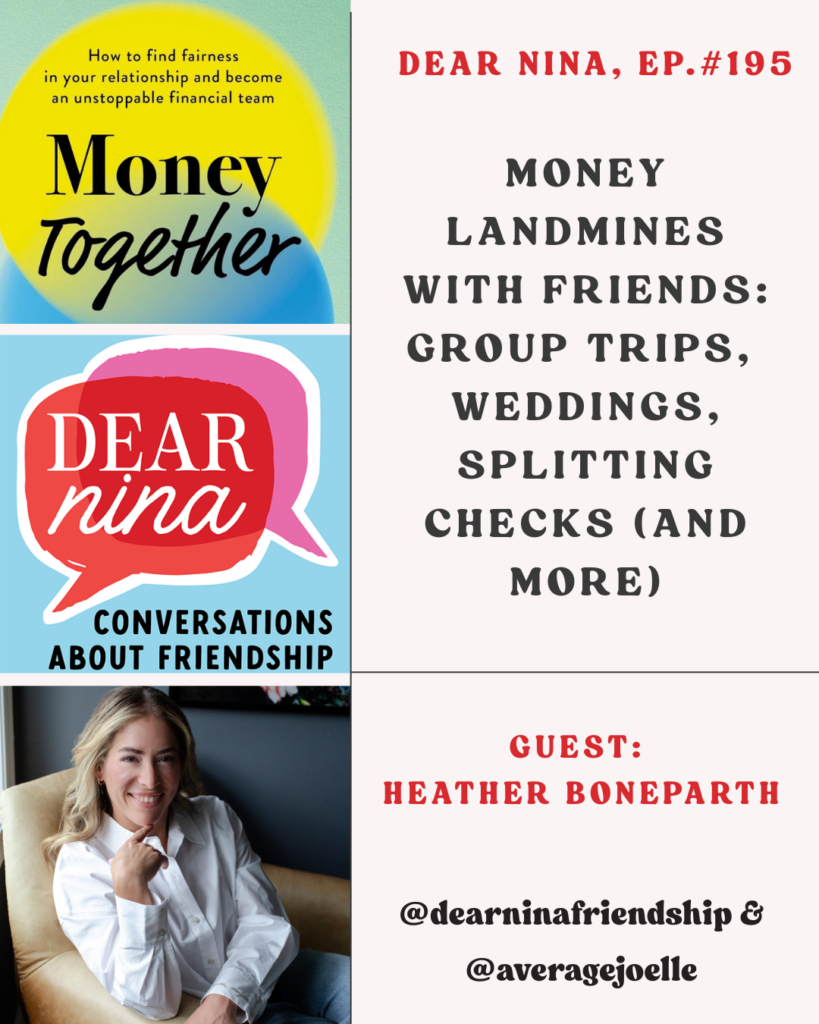
Nina: [00:00:00] Welcome to Dear Nina, conversations about friendship. I am your host, Nina Badzin. I’ve been writing about friendship for a long time, podcasting about it for a long time.
I think I’m gonna stop saying the numbers. I always say the numbers over a decade, five years for the podcast, but I realize these episodes get heard at any point, and then those numbers are kind of. Outta date, so I’m just gonna start saying a long time, and that is the truth. Today’s guest has been writing, thinking and working with people in the subject of finances for a long time.
Heather Boneparth is the Director of Business and Legal Affairs for Bone Fide Wealth in New York City. she’s the co-author with her husband, Douglas of Money Together, how to find Fairness in Your Relationship and become an unstoppable financial team. They also have 15,000 subscribers at their newsletter, the joint account. You’ll love Heather. We cover so many topics within the space of friendship and money.
We talk about splitting checks. We talk about traveling together. We talk about weddings for a long time, and [00:01:00] bachelorette parties and bachelor parties. We talk about some of the parenting things that come up where your friend’s kid gets Starbucks every single day before school.
Nina: And you in a million years would either not be able to afford that, or even if you could, wouldn’t wanna spend the money on that.
All this stuff comes up around friendships and money and how do you have this as part of your lives with friends without being judgmental? With being empathetic. Heather is very well versed in these topics, and she is not afraid to just say it like it is.
And you may even have more questions after it. Sometimes what I do is let those come in and then we address those in my own newsletter, which is@dearnina.substack.com.
All right. Here she is. Heather welcome to Dear Nina.
Heather: Thank you so much for having me, Nina. I’m so happy to be here.
Nina: So I want you to explain how you got from being a lawyer to doing what you do why the focus on finance, and then we are gonna get right into the juicy questions that came from listeners.
Heather: Absolutely. So the way that I describe it to friends, family, and colleagues is that I am a [00:02:00] recovering corporate lawyer. I spent. More than a decade in the commercial insurance industry before joining my husband Douglas, uh, full-time as the Director of Business and Legal Affairs for our wealth management firm, bonafide Wealth, which is based out of New York City.
We focus on millennials, gen Z, next gen investors and their families. Um, I got into this work, uh, for a bunch of reasons. One, because I have a messed up relationship with money.
Nina: That’s helpful ’cause I think so. Do a lot of people.
Heather: You know, it’s just very interesting because I was basically patient zero of bonafide wealth. we experienced firsthand what the generational struggles are with money. I graduated law school during the great recession with 200 plus thousand dollars in student loan debt, and I carried so many messages around money, uh, into my adult life as I was trying to start my career and really get a handle on my own financial agency. And Douglas felt that not only as my partner, but as a financial professional starting his own life and his [00:03:00] own career. And so I’ve always kind of been in the business, the way I put it is I’ve been moonlighting as the business consultant behind bonafide wealth for more than a decade before I joined the firm
full-time, but it was something that we always wanted to do. , I’ve always been fascinated, one by people’s stories, but two by why we make the decisions that we do. what is driving the way that we feel around money and how can this play into so many of our most intimate relationships?
And ultimately, why aren’t we able to talk about it? a couple years ago when I joined the firm, we actually, signed a book deal to write our book Money Together, which came out last October. And it’s all about how to have better conversations with your partner and the people that you love around money.
We’ve been doing the work, I spent a lot of time talking to a lot of people, not just financial experts, but just real people about the things that are going on in their lives with money and why this is all so hard to talk about.
Nina: And you know what? I think it’s even extra hard with friends because I know a lot of your specialty is dealing with couples and, you know, married couples, people looking to get married those [00:04:00] people are, I. It to build this household together.
And not that they all talk about money and they need to, and they need your help and guidance, but it’s clearly a thing that you’re gonna have to stop being so private about with this person you’re building a family with, with friends. There’s that added bit of, is it their business? Is it too much information are you asking for too, you know what I’m saying?
It’s, it’s
unclear.
Heather: Absolutely. But so many of our beliefs around money stem back from the time that we’re young. So we carry those messages around what’s taboo? What should we be talking about? What can’t we talk about? How do we talk about it? I don’t think those messages, fluctuate on a person to person basis.
Like we are carrying that belief am I allowed to talk to my friends around money? but in terms of our relationships, I would argue that it’s just as important to be open with a really close friend, somebody that you really love in a moment when that’s important in your relationship as it is with your partner.
the work is different, but it’s similar.
Nina: That is such a good context to go into these questions. These came from readers, [00:05:00] whether of the newsletter, which is@dearnina.substack.com, it came through my Facebook group, which is at Dear Nina: The Group on Facebook and just over the years, also people write me anonymous letters. And Heather, just so you know, people have been doing that for 12 years, writing me letters. So money I’ve talked about a few times, but not as often as I get questions if that makes sense. It is a huge topic and considering how big it is, I haven’t really covered it as much as I should, so I knew I had to talk to you.
So we’re gonna dive in and there may be some repetition here. I tried to split it up into categories of the questions. I’m gonna just tell you and everyone else the categories, ’cause I think that’s helpful to know what’s coming. There’s splitting checks and the various ways that comes about. And I have specific questions, but then there’s travel. Which is a concentric circle to spitting checks, but it’s different. There’s weddings and bachelorette parties, there’s parenting, which is a whole other category, and then there’s just the entire issue. Some of the questions fall into this of having different resources, which seems like it’s related to everything else, and it is, but it’s more [00:06:00] specific.
So we’re gonna come all the way back to splitting checks.
Heather: I am so excited, first of all, just for the record, I have hot takes as it is. It’s just generally how I am. So like off the cuff, let’s go. I’ve got opinions.
Nina: Oh, I love this so much. Okay, here’s number one. oh wait, listen. Re, I should tell you, I did not send Heather these ahead of time. We actually had a little email conversation before and I said, should I send these to you ahead of time? And we both decided, no. It would be more fun to just do it off the cuff.
And if you got this far, you can hear why. ’cause Heather’s fun all here we go. We often go to dinner with friends and my daughter wants to order a steak off the regular menu, which is pricey.
I know my friend’s kids, including the teenagers, will be told they must order off the kids’ menu. Do I tell her ahead of time her being my daughter, not to order it when we go out to dinner with this particular family, or do I let her order what she wants and I just offer to pay more of the bill? We normally split the bill when we go with these friends.
Heather: You wanna know what’s interesting? This is my daughter.
This is my 10-year-old daughter who eats like an adult [00:07:00] and we go out with a lot of families where the kids are all still on the kids’ menu. So look, I don’t think there’s a right answer here. This is a personal decision for your family and how you feel the most comfortable dealing with the other couple and family that you’re with.
I think that there are moments to show and demonstrate an exercise in being nimble to your child, for example, my daughter thinks, you know, and it’s like a slippery slope. Sometimes we let her order a drink when we go out to eat and sometimes we don’t. We know like this reader that sometimes, we go out with a family that always says no to drinks, always says no to appetizers.
And so we kind of have this conversation in advance. We say, Hey, this isn’t the all inclusive of Family Buffet tonight we’re gonna be a little mindful about what we’re ordering, but I also know that I don’t want to Penalize my daughter for the fact that one, she has a pretty hearty appetite.
She’s a growing girl. And two, she has advanced taste and I don’t want to limit her to like eating the bowl of noodles, and she shouldn’t have to be. [00:08:00] So when we go out and we order off the main menu, I insist that we pay more. I insist, unless it kind of all works out in the wash at the end of the day with appetizers and things, if my daughter were to order a full priced entree and all the other children don’t, I would at least insist now whether they accept it as another story, but I would say, look, can we find some way to even this out? Or let us pay for ice cream after dinner please. I’m not gonna stop her from ordering, but I always try to do my best to make it equitable.
Nina: Yeah, I would do that too. I agree. And to me, there’s no reason why If you’re the one clearly ordering more and you feel sort of funny about it, just from the get go, say. so-and-so’s ordering steak. We insist that, you know, we cover more. But what about the opposite? ’cause, and this isn’t written out this way, but I’ve got a lot of other questions, more like this.
On the opposite, which is you are out to dinner with people. They clearly spent more, . I’m not talking $2, $3. And I’ve seen a couple videos on TikTok and Instagram. Somebody says, I don’t know who hurt you, but you don’t need to Venmo me that $5 for the coffee.
the, I [00:09:00] kind of like that vibe and it’s like, I don’t know what kind of friends you’ve had, but it’s okay. You don’t need to Venmo me $3. So there’s that aspect of if we’re being a friend, can we be a little generous? But then there’s, you ordered four drinks you, between you and the other person you’re with maybe, and they ordered nothing.
Heather: Absolutely. So my take on this is if you are within one drink or one app differential with the group, you let it go. I offer to pay for my friends for coffee, or if I ordered one extra glass of wine at the dinner, we shouldn’t be itemizing this. When you choose to attend a group dinner, I mean, maybe this is just my take.
You choose to attend a group dinner, you know there’s gonna be a little bit of financial slippage. we’re kind of past the point where we’re asking, I mean, at least I feel like I’m past the point. I just turned 40. I’m past the point where we’re asking a waiter to split a bill nine ways in most instances.
I mean, if we go out with The moms from class and they’re not really your friends. It’s more like acquaintances. It gets a little iffy, but I think you have to be a little bit flexible in a group setting. In terms of what piece of the bill [00:10:00] you’re ultimately stuck with. Now, there are exceptions to that.
Like I said, I think if you’re within one cocktail, one appetizer difference. But if you go out and you’re choosing to say, I wanna be with this group of people, but I’m not ordering any food or I’m not going to drink tonight, I, as another friend would take note of that and say, Hey, like, especially a friend, that’s pregnant or, not drinking, or they don’t drink and you notice the difference.
I would say, Hey, look, this person didn’t, participate in the dinner this way. Or if we’re all gonna split it, maybe they don’t pay the tip. Something like that. I would, if they’re not comfortable making the gesture, which I understand, also though, I would say if you go out and you’re with a group , you know, going in, you’re not going to eat. You’re just there for the fun. Maybe you’re having one drink, everybody else is eating.
There’s a chance at, at the beginning, I’d pull the waiter aside and say, Hey, do you mind just ringing up my one beverage on a separate tab? I’ve got a skip out,
Nina: it might take a little planning like that. if you’re somebody who, and, and you’ve been in this position having been in debt, right? If you’re in a position where you’re really watching every dollar you might have to suggest other things with friends. I’ve done one [00:11:00] other episode on money and that is something we talked about a lot and I think it’s good to echo here.
For anyone in this position going, well, that must be nice, you know, to be able to just afford someone else’s drinks. We’re not saying that you have to be able to afford that or you might need to suggest other things. How about we go for a walk? I can’t make it to that. Can we hang out at my house and watch a movie?
Can we go for a walk? Might be on you though. Everyone’s not gonna do the work for you. You may have to suggest other things.
Heather: a hundred percent. And you don’t have to apologize for that. You don’t need to say, I’m so sorry. You don’t need to like couch that in shame or in anything because this shouldn’t be about. And also as the other friend, you should not be judging. It is never your place. And this is something that is true in couples work and in relationship work with friends.
You really don’t know the financial situation of anybody else. You might think you know, you have no idea. So it’s not just about what they can do, it’s about what they want to do as well. And it’s not your place to be the arbiter of what they can and cannot do, and what they do and don’t wanna do. As a [00:12:00] friend, if I felt like money was tight, I was stressed, I didn’t wanna spend money to go out to dinner, but I wanna spend time with you, I would say, Hey.
Is it okay if maybe this time we hang out, we do something a little more low key? , Maybe you could come over one night. I’m, I’m really trying not to go out to dinner during the week right now. There could be a host of reasons why it doesn’t even have to be tied to money.
Nina: A lot of times it’s food. It’s just the food issues everyone has, you
Heather: Well now you see it’s like look at, in the age of GLP one, when people don’t wanna go out and sit at a two, three hour dinner with multiple courses, whatever, but they still wanna spend time.
People I think are looking and craving for new ways to connect with people that are outside of that typical, let’s just go ball out at dinner on a Thursday night. I mean, I think people are looking for other ways to connect with their friends.
Nina: I think you are so right that people are looking for other things to do, and a big theme on this podcast comes up in any topic. This is what I love about it.
Doesn’t matter if it’s. Money it, it could be anything. Ultimately, you cannot wait for other people to do the thing you’re looking for. So if you are the person who does not want to eat as much or spend as much, and so going out to dinner is the issue in both of [00:13:00] those. It is on you. It is on you to suggest other things.
I know I already said that, but just to really be clear, be the solution, and I bet other people will actually be relieved. You may think your friend only wants to go out to dinner, and the second you suggest something else, they’re like, thank you. I’ve been waiting for someone to come up with another idea.
Heather: 100%. If you are the one that is worried or concerned. Take it into your own hands. Look, I’m a control freak. I’ve been a planner for years. Like I’ve been the friend that makes a lot of plans. And a lot of times, like, maybe that is because I like to not control the plan, but I like to have a say and the input in what we do because maybe I didn’t want to go all the way like when we lived in New York City, I didn’t wanna get on the train for an hour and a half to go to this place in Brooklyn, I, I had an idea of somewhere else, but you don’t have to wait until somebody else suggested and then you say, no, no. And like poo poo it. Why don’t you just be proactive and say, Hey, I found this really cool place that was a little more aligned with what everybody I thought everybody would like and I wanted to do, and, it didn’t come from this [00:14:00] adversarial place or a place of, no, it just came from me steering the charge of what we ultimately did.
Nina: Oh, that’s great. Next is travel. there are some similarities. Obviously people have different resources. I’m gonna read the question.
We are planning a trip with friends to Europe. We’d like to stay at a nicer hotel, . And our friends prefer lower budget hostels and they in fact think it’s part of the experience and part of the fun, honestly, I backpacked through Europe in my twenties.
Hello bedbugs and no air conditioning. And now I’m a grownup and I don’t wanna stay in a place that isn’t nice. I am worried they will be offended if I tell them I wanna stay in different places. We are taking our sons too, which adds a whole other layer.
Heather: Oh my goodness. I feel like every group bachelorette, I just went on, it just came flooding back, all the trauma of not wanting to share a bed with a stranger because other people didn’t wanna get the third hotel room. Oh my God. I think this is incredibly difficult, but, difficult.
Nina: shouldn’t be traveling together.
Heather: I, yes, they should. Difficult, just difficult to hear that
you shouldn’t be [00:15:00] traveling
Nina: Okay. I love that we came to the same conclusion, like, this is not a
Heather: You should, you need to travel with people who you are aligned on, especially when you’re including your family. I actually wrote a newsletter on this for our newsletter, the joint account, about, traveling with another family.
And I had like a checklist and finances are one of the things on the checklist where
it’s like.
Nina: be a top thing, don’t you think?
Heather: Yes, you have to be aligned on what you’re looking to get out of the vacation. Not only what you’re looking to get, but what you’re looking to spend. and it sounds like this isn’t just about lodging.
This would impact the entire experience. It’s about the kind of places you want to eat. It’s about whether you want to pay for tour guides, uh, how you want to move about the city. And your children are going to feel whatever tension arises in the moment, you can’t just go with the flow, especially overseas, these are highly planned trips oftentimes, and it doesn’t sound like they’re aligned and I think that they need to get on the same page or maybe they need to reconsider.
Nina: Yeah, because she doesn’t say how old she is, but they’re not in their twenties and they have kids old enough to travel to Europe, so like [00:16:00] let’s assume probably in their forties.
Yeah, it’s that point with a close enough friend that you’re even considering your trip like this. I think you have to be able to say to that friend and with a smile on your face. I think that for our friendship, that we just want different things in this trip, and maybe you plan something more local together. Maybe you, I don’t know, you do a staycation day. I don’t know if they live in the same place or you do something in the United States that’s a little simpler where each person can stay in their own hotel and they do stuff together in the city. That’s one idea.
Heather: there are so many more cost effective and less. potentially catastrophic ways to enjoy time with another family on a vacation the thing you wanna avoid is making financial not only financial compromises for another family or another friend, but also comfort
compromises. it would be easy to say, well, why can’t the friend that wanted to stay in the nicer hotel just, go with it? Whatever. Because the truth is, it’s not just about what things cost. Time is a currency
too. and the time that we take off of work, the time we take away from our jobs, from the rest of our family, [00:17:00] other obligations.
It’s very hard to come by. And so you are entitled to travel the way that you want to travel. I think about, trips, like now I’m more in the era of like 40th birthday trips, but it’s not much different than being in the era of bachelorette party trips They require time off from your job.
They require time away from your family, and you are entitled to certain expectations within reason, regarding that time. and you shouldn’t feel bad about it, or you just say, look, I want to celebrate you, or I wanna do something special with you, but maybe this isn’t the right thing for us to do together.
Nina: That’s a good segue to the bachelorette and weddings and, it’s a good ’cause I’m actually turning 50 this year, so we’re like a solid 10 years apart, which I think is great for our audience. And it’s been a while since both of us have been in that position. Me even more so. And I think I came of age in the wedding era when people were not going quite as nuts.
maybe there was a local bachelorette party. There weren’t so many weekends away. Now expectations are [00:18:00] really high and everything’s so aesthetic and Instagramable and, ugh.
Heather: put it this way, we were the first people with a wedding hashtag that we knew, Instagram had just come around and like the extent of the visual importance of all these, things between the trips and the aesthetic and the dress code these, carefully curated moments where like non-existent. It was like, throw our name up at the end of this hashtag and that’s it. So my point being, I was riding the wave right out of that into what it is now, which seems just so carefully controlled
Nina: Mm-hmm. Inexpensive for
Heather: as
Nina: the attendees too.
Heather: insanely expensive. I don’t understand my rule and my rule back then.
I think this is like really still the rule now is like I’ll travel once per wedding, which means if it’s a local wedding, then I would, , and oh, and this is for someone where I’m, either in the wedding or if it’s a very close friend, I will travel once. But to get on a plane twice, you’d probably have to [00:19:00] be my best friend, maid of honor situation.
Nina: Okay, so hold on. Let’s talk about this for a second. That means the wedding counts as the one time, or is that, do you
mean an
Heather: counts, but wedding
Nina: interesting.
Heather: is the one time.
Nina: So if you’re invited to a shower out of town and you’re invited to a bachelorette party outta town and the wedding, you’re just going to the wedding.
Heather: Flying. I cannot imagine a world, and I know this is the world that so many younger people are in right now, and so maybe this is like my Okay. Boomer moment. and I sound like I’m coming from a totally d lulu state compared to where they are, but I cannot imagine a world where you can confidently ask your closest friends to spend five to $8,000 on a bachelorette party and ask them to do the same for your wedding.
not only from the time off work. Of course from the expense as well. Now, if you are independently wealthy or your family is planning to pick up a portion of the tab for a destination wedding, I’ve seen it happen. I had a close friend , who got married [00:20:00] and it was a very small, intimate wedding in Croatia, and they were gonna cover the lodging put the caveat, the footnote situations aside. I really think if you plan these events out of town, whether it’s the wedding itself or the bachelorette party, you have to accept some people that you wanted to be there are not going to be there.
Nina: That’s a good message for the host, but now we need to talk to the friend who needs to say no. The courage. How does somebody tell their friend they’re in the wedding in this situation? ’cause that’s, I feel like who I’m hearing from , is people who are bridesmaid.
Heather: You have to focus on how much you love them and really lead with that and say look, I love you. I want to celebrate you. I can’t swing this whole trip the way you’ve planned out this four day, Tulum, uh, adventure. maybe there are some other ways.
Um, I’d like to be a part of this in a smaller way or some other way, or maybe I can come for a night. not, would you be upset? It’s that I love you. I [00:21:00] want to be a part of this. I cannot be a part of this the way it’s currently structured. I’m looking for help from you to decide what the best way for me to celebrate you is. , How can we fix this? How can we move forward? you know, and solicit that feedback? If your friend shuts down and is like, well, screw you, I think you’ve got a bigger.
Nina: Yeah, these, these are hard, these are hard issues, and I like the way that you now, a few times in this conversation, both with the splitting the check or making, not the splitting the check, but the, um, making differences decisions about what you do that evening, the message is you’re not leading with any apology.
You’re not apologizing for not having the funds, for not wanting to spend the funds. ’cause like, there’s also that fine line of, you may have the funds, but maybe that’s not how you wanna spend them. Maybe you’re saving for a house or you’re paying your rent, uh, for the foreseeable
future.
Heather: it is such an important message of ours, and this is throughout our book and we talk about it in the context of, you know, intimate relationships, but it’s really [00:22:00] true with all relationships that you are not the arbiter of how somebody else has spends their money or has been spending their money, or you don’t know until you know what’s actually going on in their financial life.
any notion that you can say, well, they make a ton of money. He’s a, you know, he’s in finance. You don’t know what they’re saving for. You don’t know, to your point, are they saving for a house? There’s people that, um, you know, are, dealing with infertility
that are
Nina: gonna say maybe they’re, maybe that’s on the horizon. Like they kind of know that that’s what they’re facing and then time. That’s time and money.
Heather: I can go on and on. They’re saving for starting a business and it’s so interesting. Douglas and I now, work in the same business. I work for our family firm and that was a startup for a long time. people don’t understand If you’re an entrepreneur or you’re married to an entrepreneur, there’s no ceiling, but there’s also no floor. You’re living a very risk on, life where, your idea of how much money you want saved is probably a lot more than maybe a [00:23:00] W2 employee that’s been at the same job for a long time.
you don’t understand the stakes of another person, so it’s not your place to judge. that’s why I don’t like to lead with, I’m sorry, I can’t, because that just sounds like. But if I could, I, and, and, you know, I don’t know. I, I, I, I like to lead from a place of being in control of the decision that I’m making and that I wish I could be there.
and I love you so much and I wanna talk through with you the way that we can find a way to celebrate you and that you still feel special. And that, I’m acknowledging how important this day is for you and, how much I want to celebrate you.
Nina: You know, being a guest at a wedding, just a guest is such a pleasure I love to just be a guest. All you have to do is have a good time. All you have to do is celebrate the people.
I kind of look at the bridesmaids and I’m like, oh, sorry. That must’ve been hard. It’s terrible. But it’s almost like a
dubious honor.
Heather: It really is, and I just think the power of expectations weigh so heavily on our relationships and expectations, meaning [00:24:00] like even the silent ones that we don’t share, and they come from so many different places. They come from resentment, from the fact that you had to do it for them. They come from social media and feeling like, well, I want this to look a certain way, so I’m gonna then project that onto my bridesmaids because it needs to look this way, ’cause this person had it that way.
The power of expectations are so, strong. the only antidote to that is communication, right? communication and, just openness. Openness with the people that you love and care about. You can even be a little bit miffed, but you gotta work through it. this resentment, the resentment that keeps two people from talking about money, in a relationship, it builds and it builds because we don’t have the language for it.
Because it is messy. Because you do often find yourselves in these awkward conversations that don’t always go the way you want them to go.
Nina: And it’ll keep coming up , maybe that year it’s the bachelorette party and the shower and the wedding. But in three years it’s gonna be [00:25:00] a group trip that everyone wants to take and this person wants to stay there like we just said, let’s move on from weddings and we’re gonna go to parenting.
the question was, how do we stay close with someone who has totally different money values, so not just. resources. Okay. As she’s saying, values. Take ordering out as an example. A friend of mine is the Queen of DoorDash. Recently my twins complained that we never order out like this other family does. I really do like them. So how do I explain to my kids without sending judgy or rude or having them repeat it? We just don’t spend money like that.
that’s what she would wanna say. We just don’t spend money like that. But is just saying that alone a judgey thing to say.
Heather: I don’t think it’s a judgey thing to say. First of all, I think that that is the, like she’s onto it. She’s onto the right idea because what you don’t wanna do is say, well, you know, that’s a waste of money. Yeah. Like, you know, yeah. They just blow money left and right. she’s very right to be cautious because the last thing you want is for your kid to repeat [00:26:00] whatever you said.
I have put my foot in my mouth , my daughters are 10 and seven now, I learned that lesson when they were a little bit younger, that this is the moment that I really needed to be paying attention, to the things we say, especially when we’re having conversations about other families.
So that’s. Perceptive and important. but when we talk about value systems, we’re really talking about, something that’s very personal to a family and every family makes trade offs in their lives. Again, we just don’t know. And so I always would say, we don’t know their financial situation. That is the way that they choose to do something and we choose to do it differently.
you don’t know in terms of, okay, they order takeout well. Maybe their mom gets home later at night or dad gets home later at night and that’s what works best for their family. You know, there’s lots of reasons why it’s not just they have this and we don’t, these are decisions that their family makes and we make different ones.
but I think that when you say that to a kid, the thing that takes that from, just like a flippant, well, we do it this [00:27:00] way and they do it that way, is acknowledging. And we’ve, been writing about this too, about this idea of how to talk to your kids about money at every age, and normalizing disappointment is like a huge piece of this.
it’s okay to say to your kid, Hey. Yeah, you know what? It would be awesome if we ordered delivery every night. I would also love to order delivery some nights, but that’s just not the way that we choose to spend our money. But I understand that it would be really cool, right? If you got to eat McDonald’s every night, I’m sorry, you’re a little disappointed it’s okay to acknowledge certain things and like, yeah, I understand why you would think that’s very cool, but we do it differently over here.
Nina: really smart that you’re having those conversations with, uh, your readers and, about each age, , so my kids are quite a bit older than yours. I have four kids and my youngest is 14, so they go all the way up to almost 22. what you and people with younger kids listening now will see is it just doesn’t end these conversations because college.
The whole college thing. There’s where you go to college, but that’s not just it. There’s all the different admissions advisors and what it all costs. [00:28:00] There’s private dorm versus public dorm. There’s fraternities and sororities, and all the bills your kid paying for that? Are you paying for that?
Even if you do pay for it, are you also paying for them to go to their formal out of town? It does not end.
Heather: Does not end. And I remember this from when I went to college too, but it’s so interesting. So we just wrote about this where we talk about when they’re young, normalizing this idea of disappointment, but then in the age group that you’re talking about with your kids, we introduced this idea of privilege.
I don’t just mean privilege, like be lucky you have what you have with a roof over your head. I mean, privilege in the other sense too in that there are people that will have more opportunities than you. There are people whose parents spent a lot of money on private tutors to help them get higher scores on their test, I know that that may not feel fair to you, but I think that there is an element of reality.
and washing over the fact that things are not always their perception of fair. we’re all living on this same playing [00:29:00] field and that, one equals one at all times. That’s an important lesson in your kids’ life. I’d rather them have those lessons from me. I’d rather them feel comfortable talking about those things with me and being able to say, Hey. I’m really upset that, I realize that these kids all trying out for varsity soccer have been receiving private coaching for the last eight years. And I know because they all told me that they had it.
Mom, why didn’t I have that? it’s not always gonna be as simple as, oh, we choose not to spend our money that way. That is a flippant response to a 16-year-old who has, feels like their heart is being broken. And that it’s not fair. You have to clue them into a little bit of the reality of the situation and the world.
And that’s not just limited to what you choose to do and what you don’t choose to do. There’s another piece of that too, and that’s, also a story of money.
Nina: true. Sometimes it’s where you have your values and sometimes you actually don’t have the funds to spend, and that’s
Heather: right. there are entry points to [00:30:00] that as teenagers that prepare them better for having that context when they do go out in the world and live their adult life for the first time, I felt like I was lacking a lot of context when I entered the, you know, my adult life. And by adult life, I mean college, uh, far away.
Like I felt like I was figuring a lot of that out. And it was, scary. It was really scary and I, I wish that I had been having those conversations younger.
Nina: I hope people will go see your parenting resources. It’s really important. So last question, Heather, is I have found that in the last couple of years my husband and I have built up our assets.
I sold a business that I work my butt off in and he has worked his way up the ranks and invested wisely. I’m stepping back at work and have more free time and would like friends who are available sometimes my husband says. I need more quote unquote wealthy friends. I don’t know if I really agree. I’m not looking to make all new friends, but I do feel that there is a widening gap between me and a few of my friends.
When you hear that,
what comes to you.
Heather: Oh my goodness. I [00:31:00] feel this so deep in my bones. I really do because I think it’s really hard when. It’s your life circumstances that are the ones that are shifting around a little bit. I think that it’s very easy to become close with people whose circumstances most closely mirror yours.
And I don’t just mean socioeconomically. So I don’t think it’s the way her husband views wealthy for I it maybe by chance it’s so happens to be that some women with more free time happen. You know, they may believe that they’re their wealthier friends, but I think some people just. Have more flexible schedules too.
you should be open to spending time with people whose schedules more closely mirror yours. You don’t have to replace your other friends. This is what’s really hard about this question those other friends might feel like you are trying to replace them.
Nina: right.
Heather: I will tell you a personal anecdote that when I left full time, I was commuting to the city four days a week.
I was living that commuting, working [00:32:00] mom life, and I’m still a working mom, but my schedule has changed dramatically. And the people that I’ve, that I spend my time with has also changed. My kids have gone to different schools than necessarily like the people we were hanging out with in preschool and we were all doing those before care and aftercare drop offs in our, business pants at seven in the morning and six at night.
You know, it’s changed. And I’ve held on to a couple of those friends that know that my heart is still in the place of loving them, even though we don’t get to see each other as often as we once did, and we were on the same schedules, but I’ve had to make room and this person should make room to fulfill themselves with MA instead of trying to turn other relationships into the thing that you need right now.
It’s okay to open yourself up to other people who might be able to fill that space, and you might find that you make a few great friends out of it, and you might find that. Maybe this isn’t as dramatic of a shift as it seems, maybe a handful of people to have coffee with, or you take up a new sport.
Something like tennis like I started playing tennis for the first time in life when my schedule got a little more flexible, and [00:33:00] now I know all these women through tennis. It may not be this big dramatic thing where you feel like you’re subbing in a group of people for a different group of people. It doesn’t have to be that way, but you might have to.
Be intentional about the friends who you’re not spending as much time with anymore, or who might feel as though you’re not spending as much time with them. You may need to go out of your way to say, Hey, I love you. Where have you been? Can we go out for a drink this Thursday night? Even if you don’t really wanna go out on a Thursday night, you may have to because that’s the time that works for them.
Nina: I’m so glad they asked this question because this issue comes up . I don’t hear it about money as much. It’s usually all my friends have kids. Now I don’t have kids, or all my friends are married now. I’m not married or opposite. I’m married. All my friends are still single, and it’s the same solution.
There’s always room for more. Yes, yes. It’s time to make some new friends. You don’t have to replace all your old friends, but if all your friends suddenly are married and have kids and you’re single. It’s good to maybe make some younger friends, maybe make some older friends who are empty nesters now.
And I’m glad she [00:34:00] asked it about money. ’cause the people who write in about the kid thing, it feels like so personal and it’s always the thing that comes between women and it’s like, guys, no, there’s also money. There’s other things that come between people and it’s not just about whether having kids or not.
Heather: I always sympathize for women in particular during these major life changes. Where they feel like they’ve lost a best friend because something has changed in one of their lives. That makes them feel as though they don’t have the time or the capacity or just the compatibility in their life to spend as much time together as they once did.
I really feel for them because I have felt that way too. I was the first one out of my friend, you know, I had my first child at 30, which in New York City makes me like. A teen mom, and I’m a lawyer and all my friends were still hard at work. And I was too, but like, it was so isolating and I didn’t have mom friends I had to be the one to go out and look for that instead of focusing on the fact that other people were making plans that I couldn’t be a part of.
I had to look for what was gonna make me fulfilled in that moment. And [00:35:00] things kind of leveled out eventually when, I wasn’t so focused on the loss and more focused on replacing my needs and then allowing the friendships to evolve in the way that they organically evolved. If the love is there, the love is there.
Nina: Oh, that’s great. Any last thoughts on money and friendship and not allowing money to get in the way of your friendship? And then we will say goodbye.
Heather: Just be empathetic. Be empathetic to, other people. Try and see things through their perspective if you don’t think you’re capable of that, just remember why you became friends with them in the first place. And just say, you know what, I may not understand it, but I love them and I’m not gonna let this get in the way.
that’s really important. And just not to think that you understand, you can be emotionally empathetic without believing that you have a full understanding of their financial picture because you absolutely don’t.
Nina: And that goes for both directions. I think that’s a great message to end on, meaning you don’t understand why someone’s spending so much and you don’t understand why [00:36:00] someone is not choosing to spend, whether it’s a trip. Or the wedding or all the different things we’ve talked about. Why they let their kids, you know, get Starbucks every single day.
That came up too, right? There’s the kid who always comes outta the car with the Starbucks. There’s the ones who go on three vacations a year and you guys are saving up to go on one. I mean, the questions are endless.
I couldn’t even
Heather: Endless. We could do this for hours, Nina,
Nina: And it’s always gonna be the same answer, , which is, yeah, empathy and not assuming you know everything.
I like what you said, remembering why you were friends in the first place. Yes.
All right, Heather, thank you so much. I will have all the ways people can find you. I’ll have the newsletter, I’ll have the book. You and your husband are such a great resource. You’re such a pleasure to speak to.
Thanks for
being here.
Heather: Thank you so much for having me.
Nina: Listeners, thanks so much for being here. You know, I always will tell you to come back next week when our friendships are going well. We are happy all around. I hope you got a lot out of this episode. I know I did. It really is a mindset shift you have to constantly work on, and not just about money, but which is, you don’t know the full story and you think, you know the full story. Money is one of those where you definitely think you do ’cause it [00:37:00] seems more obvious what people are spending, but you still don’t know the full story.
You just never know. You don’t. we would get out of a lot of friendship issues if we would remember that more often. All right. I will see you next week. Thanks for being here. If you’re looking for me on social media, that’s at Dear Nina. Friendship on all the different sites, and I love chatting with people there too.
See you there.