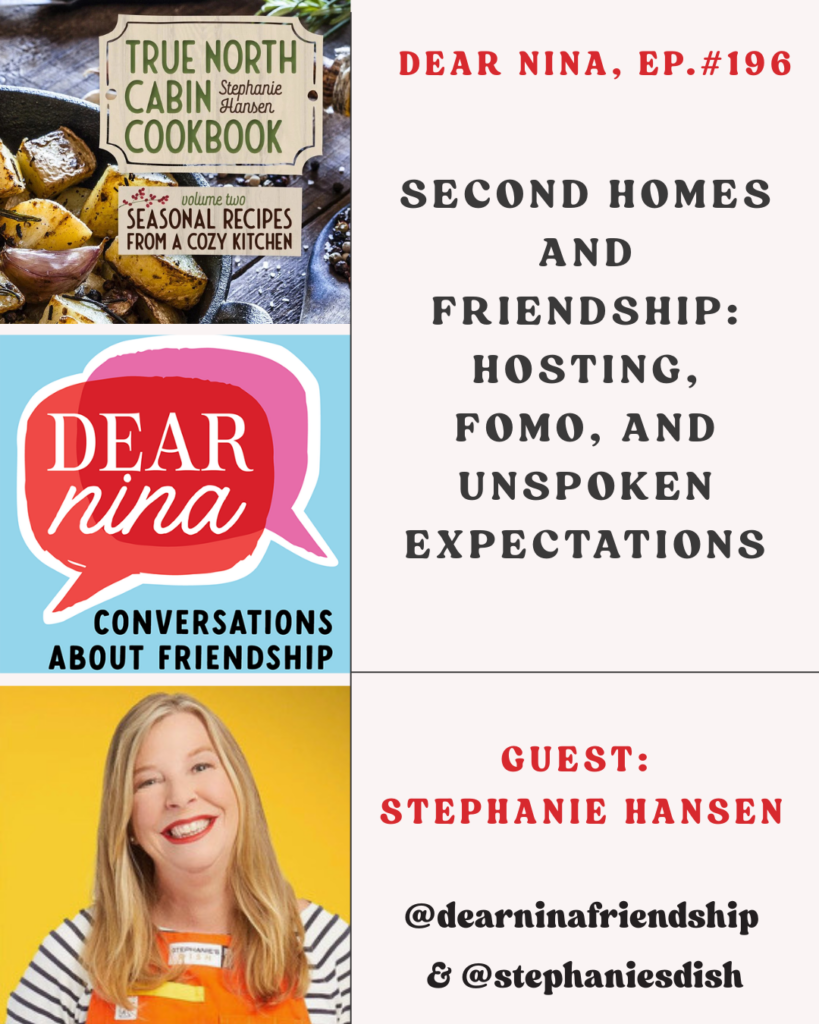
Nina: [00:00:00] Welcome to Dear Nina: Conversations About Friendship. Today is a topic I am shocked I have not covered considering I have been doing this podcast for almost five years, and that is the topic of having a second home, whether it’s a cabin, I’m in Minnesota, we have a big cabin culture here, or it’s having a home where maybe you go when it’s cold, so like Florida, and you have a condo or a house where you escape to for a little bit.
Or maybe you live in a place that people like to visit, so you live in Florida, you live in California, you live in Arizona, these places that people wanna come see you. The topic of how you handle the friendship etiquette around all of that really is complicated.
And of course, family comes into play there too, which we get into a little bit in this episode. I don’t normally do, but it’s just, so part of the topic.
And considering I live in Minnesota, there is no better guest for this episode than the talented Stephanie Hansen, who is a cookbook author, a novelist, a broadcaster, a [00:01:00] TV host, a podcast host. Stephanie is the co-host of the Weekly Dish, on Hubbard Broadcasting My Talk 107.1. Stephanie has regional Emmy Awards for her TV show Taste Buds with Stephanie that airs on Saturday mornings and is currently in syndication at 89 TV stations throughout the US.
You can see her cooking and sharing recipes weekly on The Jason Show. She has a podcast of her own called Dishing with Stephanie’s Dish, where she talks with other food writers, cookbook authors, and fans of food. She has three books you should know about. Most recently she has a novel she co-wrote with her husband, Kurt Johnson, called The Moon Tavern: The Culinary Love Story with Recipes. And two cookbooks, The True North Cabin Cookbook, Recipes and Stories from a Northwoods Table, and volume two is Seasonal Recipes from a Cozy Kitchen.
Stephanie also is a big part of cabin culture. And we get into all of the ins and outs of what it is to have this second home, a place people want to visit, a place you need to manage, what it’s like to be the host,
and what it’s like when you disappear for part of the year and keeping in touch with your [00:02:00] friends and making sure you don’t completely fall off the face of the earth. So excited to have Stephanie on Dear Nina. I’ve been following her work for years, . Here she is.
Okay, Stephanie Hansen, welcome to Dear Nina.
Stephanie: Thanks. I’m excited to be here.
Nina: So this topic came up in my mind because I am not quite at a place where I have a second home. God willing, eventually I’ll have a… Probably I’m more of a warm weather person that might wanna have somewhere to go in the winter as opposed to a cabin, but I do live in Minneapolis just like you do, and I am very much aware of a cabin culture. How far away is your cabin from the Twin Cities?
Stephanie: so it is four hours away, three and a half with no traffic.
Nina: Okay, so it really is a getaway.
Stephanie: Yeah, it’s in Ely, Minnesota, so right up in the Boundary Waters, right up near the Canadian border. I have two cabins. I have the family cabin that’s on an island, and so there’s some logistics to get there ’cause you have to get in a boat, park your car, get all your stuff, and then get out there.[00:03:00]
And then I, about 10 years ago with my husband, we bought our own place on the same lake, across the lake, that’s a one-bedroom cabin that’s sort of small that we thought we’d use for guests, and we use it as an office in the summer too.
Nina: So yours is really truly… Unless you have local friends in Ely, it really is for sure at least an overnight, if not well more than that.
Stephanie: For sure. Yeah, people don’t just pop in or come and say hi.
Nina: So how long have you been having guests up there?
Stephanie: We’ve had the cabin since the– my husband’s family bought it in like 1972, it’s only a 12-week place. It’s a Memorial Day to Labor Day place because in the summer in Minnesota it’s glorious, but summer doesn’t start up there until literally right around Memorial Day. And then Labor Day we have to close it because the pipes can freeze. One year we left it a couple weeks later, and when we got up there things were frozen. So it’s a very tight season, [00:04:00] which is challenging but also in some respects lovely because you know when cabin season starts and cabin season ends, and I plan my life to really maximize those 12 weeks.
I’m, because of that, kind of a terrible friend because I really am not available in the summer, I get left out of things, and people move on with their lives, as of course they would, ’cause I’m over here protecting these 12 weeks with my life.
Nina: Do you know that’s something I think about when I– Like I said, I imagine one day I’ll want a place to go in the winter. Not the whole winter. I don’t see us as snowbirds ever. But I have that same kind of FOMO fear. I’m not saying that you have that, but you did say
Stephanie: Oh, I do.
Nina: Okay, fine.
I don’t wanna put words in your mouth. But yeah, you implied it. You can’t be in two places at once.
Stephanie: And people aren’t required to keep up with me or know my schedule So you fall off the radar, and it really requires you as the friend to keep reaching out when you are [00:05:00] available or to say like, “Hey, I’m in town this week. Does Monday, Tuesday work?” So it requires a little more of me to be a better friend, and I have to be intentional about it.
But also I have to understand that people aren’t waiting for their lives for me to show up and, uh, grace them with my presence too. So even though I have FOMO, I have to like check it and be generous about, this is just the way that my life is, and hopefully people get the good parts and hang with me.
And, some of my friends will schedule calls in the summer or you know, Zooms or just ways to stay in touch. But I do worry about that because in the wintertime, we’ve talked about like buying a sailboat, getting a place in Palm Springs, and I’m like, “No,” ’cause I already need my friends, and I have to put time and investment into them, and I can’t now be gone all the winter too. my husband’s retired and thinking about the next place, and I’m like, “No, we have too many places as it is.”
Nina: This might interest you. I was at a wedding not that long ago, I’m almost [00:06:00] 50. I’d say the mother of the bride was closer to 60, and a lot of her friends are around that age and starting to retire.
A few have gone to Naples or different places in Florida. And one of the women who used to live in my neighborhood said to me that when she now leaves Naples, she kinda misses her new Naples friends. when she leaves Minnesota, she misses her Minnesota friends. And what a blessing.
I mean, isn’t that kind of the ideal that she is happy where she is in both places? I guess cabin life is different than Florida life. You know, cabin life, you’re not necessarily there making new friends. You can see how second home in a warm weather place is a different vibe. You kinda have to create a second social life.
Stephanie: It’s weird, and I’ll tell you why it’s weird. in cabin culture, in the Minnesota area in particular, and I think this happens other places too, there’s city folk, and then there’s cabin folk. the city folks, we come to the cabin, but we don’t live in the town. They call us the townies, that were coming in from out of town.
Nina: Oh, they call you the townies? I would think the townies are the ones that live [00:07:00] there.
Stephanie: No, it depends on where you are, but so we’re from the cities. We’re the city people, and people get feelings about these city people that invade their town in the summertime and come and shop at their stores and interact and don’t know sort of all the ins and outs of living in this smaller town.
But then there’s also the piece of, well, a lot of these homeowners have significant homes, significant investment in the community. We pay a lot of taxes. So there’s this sort of schism. And being on an island, if we are there just on weekends, we don’t really leave the island to hang out in the town too much.
I knew no one for about 20 years. And when I wrote The True North Cabin Cookbook, and I wrote the book on the lake, kind of using it as a backdrop for the stories, then I started to meet people in the town, and then I started playing pickleball.
Nina: Oh, yeah.
Stephanie: And pickleball has really created a community for [00:08:00] me in Ely, because now, When I’m there, I go into the town, I get in the boat, I drive into town, I go to the high school where the pickleball courts are outside, and I play pickleball with anyone who will play. I’m playing with my postal person. I’m playing with the principal of the school. I’m playing with teachers, cabin, resort owners.
all of a sudden, I’ve met everybody in the town that lives there year-round. We’re talking about events that are happening. It’s really created a culture for me that I never had there before, and it’s been great, and I think it’s great for them, too, to see these weekend people, we’re very invested in their community.
We want friends. We wanna be in book clubs. We wanna join things. The also weird part about this particular area of town is Ely, Minnesota, is front and center in the mining debate, all that’s happening all around the country. there was a huge mining culture there- that stopped in the ’80s, and so people still remember the glory days of the mines.
the [00:09:00] new mining culture that wants to come into Ely is a copper-nickel mining culture and a sulfide mining culture, which is very different than the ore mining culture of years past. So you now have this schism of mining people that wanna bring mining back to that area, and then you have all the outdoors lovers, the Boundary Waters people, the canoers, the camps.
There’s a large base of people that go to Ely in the summer times to do these outdoor activities. And most of the money that’s in the town now comes from that outdoors culture. And there’s a real schism between do we bring back mining and the potential, damage that mining can cause, or do we lean into the outdoorsy area here?
And so in this town, you have really split divisions about which side people are for, but they spend a lot of time as a town talking about respectful communication, talking about how to share ideas. You can be in a [00:10:00] neighborhood bar and have a conversation with someone that really believes that mining is going to be the thing that is going to save the town, two seats over is someone who is vehemently opposed to mining and might be, you know, someone who’s supporting Friends of the Boundary Waters, and you’re all sort of in this same place all the time. It’s very interesting place.
Nina: I’m gonna move us to the issues of hosting when you have a second home. again, your situation is slightly unique because it’s so hard to get to. But I still feel like we can extrapolate people having to fly to go visit a friend. So you said you sometimes feel really a out of it with your regular social life when you’re there. So do you invite people to visit?
Stephanie: It’s a complicated question because technically the property is owned by my husband’s family. So While I’ve been in the family for 40 years, and while I am the primary steward of the place with my husband, our family lives in California and lives in Canada. I am still treated like [00:11:00] the outsider because it’s not technically my family property, and that creates some friction for me, because I am the one that takes care of the property with my husband.
I’m the one that cleans it, opens it up. I am all responsible for are there enough pillows? Are there enough sheets? Is the tent ripped? Uh, does the refrigerator work? did someone leave food, you know, when they came two weeks ago and now there’s fruit flies everywhere? I am really the matriarch of the place with my husband, and we have a 93-year-old mother-in-law, my mother-in-law, that comes with us and spends most of the summer with us.
But family tends to kinda see it as almost like a VRBO. They come with their stuff, they leave their stuff, they will leave food ’cause they don’t wanna throw out a half a loaf of bread, and then I’m sort of left with all of this family’s food coming back up, what’s there, what’s not there.
By the end of the summer, I have at least six bottles of ketchup, three bottles of [00:12:00] mustard. it creates some drama for me because I’m trying to manage it all, but yet it’s not my family, so I don’t really get a say,
I invite one weekend a year, I have what they’ve termed the Hansen family weekend, and I get four days.
Amongst that, the part of the reason why we bought the other place was so that I could have friends and I could have family. Now we kinda use that place as overflow, people see that place as part of the whole. So that’s weird, too, because I Oh, no, that’s my place. You don’t get to have your extra friends and family stay at my place.” I can’t be like that either because that’s sort of what I’m bristling against over in the family property. It’s very complicated at times
Nina: everything you’re saying does not surprise me. it’s very hard to share a home, I think, with with an extended family. Because I was even just thinking on the friend part, you know, obviously that’s my focus here, when you invite somebody– Let’s say you invite people for 4th of July, [00:13:00] so not you at your house ’cause I don’t think you would be able to do that.
let’s say other people with a cabin or a condo or any kind of thing, invite someone for a major thing. 4th of July is a good example for us. Is it assumed that they get that invite every year? Are they supposed to wait for the invitation, or should you not assume? I’m just, , thinking advice to people who have
Stephanie: The answer is yes, everyone assumes. Once someone comes and experiences the glory of your cabin, they wanna come every year, and they assume they’re coming every year. Memorial Day is a good example that’s typically my birthday weekend, and so we do some family things. But we have a couple of friends that come every single year, and they, wait for the invitation.
And if I don’t invite them, I feel bad. But, this year we’ve all been working a lot, and my daughter’s like, “Oh, wouldn’t it be great if we could just, have a low-key weekend?” And I was like, ” Well, yeah, but that’s not who we are.” Also, there’s this element of cooking that comes into it because I’m a cookbook
Nina: I’m dying to get to that. the hosting and the cooking and even, like you’re [00:14:00] saying, the six bottles of ketchup. I totally get that. Everyone brings. They’re like, “Let me, I’ll bring it,” and then it’s like, “We didn’t need that.” How do you organize all that?
Stephanie: I do my best. originally I cooked everything all the time. And I like entertaining, so for me cooking a meal for you is part of the giving of who I am, right? people would say, “What can we bring?” And I’m like, “Nothing, just come.” So then people, my good friends got clever and they’d bring, like, toilet paper or an extra set of sheets, things that actually were kinda helpful because you can always use toilet paper.
You can always use paper towel. An extra set of sheets comes in surprisingly handy with air mattresses and things. But over the years when I started cooking more for a living and not just for fun, now all I’m doing is cooking during the week. I’m cooking Monday through Friday. I’m filming TV shows in my home.
cooking for, five days almost feels like a burden because I’m just like, “Ugh, I just wanna not cook for a day.” So I’ve gotten better about asking for help, [00:15:00] but not great. I’m still just like… For this coming four-day weekend we have, let’s see, seven people coming to the cabin, and I’ve asked for someone to cook one meal.
Nina: Do you think people are nervous to cook for you? I imagine. and I wish they weren’t Right. Let’s get it out here, everybody. If you’re friends with Stephanie, she just wants a break.
Stephanie: And it’s the act of just the kindness of that you extended yourself. I’ll also tell you, and this is maybe getting into some real dirty laundry, but I’m a huge entertainer, so I entertain a lot. I can’t remember the last time somebody actually invited me to their home.
Nina: This is like a mic drop moment, okay? Not just for you. A lot of people have this issue where they– In a, in your case, it’s gonna be cooking and hosting, but for other people it might be different things where they feel like they always are doing a certain thing and it’s not reciprocated.
Stephanie: I don’t need you to entertain like I entertain. we could sit around and have Indian takeout food. I would not care. I do have, a friend that is [00:16:00] a mahjonger, so, you know, we’re always going to her house to play ’cause she’s got the set. But I’m trying to be, like, mindful of at least saying, “Hey, you can bring your set to my house,” because there is some setup involved.
I’m just surprised at the people that just assume that you’re entertaining because of your love for it, and therefore they never have to do it.
Nina: The message I would give to people out there, like you said, do it as takeout or take you to a restaurant. If you’ve had people over a number of times, I, spend a lot of episodes on this, Stephanie, that reciprocity doesn’t have to be, “I did this thing for you, and now you have to do this exact thing for me.”
So in your case, it would be, “I had you over for a meal,” or, “I had you at the cabin.” They should take you somewhere cool in Minneapolis and just treat you. That’s all. And reach out and plan it and pay for it. And it’s not about the money, it’s just the gesture.
Stephanie: And I even think, it’s not even about the onesie, twosie guest because part of the thing I love to do as an entertainer, I started doing this, is I have a dinner once a month where I invite people that I don’t really even know. I like people in the food business. I like women in food.
So I do [00:17:00] that. I gather people, and what I love about that is them making connections in the food industry and expanding our circles ’cause many of us work freelance within our homes, and it’s a different kind of work. So it isn’t even that. It’s the people that, like, you know who you are. You come to my house all the time. w- how hard would it be just once or twice, or even just to say, “I know you have me over all the time. I hate cooking. I’m not you, so let’s go and have chips and salsa next Friday”?
Nina: So putting my friendship advice hat on, not that you asked, but I feel like I
Stephanie: I’m asking.
Nina: if these are good friends, I think you have to be more direct about it, ’cause it’s going to just continue to fester. And I actually think instead of waiting for them, clearly it’s not gonna happen, you’re gonna have to directly say, with a smile on your face, “Hey, I’ve had you over a bunch of times. I would love to come to your house. Just bring in takeout. I would love a night off.” And I’m sure they’re gonna say, “Oh, I had no idea. I thought you, like, wouldn’t– I thought it had to be home-cooked,” or, “I didn’t want the pressure,” or, “I thought you always liked entertaining.” And you could say, “I do love [00:18:00] entertaining.
Of course, it’s who I am, and I also like to have a night off.” And they’ll do it. I would be shocked if somebody… I mean, they may feel, like, a little embarrassed, but you gotta tell them, ’cause now a lot of years have gone by, I have to imagine. Some of this is a pattern that you’ve gotten into with these friends. By the way, I almost never give advice directly to a guest. That’s not usually
Stephanie: kinda glad you did. Now I have another question
Nina: and I actually think your friends will be grateful. Most people actually really appreciate direct communication,
Stephanie: Do they? Do
Nina: don’t mean criticism. Uh, you can’t say it as a criticism. you have to say it as, an opportunity. they obviously like to hang out with you.
Stephanie: Yeah, we have fun. can I ask you, this is a little not related, but as long as I’m with the friendship expert, I feel like…
Nina: Let’s do it.
Stephanie: kind of in the same vein, but friends have seasons, right? And I have a lot of friends in a lot of different seasons. I have a very good friend that is becoming insufferable to eat with at restaurants
Nina: Oh, yeah.
Stephanie: of her behavior, and I am in the [00:19:00] restaurant business too.
I’m a hospitality person. I have a radio show about restaurants, so when I show up in a restaurant, sometimes I know the people, I was a server, so I feel acutely for the position of being in the restaurant industry. But I have a friend who is really just, I’m starting to notice, i- won’t ask for separate checks then demands them at the end and is irritated if the server isn’t overly accommodating.
When the server walks by, just hands them dishes. has said, “When I go and I buy a drink at a bar and it costs $18, why do I owe you 20% of that? $2 just to make me a drink?” these little comments are coming out. And I’m just like, ugh. I’m leaving twice as much tip to try to accommodate for my rude friend, and it’s getting to the point where , I’m not sure if she knows or she doesn’t care, or… But I’m like, okay, I don’t know if I can eat out with this person anymore ’cause it’s getting so [00:20:00] uncomfortable.
Nina: my advice was going to be, you kind of answered it for yourself, this is gonna be your walking friend. This can be a pickleball friend. This can be a, “Hey, there’s a really cool speaker coming to the Hennepin County Library this weekend that wanna go see it,” friend. This is not a dinner, drink, coffee friend anymore. She’s
Stephanie: so obvious, but you’re right. Okay.
Nina: this would be an example… some people would disagree with me. I would say on this one, I would not necessarily be direct ’cause I don’t know how you say to a friend, “I think you’re rude to, servers. It’s embarrassing,” which really is the issue. That’s the issue.
It’s embarrassing, it’s rude, it’s– represents you in a way you don’t wanna be represented. I would feel that way too, and I’m not a food person who knows anyone in the food business. So I can only imagine how much worse it feels for you. I have a Facebook group where, uh, people write anonymous questions, and a lot of us answer.
I answer, but so do the listeners. a couple people would say, “No, you should always be direct, clear is kind, and women aren’t direct enough.” I don’t know in this one because you’re not her mother.
Stephanie: And I’m not gonna change her [00:21:00] behavior or perception about value. As things have gotten more expensive in restaurants, has the service increased proportionately? No. In fact, it’s probably gone down. But that’s not really, the, relationship that you have with a restaurateur, you know? It- it’s if you’re gonna go into the restaurant and start the experience, it’s not always a, an equal game.
Nina: And then, yeah, you’re not gonna change her. You’re not like there to lecture her. an example like this, if you wanna stay friends and still hang out with her, which is something you may still have to answer for yourself, but assuming you do, then you come up with other things to do.
Stephanie: It’s her only failing. She’s a great friend.
Nina: oh, good. That, makes it easier she’s your walking friend.
Stephanie: Yeah. Okay.
Nina: can be your mahjong friend. Oh, perfect. You have so many options with her. somebody else is getting that dinner slot, someone who should be taking you out, frankly. Bring in one of the people who owes you a dinner in her slot. uh, another question when you… Well, t- uh, for you, again, it’s a little hard because you don’t always have guests based on the issues of all the family stuff at the house, which I totally get.
just [00:22:00] extrapolating the idea of having guests, what are the expectations around them helping empty the dishwasher and, you know, would you want them to throw in a load of laundry, or do you really want people to just, like, be your guests? Or after a number of years, I imagine you’re like, “Yes, empty the dishwasher.”
Stephanie: I’m probably not different than most people in that what I say I want isn’t necessarily what I want. Because I say I want you to just come be my guest, and you don’t need to do anything. At this little one-bedroom cabin, there are guests that stay there quite a bit. And when I come over and you’ve left- And the place is clean, and the sheets are pulled off the bed, and they’re already in the washer, just with a note saying, “Hey, the sheets are in the washer.
Put ’em in the dryer. We left you something in the refrigerator,” that feels great. And that feels like, oh, I don’t have to clean up the whole place. there are guests that come and literally they s- do nothing, and they leave, and you have to go back through the house and clean it again or get it ready for the next guest.
I don’t know that that would [00:23:00] disqualify you from being a guest ever again, but that would mean you’re a really fun person and we’re doing lots of other great things together. Everyone’s relegated to
Nina: pickleball.
Stephanie: And I do think women are different than men. when my women friends come, they’re just, A, bringing stuff, B, stripping beds, getting towels, asking about trash.
when our couples friends come- Yeah … the men, and not to be sexist here, but they’re really not doing much of that type of thing. They’ll probably ask my husband, like, if he needs help with the boats or… It falls along sort of, sadly, man-women lines.
Nina: I know. I’ve seen that too.
Stephanie: I mean, we’re talking about guests and friendship, let’s be honest, some of my in-laws, they’re family, I guess, on paper, but we’re really just friends, right? We don’t spend a ton of time together. My husband’s sister, for example, yes, she’s She’s my sister in that way, but I barely know her.
She lives in [00:24:00] California. She’s got her own kids. We spend time together twice every 10 years. So in some respects, these friend conversations are kind of similar, but they get a little weirder because, when you come into a place that you only visit once every five years and start moving the furniture around and getting rid of things and, bringing in all your weird stuff. I come back the next week and I’m like, “Wait, where’s the measuring cups? That’s also kind of weird too, like when guests come and start moving things around.
Nina: This whole business of it’s the family’s cabin, but you have to do everything is not working for me. I’m just gonna be honest.
Stephanie: It’s a lot, and it requires, oh, my poor husband. I mean, we’ve had so many fights, and I understand more where he’s coming from simply because age and I’m just trying to like understand where he’s at on the whole thing ’cause he’s in the middle [00:25:00] always. But it is challenging. You know, people want their family stuff to stay as it is forever and don’t wanna share, but they also don’t wanna contribute.
when the dock is broken, no one’s sending us checks to fix it. They’re just expecting that when they come, that the dock is gonna be there and work. And also, boats. people crash boats into things, and they don’t tell you, and you come up and you’re like, “Oh, wow, there’s a giant dent in the boat, and I wasn’t even here.
That couldn’t have been something I did.” But you just have to maintain it as part of the whole collective experience and you just shake your head.
Nina: so many little details do you ever come up and the gas is empty in the boats, like they didn’t fill it?
Stephanie: Always. One time we came up and the entire lower unit of the boat was ripped out and no one said anything.
Nina: they crashed it or what do you mean ripped out?
Stephanie: I don’t know.
Nina: How does that happen?
Stephanie: I still don’t know. another time, again, food is left on the counter and the fruit fly incident was real. I’ve also been left with 18 loads of laundry.
Nina: You’re [00:26:00] sort of making me now want a second home,
Stephanie: there’s pluses and minuses. there’s pluses and minuses, and if you love entertaining and you feel… Like generally it’s a good experience. I’ve had great events too where, friends have come and we’ve just had a ball.
Nina: There must be something you love about this piece of property, or you guys would have found a different piece of property, I’m guessing.
Stephanie: it is, it- because it’s on an island, it’s just like a place of magic. You are on the water all the way around. You’re the only people on it.
You know, you… It is just such a… And everybody that comes loves it because of that. ‘ Cause it’s such a unique place and, just so incredible.
Nina: there aren’t so many properties like that. I mean, that’s kind of the answer to that question, right? It’s, that is… You can’t always… I know there are other ones, but not, you’ve this, been in this family for a very long time, and you, you don’t just like happen upon a house surrounded by water that you can buy, you know, financially or that’s even available to you.
Even if you could, it is not necessarily [00:27:00] for sale.
Stephanie: another thing about friendship and cabins is, like, when you have children and your children wanna bring friends,
Nina: Okay. Yeah, let’s talk about it.
Stephanie: how does that work? when they’re adult kids, it’s different rules when our daughter was little, we went to the cabin every weekend.
It was a non-negotiable. So she could bring whoever and how many, and we would just pile them all in the car because we wanted her to always have this great sense of cabin and not dread going. as she got a little older, it got more challenging, and now, she’s trying to carve out one weekend a year for herself to have with her friends, and we’re always like, “Oh, let’s get out the family calendar,” ’cause now that’s two weekends that we’re trying to carve out, one for me, one for you.
and then, you know, the adult… They’re adults, but they’re still, like, young adults, so you’re… The whole time they’re up there, you’re like, “Are they having a fire? Is it fire season? Are they in the boat? Are they drinking?” Like, you’re just, the anxiety and the whole thing, and then, “Do I have to go right up after everybody leaves to make sure it’s clean enough and for the rest, the [00:28:00] next person?”
Nina: now she’s inherited what it is to be, the matriarch of the house. Like, she’s in charge of cleaning up after her friends, I’m sure. There’s, th- it’s like inherited stress, but it is somebody’s responsibility. The thing that would come up for me in the work I do on your daughter bringing friends, other than me also being a parent and the water, anything dealing with water is so stressful, right?
just water safety and like you said, the drinking. Okay, but even when they were little and you were the ones bringing them up, I can imagine a scenario where she invited three friends, and they talk about it at school on Tuesday, or this is summer, but let’s say they talk about it when they’re back in the Twin Cities, and friend number five, six, seven wasn’t invited.
And now you have mom of friend number five kinda giving you the stink eye, being like, “Oh, my, my daughter was really upset.”
Stephanie: this is so funny you bring this up, ’cause you just, plugged into a childhood trauma of mine. My best friend growing up lived right next door, had the most beautiful cabin, and I got cabin culture from them. They taught me how [00:29:00] to snowmobile, how to water-ski, how to drive a boat. I was just so graciously enveloped into their family from a very young age.
Until about, 12 to 15, when now my friend, and rightly so, wanted to expand her friend network, and I wasn’t the P1 all the time, primary person. Now she invited Michelle. Another weekend she would invite Jennifer. And I would just sit at home and lament the cabin invitations I wasn’t getting. it was, like, at that time that I knew I was a cabin person, and I also knew I would have my own cabin.
when I married my husband, it was high on the list of not wants, needs.
Nina: and he came with one.
Stephanie: he did.
Nina: cabin.
Stephanie: He did, but I also knew like, “Okay, this is gonna be something that is gonna be in our lives.” when our daughter wanted to play soccer, we were like, “No, you, you can’t play soccer. That’s a summer sport. We don’t do summer things.
[00:30:00] We go to the cabin.” we were super intentional about making those choices. Our daughter was a downhill ski racer, and when there was a summer camp to go to Mount Hood to ski, we were like, “Mm, once. You can go once, but this is cabin season.” I just always had that FOMO about not being the person invited to the cabin that I love so much, that I just was like, “I’m gonna have my own cabin. I’m gonna buy one.
Nina: But does it stress you out? ‘Cause it would stress me out. A lot of times my questions are just me projecting my own issues. It would stress me out that my daughter would be potentially leaving out, you know, creating a you, a young you, feeling, like, sad that they weren’t invited. there’s no answer to that. You have to just live your life anyway. I know the answer is you cannot- stop your whole life because so and so is gonna be left out. we would never do anything. It would be impossible. But nowadays with the phones and the Snap and the, the pictures, everyone knows where they are, it must be a thing.
Stephanie: It can be, and it’s also can be a thing with family. my side of the family, Kurt’s side of the family, an example would [00:31:00] be, this is terrible I’m even saying this out loud, someone in our family being up at the cabin and driving our pontoon around, and like, “Cabin life.” And I’m just like, ” Are they in
my boat?” Like, I just get, like, the hair on the back of my neck just stands up ugh. Or, yeah, just, like, weird stuff that I’m not there, but they’re there, so I’m having FOMO about that.
Nina: Gosh, it’s hard. Right. like I said a bunch earlier, you can’t be in two places at once. That’s one truth, like in terms of dealing with your own friends that you miss when you’re up at the cabin. And then you can’t have everyone up there either at the same time, whether it’s your daughter’s friends, your family, you, your friends. you can’t have everybody.
Stephanie: I think too, friends are family in some respects or family are friends. identifying that is such a tricky relationship. Friend relationships are hard anyway, but then when you have like family friends or friends of family or family that are friends, also it’s a whole nother layer, I don’t know, I’m just not great at it. we struggle along, [00:32:00] and it rears its head in lots of ways.
Nina: Second homes. can you believe in five years of podcasting I’ve never done an episode on it? And it brings up all this stuff.
Stephanie: it is probably my greatest stressor in life. It’s the joy. I mean, I love this place. I just invest so much time, energy, and mental space on it.
Nina: You have two books about
Stephanie: Yeah, cause I really am into it, but it’s also creates tears, drama. if I’m ever in a argument with somebody in my family, it’s almost always about the cabin and some real aspect of it, of whether they got invited, whether they didn’t, how they left it, if they didn’t, what their plans are.
sometimes people too, we plan. We have this 12 weeks, they are just solid. You can’t just be like, “Well, you know, uh, when it gets to July, I’ll see if I’m feeling it.” No, ’cause we’ve had weekends where, or weeks where people are gonna come to the cabin, and so [00:33:00] we make other plans, and then they end up not coming.
So we’re now in Europe for two weeks and the cabin is sitting empty for two weeks because your plans changed And also there’s some things that need to happen during those two weeks at the cabin, right? So we have to then cover for you or… it isn’t in these 12 weeks you can just be casually deciding if you’re gonna come or not at the last minute.
It doesn’t work like that. But people, we have some last-minute family people that can’t plan their way out of a paper bag.
Nina: it really, yeah, shows people’s strengths and places they can improve, we’ll say. Strengths and places they can improve. Oh my gosh. Well, okay, Stephanie, I I know my listeners will get a lot out of this. I hope you got out of this, your
Stephanie: I did. I did. I have to not go to eat with this friend anymore, so that was helpful. I have to have clarity and be direct about familial conversations when they need to arise. Though I think my parents were therapists, and it’s taken me a long time to unpack all these family relationships, and I think I’m getting to a better spot, but [00:34:00] it has been years of angst and turmoil. And now unfortunately, my daughter is she’s starting to get into it and wade into the
Nina: inheriting it? Yes. all that part is really very complicated and beyond my scope on the friendship, but my third assignment for you is in my scope, and that is that you are going to, with a smile on your face, directly say to your friends, “Hey, I love Indian food.” I really want to, want to try pizza from that new, you know, place that Anne Kim’s opening, which I don’t think is a thing, but wouldn’t that be awesome? Actually, I think she has a pizza truck coming or something.
Stephanie: She does at Indeed Brewing.
Nina: So whatever. You, you know all the places. Name a place, say you would like to go there, not with that one friend, but with all the other friends and, “Hey, you guys don’t have to have me up at your house, you, but I would love… Let’s go out.
Stephanie: N- Nina, should we go to dinner sometime and talk about your second home fantasies?
Nina: Yes, we absolutely should. Stephanie, I’ve seen you, I’ve been watching you for years, and I really, really appreciate that you came in here to talk to me. For me, it was a real thrill. I mean, you’re a
Stephanie: Thanks. I was, [00:35:00] uh, I was pretty candid, so we’ll see where the chips lie once people hear the pod.
Nina: Yes. Right? Okay. Listeners, I’ll have all the ways you can find Stephanie in the show notes. You can find me on Instagram and TikTok at DearNinaFriendship. If you have anonymous questions you want to ask, you can do that in the Facebook group at DearNinaTheGroup, or there is an anonymous form, which you can find in the show notes, and I just might use that in my newsletter at dearnina.substack.com. Those answers are always a lot more intricate and thorough. But if you want other people’s opinions, I would put that question in the Facebook group. See you next week when our friendships are going well. We are happier all around