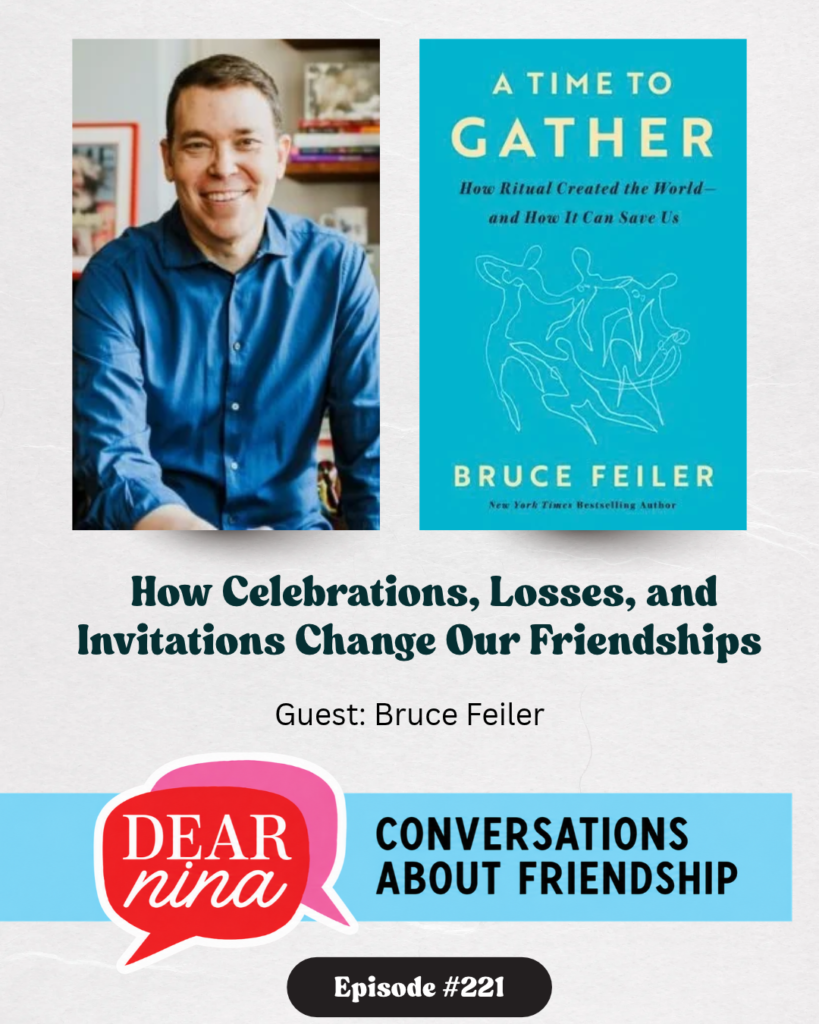
Nina: [00:00:00] Welcome to Dear Nina: Conversations About Friendship. I am your host, Nina Badzin Today’s conversation is to help us understand that feeling you have when you have a big event. It might be a wedding, it might be a funeral that you are managing for a loved one. It might be a bar or bat mitzvah, it might be a graduation party, although that I’d put in a different category. That feeling you have when someone who you thought would show up does not show up. In addition to that, today’s episode is also about the way rituals, like the ones I named and other ones, could be a way to put a line in the sand, both in a positive and a negative way, about who is close to you right now. So you might invite somebody to something, and they may receive that invitation and think, “That’s a lot of money to spend or a lot of effort to make for somebody who I don’t feel close to anymore.”
And then on the other side, maybe you did expect to [00:01:00] be in- included in something, in a big event, and you’re not, and that’s its own line in the sand. And then in a third way, you can use a ritual to bring people in who you have wanted to bring in closer, and maybe you’re using this event as a way to say, “Yes, I feel closer to you and I want to include you in this.”
And they may receive that in one of two ways. They may receive it the way I just mentioned, which is, “Whoa, why are they inviting me to this thing? We’re not that close.” Or they may receive it the way you intended it, which is, ” Wow, this is so nice.” I think about one of my very close friends, I’ve mentioned her on the podcast before.
We weren’t that close yet when she invited my husband and me to their wedding, and this is 25 years ago. She’s now one of my closest friends in Minneapolis. Why? Because she invited us to the wedding. I think that’s the reason why. Her invitations had already gone out. We started spending more time together in that six to eight-week time between when someone sends out an invitation and when their wedding is.
And in that [00:02:00] time, we, we started to become good friends. Obviously, not as close as we are now, 25 years later, but we really had the seeds of a good friendship. the thing that she did, I believe, that cemented the road to that good friendship is she went out on a limb. That was hard, that was vulnerable, to hand me an invitation in my hand and say, “These already went out.
I would love for you guys to be there.” That takes some courage. I really admire her for that. You can use a ritual to do that. I invite you here on this episode right now to think about how you could use a big event in your life to be more inclusive than you maybe had thought to be.
And it doesn’t have to be such a big event. It doesn’t have to be a wedding, a bar mitzvah. Obviously a funeral is not an invitation situation. But thinking of funerals, that is an opportunity if you think about it. You see that somebody in your community had a loved one die, maybe you do show up to the funeral or the shiva when you’re on the edge of friendship.
Maybe that is a time and a way to express to the person, ” I want to be closer to you.” A lot of times we just send a card or [00:03:00] we send a donation. Those are both nice gestures, but wow, it would say a lot to show up. And then of course, there’s those hurt feelings we have when people don’t show up, we talk about in the episode communicating why you’re not showing up, why it’s important to communicate why, ‘ because it is impossible to get to everything. It’s impossible. It’s impossible. But how you communicate that you will not be attending your friend’s event is important.
I have the only guest who could possibly take on such a topic. Bruce Feiler is the author of A Time to Gather, most recently of A Time to Gather. He’s the author of seven New York Times bestsellers. Some of those titles are Life is in the Transitions. Another, The Secrets of Happy Families. He wrote Consul of Dads and several others.
He has four TED Talks that have been viewed more than five million times. He teaches the TED course, How to Master Life Transitions,
So many other pieces of his bio that are worth mentioning, and I will link more about Bruce in the show notes. He is a walking encyclopedia [00:04:00] of ritual and why and how rituals have become so important to our human experience here on Earth, how we make sense of life. Bruce will explain how this is part of our human experience long before organized religion. So it would make sense to me, who studies friendship, why somebody not coming to a ritual could hurt so much, and why using ritual to get closer really works. Let’s get to it. I think you will really enjoy this conversation. I look forward to hearing your thoughts on it
Hello, Bruce. Welcome to Dear Nina
Bruce: Thank you very much. I wanna call you friend, but this, since this is a podcast about friendship, I should not use that word, without thinking. So thank you very much for having me.
Nina: You know, it’s interesting, cause I listened to your book and have the print too. I’m gonna show it for the YouTube. I have the print here, but I listened to it, and so in a weird way, to your point, it feels like there’s a familiarity. Like, I feel like I know you ’cause I know a lot of your stories from the book, and your voice.
There’s so much that comes in a voice in terms of knowing someone. So yeah, you’ll get to know me a [00:05:00] little bit by the end of this chat
Bruce: Excellent. Thank you so much
Nina: the thing I wanted to talk about today is the deeper side of where ritual plays into our friendships and why we take it… I’ll give the negative and the positive.
We, we take it so personally when someone doesn’t show up for a loved one’s funeral maybe they don’t even know that person, but that person meant something to us. Or a bigger, not bigger, a different kind of thing like a wedding or bar or bat mitzvah or other kinds of rituals. And then also on the flip, we remember who showed up, and we’re so grateful, like so deeply grateful.
But before we get to that piece I think it’s important to back up, from your knowledge and your research what is a ritual and how is it different from just having your morning coffee at the same time every day? And why has it carried humankind forward like this?
Bruce: So I think that, I like both the direction we’re heading in, and I have lots of thoughts about friendship and sort of the good and bad for ritual and friendship in modern life. So I’m delighted to [00:06:00] have a chance to deep dive into that topic, which I, think about a lot, but I don’t get to talk about a lot.
But I also love this idea that we, can frame the conversation. And so let me, frame it in my way by saying that I have spent, as you know, the last 25 years, writing about lots of themes that intersect with the one that we’re talking about, I spent, probably half of my adult life writing about religion and walking the Bible and Abraham and these books that sort of took me across the Middle East exploring what a contemporary life is doing with these ancient stories and why these stories have stuck around.
I then, got cancer as a 43-year-old father of identical twin daughters who at the time were three, and so suddenly my life, was in jeopardy. whatever it was, let me think here, five, three days after getting that diagnosis, I woke up thinking that my daughters, that no one would ever say I didn’t live the hell out of my life.
Like, I, I’ve lived a [00:07:00] full life. And I also thought my wife, who is a very upbeat person, would mourn me but would be able to move forward in her life, but, but that my daughters would miss my voice. So I reached out to a group of what became six men and asked them to be present in the lives of my daughters.
And the Council of Dads, which is the book that I wrote about that and the TV show, is all about friendships and when we show up and when we don’t show up. And then I spent the last 10 years writing about life transitions and how we navigate the twists and turns of our lives.
And so all of this is sort of going on in my life, and then I hit one of those transitions in that my wife and I, 21 years ago, went from empty nest to full nest in 32 minutes when we became parents of our twins. And then 18 years later, we went from full nest to empty nest in 32 minutes when we dropped them off at opposite ends of the same college campus.
And I walked in my front door, and I felt homesick in my own home. And I was like, “You can’t use this word. Like, that’s what kids do , in a [00:08:00] kindergarten or first night of sleepaway camp.” But it wasn’t just my kids. Like, my dad had died, and my mom was getting older. My marriage, which had been built around my kids, and I want that topic to come up later when we talk about friendship, needs to be renegotiated.
And I was looking for ways to connect. what I did was I stumbled into this… what I now think of as maybe the greatest untold story in the world, which is that ritual, as you say, is one of the few things that we know works to hold families together, to hold friends together, neighborhoods, communities, teams.
We have evidence going back 300,000 years that the first thing we did was gather together to bury our dead. That’s 100,000 years before we were anatomical humans. every culture in ev- we’ve ever looked at has used rituals in times of change. When someone comes in the group, like a baby or a wedding, when someone leaves the group, like a coming of age or a death, we use the ritual to kind of remake and reform the group, until this century when we’ve turned our backs on them.
And I don’t have to tell you this ’cause you live it every day. [00:09:00] Birth rituals are in trouble. Coming of age rituals are in shambles. I. And so we’re in what I call a celebration recession. And yet, at the same time, there’s all these new rituals that are popping up, and a lot of them, frankly, have to do with friends, which I think is on the plus side of the ledger. And again, we’ll get to that in a second.
So we have, gender reveals and promposals. People might think those are silly. But we also have cancerversaries and soberversaries and death of a loved one, but also, death of a job, right? Pet funerals are a $3 billion business. Like, there’s a lot going on, and I wanted to understand it, which is what really propelled me into this three-year journey of attending rituals in 16 countries on six continents.
now with that backstory, to answer your question, what is a ritual? A ritual is a shared unnecessary act that makes us feel at home. So if we break it down, first of all, it’s an act. This is a doing, this is not a talking, right? It’s embodied storytelling. We are getting together physically, emotionally, we’re trying to be present, hold one another.
It’s an act. It’s shared. as [00:10:00] much as I think, we might use the word ritual to say, “I’m gonna have a cup of coffee and read the paper in the backyard,” right? And like feed the bird feeder or whatever, I think at its heart it’s shared. So if you’re doing that for self-care, Or to make you feel comfortable and at peace before you get into a busy day, I’m all for it.
But I think of this line that the Dalai Lama has, which he said, “I don’t wanna teach Westerners how to meditate because they’re gonna meditate for a greater salary or a higher test score,” and that part of the purpose of it is to heal humanity. So I do think it’s shared at its core. even if we do it alone, it can be shared with other people doing the same thing.
But I think unnecessary is maybe even the more radical thing, which I discovered, and, and what I mean by unnecessary is you don’t have to get down on one knee to propose. You don’t have to wear black to mourn. you don’t have to circle the bride seven times to get married. These are unnecessities that become necessary, become necessities because we invest them with collective meaning
Nina: and we grow to expect those things, [00:11:00] and then that brings us to really what I wanna discuss in depth, what it feels like when you find those things important. You are having a wedding, like, you don’t wanna just elope and go alone. , You want it to be a shared experience, and people don’t show up, or
There’s so many. One other thing before we really , go deep into the friendship part. I really appreciated you spelling out how sometimes families, like this is more of a family thing for a moment, getting together to deal with these rituals.
So I’m… Mostly weddings and funerals come to mind. even though people may disagree about how they should be done, how it forces people to actually get to know each other in a different way and work it out
Bruce: I have to say, of all the ideas that I discovered about rituals, this one from A Time to Gather is one of the ones that people bring up the most,
so rituals do a number of things. They connect us, We’ve been discussing that. There are five hundred academic studies that show that they synchronize our heartbeats and align our breathing and make us feel closer in every way imaginable. They [00:12:00] also chronicle our lives. if anybody listening to us, if I said, you know, “Think of the ten high points and ten low points of your life,” eighty-five percent would have been marked by rituals, Births or graduations or, milestone birthdays or anniversaries. As we have this conversation, we’re about to gather as a family this weekend to celebrate my mother’s ninetieth birthday, and my brother-in-law turned sixty, and my, brother turned sixty-five. So we’re gonna all have kind of a made-up mystery weekend, we call it, where we’re not telling my mother where we’re taking her.
so they connect us, they chronicle us, they also consecrate these moments, they elevate them by attaching symbolic gestures, and symbol is by far the greatest things that humans ever created. But the last thing they do is they correct imbalances within the group.
They address the conflict, as you say, you and I are getting married. You want a, big wedding, and I want a small gathering, right? Or we just lost a loved one. You wanna lie underneath the covers with your cat in a fetal position, and I want a big old Irish wake. there’s going to be differences within the community, [00:13:00] and that’s often the reason people don’t do the ritual, ’cause they just don’t wanna deal with the conflict.
But that’s what the ritual is for. Part of its job is to modulate, to titrate the conflict so that the group can survive. And by the way, again, I’ll flag another thing when we get to friendship. Part of the challenge that friendship has, in my view, is there’s no language. We have a language around, family, right?
So we don’t have language or gestures to repair, but that’s what the ritual is doing. Like, this happened, you know, as you remember, maybe the story that’s most quoted to me from A Time to Gather is about my own dad’s funeral when he died in twenty twenty-one. So my dad, during COVID, but not of COVID, my dad was never depressed a minute in his life.
, he stopped strangers to give him directions. People would come up to him like, “You seem nice.” Like, “How do I solve this problem?” Like, it’s just who he was. Until he got Parkinson’s, uh, got very depressed and tried to take his own life six times in twelve weeks. And that was in twenty thirteen, and, and we tried every [00:14:00] way to solve this problem, and ultimately, the only way, really what kept him alive was when on a Monday morning, I sat down and sent him a question about his life.
Like, “Tell me about the toys you played with as a kid.” And he answered that, and I sent another one, and this went on for eight years until he finished a sixty-five thousand word memoir just weeks before he died in twenty twenty-one. We go down to Georgia to the funeral. My job is to interface with the rabbi.
That won’t surprise you. in this conversation, my mother says, ” I don’t wanna throw dirt on the coffin. I find it barbaric. I wanna have long stem yellow roses.” At which point my sister, I wish I was making this up, but I’m not that good of a storyteller. My sister says, “I only like throwing dirt on the coffin.
Without that, it’s not a funeral, and it’s all but, like, I’m going back to Philadelphia where I live.” nobody was backing down. And I was like, “Okay, Rabbi, I think I’ll call you back.” And then I was like, “Okay.” And I later learned ritual designers do this all the time. I wasn’t working on this book at that time.
I was like, “What’s behind what you’re saying, Mom?” She’s very [00:15:00] assimilationist, very conscious about how others perceive her. My sister is a younger person who was once more tradition in religion and, that’s her identity. So ultimately, I turned to my sister and I was like, ” She lived with the guy for 60 years, you know, and took care of him under difficult circumstances.
Let’s give her what she wants, but also what c- how can we give you what you want?” And so what did we do? We got three dozen long-stem yellow roses, and we also got little packets of Tybee Island sand, which is the beach that my dad loved, and we gave everybody a choice. the ritual is big enough to accommodate tradition and accommodate, novelty and reinvention and reimagining of tradition.
That’s what it does. It creates the vessel inside of which we can work out the conflict. and in this case, it raised the conflict in ritual but also resolved it, and the family, the group, the assembly was ultimately stronger, because of how we worked through the conflict.
Nina: Especially in such a tough time. And I wanna share with you, when [00:16:00] I read your book, I’m gonna… I hope I don’t tear up when I say, my dad also died in 2021, also with Parkinson’s. And so when I read your book, the year, you know, stuck out to me.
And we were lucky in that, I feel lucky in that, and I wonder if you do, too, that it was just post enough that period, that horrible period of COVID when people couldn’t gather for a funeral. and my dad was in bad shape. , He was diagnosed, in the late ’90s, in his late 50s, and died at 80. So I mean, by the end it was not good,
There were times when it was like, ” Nina, come to Chicago. This is it.”
false alarms. I would just like pray , “Dad, please hold on till after this horrible period.” my dad was such a good person. When I think about like… Oh my God, I’m getting like teary.
I can’t even imagine if we had had to not have a funeral. speaks to your work, too. that’s how important it felt to me that his life be honored properly. Um, and not just the basics of, being buried, which I know a lot of people don’t do anymore, but you know, for me, that was important.
another way it [00:17:00] brought my family together, like you’re saying, there could’ve been tension. I’m much more, observant Jewishly than my family. My mom, sometimes it to her it’s like eye roll.
Sometimes it annoys her, but mostly she’s very respectful over the years, and my sisters, too. They’re respectful of it. my mom knew, that it would matter to me to have somebody with my dad the entire time between his death and when he was being buried, . So the soul should not be alone, that wasn’t an important tradition to her. But she knew it would be important to me, and so she made sure. I thought this was very thoughtful, and she was the one having to deal with all these logistics, which is so hard when you’re the spouse.
She told the funeral director, I mean, she made sure that that would happen, like, that whatever needed to happen, that they would… ‘Cause they have a way to set that up. Not everybody checks that box. But, you know, she made sure that certain traditions would happen because it mattered to me, even if it didn’t matter to her or my sisters or probably would not have mattered to my dad, who was not as traditional.
Anyway, I just had to share with you that we
had
Bruce: first of all, thank you for sharing that beautiful story. And what I hear in that story, as [00:18:00] someone who’s spent years talking to people about these moments in their lives, is I’m thinking of a conversation that I had with a woman named Sarah Kerr, who’s a death doula in Canada, and she told me about this scene that she came into in a family, uh, when she’d been working with a family and the gentleman died overnight.
And she said, “When, when I got to the room, there was like this gray, murky, kind of sludge in the air. there was no shape to anything.” And what she said was is that trauma is when the body understands what the mind has not caught up with, and that part of the ritual, what it’s doing is creating the shape, the structure, the circle, the boundary in the language that I use in “A Time to Gather,” that allows the mind to catch up with the body, right?
So even when you’re telling that story and you’re crying, that’s coming and you’re like, “I don’t wanna be crying right now. I’m hosting a podcast.” Like, that is counter to, what I wanna be communicating, but the body is more [00:19:00] powerful than the mind, And that you want this thing. Your mother wants this thing.
She’s thinking about the children, what I think this is a reminder of is that the urge is in us. the body craves this kind of… the body needs its own grief. It needs its own storytelling. It needs its own, uh, disconnection and reconnection, and that what the ritual is doing is serving both the body and the mind or the heart or the soul or whatever you want to call it, that goes back to the shared unnecessary act.
It is an act, a physical gesture that I think of it as kind of co- you know, co-narration with the body, with the, the body is co-narrating the experience with the mind.
Nina: Oh, that speaks to me, and it’s the perfect transition, especially considering my dad’s funeral. It meant so much to me. This is the friendship piece now. I mean, this was… It’s 2026 already. I could tell you every single person who came to that funeral. I remember when my grandfather died I was in college, but I remember [00:20:00] my mom and dad’s friends who came to Rochester, New York, where my mom grew up.
that was so long ago. 30 some years ago, and I remember my mom’s friends who came to New York from Chicago to be there with her. And so then I remember when my dad died and, like, of course I knew my Chicago friends would be there. It’s not that hard for them. But I had lived in Minnesota over 20 years at that time, and I wondered, like, would people come from Minnesota?
Would they come to be with me? And they did. Not everyone could, but the ones who did, you remember it. So I think part of this friendship with ritual is it’s like we want people to bear witness to these moments in our lives. Doing them with just family or doing them certainly alone, it doesn’t have the same weight.
It’s like, why do we feel we need people to watch us do a ritual? That’s where you said you had some thoughts of, and that you don’t often get to talk about, having to do with friendship and rituals, and I’m just gonna give you the floor for a bit.
Bruce: You know, you think about this so deeply, and so I’m definitely interested in, in your thoughts and in kind of what ideas emerge from this [00:21:00] conversation. let’s do the stepping back part at the beginning, right? So I think, there are a number of forces that are counter to contemporary friendship and a number of sources that are constructive, if you will, that are helpful to contemporary friendship.
and a lot of this goes back to my own life. I’ve had very intense friendships, I wrote a whole book on called “The Council of Dads,” which is about friendship, as we were saying earlier. I’ve also had a number of very painful breakups with friends in my life. so, a few thoughts.
So let me just sort of set the stage with a couple things I think that are working against friendship, and one is a very positive thing, which is that family has become so much more important, if you look at modern families, working women today spend more time with their children than non-working women did, one or two generations ago.
I remember when
Nina: I believe
Bruce: yeah
, When my kids were young, my mother was like, “Put the kids in the playpen,” right? You know, “What are you doing getting on the floor and playing with your kids? [00:22:00] They’ll be fine.” You know? Like, so a lot of our mothers were, like, smoking and playing bridge and, and doing all sorts of things that we’re not doing today.
So parenting is much more important for modern moms, but it’s especially more important for modern dads. If you look at the data, every- men in their 50s spent more time with their children than men in their 60s, 40s more than 50s, 30s more than 40s, and 20s say they wanna do it even more, So you have a changing dynamic here where work has always been important. Now three quarters of women work outside the home, and now you have, let’s just round number up, three quarters of dads much more involved in parenting. So when you have a situation where work takes up a lot of time and now family takes a lot of time, something has to give, and one of the things that has given is friendship.
this is one of the reasons that it’s especially more complicated for men. Every week I’m in a conversation about how men can’t make friends, I was on with my friend Fareed Zakaria on CNN, who I’ve known since we were [00:23:00] teenagers, the first question was, about the loneliness epidemic and, how can men make friendships?
what’s working against that is that the child-rearing is more important, and that extends, as we know, through adult life. The second, of course, is the screens, right? We are spending much more of our time, and one of the th- things that screens have done is created sort of, I don’t know, simulacra, like artificial friendship because a Facebook like, right, or a text, it gives the appearance of connection when in fact it doesn’t have a lot of the intimacy or the rawness.
So that’s another thing working against friendship. And then it’s just the pace of modern life. I mean, we all hear about the loneliness epidemic, but let’s remember it includes a collapse of friendship, The number of people who have, you know, five friends, four friends, three friends, two friends all have declined.
The number of people who have zero friends has like quintupled in the last ten years. Also, we walk faster, so we spend less time on streets talking to people that we bump into. And now [00:24:00] also we spend… This is one of my favorite stats for this. We spend half of our lives consuming calories by ourselves with solo snacking as opposed to meals.
So everything that is the backbone of how friendship actually transpires has gotten weaker. So that’s the negative side, but I also wanna say it includes positive things. We’re spending more time with our kids. , Now the positive thing. I think the biggest positive thing that I’ve thought about or come to see with rituals is that there is a collapse of the tyranny of who gets to design the rituals.
This is what I call the ritual renaissance. a lot of them are about friendship. Now, and I’m a defender of organized religion. I wrote five books about the Hebrew Bible, right? And I know you are an outspoken person about religion, and you just said in the story about your family that you’ve become more religious, and you’re very sensitive to it.
But we need to say that organized religion created an opening for [00:25:00] these new rituals because a lot of what people wanna ritualize are things that organized religion wouldn’t touch. Not just marriage, but divorce. Not just fertility, but infertility. Not just birth, but stillbirth. It was in the 1990s.
Maimonides, the greatest Jewish thinker of all time, if you die before 31 days, it’s as if you never lived, and you cannot be mourned
Nina: It’s crazy,
Bruce: It’s unbelievable, Nina. And, you know, and then I talked to a woman, Stephanie Dickstein, the, a rabbi who wrote the first Jewish ritual in the 1990s about miscarriage and stillbirth because her mother had a miscarriage and felt alone.
this opening that organized religion has accidentally left, or not accident, purposely, but accidentally left, is allowing friends to come in and fill the gap. That’s why I mentioned friendsgiving or Galentine’s Day. But ritual after ritual that I heard, I’m, I’m thinking of one, a young ritual designer said, “I’m gonna go out and talk to people about what they want.”
And one person said, [00:26:00] “Will you organize a ritual for my double mastectomy?” Didn’t exist in organized religion. She invited a group of friends over, walked them through it, because this will be the last point that I say, is that a challenge that friendship has is trying to come up with a language when there isn’t a language for it, because organized religion didn’t create a language for it, and that’s a lot of our language.
And so it was, “We’re not here to judge. We’re not here to preach. You know, we’re not here to say… I mean, trust me, I’m a cancer survivor. you can’t imagine the number of emails about, ‘Use turmeric,’ right? ‘And here’s my grandmother…’ Like, everyone’s telling you what to do all the damn time. it’s like, enough.
So we’re just here to hold, to listen. What’s on your mind?” And they brought gifts, and they brought, uh, loose-fitting, sweatshirts, because there’s all those tubes that you’re gonna have when you’re recovering. They brought fuzzy slippers. They brought candles. . So we’re here as friends, not to tell you what to do, not to insist that you do it a certain way, but just to hold you, to be present, and allow you to experience [00:27:00] whatever you’re experiencing without feeling like we have to tell you what to do.
Nina: One of the most important things I hear in that is this idea of a ritual designer and that you don’t need to have an outside person. It makes sense that these people exist, for sure. what I wanna push, and I push people a lot on this, on the topic of birthdays, we’ll get to in a second, is taking some ownership of the thing you want.
And so it’s up to us to design these moments if they’re not going to exist in an already established community like a religion. And so birthdays are a great example. It’s a great secular example, takes us totally out of the religious realm, birthdays come up a lot in my work.
So the reason my show is called Dear Nina, is people have been writing me letters. writing me emails for almost 15 years. Friendship advice and how that happened is very long story But it’s been a long time. I’ve been answering a lot of letters. I will say birthdays come up quite often. Most people are disappointed. That they’re not writing to me, of course, to be like, “Listen to this great thing that happened…” Actually, someone did recently, which was so nice, cause they had taken my advice, so they were, letting me know, which was great.
My advice is consistently plan your own birthday. Plan [00:28:00] your own birthday. I am turning 50 in December. I’ve spent the last few months, I haven’t come up with my final decision yet, thinking about how do I wanna mark this birthday, but I also did that for my 49th. It wasn’t a big party. My birthday’s December 30th.
That’s a g- kind of a, an annoying time to have a birthday, and I always feel a little irritated that people aren’t around. What I did for my birthday last year, I knew some of my friends would be home from their winter breaks.
All I wanted to do was play mahjong for a few hours and be with friends. I didn’t wanna… Love my family, but to your point, I’m with my family a lot, and we were just on a vacation at that time, so I wanted to be with friends. So I sent out a text to maybe eight different people who I thought might likely be in town, and I said, “I wanna play mahj on my birthday.
Will you come? From 12:00 to 2:00?” Basically, I did it at a time that works for me. One of my friend’s offered to host, which was great. I find that people They’re thrilled to come.
They’re like, “Great.” They don’t have to think of it themselves. So when people write to me and they say, “Oh, my friend didn’t do this for my birthday, and this friend didn’t show up, and this friend didn’t take me out,” , I say, “No, you plan your own birthday.” We are [00:29:00] adults. Plan your own birthday. And then if people don’t show up and this and that, that’s a different
issue.
Bruce: We keep putting it off and we can put
that off.
Nina: talk about
it. let’s
Bruce: this right… Well, let’s, right now I wanna plan , your 50th party.
Nina: Okay, what should we
Bruce: okay,, Here’s how I hear this. I like that I’ve thought about these ritual things and you’ve thought about this friendship and we’re hearing different things.
Okay, so here’s how we’re gonna do this here. You need three things to have a r- a successful ritual, First, you need, a boundary, You wanna create the circle, circuses have rings, trials have courtrooms, basketballs have courts, You need a boundary. You need a way to say, “We are leaving ordinary time and going into non-ordinary time,” So we’re going to say, because you’re saying, “Outside the circle I was that, and inside I am this,” okay? So in this situation, what you’ve done with the mahjong is you’re saying, ” Here’s the boundary. 12 to 2. That’s the sacred space.” you don’t wanna do that again. So what are we doing for your 50th?
W- give me… what’s the location? Are we doing the backyard? Are we doing the house? Are we
doing it ‘
Nina: cause it’s winter. And I’m not gonna do it on my birthday because I do want [00:30:00] more people there this time, and it’s… So I’ll probably do it two weeks later. I’m picturing a Sunday, like a Sunday morning, and I have not figured out the place yet, but I want it bigger. My vision is this is an opportunity for- It’s 50.
It’s a big de- This is an opportunity for me to be inclusive of people who have meant something to me, and it doesn’t have to be super, super just close friends.
Bruce: . So therefore you want a restaurant, you want a, so you want a third place, what they
Nina: Yes, I want a
Bruce: So it’s not work, it’s not home, it’s a different place, okay? So, and then what we need there so going to that place will affect, create the boundary, but we need an opening wow.
Okay? We need a way, so we need a piece of music, we need a movement, we need to light a candle, So what’s the opening wow that once we get to this space will signify to everybody now we’re in it
Nina: Okay, good. I don’t know the answer, but I’m gonna think about that.
Bruce: You think about that. Okay, so that’s the beginning. Then you need a middle, and here we get back to the funeral stories that we shared, right?
In my case, my dad, we end up with the flowers, the roses, and we end up with the dirt. Uh, in this case [00:31:00] it was sand. In your case, we end up with someone sitting with the soul. and what, what is in that? I call it a peace plan.
Nina: Yeah. Yes,
Bruce: you want something, if someone wants to m- dance, they, they dance.
I have a bad leg. I’m not dancing, so I need something. I need something, right? You need, everybody needs something, so you, I mean, my frame for this is what I call the four somethings, as you know. Something old, something new, something borrowed, something you. So maybe in your case you want something a little bit religious because that’s your language, right?
So maybe you want a prayer. Maybe you want a song. , So get something from your religion, maybe give something from your podcast. You know, different aspects of your life. Maybe a food, maybe different music, whatever it is.
That’s the middle, and then here’s the thing you need at the end. You need another wow basically, but you need what I call a moment of hope. Something that we can do. I’ve been doing this thing at the rituals I’ve been leading. I did two of them at TED, uh, a few months ago. I did one at LinkedIn. I’m, where I give people stones and permanent markers, [00:32:00] colored, and have them write down a hope they have for their own future.
We did this at the book party for A Time to Gather. And then take those stones, put them in the middle of the circle upside down, and then have everybody go pick up a stone and take that home with them. So they’ve now embodied their hope, and they are also carrying someone else’s hope, and we have this web of hope because what the, what the moment of hope is doing is creating sort of our best possible selves.
What is the fantasy of our community so that when the community fractures, when someone’s not there for you , when, when something goes wrong, we remember that this is the best version of who our group can be. So give me a moment of hope that you can do at the end.
Nina: Well, I have something in the middle. You gave me an idea. just this is from this conversation, that it is a Jewish custom to give someone else a blessing on your birthday. So it’s not about getting blessings from other people, it’s opportunity for you, it’s really on your Hebrew birthday, for you to give other people a blessing.
And I think that I wanna do something with that.
Bruce: My mother, [00:33:00] as I mentioned earlier, just turned 90 last week, and we’re getting together. And I went to my mother over the summer and I was like, “Mom, guess what? We’re not giving you a present for your 90th birthday party. We’ve already got all your stuff to give away, and so why don’t you, why don’t you give something to each of the grandchildren?”
And we walked all the way through the house, and when she, when she was a 20-year-old, went on her first trip, her mother said to her, “You should collect something.” And she collected elephants, so she’s got probably 30 elephants, gathered from all of her life and travels around the house.
And she said, “I’ll give an elephant.” So she’s gonna give an elephant to each of the grandkids, , and I’m helping her write a letter that explains this intergenerational gift of elephanting. and that’s what we’re doing on Saturday night for her birthday.
Nina: Oh, it’s fantastic. I think everything we have spoken about… It’s funny, I know we keep pushing it off, but it’s like we actually have been talking about it, because what we’re talking about is how deep and rooted and important these rituals are, whether we create them thems- ourselves, whether they are just part of a custom we already have in a community we’re already a part [00:34:00] of, and that’s why it hurts so much, I think, when someone doesn’t show up for it.
there’s so many things you can miss for a person, but the big ones, I won’t even put birthdays in there, ’cause you do have a birthday every year. The big ones, like the funeral, the wedding, do you feel like we have, in a, in a way, indirectly spoken to what that pain is?
Bruce: I think we’ve indirectly spoken to what the answer to the pain is actually. So I wanna say a couple things. I think the first thing I wanna say is why are they not showing up and how are they not showing up? Uh, I was at a gathering recently of sort of high-profile people on a kind of off-the-record weekend, and we were in a conversation about friendship, and a woman told an astonishing story of the death of a young, five-month-old child, and how she actually called a friend and said, “I need you,” and the friend couldn’t deal with the pain and did not.
And everybody in the… I mean, it stopped the
Nina: Yeah. I’m, I’m like, I
Bruce: [00:35:00] for twenty minutes, people wanted to ask questions about this situation. So I’m saying why are they not coming up? Are they not coming up because, you know, I have young adults, and we know that weddings for young adults have become multi-event events, You gotta show up for the engagement and hide in the bushes and then sh- and, and then come out, right? Then you gotta go to the bachelor or the bachelorette party, and then you’ve got the destination wedding, right? And then the hon- and, a lot of people can’t afford that, right? So they’re not coming because they can’t afford to come, because they have a sick child or, you know, a dying parent, so I wanna know why they’re not coming, and I wanna know how they are communicating that they’re not coming. Are they just not showing up and in a passive-aggressive, aggressive way saying, “I don’t really care about your feelings”? Or are they honestly saying, “I can remember my wedding. My son’s in the hospital.
My five-year-old’s in the hospital. I can’t be at your wedding.” , I can’t hold that against that person, and they’ve gone out of their way to tell me that, Or can you maybe even have the difficult conversation, “I would love to be there. I feel sad that I’m missing it, [00:36:00] but it’s not in my budget right now,” or, “I’m strained,” or, “I have college debt,” or, ” whatever it might be.
“My spouse lost their job.” So again, if the communication is such that it’s reaffirming the relationship, then I think holding their absence against them is problematic on your part, and you’re not being sensitive to them. So that’s point number one. Point number two, I want to say We don’t have rituals around two things in friendship that would be helpful.
One is saying goodbye to the friend or acknowledging that that friend has gone from a A-level friend to a C-level friend or whatever. We don’t have language for that. We also don’t have language or actions around forgiveness, which is an idea that we have lost. In the conversation with the woman whose friend, I said, it was in the middle of the conversation, everyone was getting the facts, and I was like, “Have you considered forgiveness?”
And what I’ve learned about forgiveness over the years is that we forgive not for them, but for us.
Because if you’re carrying around the burden of the hostility toward the [00:37:00] person, if you forgave them, even if they moved from an A friend to a C friend, right? And even that’s clunky language, but it’s a reminder that we don’t have language, but forgiveness can be v- a forgiveness ritual can be powerful in your own healing.
And then the last thing that we do not have is rituals of repair, and that’s what we have in families that we don’t have in friends, If the family member doesn’t show up for the birthday party or the shiva or drive from Minneapolis to Chicago for the funeral, the family member, you’re gonna see them at Mother’s Day or Father’s Day.
You’re gonna see them at the summer vacation. You’re gonna see them at Thanksgiving, and there’s a moment to repair. We don’t have that in friendship. So the thing just sits there eating at you for a very long time, and it’s a reminder of what I said earlier, that part of the purpose of the ritual is to cure the conflict
Nina: You know what the ritual does in the friendship the story you shared of, of the woman who reached out to a friend, said, “I need you in this moment,” and the friend couldn’t quite do it. But, like, what the ritual does is it draws a line in the sand in a way much more, like you’re saying, much [00:38:00] more severe than family.
So where a ritual can become the thing that you just said brings us together, forces us to work it out, in friendship it becomes sometimes the thing that lets you know, oh, I guess we’re not a friends, which may be true or maybe you’re reading too much into it. Either is possible, and I would need to know the individual situation.
Sometimes that is the marker. Sometimes you get an invitation in the mail, I mean, this really happens. It’s happened to me, it happens to people who write to me, And you think to yourself, “We’re not friends like that anymore. I don’t wanna spend the money,” not ’cause I don’t have the money, ’cause o- that’s a different reason and a totally valid reason, but because we are not friends like that anymore, which you might not even have realized until you received the invitation.
Bruce: So this is the last point I wanted to make, , in the story that I shared earlier, a powerful thing about that moment is that the woman with the friend, they’re colleagues, so they have continual presence, it has to then accommodate the fact that we are no longer that type of friend, And even the fact that we’re doing this in scare quotes and we’re s– is the reminder that we don’t have this language, and that [00:39:00] is a, that is a challenge. but the last thing I wanna say is I wanna link two i- things that have been unspoken in this conversation that are a big part of how I’ve come to understand the world.
and the first is that life is nonlinear, Those of us who are sort of 40 plus grew up in a world of linear expectations, but we have nonlinear lives. And what I mean by nonlinear is we spend half of our lives in transitions. This is the idea in my book, Life Is in the Transitions.
I collected and analyzed 500 life stories, the idea that we’re gonna have one relationship, one job, one belief, almost anything, one, we now know that these oscillate and fluctuate in the course of our lives. you’ve told beautiful stories even in this conversation about fluctuating faith, right?
And understanding that that’s a nonlinear path. That’s what happens with friendships. And we need to re-normalize the idea that if I even think of the closest friends in my life right now, even within the Council of Dads, those things rise and fall over time. I feel like I’m constantly saying to my young adult [00:40:00] children, “It’s okay.
Maybe they just fell in love, and you know what? They’re gonna disappear for six months.” the honeymoon will end. They’re gonna come back to you, right? Maybe they’re going through a divorce, and when you go through a divorce, it’s the only thing you can talk about. It, like, blots out the sun. So maybe they’re going through a difficult time, and they don’t feel good about themselves, that they wanna be with you.
Friendship can be nonlinear. And so it’s okay if you were super close at one point or less close now. the sine curve may go up again. if we accept that life is nonlinear, that we are nonlinear, that our friendships are nonlinear, it allows us not to use sort of black and white judgment around them and to accommodate those fluctuations.
Because you know what that invitation from that friend who invites you to their event and you think, “I’m not that friend”? That could very well be a signal, ” I’m open now to becoming closer with you.” and that would be a shame if you miss it too to say, “Just because we weren’t close the last three or four years doesn’t mean we can’t now.”
Because you know what? Maybe that parent died. Maybe they’re doing better. [00:41:00] Maybe they’ve stepped back from work to spend more time with their relationships. Life is nonlinear. Friendships are nonlinear. Everything in our life oscillates. Sometimes those oscillations sync us up. Sometimes they may make us a little bit more distant.
But another oscillation is coming soon.
Nina: Oh, that’s beautiful. And the only thing I’ll add to it is you can look at that invitation someone might give to you. Like you said, it could be a time now to repair what was potentially a little rift, or just not even a rift, but time, too much time apart. But also it’s a way to bring newer friends in, which is how I’m seeing my 50th,
I have some newer friends, even though I’ve lived here 25 years. And I could say, “No, I’m not gonna invite them. That’s weird.” Like they’re gonna be like, “Why is Nina inviting me to her 50th?” But instead, I’m using it as an opportunity to say, “I really like you, I want you to come to my event because I like you, and I’m not gonna wait until my 60th to let you know.”
Bruce: And that’s the most beautiful oscillation of all because you know what that sounds like? A five-year-old without the filter, without all the analysis saying, “Oh, there’s a new kid in class, and I kinda have things in common, and I wanna reach out to [00:42:00] them, and I like them, and I wanna be friends.” And why can’t we do that in our 50s?
Nina: . Bruce, thank you so much. It really is so exciting for me to, talk to a writer I, I have admired, and thank you for bringing your wisdom here to my show, to my listeners.
Bruce: Thank you very much for inviting me. Happy early birthday, and, uh, I’ll be hearing the clink clink of the mahjong tiles in my head
Nina: Thank you listeners for getting this far. I loved talking to Bruce. I could have talked to him for so much longer, but I always control myself and understand that my guests have busy lives and lots to do, and I have to release them at some time.
If you would like to continue this conversation, let’s do that over at the Facebook group at Dear Nina: The Group on Facebook. You can always find me on Instagram, at TikTok and dearninafriendship, and I further the conversation on my newsletter at dearnina.substack.com, as I always say, when our friendships are going well, we are happier all around, and these conversations just seem to prove that again and again. Bye.
[00:43:00]