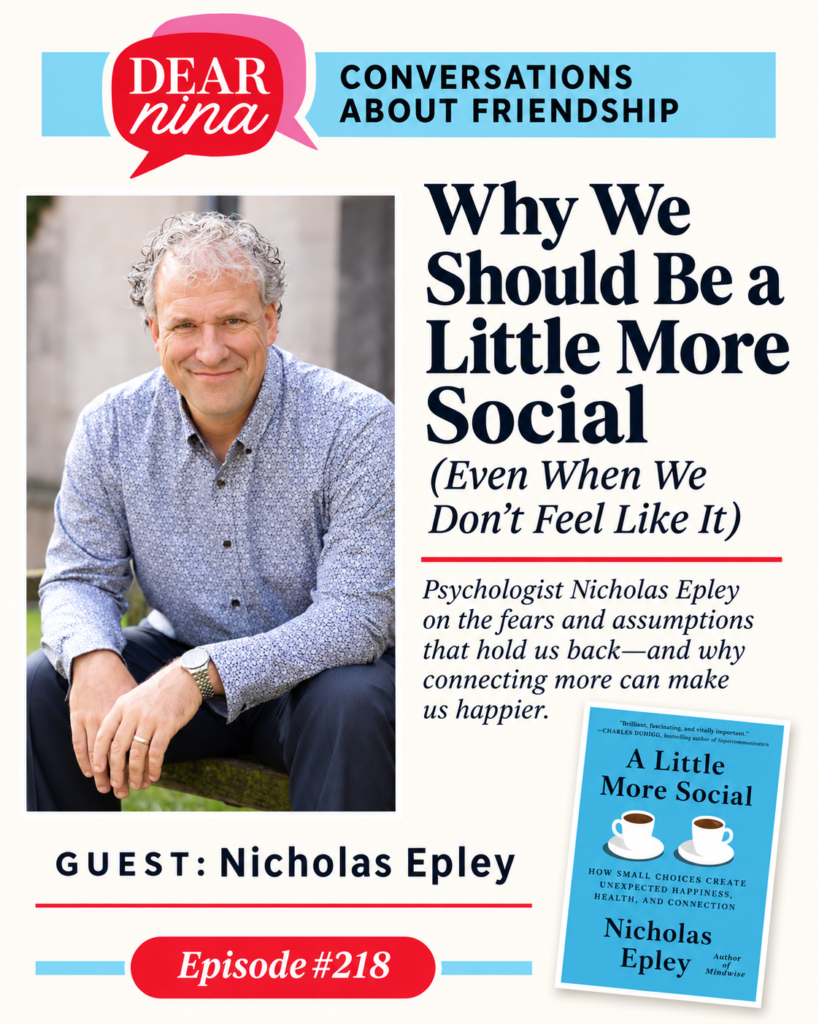
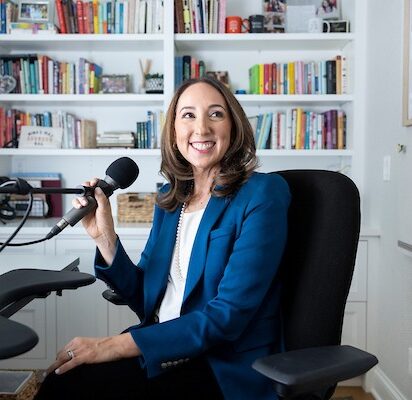
Nina: [00:00:00] Welcome to Dear Nina: Conversations About Friendship. I am your host, Nina Badzin. Today we are talking to Nicholas Epley, University of Chicago Business School professor, psychologist, behavioral scientist, author of Mindwise, and more recently, A Little More Social.
I’m gonna hold up the book for the YouTube watchers out there. I enjoyed this book so much. The full title is, A Little More Social: How Small Choices Create Unexpected Happiness, Health, and Connection. What we are talking about on the show today is the idea of pushing yourself a little bit, not overhauling your entire life, not overhauling your entire sense of your personality and your preferences,
but pushing yourself a little bit to be, as his book says, a little more social. We’re talking about the little choices we make, the times when we could call a friend in a car ride rather than listening to something. Although, of course, I do want you to listen to this [00:01:00] podcast. But yes, you should also reach out to people
There’s a chapter in Nick’s book I was especially focused on in this interview. I really like the entire book and highly recommend it. This one chapter had some research about how our sense of whether we will feel worse if we push ourselves, if we see ourselves as introverts, as we call ourselves introverts, or we see ourselves as somebody who doesn’t like to be as social or who needs a certain amount of alone time, if we then push ourselves a bit to reach out more to people, are we going to feel inauthentic?
what Nick has to say about what the research shows is really interesting, and it kind of goes against what you might think. Because I think a lot of us have a sense of who we are and the way we like things, and that we won’t feel good or accepted or right inside ourselves if we push ourselves outside those lines.
he will tell you that is often not the case.
he is very research-based, and you will [00:02:00] feel and hear immediately that you are in good, capable hands with Nicholas Epley from A Little More Social. Let’s get to it
hello, Nick. Welcome to Dear Nina
Nick: Hi, Nina. Thanks for having me today
Nina: So my entire show, 200-plus episodes, five years, 15 years of writing about friendship, is built on the premise that we need social interactions.
And so I actually don’t normally spend time in any of my episodes explaining why. It’s like that is the thesis, and sometimes people pitch me episodes and they’re like, “I want to explain why we need friends.” and I usually say no to those because Well, of course.” We are moving towards issues of introverts and extroverts and what really keeps us from reaching out. But I still wanna start with something I don’t normally do, which is a little bit of a convincing the listeners in case they aren’t already, why do we need to be a little more social? Why do we need to choose interaction more, even if we don’t feel like it?
Nick: Yeah. So, there are many layers to that particular onion, but let me just start on the [00:03:00] outside, layer, which is that social connection is critical for our happiness and for our health. For most of human history, being connected to other people was essential for survival. We therefore, in the same way that food was and in the same way that sex was required for reproduction, being connected to other people was critical for us just to stay alive.
And so we have a neural architecture that is really dedicated to encouraging us to reach out and connect with other, people. And you can feel that. You can feel that in your day-to-day interactions when you are, alone and, and isolated, feeling disconnected from other people, you kind of feel like crap.
You don’t feel very good. You feel blah and lethargic and don’t have much energy, and, it kinda hurts in your stomach. that is cortisol in your bloodstream. cortisol can be good. It’s a stress hormone. It can be good for you in some ways, but chronic levels of it turn out to be really bad for your health.
It compromises cardiovascular functioning, compromises your [00:04:00] immune system. You’re more likely to get, more likely to get sick, if you’re feeling lonely or isolated, pick up pneumonia or COVID or the, or the cold. And as a result, over time, you’re also more likely to live a shorter life or less likely to live a long life if you’re lonely or isolated, if you’re not connected with other people.
That comes from two different sources. One is if you’re living completely alone, nobody’s there to take you to the hospital when you have a heart attack or, encourage you to live a healthier lifestyle, if you’re not doing that right now. So that’s one. That’s the consequence of being alone.
but feeling alone produces those psychological stress responses which compromises your health and also, makes it more likely that you’re gonna live a shorter life. I think the big thing is that other people just make our lives better in so many ways. it’s not health and longevity that we’re going for.
It’s that it makes the moments of our lives brighter. When people are connecting with somebody else, they report feeling happier. That [00:05:00] moment is more positive. Even if it’s just a fleeting moment, even if it’s just a smile or hello that another person gives us or that we give to somebody else, it makes that moment feel more positive.
Other people validate us. we also learn things when we talk or connect with, other people. We strengthen relational bonds when we’re connecting with other people. It makes our lives feel better and enriches them moment to moment. And I think that’s the reason. It’s not actually the long-term stuff.
If you wanna have a good hour Reach out and connect with somebody. You want to have a good morning? Do that as well. You want to have a good afternoon? Do the same thing, You stretch those moments out over the course of a day, that’s what makes a good day. You stretch a few of those days together where you’re reaching out and connecting with other people in positive ways, that’s what makes a good week, right?
You stretch some of those weeks together, you got a good month. Some of those months together is you got a good year. That’s what it looks like to live a good life, and that’s why I think you reach out and connect with other people. It just makes your life better
Nina: It’s like [00:06:00] Annie Dillard’s quote, “How we spend our days is how we spend our lives.” It’s really true.
Nick: Yes
Nina: I think about that if I’m on my phone too much, and I’m like, “Is this how I want to spend my life,” right? That’s like, right, an hour stretches into two hours, same thing
Nick: I think the other thing that’s important to realize is that our choices, also constrain the experiences we have in the sense that they also cause us to miss things. So when you are looking at your phone, you are missing things, and it’s not always obvious what we are missing. The person you chose not to say hello to, in your Uber or Lyft ride.
the person who you feel grateful to but never pass that along to. The time you needed some help but hesitated to ask for it, The time you needed to be honest in your relationship but, were too reluctant, too avoidant to actually be open and honest with somebody. We don’t know what we’re missing in those cases, that’s, I think, the big cost of the choices that we make.
Anything that creates avoidance means we’re missing stuff, and we don’t learn, [00:07:00] what we’re missing
Nina: It’s a perfect segue to what I really wanna get into, because from your book, and I just know too from living my life and writing about friendship for so long, I think two things keep us from making the more social choice. You know, when given any moment, we could choose to connect, choose not to connect.
one is, you talk about a lot in the book, is this fear that we’re gonna get rejected and we’re going to annoy people.
And then I think the other, and we’re gonna talk about both pieces, the other is maybe a belief about our own nature. I’m an introvert. I don’t need people. okay, I wanna start with the introvert/extrovert, and then we’ll go towards the rejection fear piece. What do people get wrong about those definitions? ‘ I know that we all use them really loosely, we’re not really sure what we’re saying anymore. What is an introvert? What is an extrovert?
Nick: the way psychologists measure it, and you could measure it different ways, but what people are talking about typically when they talk about extroversion and introversion are people’s beliefs about themselves. That’s the way we measure it as psychologists. We give you the Big Five [00:08:00] personality survey, which asks you things like, “I’m generally a talkative person,” asks you questions like that, asks you to evaluate yourself, And your friends can evaluate you too, and so on. but really what it’s measuring are how you perceive how you choose to behave in daily life. and so what they really reflect are the choices that you make day to day, Do you choose to be talkative, or do you choose to be relatively quiet? They don’t necessarily tell you about the types of experiences you have if you were choosing to do one thing or another, they predict things like whether somebody will choose to go to a party on a Friday night versus Netflix and chill at home in the evening instead.
They do not necessarily tell you how you will experience those choices if you actually did them, and that’s, I think, what people often misunderstand. People think that extroversion and introversion describes the type of person you are and therefore the types of experiences you have.
In fact, what they [00:09:00] do are they describe the types of choices that you make, right? So a good analogy is to ex-exercise. Some people choose to exercise every day. Some people choose not to exercise every day, those people could vary along the exerciser dimension, right? But everybody would benefit, would be a little healthier if they exercise than if they didn’t, and so that exerciser dimension would describe the choices you make, not how you would experience actually exercising necessarily if you tried to. That was really, kinda a, a revelation for me when I dug into the research because people think about personality like they think about height.
“Oh, I am this way,” right? “As the type of person I am.” that’s just not, that’s not what they do. they predict the types of choices you make and therefore the habits you develop, which can then become the type of person you are, but that’s not what they’re actually measuring.
Nina: I try to [00:10:00] push people in my own work to do more, see friends more, reach out more, the pushback I get is, “That’s not my nature,” or, “I don’t need to be with people as much.” And, but I just don’t, I guess, agree that just because you think it’s not in your nature, you don’t need it. I think you need it. I’m gonna give myself as an example.
I do call myself an introvert, and I don’t know if I’m using it correctly. And what I mean when I say that is, I get really exhausted when I’m with people a lot, but I am with people a lot, okay? I have a big family. I have a lot of friends, by choice. I make a lot of effort to have a lot of friends, and I see those friends a lot.
And I compare it to my husband, we go out almost every Saturday night when we come home from a night out with other people, I am done.
I don’t wanna speak to him or anyone. He is just getting started. He would love to keep talking. I’m like, “I’ll watch a show with you. I will sit and read a book next to you, but, like, I don’t wanna talk anymore.” he kinda sees me as, like, a recluse. I can go hours, and I work a lot. I write a lot.
I work on my computer. I edit. I record. And [00:11:00] I could be alone, alone, alone, alone for hours, and he kinda has to, like, drag me out of my office sometimes to be like, “Hey, you have to interact with people who live here, by the way.” So we have this little fight, and I’m always like, “Oh, but I’m an introvert,” but he’s not wrong, where it’s like, okay, that’s fine, but you also live with other people, and you have to talk to them.
So anyway, I push myself, and since I read your book, I pushed myself several times. A friend wrote about a… Indigo Girls were coming. Who wants to go? I’m like, “Yes.” I said yes to, like, three things in one week that I might normally have said, “Oh, you know, I have a, an interview tomorrow I gotta get ready for.
I have this. I have this. I have all the excuses in the world, and also I’m tired of talking to people.” But I pushed myself, and I was happier each time that I did, to your point of your book.
Nick: Yeah. So, the theories about, energy, those are tricky. I don’t know where these beliefs about social battery actually came from. when psychologists test them, they tend to find, on average, pretty consistent patterns of getting excited and energized when you’re actually [00:12:00] in conversation with somebody, in interaction with somebody, right?
And of course, the more you do it, like the more… Conversation is mentally taxing, and so the more conversations you have to handle, the harder it, can be. You can, you know, if you do the, do it a lot, if you practice a lot, you can get better at it. Your husband is better practiced at it perhaps than you
are, and so finds it a little easier perhaps than you do to do some of those things.
And just like somebody who fit, you know, is physically fit doesn’t find exercise to be as tiring perhaps. But then after those interactions, then there is a crash. You are tired, just like if you exercised. That pattern of getting tired after you interact or finding it depleting in some way after you do that doesn’t make you introverted, it makes you a human being.
and in fact, introversion and extroversion doesn’t– people think that introverts get drained by social interaction, whereas extroverts get energized. But when psychologists actually test that, just actually put it to the test, you see that in the data We [00:13:00] don’t find that. and there were, you know, psychologists back in the ’80s, that was when psychologists first started asking, is personality, that is the types of choices that people make in their lives, the way people think about themselves, is that related to well-being?
On the face of it, you might imagine it wouldn’t be, I don’t know, extroverts like, right, the type of person they are, somebody who likes interacting. Introverts like keeping to themselves. So, you know, people get what they want and, you know, so there’s no relationship between personality and well-being, and that’s just not true.
If just full stop, not remotely true. Extroverts are happier, full stop. And the correlations aren’t small, they’re big. With positive mood, reported positive mood on a day-by-day basis, , extroverts report feeling more positive than introverts do. correlation’s about .5.
That’s as big as the correlation between the heights of fathers and their sons, which is uh, tall fathers tend to have taller sons, shorter fathers tend to have shorter sons. Those are [00:14:00] big effects. When psychologists then started asking the question, maybe, maybe the reason for this is that acting extroverted, actually being a little more assertive and outgoing and connecting with people might actually make us feel better in the same way that physical exercise makes people feel better, even if folks are choosing not to do it.
But when they actually started testing that as an experiment, they found that when you ask people to act more extroverted, their moods were elevated compared to when you ask them to act more introverted. And that was true regardless of how extroverted or introverted you were,
Nina: This part of your book I want you to know I was, like, starring and circling and, I read the entire book, but that was maybe in chapter two or so. It was, like, on the earlier side. And I was like, “This is what I know I want to talk to him about,” because this is what I want people to understand, that what one person might call inauthentic, and you deal with this in your book, it’s got to be pushback that you must get.
I know I get it when I encourage people, to reach out even if you don’t [00:15:00] feel like it. Reach out even if you were the one who reached out the last few times and you’re like, “Maybe, this should be more equal.” I, I talk a lot about redefining what equal means. And anyway, reach out even if you’re not good at it, because you’ll get better at it.
And then people say, “Well, that’s not authentic. That’s not what I really… That’s not my authentic self.” And I… Can you, yeah, continue about the studies and what that has
Nick: Yeah. So, so there was– I mean, psychologists went through the same kind of, “But wait, what about…” kind of reaction to this research that, any-anybody who learns about this research will go through. Yeah, but what about, you know, people getting tired? Well, it turns out that trajectory looks similar for folks who are report being relatively more extroverted versus less when you actually test that.
We’re not finding evidence for that. What about feeling inauthentic, It’s not the type of person I am. Well, when you ask people to act extroverted, when psychologists tested that, the hypothesis was, and there, there are like dozens of these papers in the field that tested these what about potential costs of [00:16:00] acting extroverted, and they all follow the same pattern.
I mean, it has been relentless. Well, what about this? The experiments they ran didn’t support that. Looks like there’s not that cost. And one of them was about authenticity, right? That, folks who are more extroverted will feel more authentic, whereas folks who are more introverted will feel less authentic when they’re acting extroverted.
And that just turned out not to be true in the experiments, in part because when people were more outgoing and more assertive. Now this, by the way, doesn’t mean that everybody does this in the same way, as psychologists, we don’t know exactly what people are doing necessarily in these experiments.
You ask somebody to act a little more , assertive, be a little more outgoing. People lean into that in their own way. When they lean into that in their own way and they feel better, they also report feeling more authentic
Nina: Oh, interesting.
Nick: Because when people feel authentic is when they’re doing something that makes them feel better.
And so the finding was that people actually felt more authentic [00:17:00] when they were asked to act more extroverted, to be more talkative, more assertive, more outgoing than when they were asked to be more introverted, Precisely the opposite of what you might intuit. and this is true if you ask people to do this over the course of days, there were, hypotheses that people couldn’t keep this up for a while. That just turns out not to be true. I wanna be gentle on this because it’s a little like a doctor encouraging someone to exercise a little more, but that’s not in my nature. What they mean by that is that that’s not what I’m choosing to do now.
Those aren’t the habits that I’ve created in my life, and it can be hard to get over that. And, you know, may– it’s possible that, you know, starting to exercise would be hard for you if you’ve crafted a life around choosing not to exercise. but the sense that it therefore won’t have benefits for me, it won’t be good for me, I won’t show the same effects ’cause I’m a different type of person, it’s harder to find evidence for that than I would have guessed.
my encouragement to folks [00:18:00] is to just test this, to not hold yourself back by this. And I, and I should also say, I usually think we’d be much better off just getting rid of these labels
Nina: It’s used a lot. People, people use those two especially, introvert, extrovert
Nick: do. it doesn’t explain much variability in people’s behavior. We actually don’t find very big correlations between measures of extroversion and introversion and much of anything. It’s more highly correlated with people’s beliefs about how they’ll feel in an interaction than with their actual experience.
But the correlations are small to begin with. If you look across the course of a person’s day, most of our behavior is dictated by the context that we are in, So when I’m speaking to you, I’m acting more extroverted. When we’re done with this and I go back to writing, uh, I’m gonna be, you know, more introverted.
This is determined by the types of things we’re asked to do than by anything measured by personality. In fact, only about fifteen to twenty percent of the variability in our behavior in any given moment is predicted by these personality scores. So it’s a kind of a very small amount, and [00:19:00] I think the beliefs, they just serve as constraints on us
Nina: Yeah, I was gonna ask, why do you think people are so attached to those labels? It’s not just people, it’s like whole,
Nick: Yeah, I know. I
I, I know. I know. And, when this research gets shared, that is the thing that people push back on. It, it would be a little bit like, if you didn’t exercise physically, right? If you weren’t… And your doctor told you, uh, that you needed to exercise more, to get offended that that’s not the type of person I am.
We don’t do that with physical stuff, but we do that with social stuff. And it’s interesting. I don’t know why. I don’t know why people have come to think of these dimensions as part of their identity
Nina: yes. And to question someone’s identity is, puts them on the defense
Nick: I think maybe to question the choices that we make puts you on the defensive. And, , I don’t mean, not, that for our work to do that to people, but I would encourage people to think about that in their own lives, I met [00:20:00] Ann Patchett this spring.
Yeah, yeah.
Uh,
Nina: work. I don’t know her, I should
Nick: she turns out to be as delightful as her work. She’s
fabulous. her husband is wonderful, too. We spoke at TED this spring in Vancouver, and, and she was part of the group that I was in, and so that was just a lovely, lovely, getting to know her. She’s amazing. she claims to be very introverted, and she loves reading books.
That’s what she does, Now, does that make her introverted? No. I mean, her, her TED Talk, in fact, I encourage people to go watch it, was all about the power of one experience in her life of meeting a Hare Krishna in an airport and how beautiful that moment was. She describes herself as a very introverted person, and I think by that she means, “I like to read a lot of books.
That’s what I do for a living, and I love books.” And that’s okay, right? That’s perfectly okay. We all have different preferences about things we do actually enjoy doing. That’s okay. . It can sound to people like the things that you think you like are wrong, and that’s not it.
Our data suggests that folks [00:21:00] could make moments of their lives a little better if they took opportunities that they had to reach out and connect with other people a little more. That doesn’t mean you have to stop things that you actually do enjoy doing. You’re reading a book, fine. But just ask yourself, if that label is keeping you from reaching out at a time when it would be easy to do.
You don’t have other things going on. You’re sitting in a cab. You get carsick from reading, so maybe you should talk to the driver, Just try to learn something about them a little bit. try to connect. Just see how it goes in those moments.
Nina: That is the perfect moment to move to my other reason. So I said the, our beliefs about ourselves, what we think our nature is, and you used the word identity, I think that’s true, might hold us back from being a little more social. And then there’s this other piece that is really often what I deal with on this show, which is the fear that your attempt to talk to someone, to reach out, whether it’s a stranger or a friend, but I’m really more on the friend thing.
Although everyone starts as a stranger. So it’s, it’s really pertinent. But in [00:22:00] either way, whether you’re talking to a stranger or talking to a friend or someone you would like to be friends with, the other thing that holds us back is that deep fear a lot of people carry around of being rejected, being seen as annoying or pushy, all those things.
I would love to hear more about what you found with that
Nick: so in general, we find that people are overly pessimistic about how positively others will respond to them when you reach out to, to connect with them. And these are not always fears of rejection. There, can also be fears that you’re annoying or bothering somebody, that it’s rude to talk to somebody sitting next to you on a plane if, you know, or, or on a, in a cab or whatever, right?
There’s a, there’s kind of a… You’re in Minnesota. There’s a Minnesota nice, right? That I, I don’t wanna interrupt. I don’t wanna bo- well, of course, how nice is it to ignore people around you and not reach out to be kind to them as well? but when people anticipate how others will respond, how interested will they be in having [00:23:00] a conversation, how willing will they be to talk back to you if you tried, how willing will people be to help you, how many people will you have to ask, for instance, in order to get, say, three people to let you borrow their cell phone on a subway in New York, Researchers ask people these questions, ask them to anticipate it beforehand, and then they actually go out and do these things, and they find out, for instance, how many people did you actually have to ask, in order to get three people to, borrow your cell phone? and you find people expect on average they need to ask about ten people to get three to let them borrow their cell phone.
In fact, they only need to ask four or so on average. And that result is something we see over and over and over again, and I think it reflects, two biases, two mistakes that we make in our own minds it, it is a hard problem, by the way, to anticipate how somebody’s gonna respond to you.
That’s a challenging problem. There are two minds involved here, if there’s a gap between how I’m viewing myself and how you’re viewing me, we’re [00:24:00] gonna misunderstand how somebody will respond to us. We find that people tend to focus a lot on their own competency when thinking about themselves, right?
We’re out there trying to do things. We’re an agent. We’re trying to be effective. We’re trying to be smart. We’re trying to get things done. We’re trying to be capable. So we focus on our competency, and that’s one dimension that we evaluate each other on is competency. But the other big dimension that psychologists find we evaluate each other on is our warmth.
How friendly, how kind, how honest, how trustworthy is somebody? And that second dimension of warmth turns out to be the way other people primarily evaluate us, Is Nina a nice person? Is she kind, right? Every parent can ask their kids about their teachers, and what will they get back about their teachers?
Not how good are they at teaching algebra, What is their corpus of knowledge about, ancient, you know, Mesopotamian history. It’s not gonna be that. It’s gonna be, “Oh, th-they’re nice,” or, “No, they’re not fri…” Right.
But if I’m reaching out to [00:25:00] you in a kind way, a warm way, but I’m worried about my competency and you’re thinking about my warmth, I’m gonna underestimate how well it’s gonna go when I reach out to you in a way that’s kind and friendly and warm.
That’s one thing. Another thing is that social interaction is complicated. It unfolds over time, and we have a hard time representing that unfolding in our minds and those dynamic properties. And one of the most powerful dynamic properties in all of social interaction is reciprocity.
you scratch mine, I smile at you, you smile back at me. I say hello to you. What do you do to me? You say hello, And that is not just powerful. It turns out to be surprisingly powerful. people reach back to you generally when you reach out to them, but failing to appreciate that can be part of the reason why people underestimate how well it’ll go when you reach out to somebody in a kind, and friendly way.
Both of those things, I think then just lead us to fear rejection way more often than we ought to.
Nina: We assume it will [00:26:00] go badly.
Nick: Yeah. Particularly with strangers we find. With friends we know a little more about, And so when we’re thinking about the world of friendship, that changes a little bit. but certainly when we’re reaching out to people we don’t know, that’s where the gaps are without question the biggest
Nina: You talked also in the book though about reaching out to people we do know and, like, the times that we could choose, gratitude was a good example. you might think something, nice or you want to thank somebody, but then you just don’t.
I feel like those same fears keep us from doing that too, being annoying, interrupting someone’s day.
it all applies to people we know as well, not just strangers
Nick: Yeah, I think to some extent, particularly when you’re doing something somewhat novel, you know, somebody said something kind to you years ago that you’ve never forgotten, but it’d be a little weird to share that in conversation now, you think. You’re not quite sure how it’ll go, and so you choose not to.
Yeah, so we, we have a kind word we could pass along, but again, if we’re thinking about our competency whereas other people are thinking [00:27:00] about our warmth, we might worry as we find in our work that we won’t get the words quite right, the timing won’t be quite right, I won’t be able to articulate this feeling as well as I could or as well as I should, and that keeps us from reaching out
Nina: I think this is why, and I think you agree, this is why a lot of us text or email instead of call or try to get together in person. what is lost when we do that? ‘Cause I, I know the reason people do it, because they think they can look at it really carefully and edit and be really sure about what they sent, Yes, you can do those things. So that’s what we gain from writing instead of talking, but what, do we lose? I’m a big voice memo evangelist, by the way.
I… Pushing people. I’ve taught so many friends. I literally show them, my fellow, you know, almost 50-year-old friends, I show them on the phone, , where that button is, and it’s changed in the past 10 years.
They’ve changed it. Like, now it’s a plus sign instead of the microphone. Whatever. I j- I keep everyone up with the tech because I think that it makes a big difference. Why does it make such a difference?
Nick: Yeah. So what you’re talking about [00:28:00] there is the presence versus absence of the human voice, And again, if we focus on our competency, we’re trying to get the words exactly right. We think it’s the words that really matter to us. We’re gonna wanna write the email so we can edit and adjust and get all of that.
And it’s not that the words don’t matter, the words do matter, But what you lose, what gets lost out of that, is the presence of the human voice. And it turns out the human voice actually conveys a lot beyond the words themselves. So it also conveys what you’re trying to say more clearly.
So if I’m really expressing warmth to you authentically, Nina, you can hear it, You can hear it. You can, you can hear that I am thinking carefully when I’m passing along a kind word to you, In your text, text is dead, there’s none of that, uh, in there.
the other thing that the voice conveys is not just what’s on your mind. I can tell when [00:29:00] you’re being authentic, sincere versus more insincere. it also conveys that you have a mind, That you are actually thinking and feeling. The voice contains a lot more warmth than the text alone, and it does so through the dynamic properties of your voice.
Your voice, it turns out, moves. It’s alive in a way that text is not, except in the hands of very skilled writers. But your voice, it goes up and down in pitch, That’s intonation. It speeds up and slows down. It goes faster and slower. That’s variability in, pace. it’s that variability, just like I can tell you are alive biologically by watching you move, If you didn’t move at all, I’d wonder if you were dead or a picture or whatever, right? The voice also conveys mental life and allows me to recognize that you’re thoughtful and intelligent. We find, for instance, that people are rated as more thoughtful, more intelligent, more rational when you hear what they have to [00:30:00] say than when you read the same content.
that reading it is essentially dead. It’s monotone
Nina: interesting. Does not surprise me
Nick: but people themselves don’t anticipate that. We find our MBA students here at the University of Chicago, for instance, when we ran an experiment and asked them, to deliver an elevator pitch to their dream employer, They spoke it, we did an, an audio visual. We recorded , them delivering the pitch verbally, or they wrote one, They wrote a pitch. Most of them said they would prefer to send the written pitch to the employer than actually use the audio one. But when we actually played the audio and, and, uh, showed them the written ones to folks who were actually in HR groups in Fortune 500 firms, they actually rated the person as more hireable, more intelligent, more rational, more emotional when they heard what they had to say than when they read it.
And so people’s intuitions can get this wrong. That’s another dynamic property of an interaction that people are, missing, I [00:31:00] think
Nina: the theme to me throughout all this is we just have these assumptions. our nature, what we would enjoy. even if you think about the physical exercise analogy, Let’s say like going back to the doctor says to do a little exercise and you say, “Well, I don’t, that’s not something I do.”
It’s, but like you don’t know that you might actually take to it. You might actually become somebody who, likes to exercise. You might become somebody who has more social connections in your life when you do these repeated choices to be more social.
Nick: Yeah. The thing that started me going down this entire line of research, wasn’t actually the thought that people need to radically change their lives. That’s not at all what the thought was. I was looking around in the world.
It started on a train ride into Chicago, in fact, for me, where I was noticing opportunities where it’d be very easy, very, very easy for people to reach out and engage with somebody, where people didn’t really seem to be doing other [00:32:00] important things at the time anyway. It’s not like it would be hard, to reach out and connect, and people were choosing not to.
And that made me wonder w-w-why, So on the trains, almost nobody talks to the person sitting next to them. Is it really that they’re getting a lot of important work done? I mean, sometimes. Sometimes you got a good book, Or maybe that’s better. it made me wonder, well, what happened if we just took, just took those easy times?
All that is like low-hanging fruit, I walk into my office, I pass a bunch of people on the way. Do I say hello and smile to them? do I greet them in the morning? Or do, do I keep my head down and just get to the office? It’s not any– doesn’t take any, any more time, I’m walking on the train to my office with a whole bunch of other people who just got off the train here in Chicago.
Do I say hello to them and have a four-block conversation with them, or do I keep to myself? It’s not any harder. I wasn’t doing anything else. and so it struck me that there was a lot of low-hanging fruit out there where people could choose very easily to engage a little more [00:33:00] often, but they’re choosing not to.
And I was curious, why aren’t we doing that, and what would happen if we did, if we chose differently?
Nina: Yes, I love that second piece, what would happen if we did? I think the why is often the phone and the AirPods and, I mean, I know there’s that practical piece of it. It’s very hard to break through. It’s hard to e- engage with somebody who’s on their phone or listening to something. and I do it a lot too.
I’m often on my phone and listening to something, so this is with no judgment out there for listeners. I’m right there with you. It is hard to get out of that habit
Nick: It can be, yes. It can be and, I’m not suggesting people stop listening to their favorite podcast. You know, all of your Dear Nina fans, uh, need to, need to stay with you, right? How many people are listening to this right now and avoiding talking to somebody sitting next to them?
I’m not suggesting, not suggesting that. we had people in one experiment think about yesterday. Just think about each hour, What were you doing during that hour? in that hour, was there a moment where you could have reached out and connected with somebody in some way, but you chose not [00:34:00] to?
Maybe you’re going down to get coffee at work, and you could have asked, uh, you know, your office mate to walk down with you to get coffee, but you chose not to. You were driving in the car, you know, commuting home from work, you could have called an old friend, but you chose not to. what would happen if you just chose to do one or two of those things, you know, our data don’t suggest that you need to be reaching out all the time, every opportunity you have, but what if you just took the easy ones, just the easiest ones? I think it would make your life better. And often we don’t really even notice those opportunities that we’re missing.
We put our headphones in automatically without thinking, “Well, I could talk to somebody. I could say hi to somebody when I sit down here first and just see how it goes,” We miss those opportunities, I think. And so I think our work, I hope, calls attention. It’s like people walking through an apple orchard and not noticing that there are tons of apples at eye level that they could grab easily.
What happens if you spotted some of those and took some of those opportunities? That’s all I’m suggesting folks think about doing.
Nina: It makes a difference. I [00:35:00] had you in mind when I was driving, ’cause we were going to be speaking today. I was driving home from visiting, one of my kids in college, about a four-and-a-half-hour drive. And on that drive, I have so many things queued up to listen to. I’ve got a book, I’ve got multiple podcasts, and sometimes when I’m on a long drive, I, choose music instead.
I was by myself. I- my husband didn’t go on this one, I, I just went alone, I love a long car ride. I’ve visited my parents many times throughout the years, driving from Minneapolis to Chicago and back. That’s about six and a half,
seven hours. And, and I don’t mind it. It’s, like, a little long, but it’s like it gives me a lot of time.
I can do books, music, I can do all
kinds of
Nick: It’s a pretty drive too,
Nina: Yeah. And sometimes I like music ’cause it’s different than listening to a book or a podcast or talking to a friend. It’s like I can turn off a little. It’s more, like, passive. I thought to myself, “I’m speaking to Nick tomorrow.
I am going to call friends and call a couple family members on this drive instead of listening to stuff.” ‘Cause I’d already, two days before when I drove to Madison, listened to a plenty of things. I’m like, [00:36:00] “Okay, it is time for me to be more social,” and I’m glad I did. it was a very good use of time.
I know it is.
Nick: Yeah, yeah.
of course.
Nina: you at a certain point, is it-
Nick: yeah, of course. Yeah, no, it, it, it certainly can. Our data, again, don’t suggest you should be reaching out all the time when you’re… You know, when the chef says to add a little salt to the meal, they’re not telling you to get out the shovel, and that’s the way to think about this too.
When your doctor tells you, ” you’d feel a little better if you exercised a little more,” they’re not telling you to quit your job and start training for the Chicago Marathon, To exercise twenty four/seven. They’re suggesting, take a moment. Like, you know, your four-hour car ride can have music and podcasts in it, but it’d be easy to call an old friend too and sprinkle that in too.
our data just suggests that we tend to underestimate how well those outreach moments will go when we reach out to connect with somebody, and as a result, I think we’re choosing not to do it as often as would be optimal for our own, own wellbeing. And a- again, it doesn’t [00:37:00] suggest you should go overboard and do nothing else.
It suggests that you should sprinkle a little more sociality into your day, just like you sprinkle a little more salt onto a meal to make it better
Nina: Perfect place to end. I hope listeners will pick up A Little More Social, which is so well titled. Sometimes I read a book and I’m like, “That wasn’t the right title.” This was the right
Nick: Wow, Nina, thank you. I cannot begin to tell you how hard we worked
Nina: It’s perfect.
It’s, it seems so obvious. I can’t believe there were other ones
Nick: There were other ones. In fact, the UK version is under a different title.
Nina: Do you wanna tell me what
it
Nick: version is Hello: The Unexpected Power of Choosing to Connect
Nina: That’s not bad. I like that. This one’s better because it’s like the salt. It’s like the exercise. Just a little more would improve your life, and it’s not an overhaul. I totally hear your message and enjoyed the book, so Nick, thank you for speaking to me
Nick: Thank you, Nina. Great to be here with you
Thank you for being here for this episode of Dear Nina. You can always come join me to discuss it and discuss other [00:38:00] episodes and discuss other friendship issues on my Facebook group at Dear Nina the Group. The newsletter is at dearnina.substack.com, and I am on social media more than I should be on Instagram and TikTok @dearninafriendship.
And as this book really does show you, when our friendships are going well, when we are interacting with people, when we are reaching out to friends, and we are talking and making the choice to connect rather than to be isolated, we really are happier all around. Bye.