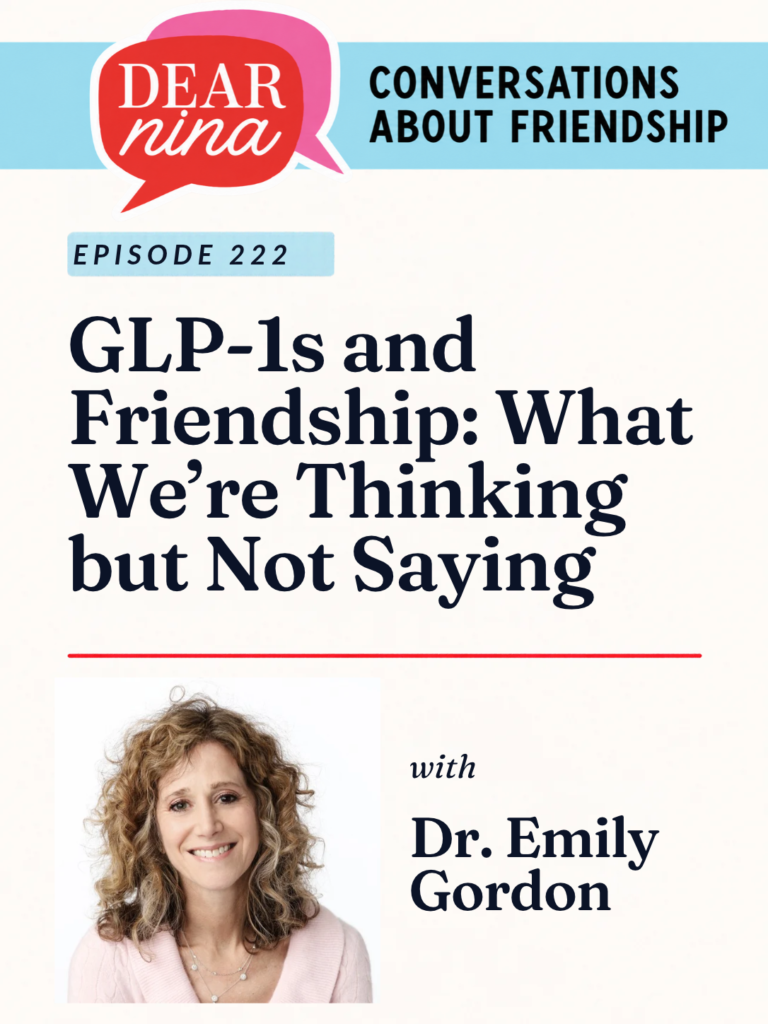
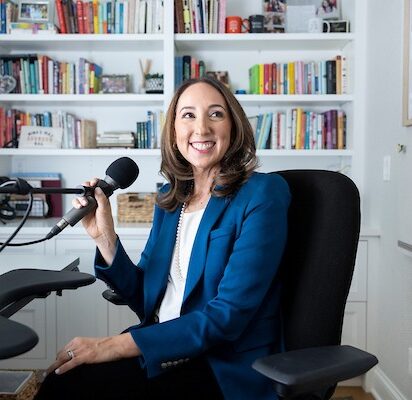
Nina: [00:00:00] Welcome to Dear Nina: Conversations About Friendship. I am your host, Nina Badzin, here today, this week, with a long-awaited and asked-for topic. Yes, we are finally talking about GLP-1s. Podcast is over five years old. We’re at about five and a half years now, only in the past two years have people been asking me for this topic.
I am talking to Dr. Emily Wernick Gordon, who is a licensed clinical psychologist with 25 years of experience specializing in eating disorders, body image, adolescent development, and women’s mental health across the lifespan.
She maintains a private practice in Massachusetts, and she is a frequent speaker and writer on eating disorders, body image, diet culture, some of the topics that we do cover today
Are we going to get into the entire history of GLP-1s? No, we are not. This is not a medical podcast, meaning obviously, I- this should go without saying, but you [00:01:00] should not be getting your advice on here or on any podcast about whether to start a medication, whether to stop a medication, certainly about whether your friend should start or stop a medication.
If you get nothing else from this episode, I think you will get that we should not really be commenting on that about our friends or expecting to know that about our friends. So that’s a tricky one. It’s one of the first ones we tackle is should a friend tell you if they’re on one? Should you ask? You will have to listen to the episode to hear all that.
But this has been such an asked-for topic. It’s such a fraught topic. It really is on all sides of it. Whether you’re on one, whether you’re not on one, whether you feel like your friend shouldn’t be on one.
Whether you feel judged for being on one, feel judged for not being on one, we really get into all of the little kernels of this thing that has become a bigger part of our world, our relationships very much in the past few years.
I hope you feel represented in [00:02:00] it on all different sides, I don’t mean sides like it’s contentious, but just how you feel this topic triggers you in some way, shape, or form within your friendships. If that is happening, this is the episode for you. Let’s welcome Dr. Emily Gordon
Hello, Emily. Welcome to Dear Nina
Dr. Emily: Hello, Nina. I am so excited to be here
Nina: I have to tell you that I have been waiting a while to do this topic. I get questions about it a lot, and it is a topic that is really out there now. It’s in terms of friendship in particular. I put the topic in the Facebook group just to get some other points of view, and so I have some of that to share with you throughout the episode.
And I just really appreciate you being the right person at the right time to write me in just the right way so that I could finally do it.
Dr. Emily: Well, I appreciate your thoughtfulness. it is a topic that is just out there everywhere, and it’s impacting so many things, and it’s interesting to think about how it affects relationships ’cause I really think it does. And I [00:03:00] don’t think there’s a lot of talk about that.
Nina: No, I agree. Can we start with exactly what your specialty is?
Dr. Emily: and that’s actually important because that is the lens that I bring to this conversation. So I’m a licensed clinical psychologist. Um, I’ve been practicing for 25 years, and my area of expertise is treating adolescents, young adults, and women in midlife, mostly with eating disorders and body image challenges.
of course, I do lots of other things, and I have lots of other areas of expertise. but informs how I think about these medications and, the issues that come up.
Nina: And how long do you feel like it has changed the topics that come up in your practice?
Dr. Emily: I would say it’s been in the last two years, I’d say that I’ve noticed it in two ways. I notice it more from individuals who are struggling with eating disorders, and they are grappling with sort of what’s happening in the culture at large, and they are noticing what’s happening in their relationships as they are [00:04:00] working through recovery.
And, you know, people are talking about it in different places, in the workplace, and they’re just sort of seeing what is happening with bodies in general in our culture as these medications have become more widespread.
Nina: Let’s start with that yeah, I’m curious .. ‘, that’s not a point of view we hear from very much
Dr. Emily: Well, I think people are really struggling. You know, so many of the people that I work with in my office, which may not be the bulk of your listeners, but maybe some of your listeners, what I hear is, you know, people who have really worked hard for many years to accept their bodies, to ignore social cultural messages.
A lot of what I work on is sort of the impact of diet culture and how we can tune in and listen to ourselves and ignore the noise that’s out there. And I think that people who have worked really hard and gotten to a place maybe where they’re comfortable or they’re making choices and they’re facing situations where they’re questioning their choices, [00:05:00] and they’re questioning whether it’s possible and feeling badly and maybe even withdrawing or avoiding certain relationships or situations where they’re, um, you know, the topic of weight loss or medications has come up.
Nina: That’s really interesting. I’ve seen that mirrored in society too. Like, there was a uh, couple years period of time, I’d say within the past eight years or so, I don’t have the number in front of me, but just anecdotally, where ads on TV, I’m thinking Target and Dove, there was much more of a accept everybody, accept all the different bodies, kind of against fat-shaming, against diet culture, and really pro all bodies are beautiful.
And it kinda feels like that’s gotten… It’s like, “Oh, wait, we didn’t mean that,
Dr. Emily: agreed. That’s the way that I see it in my practice. And, you know, you could survey a bunch of other clinicians and they might tell you something different depending on, the focus of who the people they work with are.
I’ve hearing it come up in all sorts of other places, right? Talk about ads, on TV, [00:06:00] right? Now all the ads are weight loss.
Nina: nonstop. I mean, it’s everywhere. It’s podcasts,
Dr. Emily: it’s everywhere. You know, it’s women, and I’m sure I’m so curious what some of the questions were that came up in the Facebook group.
But there’s people sitting on the sidelines of a kids’ sporting event and the conversation turns to GLP-1s. it really feels like it is infiltrating, conversations and life, especially for women in midlife, because I think there’s a lot of focus on bodies and changes and what we should or shouldn’t be doing
Nina: what I notice as a theme in the Facebook group, and I’ve seen it in, in my life as well, and in the letters I get way before I put this on the Facebook group, the theme is almost the exact opposite. So yes, it’s everywhere, and it’s like we know we are infiltrated with it. The theme is more like nobody’s talking about it.
That is what is getting
into the friend… Oh, yes, I’m so glad I could bring that to you. That is what I really wanna talk about first when people see this – in the title, I bet that at least [00:07:00] half the people who see GLP-1, I’m not exactly sure how I’m gonna title it yet, people who see that in the title are going to want to hear us discuss the fact that it is really not discussed. somebody loses a lot of weight,
and there’s no discussion of it. Especially with your practice, that’s interesting. Like we’ve been saying, there’s been all this work that’s been done over the years to like not be commenting on people’s bodies, you know, to not even be worrying so much about other people’s bodies and to be sitting with our own confidence and everything.
And then in the past couple years it feels like, wait, okay, so are we really not supposed to comment? Are we supposed to ask? Are we, do we… What if it’s your closest friend and there’s all these changes happening and no discussion at all? So yes, there’s commercials everywhere, and there’s celebrity news and this kind of thing, but there’s not a lot of actual honest talk between friends.
I’m wondering if that comes up at all with your patients who maybe have made peace with their bodies to a point, [00:08:00] and now in the past couple years are like, “Wait, all my friends are half their size,” and nobody says anything
Dr. Emily: I think I do hear that, and it’s interesting. I actually was struggling with that a little bit myself as I was thinking about this conversation. Because I say that a lot. I say a lot like, “We shouldn’t be commenting on people’s bodies,” right? And, “Can we please find other things to talk about?”
And, “Let’s not talk about calories. Let’s not talk about weight.” The reason why I say that is that I really want young people and women to know that there’s so many other things that matter. We focus on bodies, and we don’t focus on so much other things. And yet you are right that when bodies are changing, we don’t know how to talk about it. And I think that’s the part that’s interesting about friendships is we’re feeling things, and we don’t know how to talk about it
Nina: I talk all the time about how important it is to be vulnerable and to be open, and then yet this is genuinely a private [00:09:00] decision. This is where it’s tricky. It’s a private decision. It’s a private issue beyond the concept of that we shouldn’t just comment on each other’s bodies, which I think is true, it is hard to pretend a thing isn’t happening
Dr. Emily: as I’ve been trying to sort through, what is it that is coming up for people and what is the experience? I think it is so internally complicated, and I think that our culture, we talk about bodies all the time, but we talk about bodies in this, all or nothing kind of very high-level way, in terms of bodies are good or bad, or they’re thin or they’re not, or, you know, they’re healthy or they’re not healthy.
And we don’t talk a lot about the nuances and the complexity. And so I appreciate where your listeners are coming from. We don’t have ways to talk about it in, personal nuanced, complex ways.
Nina: The way I have handled it in my own life, and I probably would [00:10:00] advise others, I actually have advised others, is to never ask. So someone will say, “I’m pretty sure my friend’s on a GLP-1. It feels like they should tell me. are we not close enough? Do they not trust me? Why aren’t they telling me?” And I say, “You cannot ask
Dr. Emily: I think that’s reasonable, sound advice. One of the things I was thinking about is, you know, I’m sure you’ve had friends who have had health issues, right? We have friends that have been diagnosed with breast cancer or, you know, someone having, navigating some other medical treatment in their life.
And I struggle with this with that too, right? How much to ask, how much to be concerned. And I think there’s something about body and weight that we again, I think it stirs up so much in ourselves that I think we think it’s different, but it’s not.
Nina: That’s true. It’s like, what is this triggering for you? Really it comes back to ourselves. But you’re right with other medical things is maybe there’s more of a, an understanding and an appreciation that is [00:11:00] someone else’s business. I think of it like an antidepressant. Let’s say somebody started taking one.
You wouldn’t expect your friend to make a formal announcement to all their friends, “Hey,
Dr. Emily: Or a jus- or a justification of why they’re doing it or they’re not doing it, right? Or to get your permission. you would be very respectful in that case
Nina: People have less patience for this one for some reason. I don’t mean for some reason. That’s what we’re talking about here. it’s a really deep-seeded… And I, listeners, I wanna tell you, we’re not going to get to the answer to that per se. This is more just like I wanna reflect for you, the listeners, this is really out there right now, that those of you who are on one, and I’d say this is what I’m hearing from the Facebook group, ’cause I heard from really people who are on them and who feel judged by their friends.
I think they think their friends secretly think, “Oh, you didn’t try hard enough. You didn’t…” I’m just gonna say the things. Like, these are all the things people are thinking. You know, “Why didn’t you do intermittent fasting and why didn’t you try this?”
That’s the more common point of view, and I think everyone kind of understands that that’s out there and, and people feel feelings if they’re [00:12:00] on one. And they feel feelings if they’re not on one like, “Oh, well I, I could’ve made that decision, too.” And, someone might say, “Then do it. There’s also the cost
Dr. Emily: Yes.
Nina: piece of it, and so some people said that they don’t tell friends because maybe they feel guilty that not everyone can do it.
So there’s that. And then there was, completely the other side, and I wonder if this reflects your patients more, is people who are kind of getting advice to go on it. So maybe someone who is struggling with their weight or perceived to be struggling with their weight. So they aren’t in a super thin body and so people assume, “Oh, don’t you know that these are out there?”
Not that anyone would say it that way, but they say enough things around it that that’s what they’re implying.
Dr. Emily: So, I think that there is a fear of judgment on all sides. 100%, I think people who are taking GLP-1s, are afraid that, that as much as we value and [00:13:00] idealize weight loss in this culture, some people are s- feel like they’re actually in a catch-22 where, like, they can’t win either way. but people who are on these medicines absolutely are afraid of judgment or criticism, and so they hold back, or they don’t know what to say. They don’t know how to talk about it.
I also think that people who are not taking these medications are afraid of judgment because they’re out there, and they’re seemingly very accessible, I also think there’s a lot of misinformation about these medications. There’s actually a lot of side effects, and there’s a lot of contraindications, and there’s a lot of risks. And I think that part is not widely understood or, you know, exposed in the media and in the marketing . So I think that there’s a lot of people who might try to get these medications and might start them and really suffer the side effects and feel like there’s something wrong with them,
that they can’t tolerate them or this misperception of “Well, other people are tolerating, you know, [00:14:00] the vomiting and the nausea,” so Am I weak because I’m not?” the issue of cost is a huge one and accessibility. so some people are spending their own money.
some people are getting insurance coverage. The amount that your insurance will cover is drastically different. you know, insurance companies have also shifted. Like a few years ago, it was really easy to get them, and insurance companies were covering them. I think that insurance companies have actually faced a lot of financial difficulty from these medications, and so , they’ve had to really, rein in their coverage.
And so sometimes you might have someone who initially gets insurance coverage and then the coverage changes, and that affects you know, whether you can continue or not continue. So the issue of cost and values and priorities is a huge one that affects people.
Nina: and it’s just also visual. So I think my antidepressant, anti-anxiety medication analogy works in terms of the privacy concept [00:15:00] I think where it falls is truly it can be private. With GLP-1s, it’s created this extra layer in relationships that just didn’t exist a couple years ago. It feels new, even though weight has always been a big thing between friends, and what you mentioned earlier, like trying to change the subject and can we talk about other things and…
So it’s like in a case like this, like yes we could talk about other things. But it’s like the unspoken thing.
Dr. Emily: I think it really gets to, shame, And, grief and connection. Like, it sort of gets to these very deep topics and feelings, and I think it’s really hard in friendships to know how do I navigate my own feelings,
Nina: I love that you keep bringing it to that, and I think that’s really important ‘ cause I’m always trying to help listeners, right? And you are a clinical psychologist. for listeners, ultimately, that is the only piece of this that you can deal with. So I’m gonna let you talk about that some more.
[00:16:00] And jealousy. Throw jealousy in there,
Dr. Emily: Yeah. Well, I can’t help but not talk about these things, right? So, you know, I think that what is happening to someone else’s body triggers our own feelings about our own bodies, and about our own value and our own worth and our own decision-making. When you see somebody else, their body changing or you see what their choices are, you not only have feelings about what is happening for them or with them and how you perceive that their life might be somehow magically altered by those changes, but you also then compare yourself.
We’re so good at finding fault in ourselves or criticizing ourselves, feeling like there’s something wrong with us or that we don’t measure up. and all of those feelings of, guilt and shame and not being as good as or, somehow being left out or if your friend has made a decision and, and you weren’t informed, you know, “Why are they not telling me?”
[00:17:00] or, “What are they gonna think about me?” it’s all just so raw
Nina: I think the reaction that people might feel, like, “Why didn’t they tell me?” also might make you have fears, not just about yourself, but about the relationship
Dr. Emily: yes. And I think that, again, because it’s something that is so visible, you know, when there’s another health issue that we may or may not know about it, we don’t have the same level of awareness and then self-judgment. and I think we really have to work hard to remind ourselves that, we can be close with somebody, and yet it doesn’t mean, like, we have to share everything with that person, and it doesn’t mean that it’s something about us.
I think that is something that really cannot be overstated, right? That again, it’s so easy to feel like this is about you and to be, in your own feelings about this. But it’s really important to have [00:18:00] curiosity and just empathy for what the other person might be going through, separate from what you’re feeling.
Nina: it’s a little too much self-focus. I mean, I’m pointing the finger at myself too. I w- listeners, I hope you know that I’m also thinking about my own reactions to, seeing this change in the world and, I’m thinking about myself. I, I can really only talk about myself other than people who wrote in anonymously, which we’ll bring up in a bit.
When I’m being really honest with myself, like why does it bother me if someone doesn’t tell me? I think it’s because I consider myself a good friend. it’s part of my identity. It is. Like I’m Nina, someone you could tell stuff to. That’s how I hope people think of me.
It’s weird to talk about myself in the third person, but… And so then when there’s this thing where it’s clearly happening and no one has said anything, it makes me question like, “Am I not a good friend? Do people think I’m judgmental?” I’m having to self-talk a lot to just, flip it, and that’s my advice to people is to say like, “No, this is someone’s private business.”
They have their own [00:19:00] reasons for wanting it to be personal. And as we get older, I mean, yes, there’s a lot of personal private things, and I love what you said that just because someone doesn’t tell you something, it doesn’t actually necessarily, especially if it’s their private medical information, say anything about the relationship.
And I don’t think everyone trusts things not to be repeated,
and with good reason. There’s a lot of chatter out there. People share information and,
Dr. Emily: So I think that’s really important, we’re talking about feelings. and I think this topic and others too, in friendships really you’re, you know, we’re talking about all the range of feelings that get triggered, that get brought up by this. it’s really important to be aware of those feelings that we might be having, but to try to sort out, is this about me or is this about the friendship, Because I think your point about being a good friend is really important to you. It’s a value, and so it’s something you take really seriously. But the reason that your friend isn’t sharing something with you may have nothing to [00:20:00] do with you, it probably has to do with them.
so if we can just be aware of the feelings that it is bringing up in us, and then get really curious about what that’s about, and then make a decision about what do we do with that.
Nina: And curious about yourself. I cannot state that enough too. Curious about why it bothers you. I would not turn that curiosity necessarily on trying to figure out why your friend’s not telling you. You’ll never really know. Like, that’s a waste of time
almost. Oh, I’m so happy to have a
Dr. Emily: if it’s a part of a larger pattern or there may be other cues or clues to what’s going on and why, but to first start with the feeling. The other feeling that can really come up in friendships around, GLP-1s and, body changes is you can legitimately feel some loss or some grief, because these medications are also changing behaviors. they’re [00:21:00] changing, you know, food and alcohol and social behaviors. And you can honestly feel loss or grief over something that has changed in a relationship. and that’s something we can address, I feel like something has changed,” or, “I feel like I miss you,”
can we find other ways to, to spend time together?” but we have to get curious and be able to understand the feelings that are coming up first.
Nina: It is similar to discussions I’ve had on this show with, people who have, decided to live a sober lifestyle, in some cases, it is from alcoholism, and in some cases it’s a lifestyle choice. Either way, it’s like the same end use, which is the things you used to do with your friends change.
that one, it feels like people are more comfortable kind of more telling their friends, “Hey, I’m not gonna be drinking anymore.” Maybe one by one as you go out with people, they start making it more clear. Uh, again, I think the unspoken, the elephant in the room does put pressure on the friend who isn’t being told to, over time, adjust [00:22:00] without any explicit conversation.
So eventually they may have to realize, oh, so and so, you know, doesn’t eat that much when we’re out or doesn’t really wanna go to restaurants.
Dr. Emily: Yeah, the question of like whose responsibility is it is a valid one
Nina: There’s no one answer. Every relationship is different.
Dr. Emily: Well, I think the other thing that’s happening in relationships, and what gets triggered and brought up is not only about what is happening in this friendship or in this relationship, right? Why is my friend telling me or not telling me? but it actually is about, you know, we all come to friendships with our maps of previous relationships.
people come to discussions about body and weight and size and dieting, with a host of previous experiences and previous relationships and messages about what we talk about or don’t talk about, or what’s okay or not okay, or what bodies are supposed to look like or what we’re supposed to eat or not [00:23:00] eat.
And so, I think it’s just important also as we’re looking at our own feelings of what is being brought up in this relationship to also ask ourselves the question: Is this about this relationship or is this about a previous relationship or, something that, happened in my family when I was younger or something that happened to me in my teenage years?
because that’s all interconnected too
Nina: That’s really good advice. That’s so wise. Maybe you had a previous friendship where somebody lost a lot of weight and they dropped you,
Dr. Emily: Yeah. Or maybe you had a a previous relationship where people had very clear ideas about what you were supposed to look like or not look like. so I think we all come to it with these ideas of self-worth and expectations of other people
Nina: interesting in your practice because you have specialized in women of all ages with eating disorders and body issues, which probably covers, most women it feels [00:24:00] like. It applies to a lot of people. Because of the promise, at least I can tell you this from all the commercials, I’m not on one, but I can tell you from the many commercials I have been fed and videos and TikToks and audio things and it’s endless, that promise the food noise will go away.
I have Oprah telling me all the time on every clip I see her in, I hear the promise of food noise going away, food noise going away. So I’m curious, in your practice, there must be some desire for it to just go away
Dr. Emily: I have a lot of my own feelings about the term food noise and whether that is– You’re right. I mean, it, you know, it’s now been, like it’s got this label and it’s something we talk about that food noise is bad and we want it to go away. but I, typical psychologist, I think we need to really explore what is food noise and what does that mean.
And I actually think it’s really different for each individual person. And sometimes food noise is, actually lack of fueling and not enough [00:25:00] nutrition, and it is the body and the brain’s way of saying, “Hey,” “You need to be more, on top of this.” Like, that’s actually a biological reaction when we are malnourished, is that the brain gets more preoccupied with food
Nina: I relate this to loneliness, by the way, where loneliness is always talked about like it’s the worst thing. No, loneliness actually is telling you, ” Let’s reach out to someone. Let’s be working on our social connections ’cause it’s important.” loneliness is
not a bad thing. it’s a cue. If you do nothing about it, then yeah, then loneliness is a bad thing. That’s when it becomes detrimental. But it’s actually the first clue that you are missing something in your life. It’s your body’s way of, and mind’s way of saying, “I need to be with other people. That’s what I was put on this earth to do, is not be alone all the time
Dr. Emily: Yeah, so that is one, like, so again, I think food noise is a lot of different things, It can be an eating disorder where, you know, your brain is preoccupied with food and, calories and weight and what you’re [00:26:00] doing or not doing. And, and so the answer to that kind of food noise is not just to make it go away, It’s to really understand, what that’s about and treat the eating disorder. It can be a preoccupation and an obsession in some people’s brains. it goes with binge eating disorder, I think there is this misperception out there that again, this all or nothing, Food noise is bad and we wanna make it go away.
Nina: That’s so part of the marketing. It really is.
it’s
become
Dr. Emily: and, this idealized, like, we should all be free of food noise. but food noise is potentially really valuable information that we need to attend to.
Nina: I’m glad we’re talking about that. Nobody really talks about that, and that I have heard. I mean, I have not heard anybody defend the idea of maybe it’s giving us information that we need or should deal
Dr. Emily: I think it is not talked about. I think that is one piece, right? Again, I think there is this, condensing of [00:27:00] the topic. I think that’s really one of the issues that is one of the reasons that I am talking about GLP-1s, is that I think we have taken something that is medical, that is a very individual decision, and the marketing companies have really just, they have co-opted this.
and so the way that it’s being talked about and the degree to which it is being talked about is really very far from the actual medical scenarios
Nina: It’s in all the med spas. – Everyone’s microdosing. Are you ready for me to go to the Facebook group . I’m just gonna read some of these and we’ll comment on some, and some is just to be able to share this point of view. I thought this was a, an interesting perspective and important and, again, we kind of covered it, but, uh, she said, “Thank you for taking the perspective of how a friendship can change when someone decides to do something for themselves such as GLP-1.
This brings to mind other topics such as whether or not to take hormone replacement therapy, how your friends may have differing [00:28:00] opinions about this support while dealing with menopause, and how a friend supports another friend if they decide to have any sort of body enhancement such as breast implants or facial surgery or Botox.
We could go on and on the, on the list of different topics, but I think GLP-1 is such a hot debate right now. Thank you for taking the perspective and focusing on how friendships can alter and change based on the decisions we make for our bodies.” I liked that she brought up hormone replacement
Dr. Emily: think that’s such a great example, to me that brings up a couple things, one is that there are these topics that are so out there in our culture. Everybody’s talking about GLP-1s. Everybody’s talking about hormone
replacement, at least in, in our age group, it feels like maybe there’s a right or a wrong, or because you’ve done so much thinking or research for yourself that, therefore what you have concluded or found applies to your friend. And the truth is, is that’s again such a great example because, I can’t even figure out, the data and the research on [00:29:00] HRT for myself, like never mind for somebody
else. And s- and I, I’ve gone to, you know, three doctors and they, they all tell me something different. So I don’t, I, I don’t know how we’re supposed to have any, information and decision-making. I think one of the things that’s really important with friendships is to just try to take the judgment and the sureness about a topic, particularly GLP-1s, out of it.
And to try to be curious about what might be going on or not going on for our friends or in our friendship, rather than to come at it that like we know the best decision or we know what the truth is,
Nina: that’s true on all these topics. It’s great advice. I’ve lost 80 pounds on a GLP-1, and I will tell people how I did it if they ask me in person. I don’t wanna make a social media announcement about my weight loss. I’ve been in maintenance for over a year, and I’m still taking the shot at a [00:30:00] lower dose. I look and feel so much better.
There’s only one thing that bugs me, and it’s when a friend refuses to believe that I’m not still losing weight, and she says I’m too skinny.” And then she says, “But I’m also empirically not too skinny. I’m still three pounds above the normal overweight line on the BMI charts.
I look thinner than I actually am, but I’m comfortable enough at this weight, even though I do fantasize about getting down lower, but it wouldn’t be realistic for my body. So she’s now explaining, like, what happens when she sees this particular friend.
She says, “If I’m wearing something form-fitting, I have taken to just preemptively cutting her off as soon as we get together with, ‘Before you even ask, I still weigh the same.’ The annoying thing is she doesn’t believe me, and she does not
drop it. As a 50-year-old Gen X-er, I really don’t like this new concept of never commenting on people’s bodies.”
I thought that was interesting. “It seems disingenuous to me, and if we’re friends, I think we should just be able to ask about weight loss or gain. And if you show up with a dozen purple tusks protruding from your scalp, something is going on, and hopefully we can talk [00:31:00] about it.” I think the harder thing about GLP-1s, this speaks to your point, uh, Emily, is there’s a lot of misinformation out there.
I’ve had one friend who went through weight loss surgery but won’t touch GLP-1s because they’re, quote-unquote, “new.” But they actually aren’t a new drug. They’ve been around for 20 years or so. So when you have to decide if you want to actually get into the history of the drugs or just let it go, just nudge people to get accurate information.
and I did write back that we’re not gonna get into the whole history. My only thing back to that, that you know more than I do, – I do hear people say that a lot, “Oh, they’re not new. They’re not new.” My only thing is that, yes, that’s true, but they were not used on this many people.
Dr. Emily: Well, they’re not new. I can answer that question and then go back to the heart, like go to the… So, so they’re not new, but they were approved for the treatment of diabetes, and so what’s happened, in my opinion, I’m not a medical provider, but in, in my opinion, what’s happened is we’ve taken these medications from what they were designed for and what we have all the research on, and now we’re applying them to lots of [00:32:00] other conditions.
And the research, you know, there is more research coming on… I mean, if, I feel like any given day I see a new headline about what it’s being, what they can be used for. but we don’t have all of that research yet. So they’re not new medications, but they are being used in a wider, lens than they were initially developed for.
Nina: I agree. I feel like every day like I’m fighting internally. I guess I’m just being really vulnerable here. my decision to not use one. it’s like, “Oh, you’re, you, you won’t have dementia, and you won’t have…” I mean, none of this is proven, you guys. I’m just saying the headlines I see.
It’s like, oh, they’re seeing progress in Alzheimer’s, or they’re seeing progress in all these other things. And I’m like, “Am I gonna be the last person
alive
Dr. Emily: think it’s really hard. I think a lot of people are feeling that like, “Should I take these medications?” Right? “And is there something wrong with me or am I missing something?” I think that we all as– also as, you know, medical consumers… I was just talking with somebody whose [00:33:00] doctor prescribed it for, you know, was, was considering it, recommending it for them.
And, you know, we were sort of going over, what are the actual pros and cons? ‘ I don’t think all medical providers are, Some of them are, but not all medical providers, you know, really kind of get into the pros and cons. It’s like, “Oh, you should take this because it will help you with your cardiovascular system,” or, you know, “Oh, you could be– this will lower your A1C.”
But, you know, what will it do when you lose body mass and when you lose muscle and, and can you keep up with all the nutrition that is required in order to be on them? So it’s– they’re, they’re so complicated. And again, I think , it gets simplified. going back to this person, I think that’s so interesting for so many reasons.
But to me, what I heard is everybody really has a different threshold or a different approach to what we were talking about before. do I wanna talk about my medical decisions or my body with my friends? Some people maybe really are comfortable doing it, and some people really aren’t.
And so it’s hard to know, and I guess that’s where in a [00:34:00] friendship, , that might be something to ask. Is it okay that we talk about this?” Or, another thing that I recommend is, if somebody is concerned about weight loss, or, body size, we could take it, we could zoom out a little bit and say , “Are you hearing your friend talk about being dizzy?”
Or, is your friend withdrawing?” Or, “Is your friend, you know, having a lot of GI symptoms?” And can we try to just be a little thoughtful about what is it that is concerning us about the other person? and if we could maybe speak to that. It’s not that you’ve lost weight or gained weight or that your body has changed, it’s these other things that I’m worried about.
Nina: it’s tricky territory, you guys. I understand this commenter doesn’t mind necessarily, although she kinda said she did mind. It annoys her when her friend says, ” Are you gonna keep losing weight?” And then she has to defend that she’s not, but then she also says she doesn’t mind. And I think she was responding to someone a little younger, that’s why she brought up Gen [00:35:00] X, who said we should never comment on bodies.
‘Cause I think maybe a slightly younger generation, like women now in their 30s and 20s sort of know better. And, those of us who grew up…
Dr. Emily: you know, which, which, which, has its value
Nina: I think so. I’m going to read more questions, but I don’t want to forget to ask you, the effect on your teen patients and just what you’re hearing out there for teens, and is it approved for teens?
And is there questions about fertility later? I’m, I’m just, I’m really curious about that
Dr. Emily: Such a good question, and that is one that I, really have a lot of feelings about. So it has been approved for teens. I believe the, the recent approval was 12 and up. I’m not sure which medications have been approved for teens, but some of them have been. so I as a psychologist, I have a lot of concerns about body image and the messages that we are sending to our young people who are growing up in this culture.
and I think, [00:36:00] this message that losing weight is always good, that thin bodies are better bodies, and that we, can and we should, I really worry about that. I’ve heard some college students, I’ve seen some recent articles, right, about how really it’s a step backwards it feels like, to your earlier point of, thinness and weight being tied to belonging and connection.
And that, from a psychological point of view really worries me because those are the people who are more at risk for developing eating disorders is people who have, who are experimenting with diets and who have more, problematic body image
Nina: Over the weekend, uh, this past weekend, I’ll put them in the show notes, there was an article both in The Wall Street Journal and The New York Times about sorority culture.
Dr. Emily: are the articles that
Nina: Yes. People sent me those. The Wall Street Journal, and then s- people sent me [00:37:00] The New York Times one.
I thought it was really interesting that it was in both on the same weekend. It’s like, I don’t know if that was just… That’s
Dr. Emily: Yeah.
Interesting.
Nina: that that happened
Dr. Emily: so that is like the sort of psychological perspective, and again, I come at this with risk for eating disorders, and also just overall wellness and adolescent development, which is the heart of what I do and what I feel strongly about. The other thing that is happening that I think we haven’t answered is GLP-1s, what they do is they give you a sense of fullness earlier, and they slow the gastric emptying process.
And so what happens to people who are taking them is they eat less food, That’s what happens. again, from an adolescent development perspective, teenagers their bodies and their brains are still developing. So I haven’t seen a whole lot of talk or emphasis or research on what happens to young people who are getting less [00:38:00] nourishment at a time when their bodies are developing
Nina: Yeah. I think it’s a important question. I hope people are looking at it and taking it seriously
Dr. Emily: And I will say that’s impacting relationships too. I know the topic of of the podcast and of our conversation is on friendships, but there’s all sorts of dilemmas when parents are taking GLP-1s and their bodies are changing, and when teenagers kind of identify with their family, , like is your body the same as your mom’s, right?
There’s all sorts of messages that are getting construed and how do parents talk about it. I have heard stories of parents giving their kids GLP-1s, kids taking other people’s GLP-1s, like outside of prescriptions. And so all of these things are just, they’re happening and it’s complicated, and we don’t know how to talk about it.
Nina: I’m glad you brought that up and, you know, obviously beyond friendship, it’s so true within the household
Dr. Emily: the grandparent, all of these intergenerational relationships around body and [00:39:00] food, it’s already so complicated.
Nina: Oh my goodness. All right, I’m gonna keep looking. this comment is one I was kinda referring to earlier. I s- somebody wrote, “I wish those on GLP-1s wouldn’t see those that aren’t as lazy.” Isn’t that interesting? ‘
Dr. Emily: That’s what I meant earlier when I was saying, like, I really think both sides of this are primed for the judgment and feeling like they are going to be criticized no matter what or depending on how they’re coming to it, and so everybody kinda shuts down.
Nina: It’s true. this really speaks to you. So she said, “I wish those on GP- GLP-1s wouldn’t see those that aren’t as lazy or that we need to be saved. I had an eating disorder for 30 years and stopped, gained weight because that’s what my body needed. But I have so many people around me offering to help me and have you tried it? I’m three years into recovery from an eating disorder, and they can’t help themselves because they see me as letting myself go. GLP-1s have made this 10 times worse.”
Dr. Emily: That just breaks my heart, right? And that’s exactly what I’m talking about. And I think the thing is, is [00:40:00] that, you know, sometimes our friends are open with us about their history or whether they’re struggling. and sometimes we don’t know. We don’t know that somebody had an eating disorder or, midlife is actually one of the highest risk factors for developing an eating disorder.
And so, so, you know, sometimes we don’t know, what our friends are going through. So, I wish that we could all be a little bit more aware of that as well.
Nina: That’s good advice. I know I keep saying that, but it’s true. this one, I think if I remember correctly, like she handled it quite well, I thought. She said, “A good friend and I feel differently about GLP-1s, and we’re each doing what we think is right for us. We had an uncomfortable conversation in which we each basically said to the other, ‘I care so much about you and want you to be healthy.’
And then each said to each other, ‘Me too, and this is the right path for me.’” So I’m assuming one is on and one is not. She said, ” It actually went very well, but I would’ve been happy s- for some tips beforehand.” Listen, that’s rare. I think, I think I said to her, uh, I wrote, “That’s a successful friendship.”
I mean, it’s [00:41:00] very hard to
Dr. Emily: It’s very hard. But again, I think it’s because of everything that gets triggered and set off in us. Because look, there’s lots of things that we don’t agree with our friends on, right? I think a strong friendship doesn’t mean that we agree on everything, but it means that we can respect the other person and allow them to make their own choices and be curious and have empathy for what they are going through without making a judgment or being critical.
It’s really hard to do, especially on something like this that just triggers our,
Nina: Yes, that’s the right word. It does. so someone said, ” I’ve seen so many middle-aged peers who have lost significant weight since we last bumped into each other. It doesn’t ever feel appropriate to ask whether they’ve had the help of GLP-1s.” I think we’ve already established that.
I agree. “So my question is, is there a way to politely ask for the purpose of becoming more informed for my own choices?” So like maybe someone who is curious [00:42:00] about taking one and would like to speak to not just a doctor, but real people, like what are the side effects been? I don’t know. What do you think?
Could you ever say it for that reason?
Dr. Emily: I think that depends on so many factors. I think it depends on the friendship, and I, think it depends on the person. And I don’t know that we, , want to be getting medical advice from our friends, right? I mean, we can be curious about their experience, but we have to remember, that’s an N of one.
and so I would be careful about that.
Nina: Yeah, I think it’s a good point. And the last one, a great one to end our conversation on. This one said, “I wish people would know that sometimes we’ve literally tried everything, and it has not helped, and this is our last try getting healthy and feeling good about ourselves.
I ran every day, lifted weights, and watched my diet, but I could not drown out the food noise no matter what I tried. This has literally saved me. “My labs are great. I’m finally not considered extremely obese.”
Dr. Emily: Well, I think for me that underscores two things. It [00:43:00] underscores, how complicated and painful, like, our experiences with our bodies and our weight and our body image can be, and that it really is individual. I think that’s what this person is saying is you know, “This is my experience and this is what things have been like for me, and I wish people could respect that.”
And I think that’s true on all, all sides. I also think it does just for me bring up, there is a difference between health and size. and this person is saying that this has been a health change that has been positive. But I think we also just have to recognize that, healthy does not nec-necessarily correlate with size.
Nina: All right, Emily, we’ve been talking a long time, but this is such a big topic, and it took me a long time to do it. So this, people are just gonna have to listen to a longer one. What is the last thing you would like us to be thinking about?
What do you wanna leave us with?
Dr. Emily: Leave you with is that our feelings that come [00:44:00] up in our relationships are really important. but it’s information. It’s not necessarily action, And so I think that what we’ve talked about, like a range of experiences, a range of scenarios, a range of you know, messages, and I think if we can focus on what our feelings are telling us, both about ourselves and maybe about the relationship, and then we get to make some decisions and make some choices about how we want to respond in this relationship.
I will emphasize what I said before, right? Which is that we don’t have to agree. We don’t have to be the same as our friends. In fact, some of the richest friendships are when we have differences, and we can learn from each other. But I think empathy and curiosity and not insisting that, we know best or that we’re right and just being able to listen to our friends, [00:45:00] I think those are the most important things that I want people to take away from this.
Nina: Thank you, Emily. I think this episode will spark a lot of conversation. And listeners, just you can always join us in the Facebook group at Dear Nina, the group, to be part of that. And you don’t have to be on Facebook too. I also will always have newsletters on every episode, and people can discuss that there too.
That’s at dearnina.substack.com. And Emily is discussing these issues and other issues on her Instagram and in her work, and I will have that in the show notes. Wherever you are listening to this episode, just look down. That is where it is. But Emily, tell me your Instagram real fast as long as I mentioned it
Dr. Emily: It is Dr. Emily Gordon. Very, very easy.
Nina: actually shocked you got that. I
Dr. Emily: I, I know, and it’s a n- it’s a new account, but, um, there’s not very many other Emily Gordons, I guess
Nina: good for you, doctor at Dr. Emily Gordon. All right, listeners, come back next week when our friendships are going well. We are happier all around. Bye, Emily
Dr. Emily: Bye. Thank you so much
[00:46:00]