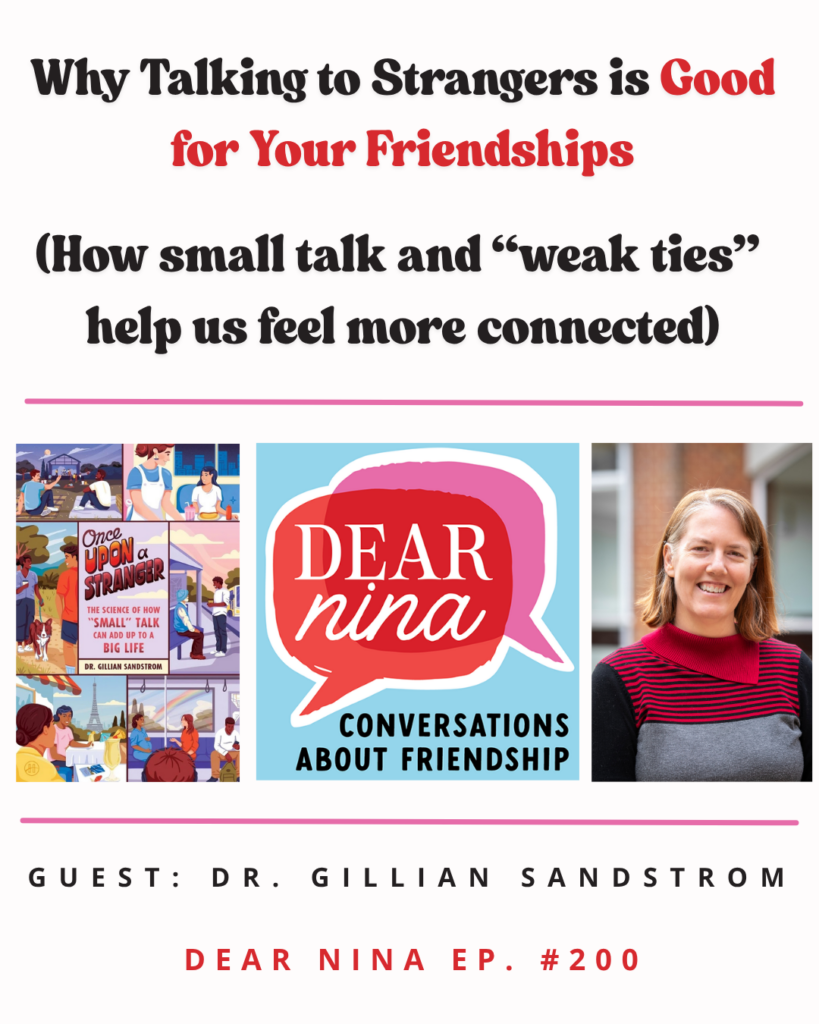
Nina: [00:00:00] Welcome to Dear Nina, conversations about friendship. I am your host, Nina Badzin.
I have been writing about friendship for well over a decade. I’m podcasting about it since 2021, and this topic is a really interesting one that I have not covered in the literal way that we are covering, which is why it is worth your time to talk to strangers. It seems like it has nothing to do with friendship, but of course it does because there is nobody that you are friends with who wasn’t a stranger, at least at one point.
Of course some of the friends you make who are strangers, you meet in a certain context. You meet them because they live in your building. They’re your neighbors. They work with you, or they were introduced to you by someone else. And so even though they’re a stranger, there’s that comfort of that. You already know you have something in common or you already know that you live near them, so it’s worth your time.
And all this talking to a stranger is different than that and the reasons to do it are not necessarily to become friends, but it still [00:01:00] will help with your friendships in less direct ways. And to explain that to us as Dr.
Jillian Sandstrom, who is an associate professor in the Psychology of Kindness. I love that. , At the University of Sussex. She lives in Brighton, England, and she’s the author of Once Upon a Stranger. The science of how small talk can add up to a big life. Her research has been featured in the New York Times, the Wall Street Journal, the Washington Post, the Atlantic.
It has been quoted in books. I will admit that I came in a little wary, like, do I really wanna be talking to strangers more? I presented some of my reasons why I am not sure about it to Jillian and talking to her and reading her book has convinced me that there is good reason to make this part of our life. And honestly the world being like it is these days, how divisive things sometimes feel also how impersonal things feel with the way AI is increasing so much. I think Jillian is onto something. I am excited for you to hear from her
Hello, Jillian. Welcome to Dear Nina.
Gillian: Hi Nina. [00:02:00] I feel like I already know you ’cause I’ve heard your podcast.
Nina: Oh, thank you. And I have heard you, and I’ve read your book . And actually as so apropos for our topic, ’cause we were of course total strangers when you first reached out to me to let me know that your book exists and that it would be perfect for this podcast.
now we’re connected.
The email version is just another version of that.
Gillian: I’ve made friends that way. I made a friend that I am pretty close to just by randomly reaching out. It was during COVID and normally I’d go to an academic conference and I feel like the best part of it is usually , I meet one new person that hopefully I stay in touch with. And so that wasn’t happening because of COVID and I thought, well, I could still meet a new person.
I thought about who I’d seen on social media and that seemed interesting and, I just reached out to someone that I’d never met before who was like a friend of a friend. and I’m just like, Hey, wanna have a coffee, you know, online? And we’re still like really close friends,
Nina: it sometimes works. One thing I appreciate about the premise of your book is there are reasons to talk to strangers, and they don’t [00:03:00] necessarily have to end in that way. It may end in a friendship, it may not. But I think one thing that you and I can both agree on is most friendships do start with some meeting of two people who did not know each other at one point.
And it’s not always so spoonfed as now your roommate’s in college. Okay? that’s different. You’re set up to meet, of course you’re strangers, but that’s not the same as what you are writing about. You are talking about. Talking to complete strangers. So before we dive into what you have to say about it, I wanna read one paragraph from your book that will help ground the listeners too.
And it’s towards the beginning. It’s an introduction Jillian writes, this is not a book about how to make friends, how to find love or how to network your way to success. However, to do any of these things, you’ll need to talk to strangers. It’s not unreasonable
therefore, to expect that feeling more comfortable talking to strangers will make it a little easier to achieve these goals. But I hope that you’ll talk to strangers for no particular reason and with no expectations, just for the joy and humanity of it. Basically what we were just talking about.
Gillian: [00:04:00] Yeah, perfect.
Nina: before we get deep into all the how to talk to a stranger, how to end this conversation, why we should do this all, even though sometimes we don’t feel like talking to strangers. What is the connection between the work you do of. Studying the benefits of talking to strangers and you doing it in your own life, you are I don’t wanna say patient zero, but you’re somebody who is engaged in this in real life. What is the connection between that and what my listeners normally come to this show for, which is about making, keeping losing friends.
Gillian: If you think about the people that you’re friends with right now, they used to be strangers, right? We’ve all heard the line. A stranger’s, just a friend that you haven’t, haven’t met yet.
Gillian: I did a little bit of homework.
You’re being on this podcast made me think I thought it would be fun to reflect a little bit. So I was thinking about the people that I’m closest to and how I met them and who started it. not all the time. Sometimes it was the context or sometimes you, you know, someone introduces you.
So it’s not kind of the context that I tend to study, which is, some random person that [00:05:00] you’ve never met before, that you just happen to come across that you chat with, and then you walk away expecting to never see them again. Right. it’s not always that, but sometimes it is. And when I thought about the people that I’m friends with now, there’s definitely times where it’s just been, unexpected friendship rather than an introduction or, oh, I’m starting new work or starting at school.
And you’re gonna keep seeing people and so that, helps make it happen. I think sometimes we have these unexpected friendships that just start from nothing. Just start from talking to someone because you happen to be in the same place at the same time. The second thing is, I, I think.
All the skills that are involved in talking to a stranger are things that benefit us in all sorts of other ways. I have a chapter in my book called Skeleton Key. And a skeleton key is like the key that opens every door. Getting comfortable talking to strangers helps you deal with uncertainty and the possibility of rejection and just all these kind of skills.
It helps you build the skills that are translatable to [00:06:00] things, that help you maintain your friendships. That’s two ways that it kind of relates to
the general topic of friendship.
Nina: that speaks to a lot of what I hear from people is they’re so afraid of rejection. So even if you’re meeting somebody in the context, which would be easier, a neighbor, someone who lives in your building, someone who works at your office. These are different than strangers, which we’ll get into later, but still requires. I need to start a conversation with this person. And it’s actually, in some ways, if you think about it, it could be easier with a stranger as opposed to your neighbor who you’re gonna run into again and
Gillian: Yeah, it’s a bit higher stakes. You worry a bit more about what
they think. Yeah.
Nina: The stranger is, a lower stake practice and it’s good practice and asking questions and stopping and listening to the answer.
And I’ve done a whole episode just about asking better questions. I mean, that’s its own topic and it’s a good thing to practice or to ask questions at all. So yeah, talking the stranger allows us to practice all these things.
Gillian: Absolutely.
Nina: And a lot of the things that stop people from wanting to do that you cover in the book, and they’re all [00:07:00] applicable to friendship too. The first thing that comes to mind is worrying what the other person will think.
Gillian: That’s a big one. I think it, all goes back to this sense of belonging. And so researchers in psychology believe that we suffer if we don’t feel a sense of belonging. So that’s belonging, connection, feeling valued, feeling seen. That makes it really important to us what other people think.
Even though we’d like to think you know, it doesn’t matter. I’m my own person. It doesn’t matter what other people think. we want that to be true, but I think we can’t help but care. Like, it’s just, built in. It’s just really, really important to us that we feel that sense of belonging.
So it feels high stakes, and so we’re really hard on ourselves and worry a lot about not being able to fill that need.
Nina: Talking to a stranger is , practice It’s low stakes practice. It can be, if you can lower the stakes of Yeah, the person might be a little annoyed. I can think of a time where I’ve been on both sides of it, to be honest, where I’ve been nervous to talk to people.
This just happened this morning. I had to move our recording [00:08:00] time because I had a conference in town that I was invited to attend very last minute. And it was only a two hour thing, which is great. But I went all by myself it was people who are, it was kind of scary.
It was people who are in this digital space. Some people came with people. I had to force myself and I knew you and I were speaking later and I had just read your book. So it was really helpful to have that reminder that these little small talk conversations
first of all, it’s gonna be short term ’cause there was gonna be a presentation of some kind. So it was just maybe the first 20 minutes. it was not high stakes. Okay. Maybe someone would be annoyed and they’d rather just be checking their phone, but maybe someone also who came alone would be relieved.
And so I ended up talking to a few people. We didn’t exchange numbers or anything. Wasn’t looking to make a friend, but it was good practice like you talk about, of just getting over yourself.
Gillian: Some of the research that I’ve done is on something called the liking gap. basically if we get two people talking for the first time, you and me we’re talking for the first time.
so after we have a conversation, if we ask you, Nina, you know, how much did you like Jillian? you’re likely to say, [00:09:00] yeah, you know, I think our conversation went okay. I liked her quite a bit. but if I said, how much do you think Jillian liked you on average? you are likely to say, oh, I’m not so sure.
I’m not that interesting. I didn’t tell that story, right. I should have said this, I shouldn’t have said that. so we really get stuck in our heads and we know that it’s in our heads because, one of the studies we did looking at the liking gap is we had people watch videos of the conversations and the observers who weren’t involved were pretty accurate in seeing how much people actually liked each other, but they were not accurate at all in they couldn’t see the gap because the gap is in our heads.
So it can’t, yeah, so, it’s not that we’re picking up on something, we’re just inventing it. we have that voice in our head saying, Nope, you’re not good at this.
Nina: I tell people that all the time and I know about this study, but it’s cool to hear you talk about it. ’cause long before I met you or read this book, people have been quoting that all the time and I like to be able to credit the actual researcher. So was it your research?
Gillian: I am part of the [00:10:00] team that did that research.
Yeah. So basically we found people like you more than you think. It’s so heartening, it’s so encouraging, and I think it, really helps people get over some of their fears. Like just the idea, I can be a little braver. I think it’s enough to plant that seed.
Okay. Maybe it is in my head. Maybe I need to just give it a try anyway.
Nina: Now I’ll tell you when I’ve been on the other side of this kind of thing, I wonder what you make of it. again, recently, ’cause obviously I could go through time and come up with a million examples on either end . I actually don’t travel that much. I just don’t, I happen to be that I was on a lot of flights . I had two friends fathers pass away suddenly, and I went to their dad’s funerals, which by the way, as a friendship tip, I always think that’s a great thing to do if you can do it.
One was in New Orleans, one was in Maryland. I live in Minnesota, so this was a lot of airplane time and they were a few weeks apart. I was just like so tired and spent after the second one. And I was thrilled to have a flight where I could just be with my computer, to be honest. I have a lot of work to do, editing all the things And the person next to me kept talking to me I was doing all the [00:11:00] cues. I was putting the ear pod in. I was like doing all the things to show like I was nice at first. I’m a friendly person and I would hate to make anyone feel bad. And I was interested to talk to him for a couple minutes, but just a couple minutes.
And he did not take the hint. something like that does make me a little afraid to talk to strangers sometimes. ’cause I’m like, how am I gonna get out of this?
Gillian: Yeah. And it’s funny because you know, I’ve talked to hundreds and hundreds of strangers now, and starting a conversation has gotten easier and easier because I notice more opportunities. I notice more ways to give me easy ways to start conversations. So that has become easier and easier.
I’m still no expert at ending conversations. I am getting better though. There is hope. I’ve run a whole lot of how to talk to strangers workshops. It’s very much about facilitating and asking people to talk to each other about various things and.
I think it’s really helpful to pre-think what you might do in a situation before that situation happens. and maybe that’s just ’cause me it went, you know, I [00:12:00] panic. So thinking ahead before it happens is really helpful. So I get people to think about what could you do if you want to end the conversation?
the single most common thing people do is lie. , I think in your case, it’s not a lie., You could have just said, and I, I realize it’s uncomfortable to say, it could have said, I’ve just kind of need a moment to myself.
I’ve had a rough day, or, I have this work that I need to do. and just being straightforward with someone can be really helpful. And, I’m kind of getting to the punchline actually, because, you most people lie. They say, you know, I need to get a drink, or I need to make a call, or I need to go to the bathroom, or whatever.
but then there’s always someone at the workshop who says they’re just direct. They just say, thank you. I enjoyed our conversation, but it’s time for me to move on now.
Nina: Wow. I just like my heart like beat a little extra just
Gillian: I know and people are like, you can do that. And I think. I needed to hear that from, these people.
, I was supposed to be teaching the workshop, but, you know, I feel like I learned from them and I’ve been trying to do that a bit more often. I go for a walk most days.
So I talk to [00:13:00] strangers and now some, people are not strangers anymore. but I do that almost every day. I’ve started experimenting with that. I had this day where I had this really interesting conversation with this, couple actually. I was really enjoying talking to them. But I thought I need to get back to my desk. You know, I’m taking a break from work. I’m happy to take a break, but I don’t want it to turn into something too long.
And so I did just go the direct route. I said, I have really enjoyed talking to you, but I gotta go now. and it was fine. So again, I think it’s the voice in our head telling us you can’t do that. But it’s fine. And I think especially if , you can do it in a polite way, right?
It’s important to first acknowledge and say thank you and and then be firm.
Nina: I had the great grandson of Emily Post on last year we talked about ending conversations a little bit. It’s just coming back to me now. He gave me two words that are very key to begin that. Thank you. Was not the one, but that also works. thank you. And then kind of go on with what you were about to say and I have to go, but his version was, excuse me, that’s what that expression is for. And then you could say the thing that you would also say after. Thank you. I think it’s [00:14:00] the same concept really, but excuse me. I have to go finish some work. It’s been so great talking to you. Yeah, that’s good. I do feel like we skipped a step.
That’s my fault. As the person in charge of this
Gillian: That’s what conversations do though. Like they could jump around. It’s the fun part.
Nina: are already at the ending of our how to end a conversation and we didn’t really talk about how to start one. I really respect that you practice what you preach and that you advocating for people to talk to strangers, to bring some humanity into their life, to work on those social skills too.
And you really do it that you do it all the time. When you’re teaching the workshop, what are some ideas you give to people who might really wanna take you up on this idea?
Gillian: I started sharing stories my sort of adventures, talking to strangers on social media. And that came about because , everybody that I knew seemed to be on social media and I was like, I wanna be there too, but I don’t know what I have to offer.
What would I share? Because, you know, academics, we do research, but , it takes a long time. In terms of having something new to [00:15:00] share, I don’t have that very often. And I was like, what could I do? then it occurred to me, I do all this research about talking to strangers, but I could tell people the stories behind it,
and so when I was writing my book, I got very nerdy and I exported all these stories that I posted on social media and look through them all for some patterns. And what I came up with was three different themes in terms of how I tend to start conversations. together they spell the word quick.
So the QU stands for question. The IC stands for in common and the K stands for kindness. question, I mean, I think that’s pretty self-evident, but , you can ask someone about what they’re wearing. I’ve started so many conversations just by saying what you doing? So one example you know, I saw this woman standing in front of a, bush and she was like lifting up the leaf and looking underneath.
And I was like, what on earth is this person doing? It, and then she taught me about insect. They, create these little galls anyway. It’s it was fascinating. And so yeah, I might see [00:16:00] someone with binoculars around their neck and I’ll say, what are you hoping to see today?
Or What have you already seen? I think that’s something you can get better at, but it’s like tapping into your curiosity and just asking people and people love talking about themselves, that’s an easy way to get started. And then the IC stands for in common. when you have an opportunity to talk to someone, you’re in the same place at the same time.
I think that’s why we talk about the weather is it’s something that we have in common. It’s a
Nina: Yeah,
Gillian: and I think you can draw people’s attention to stuff in your shared environment as well. And then the last one, the K stands for kindness. that could be just cracking a joke. So I talk a lot in the book about my dad who’s an epic stranger talker.
He’s the best. he loves to start with humor. I’m not as comfortable with it, so it’s not something I do as often. But it is, I think, an act of kindness. He does it out of a desire to, make someone laugh. But you can also give someone a compliment. That’s a classic, I think being on the receiving end of a compliment from a stranger, you’re like, they had no reason to do that. If a friend does it, you’re like, oh, they’re just [00:17:00] being nice. But if a stranger says, wow, that color looks so great on you, you think, Hmm.
You know, they kind of broke the rules to talk to you to say that. It seems really authentic. So it feels amazing.
Nina: I think for people who have not read the book, they need to be convinced. I’m thinking about the way people act at Trader Joe’s or all the jokes that happen around Trader Joe’s. There’s a lot of content out there about, everybody has to kind of, and I don’t mean everybody, but I feel this way too sometimes you have to gear up to go in there.
have you been to a Trader Joe’s? You’ve
Gillian: I have been to Trader Joe’s, but I’m not familiar with, uh, with these memes or,
Nina: Am I the first person to talk to you about this? No way. Okay. This is great for your work. I can’t believe it. You really should send someone out here to study it
Well, trader Joe’s, you know, it’s a grocery store and it’s like smaller. It’s
Gillian: Dark
chocolate, sea salt caramels. Those are my favorite.
Nina: are great. And yeah, they’re known for certain
things, but you know, it’s not a huge store and everything in there is branded Trader Joe’s, so you’re not getting 10 options of every kind of thing.
They are known for being extremely friendly when you [00:18:00] check out, that’s clearly part of their brand. They wear Hawaiian type shirts.
It’s laid back it does not matter who the checkout person is. This is clearly across the board customer service training. They have every single person say, It varies. So it might be something like, how’s your day going? What else do you have going on today?
They’ll start a conversation. Doesn’t matter if the line’s long, doesn’t matter if it’s short. This is clearly mandated. there’ll be jokes going around social media where some people don’t mind that. But the sense I get is enough people find it annoying to the point where before they go in they have to be like, okay, I’m gonna
like have this interaction.
I’m gonna now, of course, it really is a lovely thing when you think about it and your book speaks to this, like, look up from your phone, Remember that there is a human being in front of you. You are a human being. we are meant to connect and not just meant to go through life like robots.
More and more this is becoming, you know, with ai, we really have to remember that we are not robots. And yet there is still that feeling of dread sometimes.
Gillian: is it an efficiency thing? Because I think that’s a thing. [00:19:00] Maybe that’s not related to what you’re saying, but I
think some people are like, I don’t wanna have any chitchat because that’s just gonna take longer I’m in a hurry and
Nina: both of us are thinking like the researcher now, like why is it you haven’t been there? I have been there and I do sometimes feel that dread too. okay, you do write about this and let’s talk about it. It’s the small talk piece of it.
It feels pointless. A little bit you may see this person again. You may not. I also want us to talk about the difference between a stranger and a loose tie. If I always had the same person checking me out, I might feel differently.
Gillian: And I have had that, I’ve had like favorite checkout people, but that’s in a context where like most of the time there is no chatting. And I’ve happened to come across someone who seemed friendly. We had a moment, and so then if I go back to the store, I’ll look for that person so that I could see them again.
That was a choice based on a positive experience to start with. Some of the conversation starters you just mentioned, those are hard,
how’s your day going or what have you got me? on? What have you got going on that feels like, wait, I don’t know you, that
maybe it feels a [00:20:00] bit personal.
Nina: And what do you have going on this weekend is if it’s a Friday, they’ll say that do you have any more errands today? It’s, maybe too open ended. And then there’s all these people behind me and I’m like, am I, how detailed am I supposed to get in this answer? It just feels like a lot of pressure.
Gillian: I think some people worry that person behind me is going to hear my answer too. that’s not something that I’ve ever worried about. Maybe I’m just oblivious, but people have told me about that, that worry that not only is the cashier gonna have any interest in what I have to say, but just the next person is gonna overhear everything. And that’s really weird.
Nina: And maybe they wish you wouldn’t have answered so long. It’s, oh, okay. I have been behind people who really get into it with the answers. And I wanna be like, guys, we all know they’re gonna ask these questions. Just answer quick. Let’s go. If so, maybe it is an efficiency thing, but because they’re asking every person to, it does feel very impersonal.
So in their attempt to make it like really warm and friendly, it’s like, okay. I get the gig.
Gillian: I’ve been to a gym. I, and I am old enough now where I’m like, I don’t go to gyms anymore. I play tennis. I walk a lot. There are things that I enjoy. I do not enjoy going to the gym. for a while I was playing tennis at a place [00:21:00] that had a gym attached and there was receptionists who worked there and it was always the same people and I knew them and we’d have a chat and it was really lovely and it was sort of part of the fun of going and it felt really nice.
But I’ve also been to gyms where it’s clearly just mandated and they’re just like, hello? And I’m like, I don’t know you. This doesn’t feel real and it doesn’t mean anything to me. I think the authenticity really matters.
Nina: Yes. You know what, that I do go to a gym and I play tennis, but I play tennis at that gym and they do the same thing. you check in and then they have your name and they’ll be like, thanks Nina, have a good day. And then when you’re leaving, they don’t know your name at that point, because there’s so
many people and Right.
but they’ll call out and be like, hope it was a good workout or have a good day. That doesn’t bother me. ’cause it’s not a question. It’s not like I’m saying people shouldn’t talk to each other in these experiences, but I think the Trader Joe’s one is harder.
It’s the small talk that gets to me. But you do say there are some benefits to small talk,
Gillian: And, and you know what? There’s a brand new study that just came out like in the last couple weeks where they looked at [00:22:00] boring conversation topics. So they asked people deliberately, they had to rate a list of topics and they paired people up. And it was like a topic that one person found interesting and the other person found boring.
what they wanted to see is does that affect how the conversation goes? they concluded it doesn’t matter if you talk about boring topics or topics that you think are gonna be boring, because before you start a conversation, you, don’t know how it’s gonna go, right? and that’s scary and exciting, Depending on how you look at it. in this case they were told you’re gonna talk about. The weather, whatever the topic is. ‘ there are people who find that fascinating, including my husband. He’s totally a weather nerd. So it is possible to find someone who says that is a topic I’m very interested in.
But beforehand all these people knew was we are gonna talk about the weather. They don’t know who the other person is, anything about them. So they focus on the topic, and the topic sounds boring. That means the conversation’s gonna be boring. But what the researchers argued is once you start the conversation, the topic doesn’t matter.
it’s about the back and [00:23:00] forth and someone listens and someone makes a joke. It’s about creating that moment where you feel connected to each other and you can do that even when the topic isn’t all that interesting.
Nina: I would like us to define strangers versus a loose tie. we kind of talked about if we see the same person at the checkout over and over, I would call that a loose tie. I just said that earlier, but we haven’t defined it.
And I would like to know how you define the difference.
Gillian: I think a stranger is basically someone that you’ve never seen before., the kind of interactions that I attend to study are the kind where you see someone and you’d have no expectation of seeing them again. Sometimes that’s not true, right?
Sometimes you’ll talk to someone and then, maybe it’s a stranger the first time you meet a new colleague at work, and then you see them over and over again, so they turn into, they’re no longer a stranger, But I think the sort of prototypical way I think of a stranger is someone that you’ve never seen before and will never see again.
I talk in the book about this one relationship I had with a lady who worked at a hotdog stand. So I was doing my master’s degree at this campus that was in a very [00:24:00] urban environment. And I did my research in one building and my supervisor’s office was in a different building.
And when I walked between the two, I passed this hotdog stand. And I developed this relationship with the woman who worked at the hotdog stand, micro relationship. Every time I walked past I’d smile and wave at her and she’d smile and wave at me. That was it. We never spoke. I never bought a hotdog.
I feel a little bit bad about that now. I but it. Occurred to me eventually, after a while, I realized how important she was to me. just the fact that this woman knew who I was. I’m assuming, you know, I felt like I could read that in her face. She knew who I was.
It grounded me and made me feel connected in this environment. And on days when she wasn’t there, I felt a bit unsettled. That made me start thinking about all these kind of relationships that I had in my life that were like that.
So like the receptionist at the tennis club, or Barry at the pet store who, you know, I’d go to buy my cat food and he’d say, how’s Nugget doing? And all these relationships they were what I call weak ties. they [00:25:00] were so important to me, and yet there was no way I would ever invite any of these people over for dinner.
I couldn’t imagine sharing my deepest, darkest secrets. , It’s not that kind of relationship. I think a lot of times when we have acquaintances, we feel that desire. Like I shouldn’t be friends with someone if I don’t think we could potentially be closer friends. You know? I think we kind of believe that someday we might be, someday when I find the time, we’re gonna have coffee and there’s potential there.
And I think this person could be a friend. I think we think that a lot, but I think it’s okay to just have these people who are just, providing some kind of value to us. We don’t have to have that intention of moving them forward.
It could mean the person at work that you’re not entirely close friends with, you’ve never seen outside of work, but you always choose to sit with them because, they have a special relationship with you and written a paper sort of on, we call that a fringe ship. You know, they’re kind of on the fringes of
Nina: ship. Oh, I like that. That’s good. A fringe ship. Yeah.
Gillian: so there’s a range. The sort of close friends [00:26:00] on the one end we have strangers and then everything in the middle is we’re not sure how to sort those people. There’s a whole range of different people who qualify in that middle ground.
Nina: So your work focused on that extreme on one end, the true stranger, the person who you’re not necessarily gonna keep running into. Maybe you will, but like you said, no expectations, certainly no expectation that you’re going to become friends. One thing that you talked about in the book that definitely I see in my work That people disclose information to a stranger in a way that they maybe won’t or can’t with a friend. I’ll tell you where I see it. I have a Facebook group called Dear Nina, the group. Some people know each other, but generally they’re strangers There’s 700, let’s say 60 something in the group right now, but only a small percentage are active in it. I would call ’em loose ties. I know you call ’em weak ties. I call ’em loose ties.
’cause weak has like a negative connotation, even though I know you don’t mean it that way. You mean it as in not someone who’s a close friend.
Gillian: I didn’t coin the term like it existed before me, and so I just adopted it. But I [00:27:00] totally agree. We sort of sounds like they’re not, not enough or not worthy, which
is not the intention.
Nina: to add another layer, a lot of people write into this group anonymously on Facebook in the groups. If the group moderator allows it, which I do, I have the setting that allows it.
People are very kind in my group. if they started to write really off the wall things or the comments were really mean, I wouldn’t allow that. But because everybody really is coming there for friendship help and they’re helping each other, and then I, of course chime in and stuff. This is a place where disclosure is happening for strangers. They are saying things they probably don’t feel like they could say to even their closest friend.
And it’s helpful. So what did you find in your work about disclosure and strangers?
Gillian: Yeah I talk about work. It’s not mine. I can’t take any credit for it. but
, it’s really interesting because there’s actually a lot of reasons why it can be easier. Partly it’s that it doesn’t put your relationship at risk. So if, you’re talking about something, you’re a little bit worried about how others are gonna take it, how they’re gonna respond, you really don’t wanna put those close relationships at risk, so you can kind of try it out on someone [00:28:00] who has a bit more objectivity and isn’t emotionally involved with your disclosure.
And I think too, that when we share something with someone we’re close to every time you see them, you’re gonna be reminded that you share that thing with them. And they might tell other people that, you know, that you have in common. And neither of those things can happen when it’s someone that you don’t know.
And then there’s been some research that found one of the main reasons that we choose, the person that we choose to disclose to is just that they happen to be in the right place at the right time. I think we spend a lot more time with people we don’t know very well than with the people we’re closest to, which is sad.
But yeah, I think it’s one of the main reasons that we end up sharing stuff with people we’re not close to. And in a way that’s kind of nice because it can often develop closeness, you know, when you share something with someone else, you feel closer to them. They feel closer to you.
Generally speaking, people like each other more after there’s been a disclosure on either side. So you tend to disclose to people that you [00:29:00] like, but they tend to like you for having disclosed to them,
Nina: Yeah,
that makes sense. what you just said. explains why, my Facebook group works so well because people have disclosed things. Even if it’s anonymously, it’s, we still know there’s a person behind it who’s in this group. they treat each other well. People do not answer in a way like, well, what’d you think would happen? I mean, you, you could, somebody could write this scenario that they’re having with a friend and somebody could respond also anonymously. ’cause you could be anonymous in the comments and they easily could say something snappy, but they don’t.
And it’s like this respect for the disclosure that we all understand how hard that is to do. And so then we treat it with respect.
Gillian: Yeah. Actually there’s some research showing that when we consider disclosing something, we feel very vulnerable it makes us feel weak in a way, because we’re the one asking for help and can feel sort of unsettling. We don’t like to need help from other people.
But when, other people are vulnerable and share things, we tend to view that as courageous. So there’s this [00:30:00] mismatch in how we think of ourselves disclosing versus other people disclosing. So yeah, in general, we tend to respect and like people and, think of them as courageous for being brave enough to share something.
Nina: one final thought and then in the end, I am going to have you make the final case for why we should adopt this practice of talking to strangers. I know you’ve studied this thing that we all have experienced, which is the friend who feels like a stranger.
This person is not a stranger. You know them very well. They know you very well, but they feel more like a stranger now, which is tangential to your work. I mean, it’s related. It’s like next to your work.
Gillian: I did some work on this with a friend of mine who reached out on January 1st. There’s a reason that I remember that because we’ve done a lot of research together, so we’re friends, but also research collaborators. And she sent me a message on January 1st saying.
You know, Hey, we haven’t been in touch for a while. Let’s set up a call. I have this great idea that we could start to study together. And it was kind of a meta thing because the thing she wanted to study [00:31:00] was the fact that she had felt we’d fallen out of touch and she wanted to reconnect, but she felt awkward about doing it.
And so January 1st was like a good excuse for reaching out because it was like the new year and you know, you could say Happy New Year. And it’s also there’s this research on like fresh starts. feel like, I don’t know, the day of your birthday, it’s like a clean slate afterwards, even though that’s kind of arbitrary,
or the first day of the month feels like a clean start. So it feels like there’s more of a reason or it’s more okay to do something. So anyway, we started studying this. You know, how many people feel like they have a friend that they’ve lost touch
with. And it was almost everybody, like vast
Nina: I could tell you
that. Tons. Tons, yes.
Gillian: But we said, okay, how willing are you to reach out to that person both now and in the future? And people are like I don’t know. And I think it taps into a lot of the same kind of fears that we have about talking to strangers. what if I don’t have anything in common with them anymore? What if they don’t wanna hear from me?
All these kind of things we get in our head. So first thing we had to do is just establish is it that you don’t want to get in [00:32:00] touch with this person? But it’s not that because people said, oh, I’d be very happy if they reached out to me. They just didn’t wanna be the one doing the reaching out ’cause that’s where the risk comes in.
Right? And so we really wanted to fix this and so we tried a bunch of different things where we gave people plenty of time. Like we were paying them for their time to do this study. We said, we’re gonna give you some time to write the message. choose someone you really want to, reach out to who you think is gonna be happy to hear from you.
And, prompted people to do all this stuff. Still, we could not get people to do this. maybe a third of people would, do it after all of our various attempts to, Nudge them in multiple ways. And so we’re like, okay, what is going on here? we started to think, you know, looking at the things that people told us they were worried about, it kind of sounds like people are thinking of these old friends, more like strangers.
Like they’re worried about the same kind of things. People were about as willing to reach out to an old friend as they were to talk to a stranger. And we know people don’t wanna talk to strangers. So [00:33:00] that’s kind of telling. And then we ran a, a study where we found that the more they felt like that old friend seemed like a stranger, the less willing they were to reach out.
So it really seemed to be that this reluctance seemed to be related to, feeling like, I don’t know this person anymore. And so what we did is to try and fix it in the end was I’d done some research with talking to strangers where it seems hard to learn that talking to strangers is generally gonna go well.
We have one pleasant conversation and we kind of. Think it’s an exception. I ran this study that involved people playing a scavenger hunt game. So this was just a way to get people to have multiple conversations so they could see that, the norm was that they went fairly well. You kind of practiced, so we tried to, you know, how could we use that in terms of reaching out? And so what we got people to do, was practice the behavior involved in reaching out, which is often these days just sending a quick text message or something, some people, we got them to spend a couple minutes just sending text messages to their friends, to people that they knew, the friends [00:34:00] or family, whatever, just to practice the behavior.
And other people, we said just scroll , on whatever. And then we tried the same things we’ve done before, think of someone that you’ve lost touch with, that you wanna reach out to, how about you send them a message? after having that little bit of practice I guess just realizing how simple it could be to send that message.
More people were willing to reach out. it again, like just getting over the fact that there has to be this giant barrier that it, can just be a small thing. and this research has really spoken to me now in my own life. I don’t know, we all have these random thoughts, right? I’ll be working on something Catherine will come to mind and I’ll be like, Hmm, I wonder how Catherine’s doing.
I haven’t been in touch for a while. And so now I will literally just stop everything, open my email one sentence, maybe two sentences, just like, Hey, Catherine, I was thinking about you. Hope you’re doing well. Send before I can stop to think about it. Often you get a response back. Sometimes you don’t. But that’s not a big deal. changed how
I act in everyday life.
Nina: That’s great. Yeah. I think probably [00:35:00] what stops people. There’s, the worry that it’s gonna be not, welcome. I keep coming back to this. it is similar to the stranger conversation. Is there an end to it? let’s say the emails, it goes back and
Gillian: Yeah. What if it turns into, so they’re asking me for coffee. I don’t have time for that.
Nina: Right.
Sometimes there’s that fear of inviting something into your life where you don’t have time for it. Even if it is not even getting together in person, even if it is just texts and emails, it’s hard to know when to end a text or an email exchange. There’s kind of no end to it. That’s its own art But still, these are all great skills to practice and to get comfortable with being uncomfortable sometimes.
Gillian: Yeah.
Nina: I know that one of the things that stops people is kind of what I said about the airplane example.
it’s gonna be. boring or it’s gonna go on and on. I’m not gonna be able to get out of this conversation. you say something in the book. These are kinda my words, but with your, I felt like what you were trying to say is, yep. It might be, it might boring, it might be long. It might be hard to get out of it.
You might be introverted. You are saying in the [00:36:00] book it might be hard to get out of it and still you should do it. So that’s why I want you to make the case.
Gillian: , one of the things that I say is, If you like movies, for example, you watch a lot of movies. You don’t expect every single movie to be awesome. Even if you’re like super nerdy like me, and you’re reading all the reviews, and you’re looking at all the ratings and you think, you’ve picked the perfect movie, you’re never gonna like every single movie.
And talking to a stranger’s kind of like that too. You’re not, gonna like every single conversation, I have had a very small number of conversations with strangers that have literally changed my life.
These are like transformative conversations. Those don’t happen very often. I did not wanna write a book where I’m like, you could meet a celebrity or this amazing thing could happen. I wanted to write a book that was about, these are everyday things. tiny number of transformative ones.
I’ve had a lot of conversations where I’ve had a laugh or I’ve learned something, you know, maybe someone’s given me a recommendation that I’ve found helpful or just had a nice moment of connection. But [00:37:00] then on average conversations. are average. But I think that they all matter because they add up to something.
I’ve done this for many, many years now, and I think the biggest benefit is the hardest one. it’s not as tangible as some of the other things. cause it, it puts us in a good mood. It helps us feel connected. We learn lots of things. But I think this intangible benefit is just, it has changed how I walk through the world.
I know now from having done it hundreds of times that I could talk to pretty much anybody and have an okay conversation. And that makes me feel different about the world. It makes me feel safer, more trusting of other people. I just think of other people more positively and I just feel like I’m part of the world.
Related to the sense of connection. And that just changes how I walk through the world. that’s why I think it’s so valuable and important. it feeds into our wellbeing in a few different ways. So if you think about what does it [00:38:00] mean to live a good life that could be a life of pleasure for some people, that’s the definition.
For some people, it’s a life of meaning. researchers have realized that there might be this third dimension. So it might be a life full of rich experiences, and that’s not always an easy life, but it is one way to live a life of purpose for people. talking to strangers, ticks all those boxes, it is enjoyable for the most part.
People don’t expect it to be. But I can tell you from all these research studies that I’ve run it is so much more enjoyable than you expect it to be. Not every time but a lot of the time. it ticks that sort of pleasure box. It’s a source of novelty.
we can control our life so that we know exactly where we’re going and who we’re talking to, and we plan everything. it’s important to us to have novelty and unexpected and spontaneity. Talking to strangers gives you that. And I think that’s partly why it feels scary sometimes, because you can’t predict it and you can’t control it.
But I think it’s helpful to deal with that because life is uncertain we’d [00:39:00] like to think we can control things and we can control things to some extent, but not everything. And it’s helpful to confront the fact that there is uncertainty and that’s okay, , we can get through that.
And when you realize that it opens the possibilities for your life a little bit. oh, maybe I could give that a try. the third thing is a life of meaning. And we’ve talked a little bit about kindness earlier, having done this, I’ve, seen, not all the time, but every once in a while, you have a conversation and someone says, thank you for talking to me.
And you can see that you’ve made a difference just by acknowledging that person just by saying hello. And on the flip side, I’ve, been that person, I tell a story in, the book about this one day. I don’t even know what was going on, but I was just like really, really upset. almost in tears.
I still went from my walk, my daily walk because, it helps. And I was churning, my head was spinning and I saw this woman and she was pushing a baby carriage, she just looked at me and she smiled. That was it. it’s not like I felt instantly better. it’s not [00:40:00] that story.
it changed, you know, the spitting in my head, it was like throwing a spanner in the works, it was just like this spark. Hang on a second. It was just a reminder that the world is bigger than whatever the little trouble is that’s currently in my head. It’s bigger than me.
Things are gonna be okay. Life is gonna go on. that woman gave me that moment and I’d like to think I trust that I can give that moment to other people as well. And that feels incredibly meaningful to me, especially when it feels like life is just really dark and scary and I feel like helpless to do anything about that. But I can talk to a stranger and give them that moment of shared humanity and that feels really powerful and meaningful to me.
Nina: Oh, that’s beautiful. Jillian, thank you so much for being here. I think it’s an important thing for people to consider incorporating into their life, talking to strangers And I’m glad you’re doing this work and this research. I appreciate you being here.
Gillian: Thank you so much. Thank you for this opportunity. I’m [00:41:00] so excited about talking to strangers. It’s something that I’ve come to later in life, . It’s the zeal of a convert, just wanting to share. It’s meant so much to me and I wanna pass that along and give it to other people as well.
Nina: You’re a stranger evangelist. That’s what we’re
gonna call you.
I hope Jillian was able to convince you. I think she convinced me. I think I’m gonna have a better attitude at Trader Joe’s and on airplanes and just generally. It’s good to keep in mind that we are people who do need to talk to other people and it’s good practice it’s good for its own reasons.
. Come back next week when our friendships are going well and when our society’s going well ’cause we’re talking to each other. We are happier all around. Bye.