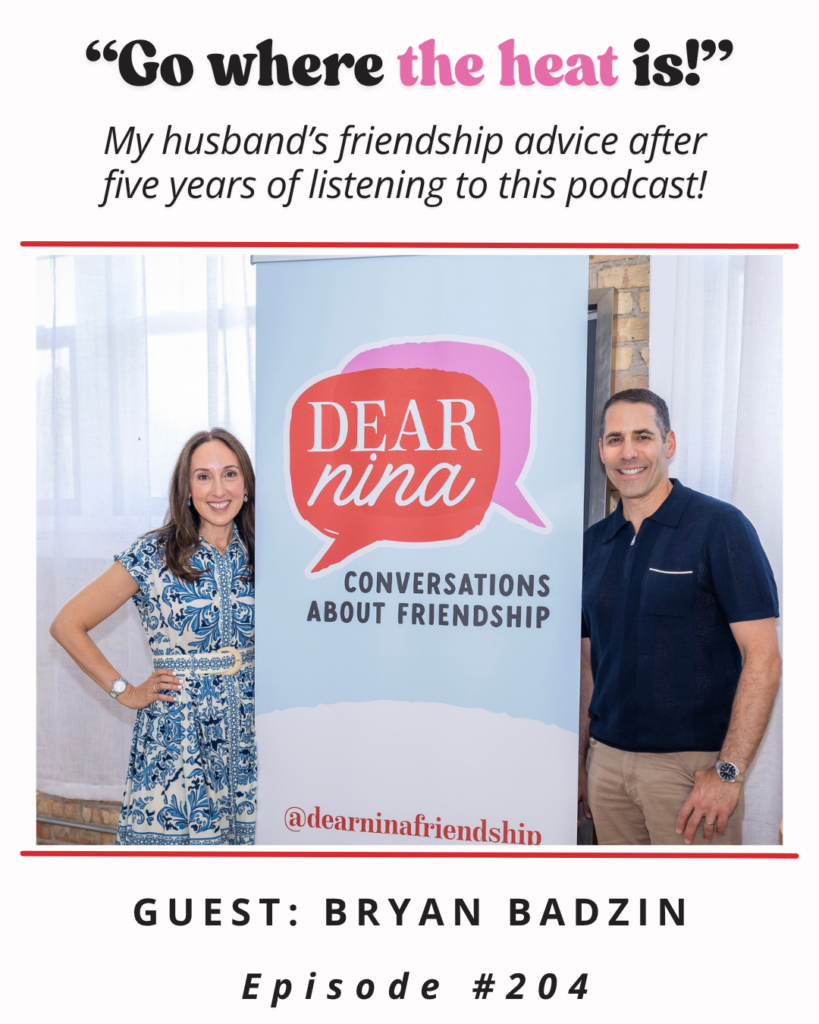
Nina: [00:00:00] Welcome to Dear Nina: Conversations About Friendship. You are here for a very special five-year episode, and I’m not calling it a celebration episode because I am having a huge celebration in a couple days in Excelsior, Minnesota. As I’m recording this, I don’t know if there are any tickets left. Today’s episode is more of a reflection than a celebration, since that event will be me celebrating with friends and listeners, 200 people, what has been a really fun and hard work of five years of talking about friendship on a podcast and 14 years now of writing about it.
I have a very special guest to help me reflect today, and it is somebody who has listened to every episode, at least part of every episode, not necessarily by choice,
Bryan: Well, I wouldn’t say it’s not by…choice. It was by choice.
Nina: Okay. Well, he gave away my intro. My husband, Bryan Badzin, is the number one listener, number one [00:01:00] fan, number one supporter of Dear Nina, the show and the person, I’m very happy to have him here to reflect today. Welcome back to the podcast,
Bryan: Nina. Great to be back
Nina: I haven’t had Bryan on since the very first year. We did two topics. We did the importance of couple friends, which is something I’d written about in the past when I was doing more freelance writing, and we did how to get out of a conversation that you don’t wanna have because you’re really good at doing that without embarrassing anyone or where I end up saying way more than I wanna say and then regret it later.
So I will have those both in the show notes. And Bryan, after listening to a podcast for five years now of mine, you really understand what the show notes are now,
Bryan: and I would say, I did not know what show notes were, but I have become an expert after five years
Nina: it’s important because a podcast is an audio or a video medium. We are on YouTube as well, so you can see that I am in my office and Bryan is in our bedroom, ’cause I actually don’t have good enough equipment anymore. I used to, but something happened to it. To record together in the same studio, that [00:02:00] takes a whole different kinda studio than we have here.
the show notes are important ’cause as we refer to old episodes and as time has gone on, I have so many episodes to refer to.
I would never expect anyone to remember an episode number later and go back to it, so you want the link to be clickable, or if I have guests, then you want their work and their books and their podcast to be clickable. So Bryan, as somebody who has been, by choice and sometimes by force, has had a lot of friendship content. I started writing about friendship officially in 2014, but I had several pieces about friendship, and even a whole novel that never got published about friendship, starting in 2009.
You’ve always been the person that pushes me to do the next thing, and so I wanted to ask, are you surprised that I am still talking about friendship and that I’m still interested in it?
Bryan: Well, you know, when you say the number of years on all that stuff, gosh, it has been going along a long time. Now, am I wrong? Didn’t you start the book and getting up really early when Rebecca was born? Like, was that ’06? I [00:03:00] mean, aren’t we at 20 years?
Nina: yes, but I guess that’s true, but the advice piece of it started in 2014. But something I don’t know if I’ve ever told listeners, I’ve mentioned the book before, but I had written a book that was about friendship in a novel. It was fiction. But within the novel, one of the characters had a advice column.
It wasn’t just about friendship, it was more of a general relationships advice column, but I really liked that advice voice, and I’d written other advice columns. I had an advice column about how to use Twitter. Do you remember that? I was like a Twitter savant back… Yes, that was early, and I did that for a writing website.
It was for other writers. And then I used to do all that baby name advice, you know, what people should name their babies. What chutzpah that was for me to think that I
Bryan: in the action. I mean, you know, but when I think of your friendship journey, I mean, I think of it, really it’s 20 years. I recall you getting up at like 5:00 in the morning when Rebecca was just a tiny baby, and that, that was 20 years ago.
am I surprised that you’re still doing it? I guess the honest answer is I’m not [00:04:00] surprised. I’m more impressed. I think, you know, as an entrepreneur myself, and I think, as being your number one fan and, multiple times telling you to just go for it, the other side of that was I, I think I would say I don’t know where it’s gonna go.
’cause who knows? I don’t have a magic wand and a crystal ball. but I always felt like, hey, it was what you’re passionate about. it was one of the things that actually I found attractive about you when we started dating, you know, 28 years ago, wherever that was. so this is obviously, it’s been something that you’ve been naturally good at.
I think your mother, the, oracle of our lives, it was a great influence. and friendship in particular. it’s become more robust than I may have been able to envision. But, you know, you’ve worked really hard, and it keeps developing.
And I’ve certainly learned a lot, and I think o- one of the things that I’ve…
didn’t know was gonna happen is how much you were going to help others. I mean, I’ve seen the feedback and I’ve heard it, the impact that you’ve had on people I think has been bigger than I maybe would’ve known to know as a guy, but, clearly [00:05:00] you’ve had a really big impact on many, many, many people of many different ages.
And that’s probably gone, bigger than I might have expected. I am impressed at how far it’s gone,
Nina: it has been fun. It’s, you definitely are the entrepreneur in the family, and our daughter Rebecca. We have four kids, so Rebecca’s getting a lot of shout-outs on this episode. it’s funny, right before we started recording, Rebecca’s like, “Mom, you know what you should do? You should put together all your how to start a podcast advice into a book and sell the book.”
And I was like, “Eh, I don’t wanna do that.” she would do it, she has several businesses herself. But okay, back to the podcast. what topic surprised you by being maybe more interesting than you expected within friendship? Because as you know, each episode is tiny minutiae of friendship.
Bryan: I’ll tell you what, has stuck out to me the most. when I think about sort of like w-what’s the biggest theme that runs through and comes out in different ways, you sort of managed what happens when two people don’t like each other the same.
So whether it’s the person who [00:06:00] likes someone else more and they don’t feel like they’re getting enough response, or the person who’s trying to like back away, the unequal, nature of friendships, I never thought about how much that is a challenge for people.
over the years hearing it, I started to realize so many times that’s kind of the underlying question is like: Hey, me and this other person don’t wanna be friends in the same way, or our kids don’t wanna be friends in the same way. What do I do? that’s the thing that I, didn’t know to know that I’ve really become much more aware of and, and then sometimes now the, the blessing’s a curse.
I can see that sometimes now just in relationships, whether it’s mine or even people I know, in a way that I– as a guy, I might’ve been like, “Eh, okay, whatever.” Now I’m like: Oh, well, there’s an imbalance here. that’s the thing I probably learned.
Nina: But I think what I try to help people with, and ourselves, I give advice to both of us too, and then you give it back to me, which is great, ’cause like I need the advice too, and you’re like, “You know, you always say…” that imbalance can come in two ways.. Well, first of all, there’s never 50/50.
I mean, I’ve never seen a friendship that’s exactly 50/50, maybe over [00:07:00] time. in a really great friendship and marriage, I think we’d agree, over time it will be 50/50, but not in any given month or year even, or set of years. But that imbalance can come in the form of desire for the friendship, which feels worse.
That’s hard, when you feel like the person just isn’t as interested, doesn’t like you, to use your word, as much. But it also can come in a different form, which I try to get people to see, which is it’s not always about desire. It’s about ability, time, stage of life. And so deciphering which of those things we are dealing with is the issue.
And so a lot of people are writing in to get help deciding which one of those it is, and they’re asking, “Okay, this happened, this happened, this happened. Is it desire, or is it just that this person’s really busy?” what most people want to know, and we’ve both been there, is, “Do they even like me?” It’s just very vulnerable, and it’s, That’s hard, and we will never know sometimes. that is impossible to read other people, and so then you’re looking for signs, and sometimes we are [00:08:00] misreading signs, to be honest. Along those same lines, is there something that you’ve heard me say so many times that you find yourself, saying it or thinking it?
Bryan: and obviously you didn’t really prep me, right? this is off the cuff just in case anyone was wondering. You know, it’s not, there are two things that I feel like when you’re like, are there, things that have impacted me or struck me the most?
one is I think the most important thing I think you have brought out, in my opinion at least, and it definitely was not an issue for me, but it reinforced something that I learned to do, I guess, independent of this, but it r- this– you reinforced it, and that is, you want friends, call, reach out, don’t wait.
I think that’s a really helpful thing for people because I do think, you know, we talked, a little bit about just, w- what’s kind of the, well, that underlying theme of the difference. Well, in the end of the day, to some degree, okay, guess who cares?
Do something about it and don’t wait. Don’t be a victim. I– to me, that is the number one thing that you have pushed [00:09:00] that I’ve really never heard someone pushing before that I think is extremely wise, is extremely helpful. it has helped me to do what I would naturally do, but sometimes I would even myself be like, “Oh God, this one doesn’t call,” or, “That one doesn’t respond quite right.”
And, in my head I’ll be like, “Nope, that’s not how we do this. We just call.” And it, it gives me sort of that affirmation to just keep calling. Don’t worry about it. the other thing, I think this is maybe just a cute insider tip, is the times when, you will come to me with a, an issue, know, a frustration “This one didn’t call back,” or “I, I, gosh, I have to call again,” or whatever. And I’ll say, “Well, you know, the, a- as the friendship expert.” And you’re like, “I’m not a friendship expert.”
I say, “Fine, whatever. The friendship enthusiast, that I listen to every week, uh, he always says, ‘Don’t wait.’” in the end of the day, you are giving yourself advice because, it is hard. no one wants to feel like they’re the nuisance or they’re not being, appreciated. that’s a cute little thing sometimes when I get to use your [00:10:00] podcast advice, against, against you, but give it back to you.
Nina: And I’m always glad to take that advice, and that’s why I keep dishing it out. people fight me at it sometimes because the more popular thing to do, at least I see people talking about on social media, is people call it matching energy. It’s a younger person’s expression too, and it’s like, “Nope, I’m gonna match their energy.
Like, if they’re only gonna text back every five days, I’m gonna match that energy.” you hear me tell the kids too, and I remind ourselves, “No, we don’t do that. We don’t match energy.” I have my own energy, and my energy and your energy, everyone out there, I don’t believe should be influenced by other people’s energy.
You can choose to step back from the friendship for any number of reasons, but if there’s a certain way you like to communicate or you like to reach out, you like to respond quickly, I, I don’t think you should measure yourself against how everyone else does it. Like, be a leader. Don’t be A follower. You text how you text, unless you don’t text people back. That’s rude.
Bryan: you’re right, I agree with that, and I think another way of, viewing it, not just leadership, which it is, [00:11:00] it’s also don’t be a victim. I do think one of the things that I think you do a great job of saying, and obviously we live this in our lives, we parent together this way to the children, but, you know, it’s, if you want to do something, if you’re interested, kind of I guess as a derivative of don’t wait, but it’s like, don’t sit there and, say, “Well, if this person isn’t gonna call me, then I’m not gonna call. I’m gonna match their energy.” well, that might be a catchy little phrase, but it’s, not the smartest thing to do. Be your own boss and make your own life. it’s a good piece of advice.
Nina: one further thing to help people who feel like I can just hear the voices of, “Well, like everybody I text doesn’t text back, and it feels like I’m always chasing,” it may be that you do need to prioritize other people. If you have a bunch of friends or people you know, classmates, colleagues, if you have a bunch of people you know and some are more responsive than others, then yeah, I would put more energy into the responsive ones.
I am not saying that everybody deserves all of your time equally. The people who are more responsive who also do reach out to you probably should get more of your time and energy. But [00:12:00] I wouldn’t dump everyone who isn’t exactly like you. That’s the thing I talk about a lot, right, is that reciprocity issue, is we can’t have everyone be a mirror.
So nobody’s gonna do a friendship exactly like you, which we will be talking about that a lot at the show, so we won’t say too much more about that now.
Yeah, don’t wanna spoil it. Well, you kind of already answered this. I wonder if there’s anything else, and the question I wanted to ask you is what do you think listeners and readers, ’cause you read the Dear Nina questions that come up on dearnina.substack.com…
Bryan: actually. Paid subscriber.
Nina: Bryan is a paying subscriber. Thank you. Those paying subscribers are getting a little something extra, which is my answers once a month to these anonymous questions, and much longer answers. I do answer questions on Dear Nina, the group on Facebook, but I’ll only write a little bit. Like, it’s the subscribe. I mean, I’ll tell you as a paid subscriber, it’s worth it. Yep. Thank you, Bryan, for
Bryan: I have. Yeah
Nina: that endorsement. the episodes. I was gonna ask, what do you think people are really [00:13:00] asking, like the underlying… You already answered one version of that, which is understanding about this unevenness that comes up in friendships and a difference in who has desire for the friendship or not. Is there anything else that you feel people are really asking?
Bryan: I think there’s another thing, and that you’ve hit on it. you asked, am I surprised at, the two decades really of building this sort of friendship, enthusiasm as you like to call it, and just helping other people think about it.
Uh, people, want friends. so yeah, I think that one of the hardest thing is when the energy’s unequal. and I don’t know if it’s in our time versus history, ’cause you know I love history. I’m a huge history reader, so I– Sometimes it’s like, well, things were different.
Well, and sometimes they weren’t. it does feel like electronics have created a bigger, issue in connectivity. and I would even go back to starting maybe with the television, but I think it’s [00:14:00] absolutely accelerated. There is almost a confusion that comes out in different ways of, social media and having friends. And I do think that one of the things that you have helped people to realize, People sort of theoretically know it, but I don’t know that, that they actually always, act on it.
And I think your encouragement of, real interaction with real people, talking on the phone, like the lost art that many people don’t do, or going, on walks or getting together in person versus just liking posts it does feel like maybe that’s a, a piece of what you’re helping people to do is Don’t think just because you’re sending messages back and forth electronically It’s okay to do that, but there’s a consequence of, how you don’t necessarily connect in the same way that when you, get together or even talk on the phone, Feels like that’s maybe underneath some of what’s going on out there, that friendship, needs an extra boost to get out from under the noise of all the electronic stuff.
Nina: I think there’s something to that. And if you think about, [00:15:00] I started the podcast, so again, that’s 2021, way into the writing about friendship enterprise I’d already started. But in that moment, people were home, right? It was COVID times. It was remote work that then extended long beyond 2021, and that just made everything worse, ’cause even though that’s different than friendship, it’s if you’re not even getting out of the house to go to work, you’re really not interacting with people. And yeah, I think it was, I think it was needed clearly, ’cause here we are still
Bryan: the thing that maybe people, you know, listening don’t see that I get to see, I get to hear the podcast, I read the stuff, but then I also see and hear people come up to you, out in public or at a party or whatever that you don’t know.
and what’s interesting is the age range. it’s people that are in their 30s, occasionally in their 20s, up until 70s or 80s. clearly there’s, a real desire to have more friends and to be more connected,
Nina: and you already said that you have realized through listening to everything that it’s great not to be a victim, to call people when you want plans, even [00:16:00] if you’re always the one who calls. Is there anything else, you feel like you’ve taken that’s changed your personal friendships?
Bryan: maybe one thing, I don’t know if it’s unique about us, but I worked really hard before we met on making friends.
You obviously also separately had a real passion for friends. So we both like friends, couples, separately, whatever. I would say the one little insight that was given, and I think I’ve told you over the years, it was one of my favorite episodes, was with Ruchi when she gave the sort of insight of like a lot of times we want friends because we wanna connect and we, get something out of it, and they get something out of it.
but she made the just– It was such a great insight and such a, good thing for people to think of is, you know, sometimes we’re friends with people really for what we’re giving them. It’s not as much what we get. and I feel like that insight, it’s not like you hit it over and over. you’ve hit it, a few times.
Nina: Actually, I haven’t brought it up in a while, so I’m
glad you It’s a big one, because obviously you do spend a lot of time on the other stuff. But for me that has resonated. It’s like the, [00:17:00] episode that I think of kinda comes to mind, and there’s a, a lot actually that I, I do remember. But that one in particular has always struck me as just such a great insight into thinking about not just taking but also giving sort of selflessly
That was a really deep episode. I just wanna let listeners know about it. I don’t remember the number, but again, it will be in the show notes. And it was titled something along the lines of, “I’m Just Not Into This Friendship.” I actually did use an anonymous letter for that from somebody who is in a situation that many of us find ourselves in, which is not the situation of I’m trying to be friends with someone and they’re clearly not as interested, what do I do? It’s like the opposite, is it’s almost coming from the other person.
It’s someone’s trying to be friends with me, and I don’t wanna be mean. It’s like the letter was really sensitive. It was from someone who absolutely understood that if she didn’t really text back or she canceled plans or did all these things that one might do to make it clear they’re not interested, that it would be hurtful to the other person.
And then [00:18:00] we- if you are a nice, kind person, it is very easy to get stuck in this loop of you never wanna say no, or maybe you only schedule a few times a year, but even that, you’re kinda like, “I don’t even wanna do that.” And Ruchy, instead of giving the easy answer of, You need to just have boundaries, and you need to just do what you wanna do,” she was like, “You know, sometimes we are friends with someone for the other person’s needs.”
And she didn’t mean that should be your once-a-week friend. I mean, that would be a lot to ask. But she was like, “Can you find a place where this person could fit into your life?” it was a really good episode, ’cause we went back and forth. I was like, “Yeah, but maybe are you misleading the person?” I we can’t regurgitate it all here, but people should listen to it, ’cause it is hard. There isn’t an easy answer
Bryan: That was my favorite. and I– I– just to go back on something that you said, a little while ago that I don’t know that you’ve made this point exactly. maybe you did, but, you know, you talk about the matching energy and how don’t do that. a term that, I use, I use it in business, but I think it also totally applies to friendship, and you were sort of saying it, which is go where the heat is.
if there are people that are responding more, it is [00:19:00] completely wise, smart, and the right thing to do to reach out to people that you like, but the people who are responding, of the subset that responds, go where they’re returning the heat, right?
And, that’s just a little point that you sort of made right there that I thought is, it’s really a wise, next step to after reaching out. don’t just keep reaching out to everybody, but yeah, start to hone in on the people who are giving you the heat back.
Nina: Okay, now this question’s gonna put you on the spot, and I have an answer to it in my mind, but I wonder if you would have the same answer. What do you think is the one area of a friendship I still need to constantly work on? And I do wanna clarify and say I do this podcast first and foremost for me.
There’s always stuff I think I need to work on. That’s why I often correct people when they call me a friendship expert.
Bryan: Which includes me,
Nina: that’s true. I always yell at Bryan about that. the truth is when you’ve been writing about the same topic for 14 years, really 20 years if you add the novel and everything, 14 for the advice column, I do think that number of years I’m getting little more comfortable with the expert thing.
But it’s just because I still need to work on stuff [00:20:00] myself that I sometimes bristle at that word. I know something that I need to work on for sure, and I think I’m getting a little better. But I wonder if you that thing is do I think the thing is that you need to work on?
Bryan: Uh, that you are Not that I don’t know, that
Nina: I know I’m working on. always.
Bryan: I… Well, I’m gonna tell you what I think it is, and if I’m, if I’m wrong, then good, then everyone
Nina: let’s hear. Well, we both love a quiz. ‘
Bryan: Cause we both wanna win. I, the thing, it’s not that it’s a problem. the asset i-in life is always a liability, and I think your asset is you like people, and part of liking people is you wanna connect and you wanna be liked. you wanna like people, and you wanna be liked.
where it’s an asset, then becomes a liability, where sometimes if you’re feeling like people maybe don’t like you, that can bother you. Sometimes it’s made up. they’re fine, But sometimes the energy isn’t matched or whatever. so I would say, you really like to be liked, and sometimes kind of to your own detriment. That would be my answer. Okay, what’s the answer on your end? Go.
Nina: Well, that is not what I had in mind, but it’s absolutely [00:21:00] true. I think I actually have gotten a lot better at that. When I think about when we
Bryan: Yeah.
Nina: here in June of 2000 compared to how I feel now
Bryan: of course. But oh my gosh, lifetime of differ- But yeah, it is still something I do.
Nina: Um, the one I have in mind is something I remind listeners about all the time, and it’s something I always am working on, which is just remembering that your friends can have other friends and will not always do everything with you. your friends have permission. I think I even had an episode early on in the first year titled Your Friends Can Do Stuff Without You.
I have to remind you and me, sometimes both have to remember that together. I remind listeners of it. Listeners, you should know when I’m reminding you of something, I am often reminding myself, because it is not a good way to go through the world worrying about people getting together without you, because it is a certitude. You can know people will get together without you, period. They will. So you have to get okay with it
Bryan: Yeah, that’s true. you’re right. That is a concern, which by the way, you and I have both gotten better [00:22:00] at. I see that as a derivative of being like
Nina: yeah, that’s true.
All right, Bryan, before we totally wrap up and say goodbye and meet in the kitchen to clean up for the end of the night, Last time you were on, I think was the one about couples friends. I think the very first one you were on was about how to not answer certain kinds of questions without alienating your friend, which is really the point. you don’t wanna embarrass your friend. Anyway, anything that you would wanna add to those? I haven’t played them in so long. Anything that’s changed after five
Bryan: was– You’re right, it was… God, the years go by, don’t they? I would say one thing that I have had maybe an incremental insight on, just about us, we’re talking about couples friends. one thing that has become a little more apparent to me I’ve said I, I found your desire to have friends and your proactive approach, the way you view making friends, having friends to be an attractive thing from early on.
I think one thing that is a unique thing that we share is being a couple that [00:23:00] both are really friendship-focused.
over the years in listening to the various podcasts, it just occurred to me how, how many people don’t have really many couple friends, or they do friends so differently, or that one’s proactive and one isn’t. And I, I guess I just, you know, you’re obviously really, the leader on the friendship area in the house, but I am also a big friendship enthusiast, you know, kind of independently but together.
And I, I guess I didn’t necessarily realize that as much a number of years ago when I was on, that I’ve become more aware of now that we’re both following your advice, and implementing the advice of your guests. it seems like that’s not as common, and I didn’t necessarily realize that, when we were together even, you know, for many years, but I have through listening to the podcast.
So that’s an incremental insight, it also should be, I think, an encouragement to couples that, hey, as we said, yes, you should have couple friends in addition to individual friends. But both couples can both be taking the initiative [00:24:00] regardless of where they start, regardless of, how good they may think they are or aren’t. It’s worthwhile.
Nina: Yeah, I think it does take both people. It would be a lot of pressure if it was only on one of us to keep those relationships going. I really have had some great guests. Like, I’m very grateful, including you. I’m very grateful. Oh, you know, one thing that surprised me, I’m gonna answer my own question, about the podcast is I did think when I first started it that it would all be based on the seven years of letters I had before that, and letters that would keep coming in.
And so as I was planning episodes, that’s why I called it Dear Nina: Conversations About Friendship, ’cause all those letters start with “Dear Nina,” or “Hi, Nina,” the episodes quickly started having guests because as soon as I got on social media where I already had somewhat of a following, not like I have now, but I had some, and I said I was starting this podcast, turning the column into a podcast.
Right away, I was getting pitches from authors and stuff. It’s been really fun for me to talk to certain authors I’ve admired, to be able to be the person [00:25:00] that people are coming to ’cause they want their friendship book or their friendship whatever, like research at a university.
They want it on the show. Sometimes I reach out to people, but more often than not, it’s people reaching out to me, and I never would have in a million years have predicted that. I just thought it was gonna be, like, me and my mom or you, Taryn, , Rebecca. Se- there’s several Rebeccas. So many Rebeccas. You know, there’s Rebekah, the assistant
producer. There’s Rebecca Kotak. we call her RJ. By the way, RJ will be at… She doesn’t go by that. We just call her Rebekah Jacobs will be at the live show. She will be with me in conversation about the five years, about the five top pieces of advice. We’ve had Rebecca
Kotok on a few times, and then I’ve never had the kids on, and I don’t plan to.
And the reason why, even though I think that the older two especially would be really fun guests, I don’t do it because these files are online forever. And I just think something you may say when you’re 19 or 21, which is the age of our older two kids, they may not still [00:26:00] think when they’re 30, and, I just, even though they’re old enough to give consent, it’s why I stopped writing about anything having to do with kids when Sam was about 10, and, and moved to the friendship topic. Because, um, yeah, I don’t want them to have to stand behind something they said when they were 20 years
Bryan: you are a mother too, and in addition to being a podcast expert enthusiast or whatever it is,
Nina: I do think I’m an expert
on podcasting. That I feel good about All right, I think it is time to wrap it up. Uh, Bryan, thank you not just for being on this episode, but for being the man behind the podcast for all these years, and the writing, and . For being so encouraging and supportive, and any time I’ve doubted things, even doing this live show, you are just very much like, “Go for it.
Do it. If it doesn’t work, you won’t do it again. If you don’t like it, you’ll stop. Keep going, keep going, keep going.” I would not have started it or kept it going without you,
Bryan: Well, you’re welcome and listen, you get all the credit – I gave advice, but you did it I’m just so happy for how things have gone for you and I, I know you enjoy it, but I also know how hard you work the people who are coming out for the live event are gonna get something totally different.
You know, I saw the last [00:27:00] one and it’s different than the newsletter, it is different than the podcast, it’s its own thing, so super excited to, uh, see that here shortly.
Nina: All right, thanks. Love you. Bryan. Congratulations. listeners, come back next week. Bryan, what
Bryan: Because when your friendships are going well, you’re happier all around. Did I do it?
Nina: when our friendships are going well, we are
Bryan: Okay, there we go. Yeah. Okay, bye-bye.
Nina: Hey, listeners. I want to mention one thing that is so important about five years of podcasting, and that is that this podcast would not have started without the help of my brother-in-law, Dave Dluger, who helped me produce and edit the first handful of episodes. He was so encouraging, and he told me, “You can do this.”
And I was always like, “I don’t know. It’s too hard. There’s too much to learn
I’ve told more of that story and how I started the podcast, and what advice I would give to other people on an episode called How to Start a Podcast, and I will have that in the show notes. And I mentioned her in the episode today, but a special extra thank you to [00:28:00] Rebecca Jacobs, who’s been with me for several years now, who is an assistant producer. We talk about all of the ideas together.
If you’re sending pitches to be a guest, those are also going to Rebecca Jacobs, And I make very few decisions these days about the podcast without her input, ’cause she really gets what I’m doing, and what I am aiming for
Finally, people are asking anonymous questions all the time about their friendship dilemmas on the Facebook group at Dear Nina, the group where we also talk about books and TV and all kinds of other things.
But I really love that when you’re on there, listeners are helping each other and if you want longer, really detailed answers from me, that is going to be for paying subscribers at dearnina.substack.com. All right, that is it. Thank you for your support. Have a fantastic week