Mary Laura Philpott: [00:00:00] I hope whoever sees the title of this podcast about being lonely, even when you have friends understands, I love my friends. They are wonderful. You love your friends. They are wonderful. You can have great friendships and still be lonely just because loneliness is a facet of the human experience. Welcome to another episode of dear Nina conversations about friendship. I’m your host, Nina Baden. I’m a writer, a writing group leader, and a friendship enthusiast.
Nina Badzin: On each episode, I have different guests to help me get into the nitty gritty of friendship, what works, what doesn’t work and all the little friendship stuff we think and worry about. But don’t always say out loud today’s episode is about feeling lonely, despite having close friends. And I am so excited to introduce this week’s guest author, Mary Laura Philpot.
I’m a huge fan of Mary Laura’s work. Welcome Mary.
Mary Laura Philpott: Hi, how are you? Nina?
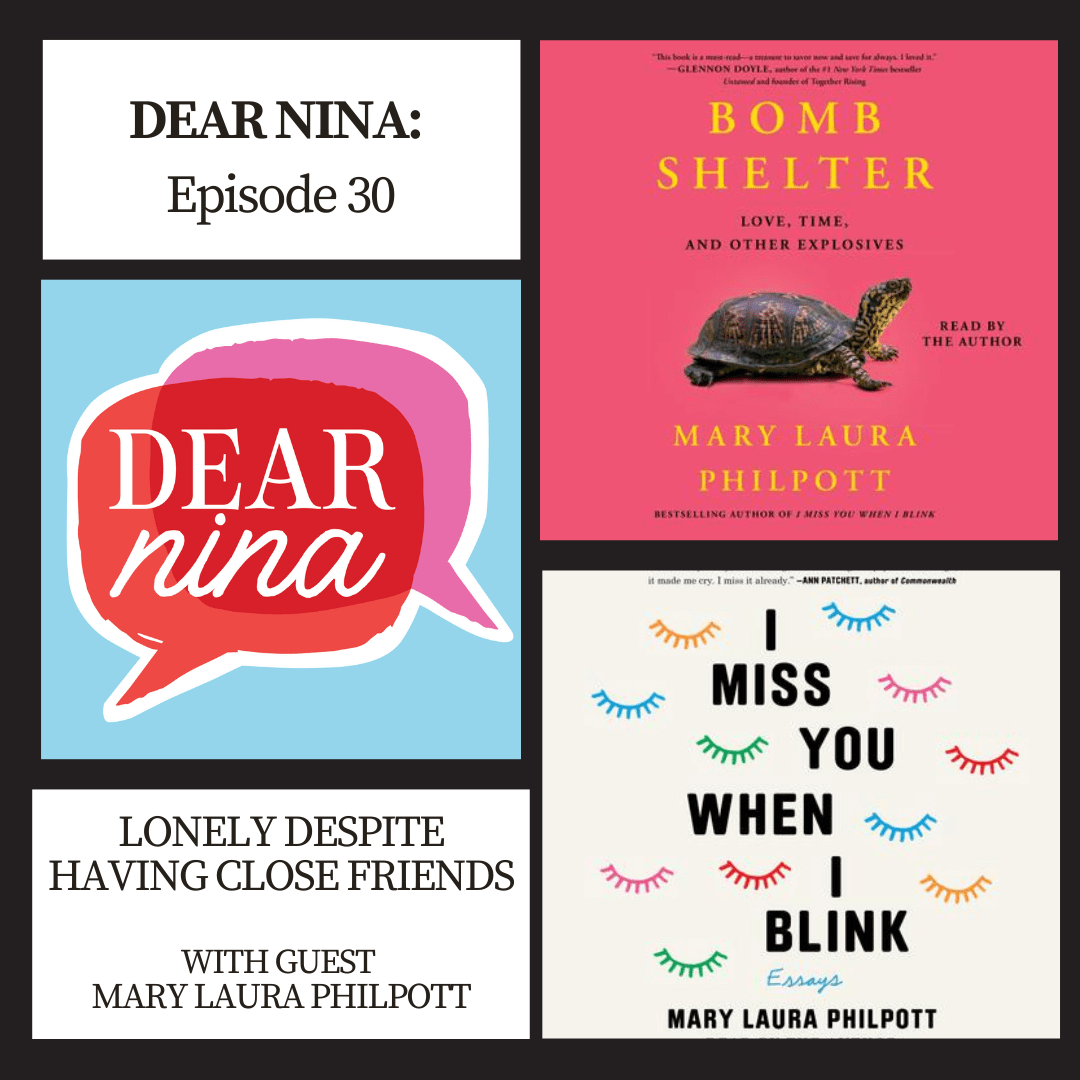
Nina Badzin: Mary Laura is [00:01:00] the nationally bestselling author of I miss you when I blink, which has maybe one of my favorite book covers ever, and of bomb, shelter, love time and other explosives.
She writes about the overlap of the absurd and the profound in everyday life. Her writing has been featured by the New York times, the Washington post and the Atlantic among many other publications, a former book seller. She also hosted an interview program on Nashville, public television for several years.
Mary Laura lives in Nashville, Tennessee with her family. So Mary Laura, you know, I love your work because I’ve said so for many years on social media so like, we’ve been, we don’t know each other know, know each other, but we have met one time in Minneapolis when you were here for
Mary Laura Philpott: We
Nina Badzin: yes. You were here for the loft, why can’t I think of the name of their conference.
Mary Laura Philpott: Word play
Nina Badzin: wordplay
Mary Laura Philpott: the, book festival. Yeah,
Nina Badzin: and you came to the modern, well, little area that we were hosting and giving snacks to authors, but it was, it was quick and we have a cute picture. , [00:02:00] I’ve read a lot of reviews of bombs, shelter. I’ve read the book, loved it. , loved that cover too, but that cover of I miss you and I blinks, especially just happy.
one of the reviews, , Of the book, I mean, there’s long reviews. You’ve had excellent reviews in the big publications, but, Duche Goldblatt author of becoming Duche Goldblatt and other memoir. I loved, and I still don’t know who she actually is.
I’m I’m sure some people do, but I never,
I don’t she’s anonymous writer. It’s so cool. But I loved what she said about bam shelter. She said, I’ve never met Mary, Laura, Phil, but reading bam shelter felt like sitting up all night, talking with a dear friend who saved up all her best secrets to share with me delicious.
And that kind of echoes a lot. She said it so succinctly. That’s why I picked that one, but it echoes a lot of reviews. I saw even just like on Amazon and good reads, but also the professional ones. So we’ll kinda get to that idea later about what it means to have written something. Makes people feel like they know you and you’re a friend, but for listeners who haven’t read bomb shelter, can you say a little bit about it and well, really in there, I guess why you [00:03:00] think people makes it feel like you’re friends.
Mary Laura Philpott: Oh, absolutely. , and I love that quote you shared from Duche school, blood. I don’t know who she is either. We correspond, but it’s. It’s funny because I don’t know, like I’m, I’m sort of corresponding with someone who is a mix of the persona and whoever the, the real person is in there. And I, I don’t know her identity.
But I love that quote. So bomb shelter, if you think of it like a, some sort of multi-layered dessert or, or an onion, or what have you at kind of what you get on the outside is a, a personal story about. Me from my life and that personal story, the narrative thread that kind of pulls you through. It begins with, , a before and after moment when my world just turned upside down.
And that was the morning that my teenage son had his first epileptic seizure. Which came as a total surprise at four in the morning with a big loud crash. And it was terrifying. And I, I tell the story in bomb shelter of calling 9 1 1 [00:04:00] and the ambulance ride, and this, this whole chaotic morning where we didn’t know what was happening.
I didn’t know. Was he dying? What you know, was I at the brink of death with my child, what was going on? We found out by the end of that day, and at the very beginning of the book, I should say, this is, I’m not giving too much of a spoil. That he had epilepsy and that he would have epilepsy for the rest of his life.
And so suddenly I saw my role as a mom. in a whole different way, because I felt like, you know, you always have the job of keeping the people you love safe. But now I had this extra big job of, of keeping him safe from this thing. , but I also started seeing the world differently. I tend to be kind of a happy go lucky person.
, , I’m pretty optimistic. I feel like things are gonna be okay. But I started seeing threats everywhere after this thing came for my son. I became, , very fearful. . There was just kind of a dark streak to my thinking. And I had to rejigger the balance between my optimism and my fear , not just my fear, but sort of my anticipatory grief.
[00:05:00] I had come so close to looking mortality right in the eyes. And. I couldn’t stop thinking about the fact that everyone I love will die at some point and I can’t stop it and I can’t save them all. So that’s kind of the story you get on the outside. , but on the inside, what it’s about at its core and what I, I think is probably what makes it so relatable to people who have nothing in common with the outside story, people who, you know, have no experience with epilepsy, don’t have kids, even aren’t parents, , is that it’s about being a human being it’s about Walking through this world as a thinking, feeling soul trapped in a mortal body and how frustrating that is and how frustrating it is that all the people we love are also trapped in mortal bodies. And we can’t just love everybody hard enough to keep them safe. So if we can’t do that, how do we get up every morning?
Like , what keeps us going? Where do we find joy? Where do we find humor? , it’s a story about being a human.
Nina Badzin: Of course, you’re gonna give it a, a great summary cuz you wrote it, but it is a [00:06:00] hard book to summarize and you did a good job. , well it’s very accurate that . There is a lot of humor in the book
it’s not a comedy, but there is a lot of humor in it I’m thinking about the story in there about. College tour and that , the person giving the tour.
It’s funny. I gave tours in my college and like, yeah, you have your couple of stories. You trot out as the tour person. And then everyone laughs and
Mary Laura Philpott: fat. Of
Nina Badzin: right.
Mary Laura Philpott: you did.
Nina Badzin: and right. So, you know, I’d learned to walk backwards and all that. So I related to this tour guide telling the story of the mom who was screaming at her kid in the quad and , the tour guide’s point was like, don’t be that mom.
And, but your. Essay. And there was really about how like, well, what if that woman was just having a really bad day and , you brought it bigger. I like that bigger lens of how terrible that sometimes. And that’s just reality. People do see us at our worst, and then they assume , that’s who we are. And it’s so unfair.
But like each piece , of your book has these moments of seeing below the surface and it’s not a book about [00:07:00] friendship. And yet when I read it, I really thought about you for the podcast. Cuz I think having gone through what you did with your son and learning that he is, , going to be suffering with, well, not suffering day to day with epilepsy, but the worry of it, like him going to overnight camp and college and everyth. Just this idea of feeling lonely, despite having close friends. And this is not a knock in any of your friends or mine, , in the discussion we’re about to have, but, , I’d love if you could talk about that , just that reality of what it’s like. Raising a son with a diagnosis and in your career as a writer and someone who has some notoriety, you and I emailed a little bit about the difference between famous and literary famous, which I thought was, I love that.
it’s, it is a different kind of famous, but still people recognize
you.
People know you .Yeah. So, and yeah, you get the idea. I’d love to hear what you have to say.
Mary Laura Philpott: I get, what you’re saying. I mean, I, I think on some level, no matter what your personal circumstances are or your professional circumstances, there is an [00:08:00] elemental level of loneliness baked into the human experience because the only world each of us knows is the world we see and hear and perceive with our own senses, which if you wanna get deep and weird about it kind of means.
each of us is an experience in kind of an illusion of the world, some sensory illusion of what the world is. And we are all trapped in our own perception of the world. The world, as I see it, is different from the world as you see it. , and there’s nothing that can change that. So on some level there’s a, an unfixable level of loneliness in being a human being, because , you can only exist within the bubble of your own perception of, what you see and here and feel, and, and what the world is like.
And I think we’re all in some way, trying to kind of reach past that and break the walls of those, bubbles and feel like we’re not. In our perception of the world. But as you said, sometimes things happen that really kind of compound that loneliness, [00:09:00] something happens that you feel like, oh, the people in my life haven’t been through this, so they won’t understand.
, for example, when my. Kid got sick. I didn’t have any friends who had epilepsy. I didn’t have any friends whose kids had epilepsy and I, myself didn’t know much about it. And I had to do all this research and the more I understood about it and the more, , I became just really entrenched in these thoughts about what is this gonna mean for my kids’ life?
, is he going to go to bed every night? Not knowing if he’ll wake up. Does that mean I’m going to go to bed every night, knowing that he’s going to bed, not knowing whether he wakes up there were all these huge, heavy, existential things I was thinking about all the time. In addition to just the surface level logistical stuff like we’ve got all these doctor’s appointments, I’ve gotta figure out what medicine he should be taking.
It really had kind of overrun all my thoughts in all these different ways. And that made me feel separated from my friends. . And so I found myself often trying to, you know, when [00:10:00] we would get together for, whatever, get, let’s go have a glass of wine with, on a friend’s porch and we would do, how are you, how are you?
How are you? And we’d get to the part where, how are, how, you know, how am I I would just, I wouldn’t be able to find a good modulated point between just saying fine, or just spilling my guts
and trying by talking and talking and talking to get them to understand.
There were very many points during those, those months and years where I thought nobody wants to hear all this. nobody wants to hear it, but I need to say it because I need, this to exist outside my head and outside my life. And for someone I know to understand it. , I had a wonderful interaction after I describe it, you’re gonna say that was wonderful. But I had a, an interaction with this woman who I kind of knew on a professional level, but not really well,
and I guess she had heard that something had happened to my son. And so she messaged me and said, Hey, just so you know, you probably don’t know this about me, but I have a young adult daughter with, , and I’m gonna get the words wrong because I don’t know [00:11:00] diabetes. Vocabulary, but like extremely severe diabetes, the kind where , she’ll never be able to sleep alone in a room because there has to be someone there in case the alarm goes off on her monitor, that kind of thing.
, and we had this wonderful back and forth exchange about just what it feels like to be walking around, doing everyday things, going to the grocery store, you know, brushing the dog’s hair, et cetera, while carrying around these huge. , life and death, kind of thoughts about your most loved people in the world that kind of interchange.
To me, it didn’t change anything about what I was going through. It didn’t fix anything about what my son was going through, but I felt so much better just because I didn’t feel alone anymore. And you mentioned earlier, , you were like, and you know, also in your writing life, do you feel lonely? Yes, I.
Professionally, if you do something as a job that most of the people around you don’t do, like you have a podcast. I don’t know how many of your friends have podcasts. [00:12:00] Is
that kind of a lonely thing?
Nina Badzin: It, is a lonely thing sometimes. And it was too when I was writing and publishing a lot more. I wasn’t doing books, but essays and, and that kind of thing. , there’s always that balance. Of wanting to talk about it, just like other people talk about what they’re doing, but not wanting to sound desperate.
Like listen to my podcast, right. How do you talk about it? You must feel the way with your book. , how do you mention oh, I’m going to New York for, you know, a book signing without it implying. Have you bought my book? right.
It’s awkward.,
Mary Laura Philpott: As there are in any business and in any career, there are so many intricately, complicated ups and downs in the business that only people who also do. This work can understand. , I can’t just sit down with my friends who are not writers and talk about, you know, we’re having this back and forth about the book cover , , there comes a point in that conversation where they zone out, because they’re like, who cares?
Just pick a book cover. Well, So cultivating writer, friends, like specifically author friends who have books and have published books [00:13:00] that alleviates loneliness. Because now I can have conversations with people who know what I’m talking about and who are like, yeah, you should be mad about that instead of what are you talking about?
finding friends who have been where you are. Makes a world of difference in alleviating loneliness, finding friends who are a little bit older, or even not, not even necessarily older in age, but ahead of you on the path of life. That’s huge. I have one of my best friends is 13 years older than I am.
And she has therefore been through, , the empt nest already. So I can talk to her about that and she knows what, I’m what I mean. She’s been through the loss of both her parents. She was the person I called, , after I read about this in bomb shelter, my dad had this, , sudden surprise. Triple bypass surgery, the kind of thing where we didn’t know if he was gonna make it off the operating table.
And then he did, and I, you know, drove and drove and drove for six hours to go spend a week with my parents taking care of them. And it was the first time I had ever. Really seen them [00:14:00] both kind of incapacitated and not functioning. And I called this friend of mine who was 13 years older than I am on my drive back home afterward.
And I was just sobbing going, how are we gonna live like this? This is, this is a nightmare. It’s so sad. It’s so awful. And she was like, it, it it’s going to get a little better and then it will get worse again. But then it will get a little better. It’s not going to be like this forever. Just hang on. And just having a friend who’d already been there again, lifted that loneliness off me.
It
Nina Badzin: So true about having older friends. I have several friends who. Older enough and yeah, so they, their kids have done all the things and yes, with the, with their parents. And then I am also the older friend to some others, and it’s kind of fun to be in that position too, to be the person who can assure somebody else, like this will pass this too, shall pass, you know, for better or for worse, the good stuff passes too.
, , I give advice, right? I’ve been writing a friendship advice column for a long time.
So that’s fun for me to be the older friend too.
Mary Laura Philpott: It is. And [00:15:00] sometimes those kinds of loneliness overlap. I can think of a conversation. , this was from this spring when bomb shelter had been out maybe a month or two. And I had been on the road and I guess a,, not a super, super close friend, but kind of medium close friend of mine had texted a couple times and I, I just hadn’t texted her back.
And she texted again at one point and said, well, I haven’t heard from you in so long. I guess you’re just so famous now that you can’t respond to texts. And , I didn’t even know where to start in responding to that, because first of all, there’s this whole , misunderstanding, as you said of like, what is famous in books?
Literary, famous is not famous. I am not famous. even if. I was selling billions of copies, which I’m not, I don’t think I would ever wake up in the morning and go sure is great being famous. Now I don’t have to text people back,
like I think people forget, , bomb shelter is a memoir about. A lot of things that were stable in my life, destabilizing, it is not the [00:16:00] kind of book where you get to the end and everything is fixed. You get to the end and everything’s still unstable. I’ve just learned to live with it.
So everything that was happening in that book, which this friend knew was still going on in my life. So, , I’ve still got things going on with my parents. I’ve still got things going on with my kids. I’m still, you know, struggling. Mortality and and all the things that are unstable in the world.
So I’m still doing what the me character in the book is doing, which is trying to, , regain that, that equilibrium and regain that balance and find joy every day. So sometimes I don’t text people back because I’m literally like just hanging on
Nina Badzin: Yeah, no, I get it. You know, as the book is, it’s almost like it is the conversation with your friends. Then when you guys are sitting on the porch and drinking the wine and going around and saying, how are you doing? It’s like, well, it’s all in there and it’s still going on. I get it. And it is that, that is how you’re doing.
And it is like a continued conver it’s sometimes you’re good. And sometimes you’re more. You’re more worried. [00:17:00] Worry is, is our next topic actually. , I’m gonna jump to that. , something I relate to a lot, unfortunately, I wish we didn’t have that in common. , I think anxiety and worry is a big topic in both of your books actually.
would you agree? It comes up a lot and I miss you when I blink also
Mary Laura Philpott: ,
my gosh. Yes.
It’s. I mean, that’s my nature. I am naturally anxious. Although, as I mentioned in bomb shelter, I took a personality test once that ranks your top personality traits and tied in first place for me were anxiety and cheerfulness. And that is very true. I am very cheery and I’m someone probably most people would describe as very positive and at the same time, very anxious.
Nina Badzin: I think I’m similar. I often start conversations with my friends when I’m working something out in my mind, it’d be something really big. About life. It could be something really dumb, like our plans next weekend. And I I’m the, what if person, you know, well, what if, what if they don’t have enough space at that restaurant?
She like, just the other day I was playing tennis with a friend and we have a big couple’s tennis night coming up . At a park, just like at a park where you kind of have to [00:18:00] hope the courts are free. And I said to her,, what if the courts aren’t free? And I just really couldn’t move past it.
I’m like, well, how do we we’re planning this whole night? And to her, she was. Uh, we’ll figure it out, then we’ll just hang out at someone’s house. We won’t play tennis. , I couldn’t get to that. That just was like, no, not an option. We’re playing tennis. That’s what we’re doing. So if there’s not a court, like I’m actually like worrying about it now, as we’re talking about, and it could be something really big, you know, a medical diagnosis, you know, something much bigger.
And, and I admire my friends who are like this friend I was playing tennis with, who just kind of are like, have total confidence. So whatever it is, we will handle. When it faces us. Her question to me is like, well, what, what is the point of worrying about it? And I’m like, well, that’s the million dollar question.
I mean, if I realize there is no point and just wanted to talk to you about this really fine line between worrying and planning and not annoying everyone in our lives,
Mary Laura Philpott: Oh,
it’s such a fine line. I mean, you and I sound like we’re both the type of person who, like, we have a plan, but the plan is actually this whole complicated decision tree. [00:19:00] That’s like, we’re going to go here and if it’s closed, we’re going to go here. And if that’s not open, we’re going to go here because you can’t have uncertainty.
You can’t have a branch of the plan. That’s. I don’t know. , you have to know . I think a, a lot of people, you’re one, I’m one, a lot of people just don’t live well with uncertainty. I don’t live well with uncertainty. And it’s in a way. And I’m not saying this about you.
I’m saying it only about me. It’s almost a kind of arrogance because it’s, as if I actually think that if I can just foresee every possible problem, I will be able to ward it off
me. One human being. I will be so super powerful that as long as I can just see all the, what ifs I can stop them. ,
Nina Badzin: Tina Fay had a funny, , I read it so long ago when it first came out in bossy pants, she had a chapter about a trip she took with her husband on a cruise and she was worried, worried, worried, something, just worried forever.
Something would happen on the boat, but nothing happened. And she’s like, everybody here should thank me. right. Cause I worried about. [00:20:00] Nothing. Yeah, it is. It’s true. What you’re saying? Oh, if only we have thought it through, then nothing will happen. Actually. I’m gonna read you a quote from your own book that relates to this in the title chapter.
In the essay titled bomb shelter, which is the name of the book. , you say in there, I mean, you’re talking about a literal bomb shelter, but now we’re being figurative as well. , the end still await. Whenever they open that chamber, meaning no one has really saved only temporarily protected, getting ready for the bomb to fall doesn’t even predict or influence whether the bomb will fall or not.
It’s all pretend just busy work. Isn’t it? What is a bomb shelter, but either practice for something that will never happen or a post moment of the inevitable. Isn’t that just connected to the whole thing. , if we think it through enough, you have a plan, you have a bomb shelter, you have a plan for the worst.
Mary Laura Philpott: ,
Mm-hmm . But at it’s like, if you drill down past the arrogance , of I’m a superhero, and if I just think everything through it, I’ll save everybody. There is something really loving in [00:21:00] there. , at least for me. And I imagine for you as well, I want the people I love. To be happy and safe and to live forever.
And so that’s part of why my brain is like, let me think through every possible catastrophe, because surely if I can just think them all through, I can stop them all and I will therefore keep everyone I love safe. And that’s what I really want. Of course that is impossible, but that’s what I really want.
What I want is for everyone, I love to be happy and save forever.
Nina Badzin: reasonable. Right? That’s a great goal.
Mary Laura Philpott: Right. I
mean, it’s,
Nina Badzin: I’m really grateful to my friends who. Will look me in the eye and be like this isn’t worth worrying about , , it’s like a nice way to live. And I’m like, I’m just gonna try to emulate them. It’s good to have people around you kind of like having an older friend who can tell you, this will be okay and it will get better, but get worse.
And, and all of that, it’s good to have a friend who is not as anxious, sort of live their
lives and for us to be
able to
watch [00:22:00] them.
Mary Laura Philpott: Yes. It’s wonderful to have relaxed friends and to imitate them and kind of fake it till you make it a little bit and be like, okay, I’m gonna be sort of half relaxed at least. Okay.
Nina Badzin: Yeah, exactly. , final topic I wanna talk to you about is, the idea of a novel or a memoir in your case, but a novel too, feeling like a conversation with a friend. ,
do you ever, feel like people are willing to ask you things that maybe you would rather not talk about, but they think you would cuz you’re, you know, you’ve written, you’ve written true things about your life, you know, like it’s that, that could be tricky.
Mary Laura Philpott: Yeah. I do know what you mean. It’s interesting. Uh, and I’ve talked about this with other memoirists. , Danny Shapiro actually wrote an essay about this years ago, like at least four years ago for the New York times. And the title was something like when you are a memoirist, people think they know you better than they do, like really obvious.
And, and it’s true. And in a way it’s a compliment. It means I have done my job well, It means I’ve done my job as I intended to do. If someone sits down [00:23:00] and reads this book and the barriers between their mind and heart and my mind and heart dissolve, and they really feel like we are connecting. And that, that loneliness that is inherent in the, in the human experience has lifted.
It means I’ve done it. And that’s wonderful. The kind of funny side effect is then when they meet me in person or they interact with me, um, in some sort of live way is they think we really are inside each other’s heads. And I must know everything about them and they must know everything about me and I hate to burst the bubble, but at the same time, , it is good to have boundaries.
And what I think people forget about. So. , is that a memoir is a, a book it’s a piece of art or entertainment, just like a novel is. So just like when you’re writing a novel, you choose which scenes and which characters and which lines of dialogue you pull in to tell a big story.
I’m [00:24:00] doing the same thing with memoir. I’m choosing specific scenes and lines of dialogue and characters to pull in to tell you. This bomb shelter story about what it feels like to be human. I’m not giving you my whole life. This thing has 32 chapters. That means I’ve told you 32 , stories about me.
That’s it. Most of my life, 99.9% of my life is not in this book. As funny as it is, I love it because it does mean hopefully. That in writing this book and in putting these really complicated thoughts into what I hope are, are easy words to absorb and understand.
I am alleviating loneliness
I hopefully am leaving them as they put the book down, going, oh my gosh, reading this book doesn’t change anything that’s going on in my life, but who do I feel so much more understood. And hopefully they feel lighter and they feel happier and they feel like, oh, I’m gonna go give this book to some friends of mine so they will understand me better.
And, and then we can have a talk about it. And, and maybe, maybe this book is actually [00:25:00] facilitating conversations among friends that alleviate lone.
Nina Badzin: love that. It’s an important topic, feeling lonely, even when you have close friends is it’s not something we talk about that much. Like even in my own podcast, I don’t actually talk about loneliness that much. It’s like an implied topic, cuz I believe strongly. I say it a lot in my closing line that.
We are happiest when our friendships are going well. Like you could be really happy in your love life, your career, all these other things. But if you have friends who are mad at you or you’re upset with someone, I mean, it just NAS at us. And so loneliness too. Also, it just is always can be there.
Even when you have close friends, if, if you’re having strife with people, you feel lonely. If you just feel like you can’t talk about something, if you feel like you’ve over talked about a topic, which you kind of hit on at the beginning, like how much does a friend. Wanna hear about the same thing I think they do wanna hear, actually, I think we need to give people of the doubt that they do wanna hear. , we separate ourselves in our desire to not annoy people.
Mary Laura Philpott: Yeah. What, like, we don’t wanna burden people and we don’t wanna bore people [00:26:00] and we don’t wanna gross people out. So sometimes we don’t talk about things . But I agree with you, you know, even when you have really healthy, wonderful friendships, you may still be lonely and that’s not a knock on those friendships.
I hope whoever sees the title of this podcast about being lonely, even when you have friends understands, I love my friends. They are wonderful. You love your friends. They are wonderful. You can have great friendships and still be lonely just because loneliness is a facet of the human experience.
Especially in particular times of life, when you’re going through something that the people around you are not going through, but I think that’s why you have to be so intentional. We have to be intentional about putting ourselves physically or on the phone or whatever, with other people and talking and actually asking like how, how are things going?
And then listening, like we have to make ourselves do that, even when it’s hard, even when it’s not convenient. We can’t just default too. Well, we, we just won’t talk about it. It’s too much.
Nina Badzin: right? Yeah. Sometimes it is on the person going through something to [00:27:00] open up. And , I think a lot of people are eager to connect. Opening up is the key. Mary lo thank you so much for being here. , I’ll see you back out there on the Twitter and, and on the Instagram, can you tell everybody
where they find you on, , I mean, I’m gonna have it written down, but for people who are only listening, where can they find you?
Mary Laura Philpott: Thank you so much. , Instagram mainly that’s my main Mary Laura Philpot is my handle. That’s my main social media thing. I do use Twitter as well but I also send a newsletter not very frequently. It’s not one of those newsletters that’s gonna clog up.
People’s inboxes, , and I always have a good book recommendation and usually some other fun links and music, and usually something funny about an animal. And you can subscribe to that on my website. Thank you for having me, Nina. This was fun.
Nina Badzin: I can’t wait to see you, , when you come back to Minneapolis. So make sure to put us on your list again. All right. Thank you.