Melissa: [00:00:00] when we have a friend who’s just not sitting quite right with themselves and somehow it’s being projected onto us, we feel competition or envy, we feel put down, rather than connecting, there’s a disconnection and oftentimes it’s, some unresolved or unacknowledged, feelings of inadequacy within one or both people.
Nina: Welcome to Dear Nina Conversations About Friendship. Today, we are talking about the place that shame has in friendships, the place that it has in keeping a deep secret in deciding when And how to reveal that secret.
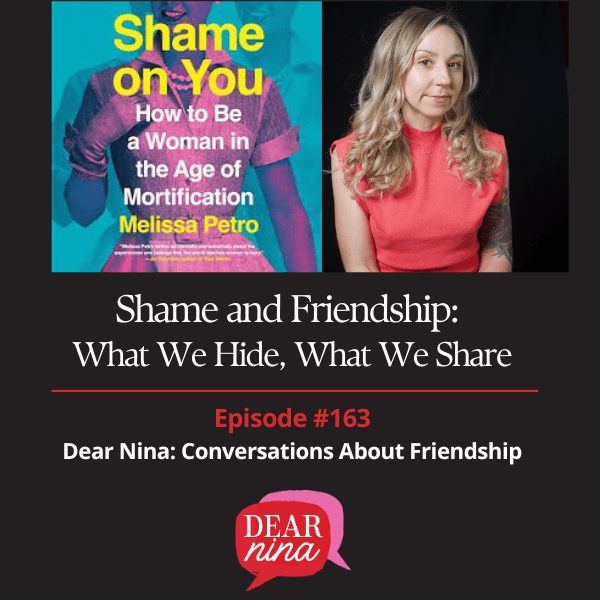
Melissa Petro is the author of Shame On You: How to be a Woman in the Age of Mortification. It is a really interesting story. a piece of her past is what brought her to this topic of shame. That’s a well researched book, but it’s also part memoir.
I want Melissa to tell you in her words why she is so focused on shame. She has a chapter on friendship in the end, [00:01:00] but there’s information woven throughout about where shame fits into our relationships. We talk a little bit about the concept of oversharing, but we actually don’t get that much into even that word because It’s sort of just a given in Melissa’s story that sharing is going to be part of her friendships.
I did do an entire episode on the idea of oversharing, undersharing, when to discuss information, two of them actually, but they all came from a different angle and they’re Really great on this topic too. So I don’t want to repeat all of that. And I let Melissa really tell her story more in this one. But if you’re interested in those, it’s episode 95 that was called over talking, under talking and lessons for friendship and the art of storytelling.
So that was a little bit more about the amount of time you’re talking in a friendship, And that was with Michaela Bly episode 95 will be linked in the show notes and then way back in episode four, such an early one with Christy Tate, an author I really love, she wrote group and she wrote the book BFF, but it was after [00:02:00] group which was about group therapy and just about her story in general.
That episode number four is called revealing too much too soon. But in this episode with Melissa, we take a bit of a different angle with the assumption that you are going to share your story, or that really makes sense to, that there are a lot of good reasons not to withhold very deep secrets from people that you’re hoping to be close to.
let’s just get to it. I want you to hear from Melissa herself. Hi, Melissa. Welcome to Dear Nina.
Melissa: Hi, thanks for having me.
Nina: I really appreciate you being here for kind of a potentially heavy topic, but I know that we will ride the wave of the ups and downs on the topic of shame resilience.
Melissa: Right. Yeah. People think it’s super dark heavy, the deepest darkest, but I think when you have some experience like I do talking about shame and, and not just me, but I’ve come across lots of people, shame resilient folks who are just, carry it as lightly as it deserves to be carried.
Nina: Before we get into your story, can I read you [00:03:00] my favorite quote from your book? Who wouldn’t love that? . This is way towards the end, page 248 in one of the final chapters. And there’s so many quotes, by the way, I could have read a million different things to you from your book, but I chose this one. You wrote, while shame is an impediment to friendship, losing our shame paves the way to closer relationships as sensitivities about our own perceived inadequacies soften.
The more we see strangers as friends. before we really get into that quote, what getting rid of shame can do to friendships, I think we need to hear about your particular story, what this book is about, at least the front end of it.
Melissa: well, I mean, for a very, very long time, this book was just a memoir and it was just what happened to me. at 19 years old, I made a choice that just seemed perplexing. At the time, I was, living as a student abroad in Oaxaca, Mexico, and I ran out of money. the job that I had been working for college credit kind of fell through.
So I was, [00:04:00] bored and free of the entanglements that a teenager or young adult experiences when they’re at home and then they go out into the world. So I made a decision to start working at a strip club and it really solved my money problem but it created a lot of other, I don’t want to say problems but a lot of confusion.
that set me on a journey to kind of make sense of, how I had done something that presumably decent women, would pause before making that choice. So I worked in and out of, the sex industry for about six years, as first as a stripper, and then as a call girl on Craigslist.
And then, I transitioned completely away from the work in great part because I had started writing about the experiences and made meaning of, That decision and you know, whether it fit into my life, after I’d stopped working in the industry, I became a public school teacher.
I how old were you at that point? I probably could do the math, but it was like, what, six years later. I was 19 when I started. That’s not the math because I was like 30.
Nina: Yeah. [00:05:00] Well, you probably had to get a degree and,
Melissa: three years in between where I didn’t. But, yeah, it was, I was around 30 when I became a public school teacher. I became a teacher through the New York city teaching fellows program. They take people from alternative careers and put them in New York City’s struggling classrooms. By then I had a degree in creative nonfiction and I was working on a memoir about my experiences in the industry. I had started publishing little short pieces because that’s what they tell you to do. I published a piece on the Huffington Post right around when Craigslist got shut down.
Nina: So when did the HuffPost piece come out?
Melissa: That was, like, 2007? God! A long
Nina: early years. Cause I started having stuff on Huffington Post, maybe four years after that. so that you were really early.
Melissa: right between where, there was moment where people were, publishing it themselves on Huffington Post, like, it was a blog. And then there was a moment where there were editors.
Nina: Now they’re back to editors.
Melissa: yes. But it was right on that line. Like, I never met my editor.
I don’t know who [00:06:00] Approved my pitch, but I had pitched the essay, and it was a 700 word op ed in defense of an individual’s right to sell sex, and in criticism of the censoring of that section, because they had shut down the erotic services section on Craigslist.
I put up ads and I answered ads. That worked for me until it didn’t. And then I stopped . It was a lot more accessible and autonomous than working for an agency or a manager. You know, I was able to just get in and out of the industry and that’s what I wrote and that 700 word article.
And as I said, I was trying to be a writer. I was a writer. So I put my name on it and I was super proud because there was my byline right next to Hillary Clinton. 27 days later the New York Post showed up on the steps of the school where I taught because I had become by then, a public school teacher and put me on the cover of the New York Post.
Bronx teacher [00:07:00] admits I’m an ex hooker.
Nina: Oh, what a headline.
Melissa: And that’s one of the tame ones. There were many headlines for the next three, four, five years. It felt like forever. Months. Months and months of headlines.
Nina: In different publications, not just the New York Post.
Melissa: the New York Post was particularly cruel. They called me a prosty teacher. And an attention whore. All of these nasty caricatures yeah, headlines everywhere. It was really chaotic.
Nina: And this is before you got married? I just trying to give context
Melissa: yeah. Yeah. No, I was single Just getting sober. I got sober when I was 27. So I was four years sober when this happened public school teaching Because I needed a real job I had a degree in creative non fiction I did want to be a writer, but I know so many writers they have jobs, you know, it wasn’t some Strategic move as some headlines had thought, you know, it was like some sort of power grab or I was creating publicity for my memoir.
None of that was true. It was just, me being naive [00:08:00] and idealistic, publishing a little piece and then being relentlessly humiliated because the world just could not conceive of a woman with experiences in the sex trades admitting that publicly, and now also being a teacher.
It’s funny because the main character happens now, every day there’s a main character online and it moves on so quickly. we don’t really latch onto characters the way we used to. We don’t create this sort of octamom but at that time it was Not uncommon that they would find, a woman to sort of caricaturize and then villainize and just mock and ridicule and write a story and just create content around that person’s image.
Nina: That’s a really good point about how the news cycle has changed. Cause with the time you’re speaking of is before TikTok and while we had the internet, obviously we had Facebook, but really in a [00:09:00] much more bare way. And I don’t even think there was Instagram.
Melissa: I didn’t even had internet at my house at this time. It wasn’t what it is
Nina: No, not even close.
Melissa: , the cycles go so quickly now. So it’s hard to impress upon people that I was in the news, I was on CNN. really guys?
Nina: And what happened at school then?
Melissa: Well, I was immediately removed. I got a phone call the night before the paper ran the headline, informing me that I was to report to the administrative buildings instead of the classroom. So I never went back to my school. I had been teaching there for three years. I taught art and creative writing to grades K through 5.
I saw every class. One day a week. I saw 300 kids in a week. We did project based learning. I basically got to do whatever I wanted because I was the art teacher and there was no curriculum.
Nina: So moving to friendship it’s an interesting dynamic because then, later when you start forming relationships, friendships, post teaching, like people who maybe didn’t know about the article at all, years go on. Eventually the new cycle of course does move on, like to your point. Maybe it’s not the [00:10:00] next day, like it would be nowadays, but eventually it moves on to the next thing, the next big juicy headline. So you’re meeting new people. How do you decide? whether to be like, Hey, I have this story in the background.
Melissa: So fast forward, ten years or whatever, I’m a stay at home mom with two kids, married, living in the suburbs. And I still have that story. you guys all moved on, but I’m the hooker teacher in my heart and brain. I’m talking about it right now, right? Like, I’m going to talk about this for the rest of my life because it impacted me so profoundly.
Fortunately, I can alchemize it into something beautiful and it’s not that source of shame, but for a very long time I felt profoundly ambivalent. Especially because, I didn’t get a book. It wasn’t positive attention. It was just this thing that happened to me that I kind of carried around. then you have to walk into spaces and introduce yourself.
especially as a mom there’s an expectation of who you’re going to be and, and I didn’t feel like the truth of me fit that expectation. I [00:11:00] remember one day I was at a farmer’s market with a fellow mom and it came up. Sometimes people would Google me because I’m a writer by then sometimes I might tell someone.
Nina: Yeah. It’s a huge part of your story. You said six years, you know, like that’s,
Melissa: You know, it would come out in this like little, like, at that time, it was very much like, can this person hear this? the friend I was with just received it so neutrally. And that’s really what you want to do when you come out. and I’ve since learned that we kind of all carry around that thing that we don’t, you know, maybe we spent time in a mental health facility, or maybe we have addiction in our past, or maybe, you know, our parents had this stigmatizing experience, or, you know, whatever, whatever that thing is that you carry, in the book, I named it Concealable Stigmatized Identity, that thing that you can kind of hide.
Whatever it is, when you, carry that, it can really weigh us down.
Nina: I want to say that expression again. Concealable. Say it again. It was good.
Melissa: Stigmatized [00:12:00] Identity. Oh my god. When I discovered that that was like a thing. I hope so liberating. It’s any kind of stigma that you internalize This is indicative of something about me says something, that this happened, or that it is happening.
Nina: the short word for that is shame. I mean, right? It’s,
Melissa: right. You really think that, you know, it can be that it’s not only am I different, but I’m a little inferior. So I had the sex work past, but I also had survived mass media humiliation. So I
Nina: right. It’s sort of a, yeah, a double thing.
Melissa: So when I would come out, sometimes people would be super titillated by it. That happened a lot when I was dating.
Nina: Yes, I was wondering about that too.
Melissa: Right? But even women, people look at you differently. sometimes you can see they’re kind of, they have some aversion to it, or they’re disgusted. I can see disgust, or they feel sorry for you, . That’s not the correct response. or they experience it neutrally.
Nina: Yes, I want to hear what that exactly looks like. I think that’s a really good advice to a listener, someone on the receiving end of somebody’s news,
Melissa: It’s hard. I’m not [00:13:00] even going to lie, like I receive it neutrally all the time when someone can Confesses their deepest darkest secrets to me, which happens often given
Nina: that
Melissa: You know, I, I jokingly call myself the shame whisperer in the beginning of the book because it’s really true. People come out to me all the time. They want to be unburdened. Assume I’ll be a receptive, neutral space. So I do try to hold that receptive, neutral space. but we’re all conditioned to be entertained by someone’s, dirty laundry. So we’re titillated or, you know, or we all have our own, we bring our baggage to everything.
So to receive something neutrally and curiously, it really takes sometimes a sort of intention and a focus, really looking into somebody’s eyes while they’re talking or reading their body. Rather than kind of getting in your head about what they’re saying and your own judgments about it, really just trying to stay with their physical body while they’re telling you.
If there’s any [00:14:00] chance you’re going to have judgments about something. And oftentimes it’s so natural because we really don’t have any judgments. And that’s what happened that day with that friend at the farmer’s market.
It was like, I’m sorry that happened to you. She was familiar with the publication. And then we moved on, talked about something else.
So, that is really a beautiful way to kind of become intimate with someone. She was immediately closer in my eyes to me she was someone I wanted to be around more.
Nina: I think the moving on is really, an underrated piece of a conversation like that, because I assume, like you said, we all have our stuff we reveal. And once you’ve done it, you don’t want to only talk about that. You don’t want that to be the only thing that, um, cause I don’t just mean moving on literally in that one conversation, although that too, but I mean, even in future conversations with that person. I shouldn’t feel like we always have to talk about that thing. Cause like there’s sharing, I think, and then there’s potentially monopolizing the friendship with your past or whatever it is you want to reveal. It really is tricky, these things. So I wanted to have you on to dice up these different [00:15:00] things, oversharing versus sharing. but the moving on piece, like I’m saying, not, only focusing on your Past or your thing that happened to not just you Melissa you anyone who’s in that position.
Melissa: Right. Yeah, you really want a friendship to be reciprocal. You don’t want to feel like you’re, educating someone. Sometimes I would find myself in that role and anyone with one of these presumably shameful identities can probably relate. I had a producer once say, you know, I’ve never been a sex worker, but I can completely relate.
I was a breast cancer survivor. And people would just look at me differently. They had questions. I became that. I was that in their eyes. And like, I don’t want to be that in your eyes. Whatever it is, I’m not just that. None of us are just that. So we have to be able to see our friends for the You know, in the big, broadest, most nuanced ways.
And that’s often times why I wouldn’t disclose that information until we got to know each other a little better so that they [00:16:00] could see I was also this, and also that. and also this. Which is the, you know, the thing that, , might be potentially shameful.
Nina: There reminds me of something in your book I would love for you to address. You bring up Renee Brown a lot which I think is appropriate considering like she is known so much for this field of shame and vulnerability You brought up her point about trauma bonding as something to maybe be wary of can you talk about that a little bit?
Melissa: Yeah, this is one of those I really wonder, because Brenny Brown is a little buttoned up. she talks about being appropriate and what she won’t share if it’s too vulnerable. I wonder if it’s not Generational, also, if she’s not just a bit more, tight lipped about things, even though she’s this, shame and empathy expert, she still is more reserved than our generation, and I think the younger generation is even more free with the truth of their experience, and so what we Or what she may consider trauma bonding, young people are just like, that’s a conversation over [00:17:00] lunch.
she’s very much like, you know, that’s not intimacy either. so I’m really of two minds, by trauma bonding we mean, just rushing out with that thing in our very first, five minutes of conversation. Uh, I did that much more when I was It’s still ambivalent about my story and making meaning of it.
I do hold it back more now, but mostly because it’s not on my mind as much. It doesn’t come up. Though, obviously, when I have a book out, people are like, what’s your book? And that comes up. I can’t even say that without saying my Story, you know, and I do often I go on podcasts and I’ll never mention the fact that I was a hooker. I don’t have to, there’s other ways of introducing myself and my experience that does not make me vulnerable
Nina: Yeah, that’s true. You could, I can see, you know, having read the book, how you could talk about the book, because there’s so much research in it and just discussion of history and context. I think it adds a richness to, the reason that you were interested in this topic to have that as part of the story, but I get how sometimes It doesn’t fit, or you don’t feel like it, or [00:18:00] maybe you don’t feel comfortable with the host, or whatever it is.
Melissa: And that’s true for all of us. We all have that thing that we could share because we could use our personal self to, further whatever we’re doing, you know, if it’s professionally or whatnot, you know, there’s a there’s reasons why we disclose information to people For the reader sense, you know, or for the, you know, the audience sense.
And then sometimes we don’t have to disclose that. In the beginning, there was like this urgent need to disclose this thing to like everybody I came across. And the more, comfortable I became with these two stigmatized identities, you know, these two things that I had survived, sex work and mass media humiliation, the more of those were understood and resolved in my own self, the less I had to introduce myself in that way.
Then I could introduce myself in all the other ways and it was just as natural. It wasn’t like I was withholding something. It’s interesting because now I’m a mom and I guess I can trauma bond as a mom too. There’s so much seemingly shameful or presumably, shameful experiences we [00:19:00] have.
And I do probably bond with mothers over those, confessions, the bad drop off or the lunch mistakes we make and, the lunches that aren’t eaten or the shoes that are the wrong size or all the, all the errors that we can condemn ourselves for.
Nina: That’s true. And it helps to have a sense of humor about that stuff sometimes. It really does. it doesn’t feel confessional.
Melissa: It doesn’t feel traumatic at all, unless I couldn’t share it. That’s when it starts to feel trauma. You know, when it starts to get stale on the inside. But I don’t let anything sit long enough to get stale and traumatic these days. So, and I do think it’s generational.
Nina: Yeah, I think there’s something to that. I can’t believe we’ve gotten this far in the conversation, and we have not defined shame resilience. What do you mean by that when you say Building shame resilience.
Melissa: so shame resilience is the ability to feel shame, but then to just let it pass through us without that shame impacting the way we see ourselves or impacting our behavior. We still [00:20:00] behave from an emotionally intelligent place. We’re mindful. We are our best selves in spite of, shame. The opposite of that would be like shame just taking over.
We don’t feel it. disavow it. We don’t acknowledge the experience. And so it’s sort of it’s, the ghost in the machine. It sort of starts to control us and influence us in these insidious ways, so that we can keep avoiding having to acknowledge that we feel in any way unworthy or inadequate.
Nina: And how do you think that comes out in friendships with other people if you don’t reveal?
Melissa: Well, I think we’ve all experienced that, right?, when we have a friend who’s just not sitting quite right with themselves and somehow it’s being projected onto us, we feel competition or envy, we feel put down, rather than connecting, there’s a disconnection and oftentimes it’s, some unresolved or unacknowledged, feelings of inadequacy within one or both people.
Nina: That’s so well said. You’re holding something in about yourself that you are ashamed of, [00:21:00] but it’s really not even always self shame. It’s your assumption that the other person is going to judge you for it. And so then I think you treat them differently without having given them a chance.
Melissa: Could be that, or it could be, Well, their house is so much cleaner than mine. They don’t judge me. They wouldn’t care. But I’m judging myself, they’re so much more X than I am. And, I’m probably talking about how it manifests for myself,
Nina: no, but that’s helpful.
Melissa: Yeah, that sort of, compare and despair attitude.
Where we, don’t really realize, it’s not about them and their house, or they’ve achieved. It’s really about how I’m measuring myself against my own unachieved ideals and feeling as if I’m falling short. that’s an opportunity. Whenever we feel, triggered. by a friend, we always then have that opportunity to see, what is that feeling of lacking? What do I want that I think I don’t have? And do I want that?
Nina: Right. Yes. There is a, be careful what you wish for kind of thing. I know it’s like a trite little saying, but sometimes you can’t have that thing that that person has without [00:22:00] also all the other things around it. So if it’s like a certain career, for example, well, do you really want to work that many hours? Maybe not, maybe there’s things about your lifestyle that you’d have to give up to have, that thing. You don’t get to just cherry pick.
Melissa: But the challenge is that for women, especially we’re taught to value everything.
Nina: Like, we are supposed to have all the
Melissa: We’re supposed to have it all. So you’re supposed to have that career and the clean house and the perfect body, and you’re supposed to be the perfect mother who’s always available for your children. And you’re supposed to have.
The list goes on. So when we see someone who has something we want, we think, why don’t I have that? We don’t think, oh, because this is where I’m spending my time. This is what I’m attending to energetically. We think we should have more energy. We should have more time. I’m lacking something about myself because I don’t have what she has.
Nina: Yeah. only because I’m hyper aware of time, is there anything else, within your work having to do with friendship and shame that we haven’t covered that we should be [00:23:00] covering?
Melissa: I think that friendships can be fraught between women. One, because we’re taught to fear each other. And we’re taught to be so self critical that we can project those criticisms onto others. but they’re also so transformative. When you find a friend who can see you, and I mean really see you for who you are, when you feel seen.
That same friend that I met up with at the farmer’s market, The very first time we were friends, I met her at a Book Babies, a library event, and somehow I said I was a stay at home mom, and I was like in the pits of despair. I hated it. I don’t know how I let that
reveal itself. I might not even have said it verbally. I may have just said yeah, I’m not working right now I’m home full time and she said oh, yeah me too. I thought I’d be canning jam ha look this. Like it was not what she thought and it was not what I thought and I could just I felt so Mirrored in that moment.
And we became friends, so [00:24:00] sometimes, just that one moment, it was so meaningful.
Nina: something about that friendship in your book, that is worth mentioning even though it’s not really about this topic is that I think that particular friend did something so generous, which a lot of people don’t do, which is she included you, she introduced you to other people.
Melissa: absolutely, absolutely. She, was sort of, um, this conduit into, like minded people. And when you have friends who, You don’t have to hide parts of yourself from. you know that there’s a language you all speak. There’s, this feeling of safety that is just so necessary.
So going back to like who I was then, this new stay at home mom with a past. everyone in that room has their past. let go of that. You’re not special. And you are special. We are all special, you know, so that feeling of safety, security, it just meant so much. I was able to become my best self, which is what friendships, good friendships, do for [00:25:00] us.
Nina: I hear from so many people. I have a Facebook group where, people write in friendship issues anonymously or under their name. And I’d say a common thread that comes through a lot, and I’ve been answering anonymous questions for 10 years, so patterns of course come up. And I’d say a big one is people want this friendship so much. The friendship you’re describing of safety and security and where you really feel like you can be your true self. I mean, that’s the ideal. And I think people struggle to, get below the surface, like I hear from a lot of people to Cut to the Chase that they have friends, but they don’t have that friendship.
they have people to do stuff with, but by the way, even that is its own challenge sometimes. Okay, we get to that part. You have people to do stuff with. how to get to the next level is something I talk about a lot, but I’m curious, um, and we’ll end with, this point. What do you feel it is that you have done to foster that and, you know, what could others do that next level below the surface.
Melissa: think it takes being brave and having the courage to be vulnerable. If you show yourself, to someone, there’s a [00:26:00] good chance they will embrace that and reciprocate. Not always. And I run into a lot of people who don’t want what I got and we move on.
Nina: Yes, same.Please. hundred percent.
Melissa: my daughter just started at a very elite private school and I walked in there feeling like the oddball in the room. And to be honest, I probably am unlike Some of the families. Our family is different. It’s a Waldorf school. They follow the rules. For reasons we don’t. I felt like an outsider. And in some ways, I know not everybody wants what I got cookin. But I found my people. Because if you look and you are willing and 100 percent you and you’re paying attention, you’ll find your people.
And then those relationships you just have to nourish and they’ll grow. You
Nina: Oh, Melissa, I love that. And I love that, expression, not everybody wants what I’m cooking. I’m so true. Not everybody wants what I’m cooking either. And we don’t have to feed everybody. That’s okay. We can make, yes. [00:27:00] We could do that metaphor forever. I could go on and on with that. I’ve so loved having the chance to talk to you.
I really enjoyed your book. Shame on you. How to be a woman in the age of Mortification. I’ll have all of the links in the show notes. Melissa, thank you for visiting with me today. I end every episode by saying when our friendships are going well, we are happier all around. And I think your book speaks to that as well.
Melissa: so much for having me.
Nina: . And while you’re here for just one moment, I love to remind you that you can find me on Instagram at dear Nina friendship. You can join the Facebook group at dear Nina, the grouper. We have lots of conversation and you can subscribe to my newsletter at dear Nina dot sub sack. com, where I do a lot of posts about what’s going on in the show. I also answer anonymous questions there I love to hear from people. So this is all meant to be a conversation always between me and between you between your friends, share the episodes if they’re helping you. All right.
Thank you. I will see you next time. Bye.
[00:28:00]