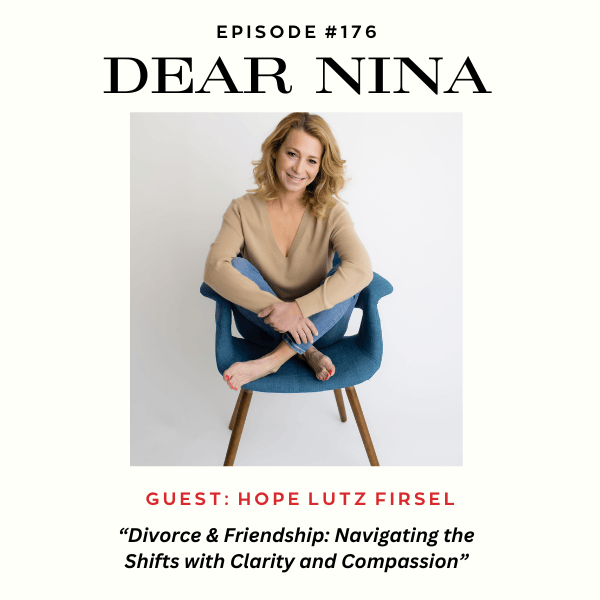
Nina: [00:00:00] Welcome to Dear Nina, conversations about friendship. I am your host, Nina Badzin. I have been writing about friendship for over a decade and podcasting about friendship for over four years. Today, we are covering a heavier topic. It is one that’s important and I have not covered thoroughly on the show yet.
It is about divorce and your friendships once you have been divorced, you’re in the middle of the divorce, you’re thinking about getting divorced. And on the other end of it, if you are a friend who has a friend who’s going through a divorce, how can you show up? What would be helpful?
Obviously in 30 minutes, we cannot cover all of the aspects of everything you’re going to go through when you get divorced, as it pertains to friends or everything you on the other end as a friend should do, can think of to help your friend. So this episode will touch on elements that will be familiar to you if you are going through a divorce or you have a [00:01:00] friend who has been going through a divorce. But like I said, you may hear and go, oh, they didn’t talk about, this one aspect.
And to that I say I am always happy to cover it again in a different way, from a different angle.
I am so grateful to have a guest today who can speak to a lot of these issues of what somebody who is going through a divorce is experiencing in their social worlds and how those of us who have not gone through it can be there for friends. Hope Lutz Firsel is a women’s life coach and divorce specialist who draws on her expertise in organizational change to help women navigate the emotional, financial, and logistical complexities of divorce and rebuild their lives afterwards. She does one-on-one coaching. She does group programs, workshops, and collaborations with family law professionals.
Hope is based in Boca Raton, Florida, but she helps clients nationwide. Hearing what hope has to say will likely affirm what you’ve been feeling if you went through a divorce or you’re going through one now, [00:02:00] she just has great tips for those of us who have not gone through it and how we can show up to be the best friend possible to a friend of ours who is going through a big transition,
hi, hope, welcome to Dear Nina.
Hope: Hello, what a privilege it is to be here today.
Nina: This is so fun ’cause it’s actually the second time we’re meeting really. The first time was at my live show in Chicago. I appreciate you being there.
Hope: Oh, I was so thrilled that I happened to be in Highland Park that night, so it was a treat for me, and I’ve been such a fan. So to be in the audience with some of your dearest and to meet you and hear you, was really such a privilege and such a fun night.
Nina: It was a fun night, so thank you. And it’s so interesting with your background, we could have done any number of episodes. Um, you’ve moved to a new town, you’ve had cancer there’s a a lot of topics right in there, but I’ve done both of those topics quite a bit. The one topic, it’s not the only topic that I’ve never done, but a topic that is screaming for me to have done, but I was [00:03:00] just waiting for the exact right guest is the way divorce affects our friendships on really both ends.
Like you have a friend that got divorced or more to the point that we’re gonna deal with for with you is you’ve been divorced and you help so many people who have been divorced, but can you describe exactly what you do.
Hope: so I’ve taken my master’s, which was in organizational psychology where I helped organizations going through change in leadership development, and really enjoyed the one-on-one work that that offered. And so I went and got my life coaching degree and a certification as a divorce specialist and training in rapid resolution therapy to use all of that experience to now help women.
Who are going through trauma in their life, mostly within the divorce world, before, during, and after to become the CEO of their own divorce. It’s a big corporate change. It’s an entire life change. So I help women find confidence, find [00:04:00] peace, and decide who they wanna be in the face of this trauma divorce.
Nina: Do people find you through their divorce attorney?
Hope: Um, word of mouth has really been the best source. I have partnered with a lot of divorce attorneys, so while sometimes I think handing it off to their clients is sometimes not as easy as one would think, handing over the referral of an outside source. I’ve collaborated and partnered with divorce attorneys from around the country.
I did an event in Chicago and Detroit and Boca, where we together create a safe space in a workshop, a group setting, an event. And I have received a lot of clients from those participants.
So a lot of , lawyers that I work with often turn to mediation or a collaborative divorce. A lot of the lawyers I’m working with are trying to find outside solutions to help the family end the marriage and create something new.
Nina: So you’ve had a up close look in your own life [00:05:00] and with your clients on not just the financial and all the different parts of divorce that now are gonna be a new reality for all parties involved, different homes kids and the family and dealing with all that. But then there’s the social piece, which I don’t think gets discussed as much.
And obviously my show is the place to have that discussion. to start, how have you seen Divorce Impact friendship? Just as a general statement, then we’ll get a lot more specific
Hope: I’m so happy to talk about this because what people need to understand and when you have a friend going through it, and it’s a world you may never know about. What we need to do is have compassion for those that are going through a divorce and understand that their entire foundation has been ripped to shreds.
how they dreamed their future would look, That is changing completely. How the past looked, you know, the stories of the marriage and the memories. Those may be changing because they’re having conversations about how did they get here and they may have lost touch long ago. [00:06:00] their whole reality is changing and within that, it’s not just their relationship status going from married to divorce, it changes their social ecosystem completely. Everything has changed, so that’s gonna impact all relationships. And many relationships with girlfriends, if you have a family, if you are married, oftentimes is based on you as a couple, with them as a couple, or you as a family, and them as a family. And so when your dynamic shifts, the entire relationship is gonna have an impact.
Nina: hope, one thing that I definitely know comes up, there’s the question of feeling like the friend of the people who got divorced need to pick sides.
So now I’m thinking from the point of view of your friend got divorced, not you, yourself got divorced. I’m curious if you could talk about that from the point of view of somebody who has been divorced and who has worked with so many people who are getting divorced. Is that true that someone [00:07:00] needs to pick a side? It might be a misnomer that people feel they need to do that.
Hope: Yeah, I mean, I would say that every divorce is different. Every story is so unique. And having worked with countless women, I can say that the friendships and the relationships have evolved in different ways. some divorced families still are very close and co-parent a lot, and in those sense, the relationships may stay afloat in terms of, if we all went to soccer every Sunday to watch the kids together and sat, if that couple is still doing that, which many divorced couples are, the relationship may not be impacted, but rather if it’s your Ex’s best friend’s wife, regardless. She’s gonna hear both sides, so having her pick a side is gonna be uncomfortable and probably something she can’t do if the ex is still closed With your ex. So you just have to really take it case by case. In general, you’re really good friends. You wanna know that they are a [00:08:00] safe, secure place for you to confide and that they have your back. It’s not necessarily that they’re gonna pick sides and wanna say that your ex is a devil and horrible, but you’re gonna wanna know that they have your back.
That they’re there for you first and foremost, and that’s what a really good friend will do.
Nina: how do you coach your clients in figuring out who those people are? Like maybe helping them figure out whether a friend of theirs might not be able to be that person in this case. Maybe they are too close to both. And can that person still be a good friend or I don’t know. Do they take a pause for a while? Like what have you seen?
Hope: I mean, I’ve seen it run the gamut. My most important is that as a coach, I’m able to be the friend, friend that maybe that woman needs, independent of a friendship, but a real solid relationship to communicate what is that individual looking for from their friends? some friends may have to [00:09:00] play a new role.
it may not be a safe place to confide in anymore. but how do you transition friendship if it’s a friendship worth saving. as you evolve and you develop a new sense of reality and become a new individual, relationships will change and you will be able to have the perspective of what relationships were situational and which one are genuinely authentic real friendships. Those that were situational
to honor that and learn what you learned and know that now that you’re in a different situation, that relationship may not continue and to honor it and to learn from it. we have to also know that our friends may get tired of the conversation. They may feel worn out, they may start to feel neglected of their own feelings and their own needs. And what I work with my clients on is how to communicate that in effective way and to set boundaries that work for both of you. if you set [00:10:00] boundaries and the friendship dissipates, then you’ve learned that was situational. When you go through a divorce, it often brings up a lot of feelings in the other fears and it may not be around their own marriage per se, but fears of loss, fears of unknown. And it may be, you know, most marriages ebb and flow as we know. So it definitely touches on some scabs of your own friends.
So I like to really tell my clients to put it out there. I have a client this weekend who’s been debating the divorce for a while and she’s going to see a friend for a weekend. She said, I don’t wanna talk about him or the divorce or if I’m staying or not. I wanna go and do something completely different.
I wanna rejuvenate, I wanna fill up on good stuff. And I said, then you, when she picks you up at the airport, you communicate that. And you say that if I get talking on this, then you’re gonna look at your watch and be like, you get five more minutes. have them hold you accountable to that.
Nina: And the friend, [00:11:00] to your point, the one who’s, let’s say picking her up at the airport might be relieved. I liked that you acknowledged I think it’s, and not just on this topic, not just on the topic of divorce. It is so important. I don’t talk about it enough, that friends can tire of a topic that doesn’t make them a bad friend.
The theme for my podcast in October was really about conversations and asking more questions and the October challenge to remind listeners, or if you haven’t heard it, is to ask your friends more questions and that there’s research that shows that people ask way fewer questions than they think there was an actual study. They had people reflect on conversations after the conversations? Like how many questions do you think you asked your friend? I’m making up the numbers here, but let’s say the person said 20. Well, like, no, actually it was three, and it was pretty common that people completely overestimate how much they’re asking the other person.
Meaning they’re doing a lot of the talking or they may together be making observations about things, talking about TV shows, this and that, but they’re not actually asking questions or [00:12:00] follow up questions. When anyone’s going through a hard time, it can be very hard to remember to think of the other person, but I actually think part of our own doing better during hard times would be to also focus on other people and not just ourselves.
So it’s a good thing to remember even if you’re going through a terrible time. I know I like when I’m going through certain hard things like I have to tell people upfront, I don’t wanna talk about this. Not in an off-putting way, but almost to relieve them of the pressure they might feel to ask me about it.
I might wanna be asked about other things. Just not that thing. ’cause maybe, maybe the situation hasn’t changed and there’s like nothing new to say.
Hope: And also in divorce in particular, when you’re dealing with relationships, discussions can feel gossipy sometimes. you know, you wanna be clear with your friends about what you wanna hear and what you actually might be okay. Not hearing for a while, And,
Nina: a really good point. Like what your spouse is up to out in the community, that kind of thing.
Hope: for sure.
Yeah. And then trusting that when something needs to be known, you have really [00:13:00] good friends that will come and tell you what you need to know and um, that’s important too. You learn about that as well, who’s gonna come and say, just so you know. your ex was on a date with so and so or whatnot.
because we don’t wanna bad mouth anyone, and your friend who’s getting divorced also doesn’t wanna be in the dark from what other people are talking about, because that can be very painful as well. And understanding someone that’s going through a divorce is grieving.
It is a loss. They’re mourning the loss of that union. everything that comes with it. we think about friends, think about family as well, who have become your friends, like your sister-in-law, your mother-in-law, a whole side of a family that have become friends that you’re very likely not gonna have much of a relationship with.
So you’re feeling very lonely and very, very insecure, I have to say. Your world is upside down.
Nina: There’s all layers of family that, those are kind of situational to the marriage. and I hate to say it that way ’cause it sounds so [00:14:00] clinical or something, but, That is uncomfortable. Like if you live in the same town with all this other family,
but then there’s even like the social media piece of it. do you stay social media connected with, friends are a little different ’cause like they’re your friends too. But when it’s your spouse’s family. That was your family? I think about how, you know, I call my husband’s cousins. My cousins, we’re family now. But that’s a very good point about like when you get divorced Yeah. What happens to those layers?
Hope: your social relationships are all changing. The girlfriends did save me. I will say, I had a best friend and her husband’s very good friends with my ex-husband, and she slept over some nights. I mean, I’m saying you are on the ground raw as you can be, as vulnerable as you can be.
in particular, if you’ve been married a long time. I’d been with my ex-husband 20 years, married, 18. all of our friends were intertwined. Everything was intertwined. having those solid girlfriends who have your back, who hear you.
Who sit [00:15:00] on the floor with you and let you cry, is really important. And if it’s a friendship that’s gonna really last, you can have these open and honest conversations where it may be, okay, well we’re no longer gonna have our Saturday date night once a month. So that’s gonna shift and let’s just own that. Saturday night plans are no longer. So what can we take on now? Now that you’re independent, how does our relationship evolve and having real conversations? maybe that means we don’t go out Saturday night for a nice steak dinner, but now we get a manicure pedicure on Sundays or now one night a week we have dinner with just the kids, so you’re not doing it alone. Doing things that meet your friend where she’s at, if the relationship means something, if it’s gonna go through the next evolution of life.
Nina: That’s such an essential tip that I hope people take seriously for a lot of situations, but obviously we’re talking about divorce here, but to be direct, I agree. Instead of trying to always figure out like, how are we gonna make these Saturday night work like they used to. [00:16:00] let’s just accept they might not work.
I think it would be nice to include single friends, but also to do other things, to not always try to replicate the same night. How do you feel about, just through your own experience and what you’ve heard from others too, being out with couples. When you were divorced, did you like that? Were you like, Ugh, no, thank you.
Hope: I wasn’t asked very often to be quite honest. me and my ex used to talk about it just ’cause we’re not married doesn’t mean we don’t like to leave the kids and have an adult dinner and a nice drink. But couples hang out with couples and it’s hard. very good friends will include you.
But it’s few and far between. . And so part of that is why I say the mourning is so important. It’s important for me as a coach to look at my clients and say that relationship in that framework is no longer.
Now let’s mourn that. Let’s not make our friend wrong or their husband wrong, or, let’s be open and honest about what’s not happening anymore and where can they fill in the pieces for [00:17:00] you. If they’re not looking to help you in a new way, in a new light, then you see that relationship is no longer part of your future. No shame, no blame. It was more based on a situation.
Nina: It’s a healthy mindset, but I can see your clients would be lucky to have you to process it with them. It’s hard to process these friendship changes. let’s think about the future. I think that’s a good segue to, okay, so maybe some of these friendships aren’t gonna be what you thought they were or they’re not gonna be on the nights they used to take place, or different activities.
But, You still do need something to do on Saturday night? What is the next step? Obviously it’s making some new friends. What are you seeing that’s been successful?
Hope: What I share with my clients is it’s really is important to find a new community, because I promise you, you’re not the only single 50-year-old or 40-year-old or single 30-year-old with two kids at home. There are other single divorced adults in the world. 50% of us end in divorce, we have to look in new [00:18:00] places and that’s all that means.
Nina: Is that stat still the case?
Hope: It just went down a little bit. Like 47, 48, something like that I just read.
Nina: Do you think that’s ’cause people are getting married a little later?
Hope: I hope so that people are being more conscious Divorce is really hard. when I have a couple that has an ability to stay together, we’re gonna work towards that because it is extremely painful and very hard.
It also is a gift to yourself. If you are in a relationship that is not serving you, you can’t be your best for your children, your career, the community. So it is a decision that often is the right decision, as hard as it is. And you are starting over. And a lot of people would love the opportunity to have a do over in their life, not necessarily with the person they picked, but you know, try new things, go to new places, and think about what’s available to you now that you’re not with that partner.
Maybe now you can go listen to country music if that was [00:19:00] something they would’ve never done. Or perhaps, a yoga studio, a new workout, a hobby, getting yourself to meet new single women, a community. I hold virtual support groups and I love that because that is what helped me. It was during the pandemic and my therapist put together a small group, ’cause there was a few of us that were homeschooling kids while getting divorced.
Locked inside in the winter. and we all spoke to each other virtually, even though we all were all kind of local, but it, it was COVID from our showers and our cars in our closets. And it was those relationships that really got me through for sure. When the time is right, dating is a great place to start meeting new friends.
not necessarily to find your next husband but who’s to say what’s right or wrong for each individual, but to also use dating as an opportunity to connect with people that are in a similar place as you, and maybe make new friendships along the way [00:20:00] as well.
Nina: Yeah, I could see how that would expand your social world, even if, it’s not gonna be a romantic relationship in the end. Like you meet people through people. I mean, that is, part of social layers is we network through each other. You know, I can imagine if you’re a divorce and it’s, you’re looking to expand your social world to always try to maintain what you had with these current friends, it’s nice to have those friends, but you’re still not gonna probably meet anybody new through them ’cause you’ve known them all these years. It’s going to take meeting new people and I share your advice I agree with it. New interests, or maybe old interests that you’re reviving or never had time to pay attention to.
That is how anyone at any new stage of life should be approaching having a lively, robust social life, as we get older is continuing to tap into what you’re interested in. We might just have to push yourself a little more if you’re going through a divorce ’cause it’s such a hard time. it’s an opportunity, I guess, too.
Hope: it for sure is an opportunity. I would say everyone needs time to mourn. So that’s when [00:21:00] the really solid girlfriends are really important. The ones that are gonna get on the floor and lay with you, the ones that are gonna cancel their plans to come over and sit with you. The ones who are gonna check in when they know you haven’t seen your kids, and you’ve been in a house alone for a few days, Or it’s just stopping by or just asking if they wanna come by or feeding the kids. And the house is crazy. Will they come keep you company? to keep in mind, and maybe a holiday and they’re all alone. the really, really core, good friends are gonna open up and they’re gonna be there and let you be raw with them before you’re ready to get out there, perhaps to make these new relationships and pursue these new avenues. You know, we first need to mourn and be honest about where we’re at. And a lot of people talk about when you go through some trauma that you get into a fight or a flight mode. A lot of my clients, as did I, we go into a mode where. it’s hard to find energy. It’s hard to get excited.
It’s not necessarily depression, it’s just overwhelmed by [00:22:00] everything that creates a sense of fatigue. almost a fear of getting out there. And that’s okay. You’re mourning. We share a common friend, Taryn, and I remember she would bring over her son and the kids would go in the basement and she would come into my bed with me.
You know, I, I just, I wanted to be in my bed. So, you find your real friends ’cause that’s who meets you there, and when I went through cancer, when I was a young mom in my early thirties, I learned very quickly some friends are there for the tough times and some aren’t. It’s up to you if you are gonna still enjoy that relationship on other aspects or not.
and you get to decide. You get to choose.
Nina: What’s hard in these things is it’s like the person who’s in a place of need is in a low place, they’re not always able to ask for what they need. If people could find a way to ask what they need, I bet more friends would show up in the way that was desired. They just don’t know because maybe your friend
hasn’t, had cancer, hasn’t gone through a divorce. I’m thinking of holidays [00:23:00] and divorce as a great example. If a friend were to ask me, can we be with you for whatever holiday is coming up, I would be so thrilled to open my doors.
Yes, absolutely. You, your kids or just if that person’s doesn’t have the kids for that holiday. But I don’t know that I could promise that I would always remember to check in. my dream for people out there in their friendships is that they would ask for what they need. I know that’s asking a lot of somebody who’s in a low place. The average person wants to be a good friend and wants to show up for their friends who are going through a tough time, but there has to be some communication on the other side, I think.
Hope: And I think that people, they see it, you know, with trauma, death, divorce, your friends and family are gonna move on a lot quicker than you are, and they may not know that you’re still struggling,
Nina: so I guess a tip maybe for anyone out there going through a hard time, I would start with the point of view of assuming the best that your friends would be there for you if they knew how even two years later, three years later, you, [00:24:00] you don’t wanna be by yourself for a holiday. Your spouse has the kids that holiday or something. I think we have to all, in all situations, just get better about speaking up. In an ideal, ideal world, your friend would say, Hey, do you have something to do for this holiday? of course, that would be really nice, like if we all remembered that, but a lot of people are juggling a lot of things, and it’s not that they’re trying to be dismissive or a bad friend. they’re just maybe not at the level 10 ability of being able to remember everybody who might be in need. If it’s your best friend, I would hope that that person would know, but they probably would because that’s a very special kind of friendship. But like the average people, friends in your life, I do think more people would step up if they knew what was needed.
Hope: and I think sometimes they don’t realize how lonely it is. Sometimes they’re like, oh, that sounds kind of nice. You got the weekend to chill. But they don’t realize
Nina: someone has said that to me, I. in the context of friendship and divorce, that’s a very insensitive comment to make. Now, I didn’t say it. They were complaining to me about someone else saying it. Exactly [00:25:00] what you just said, and I don’t love to focus on what not to say I very purposely don’t spend a lot of time on that in episodes.
’cause it makes friends who are trying to show up, scared to show up ’cause they’re like, oh my God, I’m gonna say the wrong thing. But this is a good example of, and you brought it up, I think it’s important, this assumption that oh yeah, that sounds nice.
sure, I get like a night or two to myself, but it’s with a lot of trauma around it. It’s not just ’cause like I’m on a girl’s weekend, this is not what people are looking for.
Hope: not at all. And you know, we had talked about how you asked your friends questions, and that’s why it’s also important for us divorcee, is to say. Okay, I’m only talking about this for five more minutes. And then, how are you, and ask specifically, and take it off of yourself. And then when they start talking, you realize, oh wow, they do have a lot going on too. we all do.
Nina: To also let you feel like a regular friend. like I said, if, I’m ever going through anything, I have to imagine someone going through a divorce also wants to be able to be a friend that shows up just to, to feel that that part of their life that still got that part going on.
And [00:26:00] you don’t wanna only focus on yourself.
Hope: right. And to have some laughs and get into the everyday life, to get out of the depths and darkness of what you’re dealing with. I think if someone’s mourning a loss or a divorce, it’s important to try at some point to remove ourselves from the depth of that despair and get with our girlfriends to do something like giggle.
See a movie, have us sleep over. Do what you need to do to allow each other to just let loose a little bit and get part of the living, everyday life.
Nina: Yes. Absolutely. Are there any, uh, final words you wanna share with listeners? ’cause I know that there are going to be, a lot of people tuned into this from both ends of it. Somebody who’s been recently divorced or somebody who has a friend going through a divorce.
Hope: I would say to those that have friends or family going through it just to have a lot of compassion for them and keep showing up in different ways. You’ll see what works for you guys. For those that are considering in the process or [00:27:00] post-divorce, I strongly encourage you to work with a life coach like myself or a therapist, a trained expert, or someone that’s been through it to be that girlfriend that you need.
Where you can sit in a safe space and confide and let go, and then consciously decide what you want from your relationships and what you’re gonna put out into the world. put on your seatbelt ’cause it is a new journey. And new beautiful friends are about to show up for you when you welcome this new space, this new place of being single.
Nina: I love ending on that, positive note. thank you for sharing your experience and the help you’ve given to clients. I agree. It would be wonderful for everybody to have somebody like you in their corner as they’re going through such a transition.
Hope: That’s why support groups are wonderful as well, because then you know you are not alone, that your feelings are valid, that you are seen and to be seen by others that have gone through your shoes. It’s incredibly [00:28:00] powerful, and the healing happens so much quicker in community.
Nina: I love that your name’s Hope. I feel like it’s the perfect name for what you do. so listeners, I will have all the ways you can find hope in the show notes reach out to her and she can help you out or point you in the right direction. Hope. Thank you. I’m so glad we got to have this conversation.
Hope: thank you. I would love to come back. We could talk all day about girlfriends.
Nina: listeners come back next week when our friendships are going well, we are happier all around. Bye.