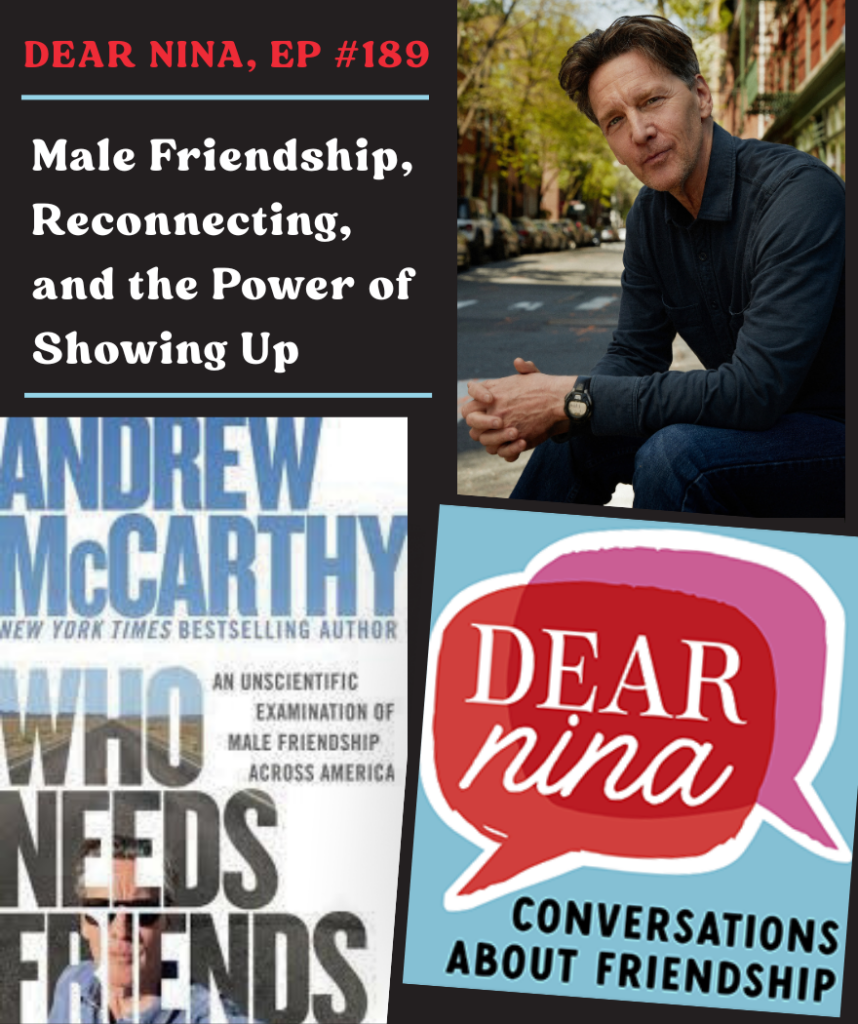
Nina: [00:00:00] Welcome to Dear Nina, conversations about friendship. I am your host, Nina Badzin. I’ve been writing about friendship for over a decade, podcasting about it for almost five years. Usually I’m speaking about female friendship, but I am hearing more and more from listeners who are worried about the men in their lives.
Their husbands don’t seem to maintain friendships. Their sons are more isolated than they’d like, their brothers, their dads. Listeners are worried about them. When I saw Andrew McCarthy wrote a book about male friendship called Who Needs Friends, an unscientific examination of male friendship across America. I knew that I had to talk to him.
Yes, I am talking about that Andrew McCarthy, the actor director, travel writer. But in this conversation, we are not talking about Pretty and Pink or Mannequin or the Brat Pack. We’re talking about his book, who Needs Friends, and the question that set this friendship project in motion when his son said to him, you don’t really have any friends, do you dad.
This [00:01:00] episode with Andrew is yes, about male friendship, but there are some big themes that apply to everyone. Old friends, newer friends, loneliness showing up, physically showing up, which Andrew does a lot of in this book.
Why men might sometimes drift away from one another. And we also talk about the positive parts of men’s friendships. There are many and what women can learn from them. one big takeaway from me in my conversation with Andrew and in his book, he does such a great job discussing something that’s hard to name in all friendships is how important it is to have a sense of safety with someone that you are going to have a deep friendship with. You can’t just trust somebody without feeling safe with them, without feeling like your information will stay with them, that they will be there for you.
And it’s not a word I have used much before and I encountered it in Andrew’s book and it really stuck with me. One thing to note in this episode is that we refer several times to another episode, which was 184 with Dr. Jeffrey Hall, who was such a fun guest. Somebody that Andrew quotes in his book as well, we refer to it many times in this episode. Without giving [00:02:00] it the episode number, it will also be in the show notes.
I’m excited for everybody to hear this conversation and you have to get all the way to the end to hear a very special moment, which I’m just gonna spoil for you right here. When I thank Andrew for coming on the show and he says, thank you, Nina.
I really appreciate it. I love your podcast. I will be making that into some kind of social media moment. How could I not? Hello, I am speaking to Andrew McCarthy. All right, here you go.
Nina: welcome Andrew.
Andrew: Thank you, Nina, good to be with you.
Nina: Most of our listeners are women, and one thing I hear is the concern they have for the men in their life. Nobody here in this show needs to be convinced that friendships matter. That this is something we need to prioritize, but they struggle helping the men in their life.
And your book, who Needs Friends captures this so beautifully. It starts with this gut punch with your oldest, Sam saying you don’t really have any friends, do you, dad? And I was curious about what that must have felt like. ’cause you do technically have friends. You actually aren’t someone who doesn’t have friends. So what would make him say that?
Andrew: Well, I [00:03:00] had a number of really close friends when I was a young man, when I first moved to New York, and I had several guys who were really instrumental in me sort of becoming who I would become in life. Over time, they moved away. I, got busy with my career. I then started having my own family.
They had their family. It evolved that I hadn’t seen a number of them in 10, 21, 30 years. when my son did say that, my son and I were sitting in the kitchen and he was playing his guitar, and I was just sitting there sipping tea and he was telling a story about one of his buds and he said you don’t really have friends do you dad? I knew it affected and he said, you don’t really have friends do you dad? because I acted instantly like it didn’t affect me because I don’t want my kids to see that he hit a nerve. I thought about it for a second and I just said, yes, Sam I do have friends, like you said, but, but I just don’t see them, but I know they’re there and that’s enough.
That was the rest of that thought. that’s what I told myself for a long time. It’s enough. I know that, I know Sevy’s out there. I know Matthew’s out there. I know. when he left, I did I sat in the kitchen and I just thought, you know, it’s not enough. [00:04:00] I need to go see my friends. That’s what it evolved into this sort of 10,000 mile road trip across America, crisscrossing the country to go see my oldest dearest friends who I hadn’t so long, and let them know how meaningful they were in my life. Which is something when we don’t tell each other when we’re young, you know? But now that we’re old, I just wanted to make a point to go, you know, did you really matter to me?
And you’ve had such an effect in my life. when I finished the trip, if there was one takeaways, I just felt so much safer after the trip and I felt like I had a net under me in a way that I usually don’t in life, So it had a profound effect on me.
Nina: I like the word safety in this, because while on one hand you knew you had these friends and in theory they would be there for you no matter what because they have been there for you. You’ve been there for them. To actually prove it again, for this period of your life, that would make sense. You can’t just know something in theory after a certain number of years.
Andrew: Well, things do start to decay and change or whatever, but that’s sort of one of the definitions of true friendship, isn’t it? That you see. Somebody then, and, it’s like it was yesterday. I mean, [00:05:00] people say that all the time. But for me, I think one of the guys, one of my friends, I think, as I said, what’s one word that describes friendship? What’s most important word for you? And, trust is a common word, but for me it’s that feeling of safety. You know, I just like, you’ve got me and you’re not, don’t want anything. I’m safe with you. Me who I am is safe with you, who you are.
And that is not something I experience a lot in my day-to-day life out in the world trying to be the guy doing stuff and all that, and it’s not something I realized I was yearning for or miss it until I experienced it again. the relief I felt in that was profound.
Nina: Something I wanna touch on. it reminds me of something you were just saying, like maybe you don’t feel it in your everyday life. And I know you can’t speak for all men, but you do encounter a lot of men, both your own friends, but also people you meet on the road. And there seems to be a drumbeat of a similar concept. They talk about this pressure in their everyday life to be the provider and where friendship maybe can’t fit into that. Can you talk
Andrew: Well, I did find, and I thought it was one of most a common [00:06:00] thread through all men that I can. And yeah, and I started as I was going to see my old friends, I started randomly going up to people, literally raised around, excuse me, can I talk to you about your friends? And guys would look at me like, your mind, But the interesting thing was after the initial sort of taken aback, not one of them said no to me. Everybody just was, yeah. Okay. It evolved and most guys, it turned out by the end of the conversation, you know, I’ve never talked about this before. They all wanted to keep talking when I was ready to move on. one of the universal things was the need to provide the sense of you need to take care because what it’s man do, but take care and provide.
And the degree to which you are able or unable to do that has a lot do with our self esteem. However much I can try and tell that to my wife. She goes, I’m, and my wife’s much more capable and can provide better than I can in many aspects of our lives. But her self-esteem doesn’t seem as tied into it as mine does. but when I would say that’s the guys, they would just look at me. Of course. Absolutely. That’s what I feel. It’s underneath it all. I can’t. you know years Years when I’m providing, meaning making money, [00:07:00] and showing up and doing things that I feel good about myself and my value value and worth and life. And so consequently, I’m more relaxed and I’m more generous and gracious and all that stuff. If I’m feeling less, like I’m not getting it done, I tend to be, more defensive, more angry, because I’m frightened. you know, and anger comes a lot from wanting control.
And control comes from fear and you know, all that stuff. So it’s a huge issue, my experience for me and for guys as well. And I’m not one of those macho men that wanna be, you know in control and I provide, I’m a provider, none of that nonsense. I don’t have that aspect. I don’t have any kind of John Wayne syndrome, but I do feel a certain obligation like I, I asked one of my friends, I said, don’t you feel this? And he goes, of course.
Nina: I wanna talk about some of these reunions because a lot of what I know my listeners will find interesting is this mix of old friends and newer friends, I mean newer compared to some of those foundational friendships. I highlighted so many things and I had to control myself because I have pages of notes of quotes that I like, would love to read to you of your own work.
But you wrote [00:08:00] it Okay, well I’m gonna read one. Good for this moment right here where we’re gonna get into some of these friendships and the difference between the old friends and the new friends. And you said, my friendships with Sevy, Matthew and Eddie are, as Eddie aptly labeled them foundational relationships. While nothing can replace those early connections. Friends made later in life have rich value.
If for no other reason than that, it can be so much more difficult to make friends as we get older. They require a conscious and active and vulnerable making commitment in a way those early friendships did not. When friendships seem to just happen. And they can propel us into the future, in a way, those longtime friendships don’t necessarily.
The lack of history with newer friends can promote feelings of expansion, a fresh outside perspective can prove liberating. I’ll tell you really fast. I was on NPR having to defend why we need to keep our old friends. that was the assignment. that was the interview was, I was defending why it’s a good sign of your social health, if you can [00:09:00] keep up some old friends, not all of them. And then of course, I got so many comments, angry comments on Facebook and stuff about how that doesn’t mean anything. And all that matters is new friends. And I of course think new friends are important too.
It’s just, I was put in that position. Both are really important. I love that in your book, both kinds of friendships are here. Let’s go back to Sevy, so rewinding from that quote, he was the first friend you saw. What can you tell us about that part of your trip? It was the impetus, and I don’t even know that you meant to see other friends after that, it felt like you, it kind of
Andrew: No. Yeah,
So after Sam left, I, I thought about it for a a minute. I, so I started calling my three friends. My three other friends immediately left to mine, se Eddie and my friend Matthew. And so I called them all up and we said, yeah, yeah, that’s fine. We made plans. I was gonna fly down to each one individually and each one of them canceled on me.
My friend Sevy I thought he was only in Baltimore. It’s only four hours away. He cancelled on me a couple of times and I knew he had back problems, whatever. And so I just got in the car and I went down to see him unannounced. I said, this is ridiculous. I’m gonna see my friend. he just seemed evasive in a way that, uh, he was always a bit [00:10:00] slippery, but he seemed evasive in a way that seemed odd.
And, you know, this was now front of my mind. I needed to see at least one of my friends since they all seemed to have rejected me. I went down to see him. He was in a tough way. He’d had a terrible back trouble. And so he’d become sort of a shut in. and I know for myself that I love to be alone.
I’m very much happy in my own company, but you know, you can slip over into isolation very quickly without noticing the invisible line. So it was just really valuable to see him again. And then so your guest in your last week’s podcast was talking about that famous thing, and it takes 200 hours to make a good friend and how consistency is so important.
I went down the next weekend to see him again, and then I went down to see him again, then I, it just sort of evolved that I wanted to see my next friend and started driving and then I sort of evolved. I started talking to other men and then I, somewhere in that early stage, somewhere in West Virginia probably had this idea that maybe there was a book here about men, and their relationships to each other. Women are so much better at connecting and checking in and all that kind of stuff.
And [00:11:00] guys don’t do that. Women can set A higher bar. Whereas guys will tolerate, I think, a lot more than women will sometimes in each other, like my wife who has deep friendships and many, many, many, many more than I ever will, but she’s can really, run a full emotional gamut with her friends. Whereas I just kinda go, that’s Sevy. And my wife goes but Sevy’s slippery Andrew. I’m like, I know he’s my friend. I’m willing to make allowances for him and I don’t need all my friends to fill all my needs. Sevy fills this certain need that I have. I trust him utterly, and I feel safe with him. that’s enough for me,
Nina: women can really learn from that. The way you said it in the book, , you said that men tend to, of course, you know, we’re always generalizing, men tend to work those flaws into the friendship instead of having to discuss them people have to apologize for them, like none of that.
It’s like you maybe discover the flaw and then you work it into the friendship. It’s part of the
Andrew: Absolutely. my friend Sevy when he does a little slippery thing, I go, don’t do a Sevy on me. Come on now. What’s going on? You know what I mean? He knows exactly what I’m talking [00:12:00] about and it’s honoring his privacy a little bit and giving respect for who he actually is. I mean, it’s not actively doing that, but that seems to be what happens when I do that?
And it lets him know I see you and I still like you and love you. I see your imperfection Or whatever you’re holding back for yourself and that’s fine. I’m still your friend, and I think that’s hugely valuable. And he sees like the other day he called me and he said, how you doing?
I go, fine. He goes, okay, I know what that means. And it, it was enough. And then I laughed and relaxed a little bit and it was able to talk to him. I guess that’s shorthand or something, but it’s also in the best version of it, a respect for each other’s privacy in a certain way.
I think. Cause you’re my dear friend, you don’t have to know everything about me. I don’t need to know everything about you. If you wanna share that with me, okay, great. But you know, if not, that’s fine too. I’m just, Anyway, I digress.
Nina: No, I think women struggle more with that, with the expectation that you’re gonna reveal everything. I think a little more privacy and respect for people making decisions that don’t necessarily have to be [00:13:00] explained, would be a good thing for more women to take on it. I, I actually think and hope that a lot of women will read your book and share it with the men in their life, but also read it for themselves because I think we can learn a lot from maybe taking the pressure down a notch in some of these friendships. Although I am glad you showed up because no matter what you do have to show up eventually and yes, like last week’s guest who you quote in the book, Jeff Hall, on those 200 hours, those 200 hours, you already put those in with each one of those friends. this book to me is, not about those 200 hours. this book to me was about, okay, yes, you put that time in once upon a time.
That’s how you are so close. But they can’t take you forever. Like in spirit they can, but that showing up that you did in this book is so
Andrew: important.
Showing up is everything. I mean, that’s really something I’ve learned in this last. 10 years of my, that, that old silly line, you know, 90% of life is showing up. I think that’s absolutely without question, truth, and just show up in whatever shape and to whatever degree you can show up. and [00:14:00] that’s really important to me.
That’s grown to be very important to me. One of the things that I learned from something you said a minute ago made me think of it. It’s I realized one of my real failings as a parent, because kids don’t listen to us, right? Our kids don’t listen once they get older. You know, they don’t listen, but they model, they see what we model for them.
One of my biggest feelings to parent was that I didn’t model friendship behavior with my kids. my kids didn’t see my buds coming over me. Going out to play basketball on Tuesday night with them, Because I am such a sort of solitary person and my family takes up a lot of my active space and I’m happy with that and my work and all this other stuff.
So I don’t have an active friend group in that way. it was a real failing that my kids see that. I really realized that, when I was doing this book that, wow, that’s something that I, didn’t teach them well. I say, of course you have to have your, but talk is cheap. And even what, like at the end of the book, I do talk much more now to my friends on the phone and we’ll text or talk on the phone a lot more since we reconnected. [00:15:00] And Sam did say, he said, , wow, dad, it’s so nice to see you talking to your friends like that. I just never heard you do that.
And it made me feel really nice because it’s like, oh yeah. And kids, you know, mirror back the truth to it. my kids have got, because my wife is so good at it at friendship, that they’ve learned a little bit better model. They’ve said a do and don’t in front of them, how to do it and how not to do it. So if that makes any sense. I realized what a failing had been of mine to not actively maintain those friendships in a daily way for my kids to see that.
Nina: It’s a good message for dads. ’cause it shouldn’t all come from the mom. If it’s not too personal to ask, did you see it modeled with your parents?
Andrew: My nicest memories of my childhood with my parents that aren’t active between us was they used to play have bridge every Tuesday night and lot of once a month it would be at our house and we used to sit at the top of the stairs and sneak down and eaop on them playing bridge.
You know what I mean? And that was a nice, I loved seeing my, and hearing my mother laugh. I never remember my mother laughing, you know, our daily life. When she was playing bridge, I guess because she’d had some wine or [00:16:00] something, she would be, I’d hear her laughing that was such the nicest memory I have of them growing up I think in many ways.
And my father had one friend who used to come over all the time. They used to sit around smoke cigars and play big shots, but I used to like being in that room when they were hanging out till they would kick me out, so I guess I haven’t thought about it much but. It was when I saw my parents the most relaxed and I saw them, you know, as a kid you never see a parent’s outside of your own experience. And it was the beginning of seeing them as individual people, which is of course one of the greatest moments in life when you realize, oh, I’m growing up, I see my parent as someone having their own separate life from me.
When I would see them doing that, it would, I’d experience that in a pleasant way.
Nina: Oh, that’s so true. You know, I talk often about one of the benefits of couple friends, why it’s good to bother having couple friends is for your marriage. You get to see your spouse put on their best face forward in a way We don’t always at home. Yes, ideally it’d be nice if at home we were like that too. But you go out with another couple, [00:17:00] you know, maybe you, turn around and you’re like, oh wait, my husband is funny. he’s just funny. He’s,
Andrew: Even better you see the other person is, see Dan thinks I’m funny,
Nina: Right, right.
Andrew: funny.
Nina: exactly. Of course I have thought about why it’s important to model friendship for the kids, but I hadn’t really thought about it for the exact reason you just said, which is similar to why it’s good to have a couple friends so that your kids can see you as this different person than just their parent, the spouse of their other parent or whatever, co-parent, whatever these days.
It is huge. My parents also, bridge was major. I was like really smiling when you said that bridge was a huge part of their social life couples. My. Dad, um, my dad passed away four years ago from Parkinson’s. He was diagnosed in his late fifties. He died at 80.
I mean, so it was really advanced But bridge, he couldn’t play at the end. He couldn’t play those last few years. He really couldn’t keep up. the many played bridge with, allowed him to stay really longer than it probably was fun for them because it slowed the game down and everything, but that bridge was like a lifeline. It’s [00:18:00] it’s so good to have something like
Andrew: I’ve been sure you know much more of the statistics and everything and you, I’m really beginning to see this. I’m getting older. How of all the statistics I learned during this book, the biggest one was that 80, 85 year Harvard study where it said the single most important thing to a longer, healthier, happy life is not career or this or that, but it’s connection
Nina: Social connections.
Andrew: and I really begin to see that. That’s a massive
Nina: Yeah. And another thing bridge did, if you think about it for your parents and mine, it had something on the calendar. It like existed higher than, you don’t have to schedule. Well, scheduling is the worst part of friendship. think about how your friends in this book, you’re like, I’m coming.
And they’re like, great. And then they’re Nope, I’m busy. I have this, this, and this. I love that you went anyway. Scheduling is the hardest part of maintaining friendships. And so that’s why pickleball so huge now. I mean, because it’s just on the calendar, you don’t have to think about it all the time. On Tuesdays we play pickleball. Women for now. Right now I’ve been playing for over a decade, but, Mahjong is huge.
Andrew: Yeah, she plays, she had the group that she plays with all the time. Yeah.
Nina: Same thing. So it’s on [00:19:00] the schedule. It kind of exists higher than you. It’s already on the calendar and there’s something to do while you’re talking. there’s actually doing, and
Andrew: That doing while you’re talk, particularly for guys, because guys are not gonna get together and have a cup of coffee. That’s just not gonna happen. people joke, oh, God’s gonna go play golf or whatever. But you know, the stuff that happens in that camaraderie is really valuable and it’s like toddlers in a certain way.
The parallel play is really important, because very rarely do you just sort of sit around and talk about stuff as a guy. You’re doing something and the doing connects you. I one of my newest friends that I made it, well, 10 years now, we’ve been friends, but we became friends because I moved in next door to him and I had to build a basketball hoop for my son who was learning. So we bought this basketball. I’m terrible at doing it yourself. And he happened to be great. So he came over and helped me and for four hours we finally built this basketball hoop. Well, he did really, and I just sort of gave him the screwdriver and that was the beginning of our friendship, Yeah. And, and, and we’ve never talked about that, but I know that’s how that [00:20:00] friendship started.
Nina: Also. Wait, so you asked him to help you?
Andrew: Yeah. He kind of poked his head over, oh, what do you basketball dude, do you know how to do, you know, and all that,
Nina: I ask that. ’cause it’s a huge part of making friends and keeping friends is asking people for help and we just forget that. it tells the other person that you trust them with your vulnerability. I can’t do this thing. Can you help me? It could be something really small, like, I need a ride to the airport or huge
Andrew: It’s huge that admitting vulnerability is of course for a guy, because if you admit vulnerability, that’s admitting weakness, that somehow that’s gotten misconstrued. They’ve gotten tied together when they have nothing to do with each other. And yet, if I admit vulnerability, then it could be construed as weakness.
And the one thing a man can’t be is weak. So we tend not to wanna do that, of course, and it’s ludicrous and ridiculous. But when you do ask someone for help. I do a lot of travel writing and I don’t speak any other languages. So what I invariably do is go up to people when I’m trying to breakthroughs and I’m pretty, self-contained and sometimes, [00:21:00] and so I’ll just go up and go, can you help me?
people never say no. because it allows them to feel empowered they don’t feel threatened then so they don’t have to behave defensively. it’s one of the best things we can do to ask for help. And of course it’s the hardest thing to do, but often with little things when I don’t even need help, I’ll ask for help, because it just breaks down that barrier and allows them people to feel comfortable. You know, more important thing is the harder it is to ask for help. So I often ask for help for things I don’t even need help, but it’s just a way for me to break ice.
Nina: Yeah. It’s a good practice. It’s a good way to bridge that gap between a person. Esther Perel had something recently I saw going around. she does a lot of work on marriages but she also talks about friendships, and just the danger out there of Self-reliance, everybody feeling like they have to do everything for themselves which leads to total lack of community. there’s friendship and then there’s community and they’re not always the same thing. you can have a good community and you might not have a good one to one, but it’s important to have both in our life, part of having [00:22:00] community is acknowledging we have needs. We can’t do everything on our own.
Andrew: The lone wolf thing, is a massive problem for guys because that’s what manhood, American manhood devolved. 18 men used to write basically love letters to each other. You know, Abraham Lincoln and Joshua Speed were the dearest friends and had, shared a bed even.
And, you know, some people were saying there was a sexual relationship and there there was a lot, there was so much intimacy and spoken intimacy among men. And somewhere between, the Victorian era and post World War II to the John Wayne evolution of Carry Your Own Water and be stoic and silent.
The idea of manhood change to that, and it’s really been a disservice to guys, I think. that notion of just being solitary and self-contained is so dangerous to us. And I mean, I’m very much, not a macho dude, but I can certainly be very self-contained and solitary. And even just guys I met on the road to the trip, some guys I remember, I’m thinking of one guy I met in Nevada, a tiny town in [00:23:00] Elco, Nevada. And he said, yeah, I never had much use for friendship. he was a lovely guy, interesting guy, but he was pretty encased in himself. it’s rough. I think that’s rough.
Nina: as we talked about, that Harvard study, that’s not gonna bode well probably. in the end, One thing actually found really surprising, happily surprising in your book is How many guys actually did have deep friendships though? More than I would’ve thought. I think I would’ve assumed that you were gonna have more conversations like the one you just said.
And you used the word skittish. That’s a great word. Like everyone was skittish at first, they didn’t necessarily wanna talk about it at first, but then. They would open up to you. And many of them did have these stories of guys who they were like, I don’t even know how I would live without this person. I’m gonna die when he dies. That
Andrew: Yeah, it was amazing. There were a couple of guys I met in Ohio that were in their seventies that have been friends for 60 years, yeah, they said wonderful things. But yeah, we started recently saying, I love you to each other. I tell my kids I love ’em. I tell my wife I love ’em.
Why can’t I tell my best friend for 60 years? I love ’em. And they were ex-cops and they were tough guys, but they were awesome those guys. And you know a couple guys I met in Austin, Texas, too they’d been friends for decades…
Nina: [00:24:00] Mm-hmm.
Andrew: I don’t know what my life would’ve been without him. It would’ve been so much smaller. I envy that when they said that. I just, it’s something I can’t even comprehend. to have that kind of daily friendship and that kind of support, a rock next to you, like that I, I really envy that I, it’s not something temperamentally I might not be suited for, but also it just hasn’t been my, I wasn’t lucky enough to have that experience, but, Yeah, I did encounter guys who had that and they tended to be a little, uh, gentle and a little more open-minded, a little more compassionate than guys who would go it alone.
Nina: Uh, on loneliness, by the way, um, I don’t know if you got all the way through my, interview with Jeff Hall, but he did say something kind of interesting that he’s working on next. Like he always has these studies. The 200 hour studies was probably seven years ago or so. His. Next one that he hasn’t quite done yet.
He’s hypothesizing, then he will put it into his relationship lab at the university. [00:25:00] That telling people they’re lonely may be causing more loneliness than there really is. I thought that was kind of interesting.
Andrew: I thought that was fascinating, you, that part of your conversation. and that notion that everybody is lonely and there’s nothing, also nothing wrong with that. because everybody gets lonely at certain moments, but then the, there’s wrong with that. Interesting. lonely thing that you got onto, talk more about that.
Nina: he was saying, and and it spoke to me too, That loneliness is actually the solution, not the problem. Just like Right. Just like, when you have pain, right? I think about, actually as I was reading your book, you’re not gonna believe this. was not as bad as what Sevy was dealing with at all.
But I had a back spasm. My back, went out last week and I’m much better now. I’m mobile and everything, but I mean, I was like in bed reading your book, although laying down was uncomfortable and sitting was uncomfortable. Like you have to constantly change. but I was thinking about the loneliness thing, the back pain and how that spasm on the back actually is something to be grateful for.
It was to save my back from, I [00:26:00] was obviously doing something and it was to like save me from further injury and I think loneliness is kind of the same thing. that feeling that you might get. The solution, it’s to tell you, okay, time to connect. you have to do something about it.
It’s not magically gonna happen that you’re gonna feel better, but it’s the sign that you’re alone too much. Maybe that you haven’t put as much time into the social
Andrew: Well, and what’s so interesting about that, it becomes sort of a positive thing, not necessarily as opposed to this negative and lacking and some, self indictment about that. You’re a failure and a loser because you’re lonely, but it’s letting, yeah, it’s spurring you to action in a certain way. Was it just to turning it on its head. That was fascinating.
Nina: Yeah, Like it’s normal. actually it would be concerning if you had no friends and no, real social connections and Felt no loneliness. it’s the inverse. It’s like the lack of loneliness is the issue. Not feeling lonely, not lack, obviously if you have a very full social life, you may not feel it.
Although that’s what our episode really was about, that people in their twenties are very connected, are busy, they’re always doing stuff, but [00:27:00] they still make feel a sense of loneliness, but it’s more like they’re just not settled. That’s his current study, Okay, finally, I want to just read you one comment from my Facebook group. I didn’t say I was interviewing you as I told you before we recorded. just in case you were super busy and couldn’t do it. I didn’t wanna tell anybody, I just said I’m interviewing. a great guest about male friendship what are your thoughts on male friendship? And this one comment kind of encompasses them all.
She said, I find it sad that my husband put so little effort into maintaining his friendships. By now, our children are teenagers, almost grown up, and I have so much time for my own friends. I didn’t have so much time In the past either, but over the past few years, that has improved so much and I don’t wanna miss any more of my friendships.
My husband, on the other hand, hardly maintains his contacts and he doesn’t want any advice from me. My husband is such an interesting person to talk to. I feel like he doesn’t even see his own potential. I thought that was sweet. He. It’s a shame, but the more I try to convince him to spend time with friends, the less he seems to want to.
At least [00:28:00] that’s how it feels. He does enjoy couple evenings. Still I think it would be important for him to also do friendship stuff on his own. There’s quite a big discrepancy now between the time I spend with friends and him. what advice can you give? Not just her, all my listeners who I kind of started with, Are concerned, is there anything they can say to their husbands or just the men in their life, to spend more time with friends.
Andrew: I go hang out with that dude because I’m exactly the same. My wife would say the same thing. I am not a social scientist. when I told my wife I was writing a book about friendship, she went, you’re writing a book about friendship.
I go, yeah, I’m perfect for it. I’m the guy with no friends. So who better to write a book about friendship than a guy who has let his friendship’s, atrophy. I do think guys do best when they’re in action, in motion. What was great about rekindling, my friendships and what was good fodder for a, book is that I drove 10, 000 miles to go them all, you know, do something. I think a lot of what guys judge our life by what we achieve. that I drove to go [00:29:00] see them meant a lot to me. It was proof to, not necessarily to them, but to me, and it was to them. They go, I can’t believe you drove here to see me. It was proof to me that this is important to me . and it was valuable So again, logged in the miles, literally, and made the effort. Action for guys is equivalent to love. for me it’s been very helpful.
Nina: That’s beautiful. Okay, two more things. I lied. It wasn’t the last one. how did they feel about being in the book? I know they’re not all the same, but just from a writer perspective, that’s sort of interesting to me in a memoir.
Andrew: I gave, I offered to everyone. You wanna read what I wrote about you and three said yes, and two just said, no, I’m good.
Nina: that’s trust trust right there,
Andrew: I said, well, you’re gonna have to buy it then because I’m not giving you, my friend Sevy read it to him on the phone. I just hadn’t read the chapter to him on, but I didn’t mean to, it just sort of, I said, I wrote this about you, are you okay with this?
That was was a very meaningful 20 minutes. Both started crying on the phone. Like, oh God, this is, and he called me back the next day. It was what you wrote it just, and look, when you get older too, it, a lot of this stuff just drops away and it’s just [00:30:00] the love there, you know? And it’s just like, wow. And so saying it, say it. Say it if you have something to say to somebody say it
There will come a time when you can’t and you’ll wish you had when my folks were dying or my friends, I’m so glad I said to these friends you mean so much to me that’s all and that’s all it takes. That vulnerability is just always was met every time. I was never shamed for that,
Nina: You said about Sevy that he was your copilot the whole way, which I thought was really beautiful. You saw him in Baltimore and then you saw him other times. He was kinda like your passenger, your unofficial passenger
in the car. ’cause he would process. Okay. I actually feel like we covered everything except the title. And that was the real final question. I was surprised by the title Who Needs Friends. you didn’t answer the question.
Andrew: Well, men’s in the subtitle,
Nina: Yeah, I guess that’s true.
Andrew: one of the working title I was having for a while was, do Men Need Friends? then I thought no guy sitting on a plane would be reading a book [00:31:00] called Do Men Need Friends? Because it makes them too vulnerable, too soft, too weak, all the things a man has prayed not to be.
So I just thought, man, yeah, needs friends. And it could be a true question or it can be that kind of defensive way. I just It just puts it in your face as opposed in a tolerable way for men particularly. because again, I thought that there was something too soft guys would reject that outta hand and not go, wanna go there. And I thought that that was, um, that’s our biggest challenge. And it’s so silly even saying it that I did this. It’s so silly. Walk me that way. But it just is though. And so you have to meet people where they’re.
Nina: Yeah, you gotta deal with reality. that’s right. You’re selling a book and you gotta deal with reality. it’s a great book. Listeners, get it for yourselves. Get it for the men in your life, but also for you because there’s so much that we women can learn from male friendship. what makes them work, what can be a challenge, but there’s a human element that’s true for everyone. I’m just glad you took the time to write it and really appreciate you being here with a little old me in Minnesota here. I [00:32:00] appreciate it
Andrew: thank you, Nina. I really appreciate it. I love your podcast.
Nina: Ugh. Thank you. And I say at the end, every time I know you’ll agree, Andrew Listener should come back next week when our friendships are going well. We are happier all around Harvard agrees.
Andrew: So do I
Nina: Thank you, listeners for being here with me for a very special episode. I talk to so many fantastic authors and thought leaders and professors, regular people, my mom, friends in my life. It’s not that often that I talk to a celebrity. So that was a lot of fun and had to kinda keep my cool. I think I did. you can let me know. I often have a discussion thread going for each episode in my Facebook group. That’s at Dear Nina, the group.
Find me on social media, on Instagram and TikTok @dearninariendship. And finally, on the newsletter there is lots of friendship advice. I do the anonymous letters that people write to me there, as well as other fun book pics and TV pics, and just friendship discussions of all kinds.
That is@dearnina.substack.com. See you next week. [00:33:00]