[00:00:00] Welcome to Dear Nina: Conversations about Friendship. I’m so glad to have you here, however you got here, if you’ve been a longtime listener, if you’re a brand new listener, if you’re here because you want to talk about the issues you had with friendship as a teen girl for this particular episode and how they might be showing up in your adult life, if you’re a parent trying to help a teen girl through the friendship issues she’s having.
“Don’t guys have friendship issues too?” Yes, they do.
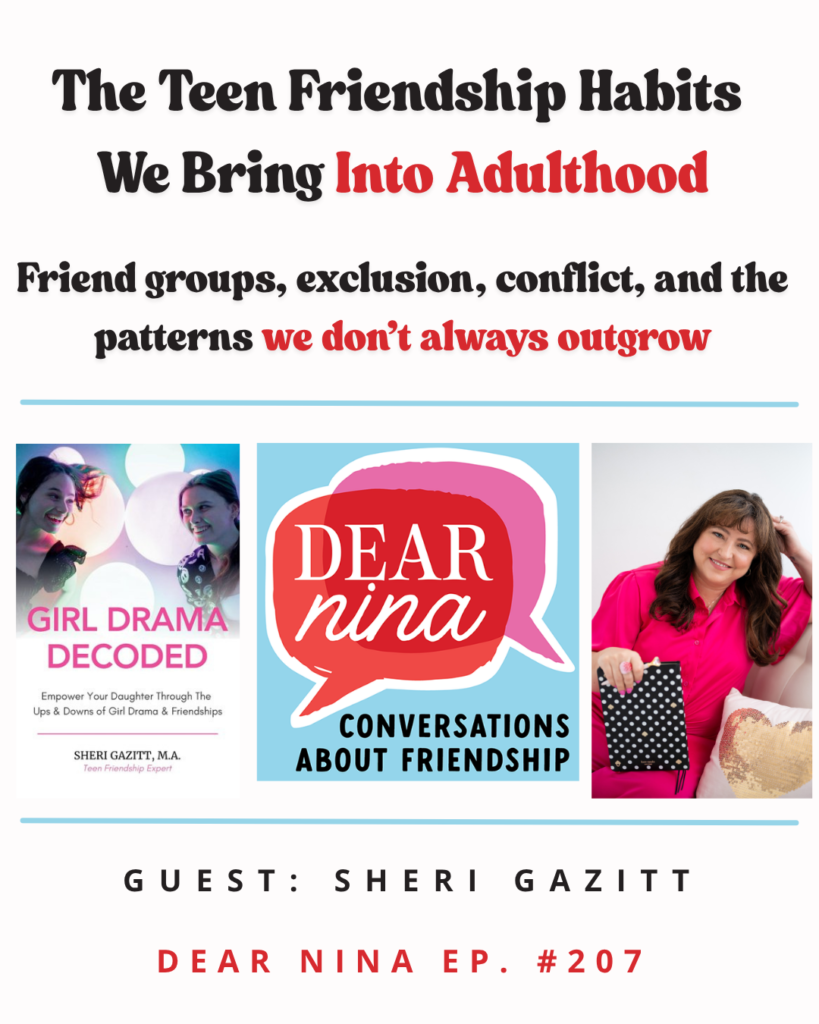
But today we are focusing on teen girls because that is the focus of today’s guest, Sheri Gazitt, who is an international friendship expert, speaker, and founder of Teen Wise. Sheri has over 30 years of experience with teen girls. She’s the author of Girl Drama Decoded. She also helps moms through a group she has called Mom Wise Collective, and she does private coaching for teen girls.
This episode is very skills and I would say thought control-focused, and it is really not just for teens, because every one of the issues Sheri and I [00:01:00] speak about show up in adult friendships as well.
Sometimes as Sheri has found, and I have seen, those patterns start in the teen years and follow people into adult years. Sometimes we don’t even know until we are watching our own kids go through things, and it brings up stuff from our past.
We get into as much as we can in about 30 minutes, so we pack it in, here is Sheri Gazitt
Nina: Hello, Sheri. Welcome to Dear Nina.
Sheri: I’m so glad to be here.
Nina: You have so much experience behind you. You could talk about so many things, but in this episode today, we are gonna focus on trying to help listeners see how current friendship issues they might be having, might be rooted in patterns that they learned as teenagers, and you work with teenagers.
Sheri: When I go to some place, let’s say, to a doctor’s office or wherever, and they ask me what I do and I tell them, and we’re talking about adult women here, they’re like, “Oh my gosh, we need you here in the office,” because they are having these issues in the workplace, and people tell me about mama drama they [00:02:00] have.
It doesn’t stop because we’re carrying those patterns forward.
Nina: let’s start naming some of the patterns.
Sheri: There’s a lot of patterns that we carry forward, and I think it all comes down to insecurity in our friendships. we kind of try to do things to secure our friendships, which actually come across as very unhealthy behaviors. So gossiping about others, spreading rumors, not being vulnerable at all, so we keep those walls up.
We don’t create deeper friendships. Those are some of the big patterns that I see. Also, the forming factions, right? We’ve gotta get people on our side, and it comes from that insecurity of the friendship. when we’re talking badly about people, the purpose is to solidify our friendship with somebody else.
there’s so many patterns, but those are some of the big ones that I see.
Nina: Okay, that is all very, relatable. And I think probably anybody listening to that could remember in their own teen life and think about their current adult life and think about every one of those patterns.
I think that the [00:03:00] listeners here are 95% adults. You’re probably, speaking to parents of teens. So your clients are generally teenagers though, correct?
Sheri: Yes. So I generally work with private coaching with the teens, but I also work with their parents so that I can help the parents to support them, and some of that work is having the parents reflect back on their teen years.
Nina: So yeah, what does that look like? Take me through what that might be.
Sheri: So with the parents, when we have had these experiences as teens, that’s the filter that we’re looking at what our kids are going through. So if there’s someone who’s mean to your daughter, you might be like, “Oh, she’s getting bullied,” thinking about all the things you went through.
when we have a filter already of that negativity we’re looking for that amongst our kids’ dynamics, then we’re thinking, “Oh, girls are just mean,” or, “Oh, boys just don’t know how to have emotions or don’t know how to talk it out.” So we just automatically put these, these stereotypes on top of the teen friendships, that reflects how [00:04:00] we are going to parent.
What are the things we’re gonna say to them? How are we gonna help them work through it? Or do we just put these labels on?
Nina: What would be the better thing to say? ‘Cause I will tell you that I also really struggle with everything being labeled mean.
Sometimes there’s meanness, and sometimes the chemistry’s not there and someone’s trying to let you know, maybe they’ve been trying to let you know all along in a more gentle way that the friendship’s not working for them.
Like, everybody isn’t entitled to our friendship. It’s kind of a harsh thing to say, but it is true. Somebody not wanting to be close to you does not make them mean necessarily. But there is real mean behavior. It does exist. I’m not saying it doesn’t exist. And you are saying you’re adding another layer, which is What we might be telling our teens or kids is mean might be our own experience from when we were a kid when someone actually was mean.
Sheri: Exactly. Yeah, and I have the interesting, um, perspective of seeing it from both sides in relationships. So I might see where one girl is saying, “I was excluded,” and the other girl is saying, you know, “I don’t really get along with her, so I didn’t invite [00:05:00] her.” so the words that we use really do impact how our kids are thinking about it, and it impacts how we’re thinking about it, either as parents or in our own friendships, that did they exclude you or did they just not invite you?
‘Cause there is a difference.
Nina: Oh my God, can you talk, just talk more about that and how you help people through that exact, example, that example.
Sheri: Yeah, so there’s an example where I’ve worked through with girls on you were not invited to a birthday party. So I have them think about all of the thoughts that they have if they weren’t invited to a birthday party. And in the teen world, birthday invitations are like gold. you know, their thoughts are about, “Nobody likes me,” “I’m never gonna get invited to a party again,” or, “They think I’m not cool enough.”
All these negative thoughts. And from there we look at what are the emotions that come with that, and then what are the actions you’re taking? Because if that’s what you’re thinking, many girls will either start doing mean things or they shrink themselves and they avoid those people, and the result is they don’t have that friendship [00:06:00] anymore.
Instead of working on maybe deepening that or realizing it’s not a good connection. So from there we look at the other, either neutral or positive thoughts that they can have. And the interesting thing about this is we don’t know the thought… Like, the thoughts, we’re just creating them. So we don’t know if the first round is true or the second round of thoughts are true, but we have the power to look at those in a different way.
And I always say it’s not about getting rid of the negative thoughts, it’s about realizing there’s alternative thoughts and alternative realities. It’s all about our perception. And when we can see it as not a personal affront, it’s not, “I’m not good enough” or “Nobody likes me,” it’s like, “Eh, that happened.
Didn’t have enough room for me,” or, “Just didn’t think about inviting me.” And then it doesn’t impact their mental health so extremely, and it doesn’t become this pattern of thought that they have.
Nina: What are some more alternative thoughts? let’s stay with this example, you weren’t invited. I like this one because it’s the biggie. It’s, it’s the big one. weren’t [00:07:00] invited. It might not be just the one time, I assume if someone’s coming to you, it’s maybe this is a pattern. Maybe they often find that they weren’t invited. what are some alternative thoughts?
Sheri: Sometimes it is that, that it’s over, over time it happens a lot, but sometimes it is just that one time, and it kind of breaks the whole friendship group apart because of those thoughts and those actions and behaviors. So some of the alternatives, and remember it’s neutral or positive, it doesn’t have to be toxic positivity.
It might be there wasn’t enough room for me, or there was a limited budget, or I’m just not close enough to her yet. Things as simple as that. And to be like, “Oh yeah, maybe there was a limit on the number of people that could be invited.” If you think of it like that, all right, so not a big deal. I can accept that.
So accepting is emotion, and then the behavior is I keep talking to that girl. Maybe even to be bold, I ask about the party and say, “Oh my gosh, happy birthday. How was it?” So that you are still part of the mix, and the result is you keep continuing to build that friendship.
Nina: [00:08:00] It’s really a point that cannot be underrated, that sometimes you aren’t as close yet. And it kind of goes back to what I said a little earlier, is that we’re not always entitled to friendship just because we’re adjacent to the friendship. Maybe it’s a big friend group of 10 kids. Maybe they got tickets to a concert for four kids.
You know, should those parents be expected to bring 10 kids to the concert? if those parents don’t, are they mean, horrible parents who are teaching their kids to be bullies? And there’s a lot of this stuff that people say about parents and kids, everybody isn’t equally close. There are individual relationships that do exist within groups, and it can be hard to get teens to understand that because it can be hard to get adults to understand that,
Sheri: Yeah, and we as parents talk about that, right? “Oh, I can’t believe that they didn’t invite you and they excluded you.” Yeah. And then talking about it to the other parents. But, you know, the difference I see in exclusion and just not being invited is if you have a friend group of 10 people and they invite nine out of 10, then that is clearly exclusion.
But otherwise, you know, [00:09:00] it’s not. It’s just you didn’t get the invitation.
Nina: it is hard to accept. for people who are like, “Oh, that’s easy to say, Nina,” trust me, I have four children that range from 22 down to 14, two boys, two girls. I have seen it all just within my own house, and then receiving people’s letters for the past , 14 years that I’ve been doing this work.
I understand it is not that easy. But I never found, in my own experience and then helping other people, that harping on this one group that didn’t include you, that won’t invite you, is not helping anyone. You’re taking all that time instead of building other relationships.
Sheri: Exactly true. a lot of times for the teens and Honestly, for adults too. There’s the idea of the popular crowd. “Well, I wanna be in that popular crowd.” So people will take the abuse or being teased or being excluded a lot because they’re like, “But I’m in,” right? And they see it as safety, but really it’s a, a false sense of safety because that group’s gonna toss you out, constantly because you’re not really part [00:10:00] of the group.
You’re just hanging on. When you can see that that pattern’s happening, instead of thinking, “Oh, I’m not gonna be friends with anyone in the group anymore,” you’ve got a couple of options. One is to think about the individual friendships you have within that group, because you can foster one or two friendships and not worry about the group dynamics anymore.
The other is to start creating parallel friendships. So you’re still hanging out with that crowd, still talking to them here and there, doing things with them, but meanwhile you’re looking for the next crowd. Who is the next person you wanna connect to? So it’s not as scary. It’s not, “Okay, I’m gonna be alone now, and we’re done with them.”
It’s like, “Let’s start fostering something else here.”
Nina: That is so true for adults too, Yeah. to not put all your eggs in one basket. I mean, I know we’re, like, talking about teens and adults, that’s kind of the whole point of this episode, is that it is all kind of mushed together. I wonder sometimes for adults who did have a positive teen experience with friendship, if they struggle to adapt as adults when they don’t have that group, that they always know who’s coming [00:11:00] to their birthday, they always know whose birthday they’re invited to, just to stay with the birthday theme.
For some people, it actually was easier when they were younger. For whatever reason, , they had a wonderful neighborhood, or they were on a soccer team, and that team was really tight, and it was just always really obvious what they were gonna be doing after school.
But then when they’re adults, they find that they don’t click with the other parents and then it can be hard, and my advice is always, these parallel friendships, you need to be trying different things so that it’s not just the school or it’s not just the one activity, it’s not just the one mahjong group.
It’s trying different things.
Sheri: And I think the key to that is instead of thinking, “I need to do this to make a friend,” just think about creating connections. It releases that pressure of, “Okay, who do I want to be my friend so I’m gonna, like, connect with them?” Just talk to people and you’ll get a sense for who is open to it, but also who you connect with.
It’s not just about who’s gonna accept you. You’re looking for a certain type of friendship, so go into it knowing what you’re looking for. Do you like somebody who teases people all the time? [00:12:00] Do you like that loud, boisterous friend? Do you want the quiet listener? know what you’re looking for. You always have to kinda know your goal in life.
And I will say be open to people that are not following that, specific guideline.
Nina: anything else, , you wanna say while we’re on the topic of- teen friend groups, and then we’ll move on from the group issue.
Sheri: there’s a lot of teens who want to be part of a friend group, but it is not for everyone. I see a lot of girls who that’s the idea that they have, and the parents also. They feel like their kids are in a better place if they have a big friend group. But sometimes there’s not safety in a group, the safety comes from individual deeper friendships.
Many of these friend groups, there are some people who have these one-to-one better friendships within there, but some of the kids get left out, and they don’t create deeper friendships. Those are the people who are the people they never get asked first, they get asked last, or they don’t get asked at all, even though they’re part of the group.
And same for, for adults too.
Nina: [00:13:00] Interesting. I know we’re trying to stay focused on breaking patterns. again, within the group question, how do you do that? How do you break that pattern of wanting that comfort of a group, even if you are the last picked or you don’t always get included?
Sheri: You have to stop and reflect on why it is so important to be part of the group, and some of that is what we learn through movies and through, magazines and all of that. We need to really focus on what do we need to really get the friendships that we want. If you’re in a big friend group, are you having opportunities to have these deep conversations with people, to really reveal yourself and be truthful about what’s going on with you?
Or are you in a position where you’re constantly having to be fine and have that mask of, “We’re all good”? Like, what do you want is the first thing you need to know. Are you craving a deep friendship? If so, you need to look, if you are part of a friend group, who do you want to create those deep friendships with?
And worry more about that instead of the group [00:14:00] dynamic.
Nina: And you can say all of that to adults too.
Sheri: Yes, all of it.
Nina: of relief and comfort I think people have being in a group. I understand. You kind of know who you’re doing stuff with, there’s a relief when your kid is in one, ’cause you don’t have to worry Okay, my kid doesn’t have anyone to, be with on the weekend, or trick-or-treat with, or go to prom with,” in a group.
It, there’s so much group action, it’s a lot of stress. Okay. So Sheri, thinking again about these patterns that show up in our adult friendship life that probably started when we were kids and teens, conflict is a big one.
Sheri: you know, boys have their own conflict resolution issues. But I’m gonna talk about the area that I focus on the most, which is female friendships. we’re kind of programmed, if you will, from a younger age as girls to always be in the second position, meaning we need to think about how the other person feels and what they think, and we need to cater to that person to not make them feel bad.
[00:15:00] In that line, we don’t want conflict, because if we tell them how we feel, but what if it makes them feel bad? What if they’re sad? What if they’re angry? So we have to learn that that’s okay, as long as when we have some conversations and we’re pointing things out to people, that we’re doing it in a compassionate way and looking for solutions.
So we have to know how to do that. So one of the things I teach my clients is a four-step solution to having a compassionate conversation, and I’ll teach that to them, and then I’ll tell them to go teach it to their parents.
And I’ll tell them to use it on their parents, because it works for any relationship.
So when they realize, “Oh, it’s not just about saying, ‘You hurt my feelings because you said this or you didn’t invite me,’” they actually have a way to do it looking for the solution. And so you start by saying, “I really appreciate your friendship.” And I always tell them, the teens, “This is what I’m gonna say.
You translate it into teen language.” But basically, you know, “Your friendship is really [00:16:00] important to me. I’m feeling really frustrated that you’re always teasing me.” So that’s the second piece, of saying exactly what’s going on. This is not about making a laundry list of all the things you’ve ever done as a friend that’s wrong.
It’s about this one specific thing. The third piece is if there’s any ownership that you need to take. So it might be, “I’m really sorry I always just laugh and I don’t tell you how I feel.” And the fourth is what is the solution that you want? So, you know, “Next time when you are teasing me, I’ll let you know if it hurts my feelings, and I would love for you to kind of stop teasing me so much.”
How simple is that, and how, like, positive is it? It’s saying to start with, “I appreciate you. This is not about pointing you out. It’s not about making you feel bad. I want to work on this because I care about you.” So it’s lowering the defenses of the other person, it feels good as the person bringing up this conflict conversation, and it’s looking for that solution.
Nina: I gotta tell you, the one that stood out to me the most in [00:17:00] that list of four, I loved your example in number three of just having a little bit of ownership that isn’t fake. It- I could see that it might seem like that part is just to appease the other person. I actually think it’s important that, that someone coming into a potential confrontational conversation does know what their part is, ’cause it often there is some, and your example was such a good one, I always laugh and never said anything.
it is, teasing’s a great example. It’s one I’ve talked about on the podcast before because I don’t like to be teased really. But a lot of people like that. A lot of people love that sort of jabbing back and forth. , People are not wrong for being teasers. They just have to know it’s the right chemistry with the right person.. The reason I bring that up, as just a personal example, is because it’s really not fair to a friend of mine if they do it all the time if I’ve never said anything.
‘Cause maybe that friend has wonderful friendships with lots of people, and that’s how they connect. So that person’s not being a jerk, not wrong. That’s just how they connect with everyone. In this case, it’s really on [00:18:00] me to, it’s hard to say, but it, it doesn’t have to maybe get this far into this kinda conversation if you say it earlier on.
So anyway, I got too down the rabbit hole on the actual teasing. The bigger point is on bringing up a conflict, and I love that piece about taking some ownership, and again, like real and appropriate ownership.
Because I think it would be a little too easy maybe for someone to go over the top with number three in order to make sure the other person isn’t, like, too upset that they’re bringing something up
Sheri: Well, and occasionally there’s not a number three. You know, we don’t wanna just create something to fill in the blank. oftentimes we can look and find that. the fifth part of this is the person that you’re talking to has the right to feel however they wanna feel.
Mm-hmm. In the moment, they may get really pissed off. They may be really sad and cry, and it doesn’t mean you shouldn’t have had the conversation. It just means they’re feeling it, and give them that space, and don’t backtrack because they get upset. And also, don’t keep laying it on, or, “Why are you being like this?
[00:19:00] I’m the one that was hurt.” , Just let them feel their feels, and then you can have another discussion later on if needed.
Nina: follow-up to that is I will say for anyone who’s, needs some courage to have a hard conversation, I cannot think of any friend I’ve had a hard conversation with where we haven’t been closer because of it. Maybe it may take a while. I’m not saying the next minute, as time goes on each one of us, whoever brought it up, has a chance to process it and then we come through it.
Usually there’s a cooling off period for a while where, eh, we don’t, maybe don’t text as much or call as much. I don’t have a lot of these. I can count on my hand probably in my adult life, but in every one of those cases, I’m closer with the person now.
You’ve cared enough to have a very difficult conversation.
Sheri: Well, and really what you’re doing is you’re trusting the friendship. You’re saying, “Because I know we’re close, I can actually talk to you about these difficult things.” And I have a friend that we’ve been friends, I think, 30 years or something like that now, and we were roommates at one point. That always creates more tension, right?
I was a letter writer, so I wrote her a letter about, I don’t even know, [00:20:00] dishes in the sink. I’m not sure what it was. But the next day she was like, “You know, I’ve never really had this kind of conversation with a friend. I feel really good about this.” That was an interesting moment for us to be like, “Yeah, we’re…
This is a real friendship,” ’cause we can disagree and talk about it and, and be good. And, um, that’s one thing that we have to realize. There are certain things that we do or don’t do in relationships that create disconnection. Not addressing conflict is a number one reason that friendships will dissolve, because it becomes resentment.
You’re just thinking about it. You’re not telling them about it. And so instead of getting closer by avoiding that, that conflict conversation, you’re actually creating a disconnection.
Nina: must be a pattern you see in adults that for sure started in their teenage lives.
Sheri: Yes, for sure, and they’ll think, you know, something happens with their friend, and they don’t talk about it. it goes back to those thoughts that lead to the actions and results that you just keep building it up in your head, where the other person [00:21:00] has no idea there’s a problem because you haven’t told them
Nina: Yeah, I would say that number three, back to the number three, I agree there isn’t always a time when you have to take some ownership, but the one that most people probably could reach for if they need one is that they didn’t bring it up sooner.
Things fester, and then it gets blown out of proportion in a way that might have been dealt with a lot easier.
And if you’re the one bringing forward the conversation, maybe you could take that on. I should have said something earlier. Obviously, if it was like a one-time major horrible thing your friend did, there was no time to say it earlier. But I’d say a lot of cases, most people waited too long.
Sheri: It doesn’t mean it’s not resolvable, though. You can still work through it.
Nina: That’s a good advice. How do you get people… I’m just assuming now. How do you get your clients to have a conversation like this in person or at least on the phone and not over text? And I’ve skipped the part where I said, shouldn’t they do it in person? ‘Cause I’m assuming that they should.
Sheri: Yes, I always encourage them to do it in person, and one of the ways I get that point, made is they always have their phones with them. They’ll bring them up. [00:22:00] I am often looking through text threads of teen girls because they, “Look, look, see what happened?” Right? So I will have them read some of their texts, I hear the sass that they’re bringing to it, and I’m like, “Oh, do you know that she really said it like that?”
And I’ll say, “Why don’t you read it in a more calm way? Why don’t you read it now in an angry way?” And then they’re like, “Oh yeah, there’s lots of different ways that this can be interpreted.” that gets that point home. We also practice it. I will have them write it out if they’re in my office on the whiteboard, and then I’ll say, “Okay, now sit on the couch and let’s read this,
act like I’m that person and talk to me about this.” then I’ll have them go home and practice in the mirror so that when they’re in the moment and their anxiety is high, that it can still flow freely . Sometimes I will say, “Okay, this is your challenge for the week, to go out and have this conversation with a friend.”
If they come back and they haven’t done it, that’s okay. “Let’s talk through this. Where’s the resistance? Why did you not have this conversation?” So it’s, it’s a big learning [00:23:00] process, but after they do it one time, they love it because they realize, “Yeah, this works.”
Nina: It’s a power move, and I don’t mean that in a negative way. , It’s like a superpower, I guess, is what I’m trying to say. It’s if you can practice, first with you or, anyone can do this on their own, with the mirror, I like that, or with your parent or something, if you could practice, and then also practice by doing it with a real person, that’s a practice for your future life Which is what we’re trying to discuss here is, having good patterns of friendship when you’re an adult.
if my listeners who are already adults, which is most listeners, and they know that they struggle with conflict, or they know they struggle with negative thoughts anytime somebody, doesn’t text back right away or all these different examples, how do they break those patterns?
Sheri: Well, I mean, I love therapy. I think it’s fantastic. But I think that most therapists don’t work through the skills that are needed for those moments. therapy’s great if you need to really process through the insecurities, and when it comes to skills, that means you’ve gotta learn those specific [00:24:00] skills.
So obviously, you know, I work with teens on this. For parents, they can also, contact me and we can work through some things. But it really comes down to what do you notice in your life that is creating these issues? Do you want to make a change or are you fine with doing things as you are? what is the purpose?
Why do you wanna learn those conflict conversations? Why do you wanna have friends? You’ve gotta dig into your why. And then when you have those uncomfortable moments, you’re like, “It’s worth it because this is my why. It’s worth having the conflict conversation because I wanna create a deeper friendship,” or, “It’s worth getting really uncomfortable and connecting with someone new because I’m looking for a good friend.”
it comes down to that why. And but I think that therapy is good for some, depending on where you are in your process, and coaching is good for other people.
Nina: So let’s end on something that definitely comes up in your teen clients, and I know for sure comes up for adults, and that is when you’ve had [00:25:00] a friendship that was not able to- get past the conflict stage. May-maybe you didn’t have the courage to bring it up, or you did bring it up and it blew up. The friendship’s done. And a lot of friendships don’t end from some big explosion of a fight. Actually, it’s pretty rare. It’s usually, like, someone disappears or they, quietly quit, as we say where they just sort of slip away.
I think a lot of people struggle with the confidence to get close with people again or feel that they are able to have close friendships. And probably for adults, that is a pattern that, maybe you’re seeing in clients now, from teens.
Sheri: we wanna protect ourselves, right? And our brain wants to protect us, so we build these walls sometimes that make it impossible for anybody to get through them. And so we create these superficial friendships, is one of the things I see. And these stick with us. There was this one presentation I was doing for Girl Scout troop leaders on friendship, we were talking about some of the patterns and how it affects us as [00:26:00] teens and as adults.
this one mom who was… She’s probably 40, 42, somewhere around there. She started crying talking about this. She’s like, “Yes, this is what I’m doing. This is why I don’t have female friends, because I’ve created this wall. I don’t talk to people in a deep way because I’m protecting myself.” So it was a really big breakthrough for her just to be able to stop and realize, “Yeah, that’s what I’m doing.”
so many of us have those walls that we’ve built, and we don’t even realize it. We’re like, “Oh, but I have friends. I’m talking to people.” But keeping it on a superficial, safe level. we have to really look at what walls did we build and why. And when our friendships end, we have to not throw the whole friendship away.
Every relationship or friendship we have, we can gather from it positivity. What did we learn about ourselves? What did we learn about what we need in a friendship? What could I have done differently? What did [00:27:00] they do that wasn’t so great? really fostering the positive memories from it. Just because it didn’t end well doesn’t mean the whole thing was bad.
we as adults do this to teens, but we do it with each other as adults when a friendship ends. “Oh, well, she wasn’t a good friend anyway. If she said that, she was never your friend.” well, no, it may have been a, a really horrible moment. She may have been going through something. And teens, they’re still learning.
every person has a capacity to be mean at some point in time. It doesn’t mean that they’re not a good friend. We have to look at what walls have we built and why.
Nina: That’s great advice. And I do think the labels that parents put on other people’s kids are pretty harsh. it’s really kind of unreal, and like you said, they are teens. They are learning, and kids too. I mean, people say really horrible things about a 10-year-old, an 11-year-old, a 12-year… they truly are still learning how to navigate in the world, I’ve never met a 12, 13, 14-year-old who has it all figured out.
Sheri: I, I heard this really horrible, um… [00:28:00] People always say girls are mean and, you know, all these awful things. But I heard this mom say something that just, like, a knife through the heart was, Oh, in middle school, it’s just biatches in training.” I’m like, “Ugh, that’s so horrible.” no, they’re girls in training to be really great friends.
They just don’t know how to do it yet, and they’re gonna make mistakes, and we have to be there to guide them. And we have to realize that that little biatch in training, as this awful woman said, that person is still within the adults, and we have to really pull that teen version of ourselves out to figure out what did we need, what do we want, and how is it affecting us now?
And we have the capacity to change that.
Nina: perfect note to end on. It’s, it’s hopeful, and I really like your focus on skills. Teens and adults, everybody can improve skills in this area, just like a lot of areas in life. Friendship is not, it’s not ever too late. I really feel like it is never too late to make new [00:29:00] friends, deepen your friendships, be a better friend, and have better friends. Thank you for being here, Sheri. When I end my episodes, I always tell people to come back next week when our friendships are going well. We are happier all around. I’m sure you have seen that in your work.




One Response
Navigating friendships can be tricky. Love the ideas and guidance that Nina offers for getting through those challenges.