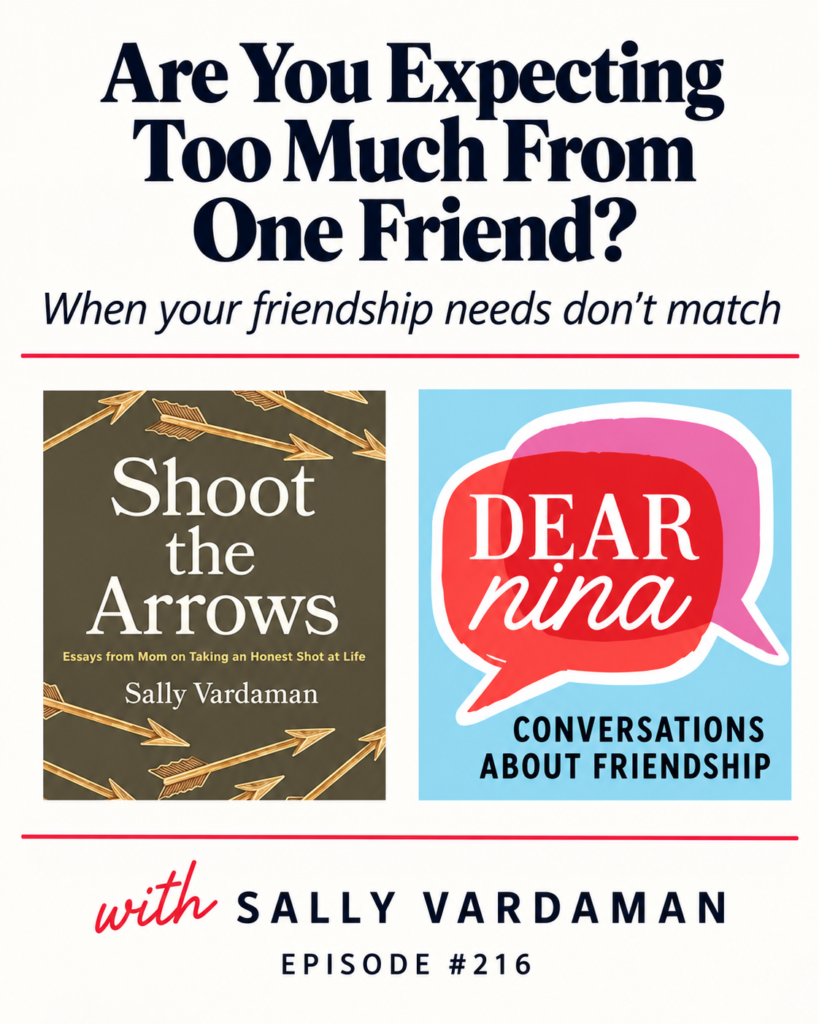
[00:00:00] Welcome to Dear Nina: Conversations about Friendship. I am your host, Nina Badzin. Sometimes I feel the need to remind listeners that it is called “Dear Nina” because people have been writing me letters for a long time. It’s been about 15 years. More and more there is a theme that is emerging in these letters. I mean, it’s always been there.
It’s not like this is a new theme, it’s coming out even more and I’m seeing it a lot in the Facebook group, which is at Dear Nina, the group, Where people also write anonymous letters in there and other listeners answer. We sort of answer together.
And that theme is the mismatch of needs in friendship. there’s the one about always being the friend that reaches out, which is a theme that comes up in almost every episode of this podcast. That is not exactly what we are focusing on today. there’s the issue of feeling like you’re always the one that’s making plans, and really that you’re wanting more from a friendship than the other person wants or seems to want.
We don’t always know. And I think [00:01:00] that’s one of the hardest things to figure out in a friendship is whether you’re expecting too much or you are accepting too little. That is really important. I’m going to say it again. When I get these letters, what it seems like people are struggling with,
And I don’t always know the answer. I’m not claiming to know the answer. The listener and I, the reader and I, we’re figuring it out together, and other listeners are chiming in. We don’t really ever know the answer ’cause we’re only hearing from the person writing in. But what they seem to be trying to figure out is whether they are expecting too much from someone or whether they are accepting too little.
Two really different realities in a friendship, and it’s never the same between any two friends. Each friendship, it’s like a marriage almost. Really only the two people in the friendship understand now, the truth is sometimes a friendship really is one-sided. And I talk a lot here about not expecting your friends to do friendship exactly the way you do.
I stand by that. I don’t think a friendship will ever be exactly [00:02:00] 50/50 but sometimes one person really is doing all the work, and the other person isn’t particularly invested, and sometimes the way they make that lack of investment known is by doing none of the work. So it is tricky out there, it’s a case-by-case basis, and no two people are the same.
Nobody has the same needs. two people can genuinely care about each other and have different needs . Sometimes someone is as emotionally invested, but their emotional needs are different, so it’s not going to look equal or feel equal. So an example of that might be maybe one person wants to talk all the time. They’re a phone person, they’re a text person, and by talk I also mean text here. So somebody wants to be in communication often. The other person might be perfectly happy catching up once a month.
I might hear from someone who is annoyed that their friend only wants to talk once a month, and then people might write in the comments, “Oh, that’s not a real friend.” Well, maybe that’s not a real friend to you, but to that person who talks to people only once a month, [00:03:00] it’s a real friendship to them.
Who’s right? Who’s wrong? All that really matters is what are your needs and are your needs getting met by this friend? And if the needs aren’t getting met by this friend, it doesn’t necessarily make that friend wrong.
It might make the match of this friendship to meet your needs impossible. How often someone wants to talk is just one example. How often does somebody want to spend time together in person is another example. Maybe one person really loves to travel, the other person doesn’t, so that friend might not be your travel friend. Does it make them a bad friend?
I don’t think so. You can’t really force someone to travel and spend money and leave their job and their house if they don’t want to. And just because you want to, and that means a lot in a friendship to you, I did a whole episode about girls trips and traveling, it doesn’t make that person a bad friend.
Again, it might make them not the right friend for you in this particular part of friendship, which would be traveling and taking trips. You might need different friends for that
but this episode actually is even deeper than all of that. It is not just who wants to talk [00:04:00] more, who wants to go on trips, who wants to see each other more in person. It’s really more about a deeper emotional need and whether the friendship that you are writing in about or concerned about is able to meet that need, and if it can’t, does that mean it’s not a good friendship?
Or does it just mean it’s not the only friendship that you should be counting on in your life? Are you expecting too much from this friend, or are you accepting too little? Like I said, it’s different in every relationship. But there are also some resources in the show notes that our guest today, Sally Vardaman, has provided as books that has really helped her.
Let me tell you a little bit quickly about Sally. Sally Vardaman is a Minneapolis-based writer. She’s the author of the essay collection Shoot the Arrows, Which includes letters to her grown children about some of life’s more complicated struggles.
And this episode came about organically in reaction to episode 72, which was called Grudges and Apologies in Friendships. That’s an episode I did with my mom. I’ve done about five or six episodes with my mom. People [00:05:00] really enjoy her and enjoy her take. My mom and I had talked in that episode about a friendship of hers that had ended many decades ago.
And it partially ended because my mom felt this other friend was too needy. And my mom used that expression, that their friend was too needy. Sally, who had listened to that episode, reached out to me afterwards with a very thoughtful and honest letter about her own history of being the friend who wanted more, of being the, quote-unquote, needy friend.
She told me about a close relationship that had survived this mismatch of needs for years, and Sally wanted more from this friend than her friend could give. And even though they really cared deeply about each other, that difference created this resentment that I’ve been talking about and that I know a lot of you out there are feeling sometimes with certain friends of yours.
Eventually, Sally and her friend were able to acknowledge that this mismatch existed. I think that’s incredible. I mean, that’s much more than a lot of people can do, is just to even say, “Hey, I have these needs. You have different needs. You’re not able to match these needs, and you’re feeling resentful perhaps [00:06:00] that you’re being asked to meet these needs.”
That happens, too. The person who feels their needs are not getting met feels resentful, but the person who feels like they never can do enough, that the need is bottomless, also can feel resentful.
I found that story really fascinating and I hope that listeners who are in a relationship like this on either side, where they feel somebody is asking perhaps too much, or you feel your friend is not giving enough, this might give you language to talk about it with that friend. Because I never like to see people just ghost their friends or do these little punishing things where you feel like your friend isn’t texting back quickly enough, so you’re gonna stop texting completely. I mean, this is the games people play when really they could have a conversation.
Maybe this episode will help you have a conversation like that. Sally and I also get into what a loaded word needy is.
The original title of episode 80 was Neediness in Friendships, and I retitled it for this replay because that was not the right title in hindsight. [00:07:00] We’re not studying what it means to be, quote-unquote, needy in a friendship. We’re really talking about recognizing your own needs, recognizing whether a friend is able to meet them or not, and then figuring out how to get those needs met. So not to not have needs, but to figure out how to get those needs met and perhaps to spread it out beyond this one person that you were hoping to get them from
and I wanna say this too, not being able to meet all of your friends’ needs does not make you a bad friend, and having needs doesn’t make you a bad friend. Those are really important ideas to hold together.
So with all of that in mind, to give you the context of where this came from, the episode with my mom, number 72, Sally’s beautiful letter, I share the entire letter with you,
and I hope you enjoy Sally as much as I did.
Nina: So here is Sally’s letter. dear Nina. I listened to the episode with your mom about grudges and apologies. In that episode, your mom talked about a friendship ending related to that person’s neediness.
In adulthood, I haven’t lost friends over that, but I definitely did as a [00:08:00] teenager. I want to tell you a success story about an adult friendship and neediness. My friend Nikki and I each had our three children in a similar timeframe. The six of them were born in a four year span. When they were all little, she had a lot of family support and I did not.
So I was in an even needier place at that time, but neediness had been a general theme with me. Nikki is like family to me, but because she has family around her, that is not the same for her as it is for me.
And it was a mismatch in what we wanted from each other. Fortunately, Nikki is a rock star boundary setter. And I had at least some awareness of my issue. She could set a boundary and still stay close to me. But there was a tension there and it existed in our friendship at a low level for 15 years.
I wrote a chapter in my book about resentment which marked the end of these feelings of tension with Nikki because we talked about that mismatch of needs for the first time. And what I think is important about that conversation is that we [00:09:00] only acknowledge that it was true, that it was a dynamic in our friendship.
We knew we weren’t going to change it, and that I was able to let my disappointment about all of that go. And the above happened after a lot of my growth around neediness. It took me a long time to mostly solve it, well into my middle age.
So I could wax on forever about its cause, finding it in myself, and the threat it poses to relationships. It relates to my upbringing, my ADHD, and ways my maturity was slow in my early adult life. Neediness is so complex, we can’t solve it in short order, but it is so uncomfortable that few people talk about it like this in the first person.
I did it in my book because it is hard to build the self awareness needed to climb out of it if no one talks openly about their experience, but it really is a common thing. it is an unpleasant topic, but I believe one that should be spoken about.
Best Sally. Welcome Sally. So glad to have you here.
Sally: Thank you for having me. I’m [00:10:00] excited.
Nina: I love getting feedback from listeners and after an episode I did with my mom, we had an email exchange. My mom and I discussed a friendship that ended for her about 40 years ago and she still remembers it really well as we all do.
This particular friend was really upset with my mom and gave her a long list of reasons why. It was something that was kind of the straw that broke the camel’s back, but this friend had been mad for all kinds of reasons.
And my mom thinking about those reasons was kind of like, you know, this friend is just too needy. The reason in particular that the friend had brought up in that moment was that she was upset that my mom had not come to sit with her husband during a surgery she was having. And my mom was like, I have little kids, you have family, your husband’s there.
Why do I need to be there to sit with your husband? And there are probably friends who would do that kind of thing. My mom either didn’t feel that way about this friend or just didn’t have the capacity at that time. My mom, instead of apologizing, was kind of like, I’m done.
Something about that struck something in you. So I want to hear about that. [00:11:00] And then right after that or within that, we should also define neediness because I think people hear that word and everybody has different things to say.
Sally: Silence. I think we also talked about in our email exchange what a loaded word needy is. And when your mom . .
said something like she was needy, she was more than needy. She was also demanding, rigid, unreasonable, the other person, not your mom, obviously. but I heard that word and I immediately exited your mother’s story and saw my own history of neediness, which is a great example of how loaded that word is.
I immediately had this emotional attachment to it.
And I sent you the email then because I thought I know I’m not the only one who responds to that that way and I know it’s really common. You know, I’m very comfortable talking about awkward things and neediness is a really awkward thing because lots of people may not want [00:12:00] to talk about it or hear about it, but the ones who do probably struggled like I did.
Nina: Yeah. And I did hear from someone else around the same time who wrote, Oh my gosh, I’m worried I’m the needy friend. I think a lot of people react that way, not just to that particular episode, but in general, when they hear somebody complain about someone else’s neediness, it really, I think would be a normal reaction to be like, wait, am I demanding too much?
I like that. You said the word demanding. It’s one way to look at it.
Sally: I need a friend to sit with me. Why does it have to be a particular friend? Why is a particular friend responsible for meeting a given need? That’s the rigidity I think is, it’s not just neediness, it’s rigid and demanding. And there, you know, neediness is a big umbrella.
Nina: Definition, if we can tease that out a little,
Sally: Yeah, I have two for neediness. I think if it’s the other person, I’m recoiling from what I view as neediness. I see it, [00:13:00] the definition from my perspective is they want something from me I’m not willing to give or not able to give or not able to give.. But for the person being needy, I think it’s a derogatory term and it’s better to say I am a person with unmet needs.
Thanks. I am struggling with needs that are unmet. Because that’s a legitimate experience. It’s not any one particular friend’s job to solve it, but it is a legitimate experience that I, as the person, need to address.
Nina: That’s actually really. Brilliant. I think that would change a lot of people’s perspectives. That’s so true. Because there is nothing wrong with realizing, actually a huge piece of my podcast, all my episodes are about that. If you think about it, somebody is looking to meet friends in a new stage of life and doesn’t have friends.
Somebody isn’t sure if it’s time to end a friendship. There’s all kinds of things within this. It’s coming from an unmet need. There wouldn’t be a problem if all your needs in friendship are being met met.
Sally: [00:14:00] Exactly.
It’s also a more empowering perspective. And what I love about your website is you’re giving all this information, you know, that’s even more empowering, These are options. These are ways you can address these things.
Nina: yeah, and I like to always think of myself as not having the answer because I really don’t, but just giving people a place to acknowledge these things and I have never heard somebody say it quite the way you have said it at all that there is nothing wrong with being needy people who are carrying shame around that
need to say it differently and then we do need to go about getting those needs met and it might not be even from a friend. I think sometimes, it’s funny because I put friendship as a huge high thing, I do think I’ve really never said this out loud. Part of why I’m able to focus so much on friendship is because the romantic relationship in my life.
My marriage is very secure. Not so much so that I don’t have a need for friends I actually I think my life would be not even close to as full if I didn’t also have the friends but you know, sometimes I wonder if somebody is looking to their [00:15:00] friends for certain kinds of needs that maybe they’re not that’s not the right place.
Silence.
Sally: then I think we have to ask ourselves, why am I so fixated on this person meeting the need? Why do I want that one person?
What I found is that when I’m fixated on getting something from a particular person, I am looking for proof that they love me and care about me. So we have a need that we think needs to be met, and we’re expecting a particular person, especially in friendship when we have, in theory, more than one friend. Why does it have to be that person to meet this need? And what I found with me is when I’m saying that, it’s usually because I’m looking for proof that they love me or care about my problem.
And if I’m so fixated on this one thing, this one action, then I might be doubting that love and care already. So then I gotta back up away from that friend and deal with that in my own head. Why am I doubtful? [00:16:00] Why am I mistrustful? But that’s my job. That’s not their job. It’s my job.
Nina: That’s so true, do you think sometimes it’s also that we admire that person, like somebody that we look up to or admire and want that person to feel that way about us? We want them to call us as much as we call them. To prove that we are like you’re saying I’m just I guess saying the same thing that we are worthy of this cool person’s
Friendship, they choose us just like we choose them
Sally: Exactly. But if we do that and we’re looking for that validation because we admire them, not just because we have a love relationship between us, we’re putting them up on a pedestal and seeing ourselves as lower. We’re automatically feeling less than if we elevate them up on a pedestal.
Nina: This relates to something I bring up in probably every episode at this point, and that is that I really urge people to not keep track of who reaches out, you know, more obviously, if it’s. 100, zero, that’s a problem. But even if it’s 80, 20, I push people to [00:17:00] be okay with that. And you know it when you see it, if you really feel that you are way more interested in this friendship. The other person is just barely tolerating you. That’s different. But some people are just not as organized about their time. You have to develop the ability to discern the difference and that takes a lot of time and maturity, but I think it starts from assuming the best that, not everybody is as organized, but I’m saying that for the reasons we’re talking about is if you’re looking for 50 50, then you’re constantly in this testing mode of do they like me as much?
Are they interested as much?
Sally: And if you’re doubting it to begin with, at least with me, if I’m doubting it to begin with, I need to be honest with myself about that and kind of deal with why I feel that way before I put a lot of obligation on the other person.
Nina: And in your book, Shoot the Arrows, I love essays. Are you willing to talk a little bit about your chapter on neediness, which of course is, you know, part of the context for this episode. You had a mentor that had some good advice, which we’ve talked a little bit about here, [00:18:00] but I’m wondering if you’re willing to talk about what’s in that chapter
Sally: I’m I’m happy to. The chapter starts with a really embarrassing story of me being inappropriately needy and rude about it and I might even also borderline into narcissistic in a particular social setting within my family. I use that example because A, it’s embarrassing and I want people to know, those of us who’ve struggled with this, we’ve probably done really embarrassing things that we’re ashamed of.
And I was ashamed of that, story. So I put it in there because there’s nothing to remove shame like telling it to people on purpose, on your own terms. But then, in friendships, somewhat in my family and in my life, I’ve definitely struggled with neediness. I’ve probably gotten past it in friendships, but it has come up in my romantic life.
You know, if we struggle with something and we improve upon it, we can kind of slide back and regress. So it’s something I’m very mindful of. [00:19:00] But there was a particular situation I was really hurt about and I was talking to this, I consider her a mentor because she’s a lot older and very wise and it just has been very generous in being my friend.
And I said something to the effect of, I feel so needy about that particular situation. And she looked at me with all this calm and smile and she said, Sometimes it’s okay to be needy. And just instantly rejected that, , deep in my soul. That can’t be true. I’m still doubting it. I was doubting it when I wrote the essay.
And she and I have had many conversations since, and I think what she was trying to say informed the definition I gave, and that is, it is okay that you have needs, but I think she would agree with me, it’s not okay to wallow in that space. We need to sort of be proactive In addressing our own needs. And I journal a lot.
I find writing it down, getting out of my head and trying to break down. What is it I need that’s not being met and [00:20:00] what are other ways I can. And it takes work. It’s not like you’re going to read an article or read a book and or listen to this podcast and oh, I’m better now. It takes work. It takes practice.
But she gave me the gift that day of what you’re feeling is legitimate. And it’s okay that you feel that way. You’re not a lesser person because you’re in this place. And that’s, you know, so generous and kind.
Nina: , yeah, it is a gift to have someone say to you, there’s nothing wrong with you for feeling this way. Okay. Now what are we going to do to get those needs met? Not from just this one person. So I love that with the journaling and then part of the journaling being. Maybe problem solving a little brainstorming, okay, I guess, identifying the need. Is it loneliness?
Is it a self confidence issue? I mean, it’s probably different in every situation, but how, are we going to get that need met? If it’s loneliness and you have one good friend and you kind of realize you’re putting too much on this one friend who maybe has other things going on in their life, then it’s, what am I going to [00:21:00] do
to make other friends. It’s not that the need needs to go away. I actually think that’s really important. There’s nothing wrong with the need for more friends, but okay, let’s do
something about it.
Sally: Agreed. Another thing I found to be a helpful practi when I’m ’m overly focused on what I need, is when i’m spending time when that friend, intentionally paying attention to their needs. Like listen extra hard. Because a friendship, like you said, you don’t keep track, you don’t want to keep score. But it should be mutual and reciprocal. .,… So if I’m stuck in that mindset, actually intentionally putting my focus all on them can help get me out of my own head while I’m spending time with them, and paying attention to people is a great friend habit.
Nina: it brings me to something else I wanted you to talk about, which is, what have you learned in all the reading you’ve done on this topic and you’re now writing about it and all the therapy and everything about why are some people more caretakers than others because some friends [00:22:00] in my mom’s situation, for example, we can use that situation again because it’s a good one are really good at being the first one to say, hey, let me come sit with you at the hospital.
Let me come bring over dinner. They don’t see you, what we might be calling, or what I might call demanding, or my mom might call demanding, someone else might just happily meet those demands. They won’t even see it as a bad thing. What I’m saying is, my mom maybe is not a natural caretaker on a friendship.
not that she wouldn’t. I mean, she does, she is a very good friend. She’s had, so I quote her all the time. She has maintained so many good friends in her life and people love her and she loves a lot of people. So she’s obviously doing something right, but she’s still probably not the first person to come to the hospital.
So like, why are some people like more natural caretakers and some people maybe back away a little bit when we sense a demand.
Sally: I’m not sure I’m qualified to answer that, but I’ll give you my theory and I’ll also say I’m like what you’re describing . Well, number one, I’m the person with the organizational challenges too. But I will [00:23:00] be generous when I have the bandwidth, but sometimes, you know, like you said, her example was when her kids were young.
When my kids were young, they were really close in age. I had no family support here. No, I wasn’t the friend who stepped up in those moments, except when I could manage to. And I did sometimes, and sometimes we can’t. And that’s why we can’t be so rigid about the one friend that does it. As for the caretaker, no one can be that person all the time. I think it’s temperament, but I also think it’s the logistics of life in that moment. We can’t be everything to everyone.
Nina: No, it’s true. There are times that are easier than others, and I guess maybe advice I’d give on friendship in general is if you are in a time of life where, and by time I mean it might be like a particular month, where you have less on your plate or you just have more bandwidth and something comes up for a friend, In the Jewish community, it’s pretty common,
if somebody has a relative die, some friend will stand up. I mean, I [00:24:00] admired watching this so much in my whole life. And then when my dad died, I saw it some friend usually like emerges to the top It doesn’t mean that like they’re the top necessarily, but they’re the person in that moment who’s like, you know what, I’m going to collect the money for the Shiva, I’m going to order the food because you know, when someone dies, the family gets together for days and there’s always.
a meal just for the family. And then there’s stuff around for people who are coming to pay a call to the mourners. That takes a lot of organization. From a kid on, I have always watched that with admiration to see my mom’s friends , stand up.
And then when my own dad died to see my own friends and to be the ones to have to do it. People want to give and, and I’ve done it a million times, not been the organizer. I’ve given money many times. I’ve written many a check, sent many a Venmo. To be the person to organize it all.
It’s a huge undertaking. You know, that friend might not have been able to do it a different month, but she was able to do it then and I’m like, so grateful. I’ll never forget it. I will never forget. It’s a huge hassle collecting money from people ordering
food.
Sally: But as, [00:25:00] you know, your kids are getting older and at least I’m a new or empty nester, my bandwidth has changed dramatically. I know when my dad died, my son was 3 and my twin girls were 2 and I’m from Mississippi.
So we had to get on a plane to go to the funeral. My best friend had 3 young kids of her own and they watched our kids for a long weekend. I mean, that was a brutal gift. It killed them. But they did it. There are people I’m close enough, when crisis happens, I will drop everything for them, because that is the nature of our relationship.
But these are short term crisis. These are not ongoing. We do things differently in a short term crisis, because
the situation demands it of all of
us, right?
Right.
Nina: And we can rise to the occasion for these short term things. Actually, I do get letters from people who really upset about friends who have not risen to the occasion in these short term things. Because that does seem less [00:26:00] excusable. it’s understandable to not be the person who’s going to watch someone’s kid every Friday for a year or something.
But if to take them for the one weekend when you are burying your
parent, yeah, step up.
Sally: And I, at least in my own practice, I still try and assume the best. Because if you’re not hearing from them, we may have no idea what’s going on with that person. And we may never know. You said that earlier about assuming the best. It’s a really good practice even when it’s hard.
Nina: The not keeping score, assuming the best really does lead to a happier life. Because all of us, there are times when we don’t maybe step up as well as we could, and we know the reason why, and it’s usually not some personal thing against the other person, and so that we have to assume that.
Sally: You know, and on the keeping score thing, because I think neediness, at least with me, and insecurity are very highly correlated. If I’m not keeping score on other people, it helps me stop keeping score with myself. It helps
me be easier on myself.
Nina: I like that a lot. And then The final [00:27:00] piece of this puzzle, which you addressed a little bit in your essay. I think it’s such an important point is having dealt with your own knowing times that you’ve been needy and how you’ve worked through it and continue to work through it when it pops up.
It has made you recognize when someone else has needs and, is maybe overly demanding, and you’ve been able to treat that differently than you might’ve had. You not dealt with it in your own life. I’m sure many of us could use that advice. You have a needy friend. What do you want to tell the person who’s listening to this, who has someone in their life that they’re like, Oh, this person is just so needy.
Sally: So I have two examples, but I will say, I don’t think everyone who exhibits neediness is demanding. I think sometimes. They can seem pitiful or we’re feeling sorry for them or, or they’re asking us simply for something we’re not willing to do. Maybe we’re not able to do it, but at least we’re not willing to do.
So I’ll give first an example from my stage of the neediness. So I’ve had the same best friend for 32 years[00:28:00]
did.
it’s not like she hadn’t been a good friend to me, obviously. But when our kids were babies, she had a lot more family support than I did here locally, and I didn’t, and I resented that, and I was jealous, even though I knew it wasn’t her fault.
But I was needier and wanted more from her than she could give in that time, and I understood it. I didn’t expect it. That was actually this time where I learned I had to deal with this need. It wasn’t hers, but I had to deal with my feelings about it. But she would do everything she could. And then when she couldn’t, she was just lovingly clear, yep, I can’t do that.
You know, she could love me, she could say no without judging me for where I was, which is hard to do and that’s a practice in and of itself. But you can set boundaries with people and still show them love and, worthiness and kindness. You don’t have to meet their every request to [00:29:00] show loving kindness towards them.
you know, when we were talking about the caretaking thing, I don’t think people dealing with neediness need people to baby them. I think if we set boundaries with people, we are giving them the room they need to figure it out. We’re not abandoning them, necessarily, unless, in your mom’s story, that person was being unreasonable, I would have done the same thing your mom did.
that wasn’t a friendship, that level of demand. So I think loving boundaries is
great for friendships for all kinds of reasons. But especially here. And then my other example. I have.,
an acquaintance, but she had shared some really personal struggles with me because I’m good at this.
I’m not good at small talk. So people do that. And she was really struggling with neediness, not towards me, but just in her life. And she was very bitter about things that had happened and, and she was talking to me about this and, she was saying, I don’t know how I can make this person this isn’t
the way she worded it, [00:30:00] but it was something to the effect of.That’s not a friendship conversation. I think a therapist
could really help you with that and help you have reasonable expectations. I think sometimes it’s a loving thing to say to a friend. And this is out of the scope of friend expertise. I think you need
a.
I think you need a more experienced coach on this.
I’ve used those words in particular. I think you need a more experienced coach on this than I can give you as your friend. Because sometimes we can be loving and we can be supportive, we can’t solve each other’s issues.
Nina: That’s a great script. That’s helpful. I mean, people are looking for that. Like what, what can you say? Yeah. Cause that’s a way of acknowledging someone’s pain. I think it’s like saying, I hear you, I hear you’re hurting, or I hear. You’re having this really serious, pervasive issue. And unfortunately, I’m out of ideas or, it’s time to take it elsewhere.
It’s, also a cue of saying that we’re going to not
solve this here.
Sally: And [00:31:00] you deserve help. I’m saying you deserve help. And if I can say that to another person, it’s because I came to believe it about myself. That I deserved help. That I deserved coaching. And it works, believing that we deserve the help we need. But we can’t always decide where we’re gonna get it.
We can’t decide, oh, I want that friend to get it. It’s not a cafeteria. There’s lots of options out there when we have to kind of trial and error and find a good therapist, maybe some more friends to balance it out. That sort of thing.
Nina: I love that. I think it’s actually a perfect note to end on unless there’s anything else we didn’t address that
you think is important to add.
Sally: And I’m so
excited to meet you because as you know, I’m a big dear Nina fan.
Nina: of pitching. Like I say, sometimes in episodes, I’m always open to new ideas. I’d never had done this topic, although I feel like I’ve hinted at it, but we’ve never addressed it. it just takes, , a great pitch , for me to say, yeah, let’s do it.
I mean, I’m, open [00:32:00] always. To an idea that we have been done and that I think we have enough to talk about. And I really think this will help people. So thank you for being willing to reach out to me and, tell me what you thought of my conversation with my mom. We were able to make some real good out of it.
So well to meet in person, eventually soon because we are both Minneapolis people. We don’t live that far from each
other.
Sally: that.
Thank you for having
me.
Nina: This is a good time to say, because it’s been a while since I’ve said it, that there are lots of different ways you can connect with me, if you are enjoying the show, if you love the topic of friendship the way I do, I talk about friendship in person. Other forums, other than the podcast, I have a newsletter on Substack called dearnina.
substack. com. Well, it’s not called that, but that’s where you find it. Substack is a website that houses a lot of newsletters. I know the word Substack gets thrown around a lot and not everybody knows what it is. It’s really just a website where people Keep their newsletters Dear Nina dot substack [00:33:00] dot com I also have a Facebook group Which I am very involved in and I pop in there a lot. We talk about shows and books and not just about friendship But of course we talk a lot about friendship that is on Facebook If you just look up dear Nina the group you will find it Instagram, of course, I’m probably there way too much.. That’s a dear Nina podcast.
Thank you. Love having you here. If this is your first episode, welcome. If you’ve been here a while, welcome back. Never take for granted anybody stopping by to obsess about friendship with me. As they always say when our friendships are going well I mean this episode is a perfect example of it We are happier all around and I guess another lesson of this is if they’re not going well, that’s okay.
Let’s get some help and
deal with it, Bye [00:34:00]