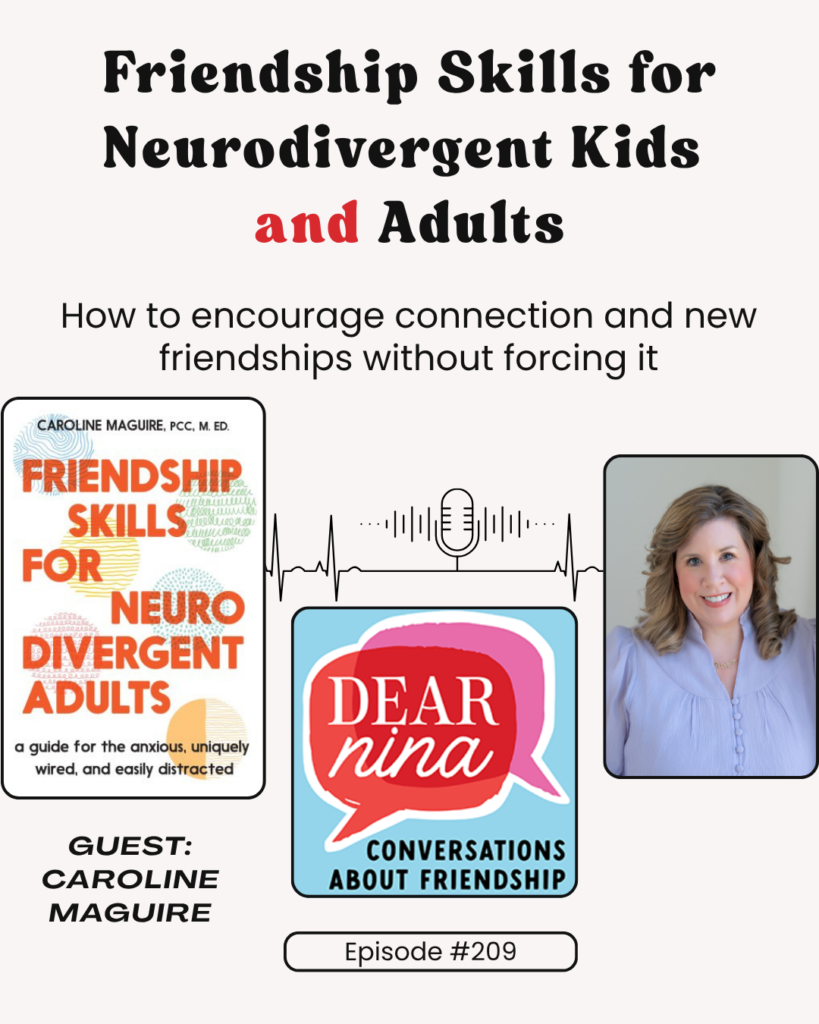
Nina: [00:00:00] Welcome to Dear Nina, conversations about friendship. I am your host, Nina Vasin. I have done a few episodes on neurodiversity and friendship, of course is always the angle, I’ll have those in the show notes. My more recent one was specifically on A DHD and Friendship with Kate Osborne and Eric Good. but I knew I wanted to do another episode with a different guest focused a little bit more for parents who are raising neurodivergent kids and teens.
And this episode speaks to adults as well I am thrilled, really thrilled to have Caroline McGuire. She is so well versed in these topics.
Caroline is an internationally recognized expert in social emotional learning, A DHD, coaching and relationship development. She’s the author of the award-winning book. Why Will No One Play With Me? And Her Second book, her current book is Friendship Skills for Neurodivergent Adults.
Caroline is an educator and a [00:01:00] coach, and a sought after speaker. I think you’ll understand within minutes why I wanted to have her on the show to speak to the Dear Nina listeners. Some of the questions came from listeners, some are coming from me, i’m so grateful to have Caroline and her wisdom and her really specific coaching here with us today. Hi Caroline. Welcome to Dear Nina.
Caroline: thanks so much for having me. I’m excited to be here.
Nina: Before we dive into you telling us exactly what you do and how you got to be doing that, can I read you something from your book that really touched me?
Caroline: Oh my God, yes. That’s so beautiful. I love it.
Nina: And listeners, when you hear this, just know this is just a taste of what the whole book is like.
Trying to make friends is not a comfortable process, while equally not having friends is also uncomfortable. And just as there is discomfort in making friends, there are also pain points. And then I’m skipping a little bit. The pain comes at different points. The pain of going for tests at the doctor’s office and then getting the news and the doctor wants to see you again and having no one to call and share how worried you are.
The pain of [00:02:00] finally getting a raise and there is no one to celebrate with or to commiserate with when your demonic boss acts a fool once more, the pain of no one calling on your birthday. Yes, you got some texts, but no one called to sing you happy birthday and be silly while telling you to go treat yourself to something fabulous.
The pain of not having a go-to person for everything from printer issues, yes, that’s still a thing to a concert or to a drive home chat. The pain that comes when you feel like an outsider or like no one gets you and you worry that you’re so different that you’ll never belong or feel included. And even when you plan every move, script out your words and plan for the right things to say, it’s impossible to get it right all the time, which is why so many people stop trying at all. So that is the context under which we are having this conversation. People want to belong. I think that your book gives a message that you can belong just as you are.
And it’s a beautiful message, but it takes some work and discussion. And how did [00:03:00] you get to do this work and tell us about yourself.
Caroline: Well, first of all, I love that you read that ’cause that was probably the chapter I spent the most time on was that first chapter. and so thank you so much because that was incredibly validating. and the reason that I, I wrote that chapter and why I do this work is because, I was a left out kid.
I was a kid who didn’t have friends. I have a DHD, I’m dyslexic. I was definitely, a little unique. I’m an only child and I spent most of my time with my grandparents and my parents. And when you’re an only child, you know, you do things like go antiquing, you know, when you’re not necessarily, up on the latest stuff.
I definitely was kind of a unique person and an old soul, and I just didn’t have friends. I evolved and I learned how to make friends and I had a, an easier time as I got older, although I still struggle with certain things. when I started coaching 21 years [00:04:00] ago as an A DHD coach, none of my clients had friends.
I just started talking about it. And at the time I was very fortunate. I worked for Dr. Ned Hollowell, who’s a very famous A DHD psychiatrist, I was. Why did none of these people have friends? What’s, what’s going on? And he was like, oh, it’s a huge thing in our community.
Nina: Was it adults or kids you were working with at
Caroline: I was working with kids at the time and teens, but I also started very quickly also working with adults because within the Hollowell Center, they had all these support groups
and once everybody heard that I was working on friendship, people would say like, I know you work with kids, but can you come to this adult group? You know, we talk about time management on Thursday nights, but everybody in this group wants to talk about friendship. I took on adults as well because it was like no one else was doing it.
And so when no one else is doing something, sometimes you end up the person.
Nina: Who do you work with now? What has it evolved into?
Caroline: It is evolved into mostly teenagers and young [00:05:00] adults and adults. I do sometimes work with kids. I train people to work with kids. I, you know, my master’s degrees covers all these different areas. after the pandemic, I stopped working in person with people, basically ’cause my family begged me, ’cause I, worked here in this office and they were like, please, we don’t wanna have to shovel the snow perfectly and we don’t have to, whatever.
So when I stopped working in person, I said, littler kids need in person. I train people. So I said, well, I’ll refer those clients to them. I love working with all different people I just kept finding that adults had no guidance. And I buy every friendship book that comes out, so many of them are great, but the advice doesn’t apply to neurodivergent people.
, It’s too broad and it doesn’t apply to our dilemmas.
Nina: exactly why I have you on here because yeah, I’m totally aware of that. I’m aware of that too. Can you tell the difference between your two books , and name them too? I mean, I’ll have them in the show notes but it’s good [00:06:00] to hear it
Caroline: Sure. Um, so my first book was, why Will No One Play With Me? And that was a guide for parents to help their child. Make friends and understand friendship. That was more skill heavy. more prescriptive so parents could sort of follow the yellow brick road and teach their kids. There were no diagnostic labels.
It focused purely on executive function, which is the management system of the brain. because at the time publishers wouldn’t let me do a book with diagnostic labels from a big publisher. Now things have changed and we’ve grown. so friendship skills for neurodivergent adults is for, people who have a DHD, autistic folks, Audi, DHD, which is the A DHD, autism crossover, dyslexic and learning disabilities, anxious people.
I think if you see yourself in this population and you can take advice from it, come on in. We’d love to have you.
Nina: I did bring up in my Facebook group where I do have a lot of listeners who are active listeners, right after my [00:07:00] episode with Kate Osborne and Eric Good.
About their book, A DHD Field Guide for adults I put in there. All right. We’ve had a couple episodes like this. Now you guys like, what are we missing? what do you still have questions about? I mentioned I was having you on so I was able to get some other questions. I would say the theme that came up again and again was on how to teach kids friendship skills that doesn’t then force friendships on them that they’re not ready for, they’re not comfortable for.
And I’ll give you like a specific question so that it’s not too broad and then we can move on from there. One person wrote, how can neurotypical parents empathize. Rather than force friendships for their teenage and college age kids, it’s like a version of that came up a lot. , What they’re getting at. It’s like we all know, yes, friendship’s important. Friendship’s important, what if the kid like doesn’t wanna do anything? What they, they’re comfortable at home.
Caroline: Well, and I think also we have to look at what is comfortable at home. Is comfortable at home. I’m scared, and staying at home is easier, so I think we, I think forcing never works, [00:08:00] So I think that’s the right track to be on. Forcing doesn’t work. Forcing makes you feel bad. And also it often creates this elephant in the room where friendship becomes this taboo topic that nobody wants to talk about.
I don’t like to do that because I think it doesn’t work. What I prefer to do is to have parents talk about friendship in general and start asking like, what do you want out of friendships? What makes you happy? Who do you think your people are? Like when you are with so and so, name a specific person, how do you feel?
remember so and so from the fifth grade, like you really got along with them, and I know they moved away, but like, what happened with with them? What did you like about being with them? What kind of person were they? And to start talking about this as part of life, And to talk about friendship and see what they want, Because once you can get the conversation rolling and it’s not this taboo topic, [00:09:00] then you can look at what do you also, what do you know about yourself, is the person a homebody? Okay, so what would fill your social cup? How much do you need? I think in the olden days, we used to sort of say, everyone needs to have this like totally extroverted, robust social life.
But we know now that that’s not the case. And I think when we have people who are introverted or who are neurodivergent, sometimes, they don’t want to have a million friends. They wanna have the right friends. And that’s where the forcing comes in too. As a parent, I would ask myself sometimes, do they have friends?
And is it just that their social life doesn’t look like my social life from the 1980s? Right. And as a parent, I have to do this to myself too, because there were so many things about the way I grew up and the way we were socialized that aren’t as true anymore. we didn’t have texts. Think about that, right?
We called people. I would also [00:10:00] say, I would start to have conversations when your teen or young adult is really comfortable when they’re playing video games, when they’re crafting, when they’re doing something they really like, where they’re comfortable and start asking them, what would it be like to, you know, you talked about joining this, what would it be like to join that start talking about activities and places and it’s all in the book.
So they can take the book and use this as like a cheat sheet, about the places where their child might find high interest activities. cause that’s where you find your people, It was with shared experiences and when you have people who are interested and speak the same language you do, it might be about helping them think through these things.
And one of the things I do sometimes as a parent is I’ll read an exercise in a book. And then I’ll just turn it into sort of questions instead of saying, let’s sit down and do this exercise. If they’re really resistant, I’ll just be like, what about [00:11:00] this? And I’ll act like we’re brainstorming, but I’ve had that guidance from whatever book I was reading.
And that might be something parents could do. They can go, they can buy this book, they can see the sections where I talk about those kind of high interest activities and how you find your people and then just talk about it and have a conversation instead of forcing.
Nina: As a coach, have you had success with kids who have been struggling with friendships at school, but then if they join something, it helps.
Caroline: yeah, because one of the things about neurodiversity is that environment has a tremendous impact on our traits. for parents of A DHD and autistic kids, we tend to be like. It’s not a karate school. It’s the right karate school. And it might be that you drive three towns over, it’s the same with friendship.
think about elementary and middle school. You’re like with a population of people who might not be your people, Or your people , have a different schedule and you don’t get to see [00:12:00] them. what can we do as parents to sort of help the environment be okay? they don’t do well with soccer.
Everyone’s playing soccer. We don’t tend to do great with team sports, but you know what? They would do great with theater or they would do great with fencing. the one in our town, it’s not very neurodivergent friendly. We know the director, it’s not great. if we go to this other one. that’s a really neuro affirming, really, good place.
And there that might be the right environment. So that’s part of this is we’re very used to as parents curating the environment. And as adults we need to do the same thing. And sometimes we don’t because we feel like, oh, I should be able to go anywhere. I’m an adult now. But why? we pick our coffee, we pick our breakfasts,
well, when you’re looking at friendship, it’s the same thing you’re looking for, people who fit what you want, not just any old ingredient.
Nina: What I imagine is tricky to help [00:13:00] people with when you’re coaching is, let’s say they try something, they, they find the activity they like, and I love your advice too, like, yeah, it might not be. this gym, maybe it’s a smaller one or one a couple towns over how many times do you need to try a place before you know what’s right for you?
I think it would be easy to give up how do you know when to give up and how do you know? Like when it’s really not the right place? That’s what I’m asking.
Caroline: yes. I think people give up way too quickly.
Nina: I think so too, but like I’m afraid to say that in
Caroline: Okay. I’m gonna, I’ll say it,
I’ll say it. so there’s a couple things. One, I have in the book. Ways to vet places, ways to say, is this a high interest, highly interactive opportunity? So maybe you write the person running the group and say, okay, are there chances to talk, chances to make friends, Because that’s part of this is do you get to interact with other people or are you kind of siloed, everybody knows that there’s places you’ve been where there’s a lot of interaction and chances to chat and to get to know people. And then other times when there isn’t, so I have that in the book so that you can, vet things. If you [00:14:00] go and you go three times and you never talk to another soul, obviously that might not be the right place.
But what I tend to see from people is that, activities and groups and things, you join, book clubs, everything is sort of, it depends on the month, it depends on the day, it depends on the situation. if we know from a data that it takes. And that everybody has a different opinion about this.
Okay? So there’s no definitive study, but let’s just take this number 11 interactions of 30 minutes each to become friends with someone. And I would argue that’s probably, an activity buddy. Someone you’re getting to know, they’re not a lifelong pal, They’re not your college roommate who you know so well ’cause you live with them.
Then if you leave after two times or one time, it’s great and one time it’s not great and then you leave, you’re not giving it the chance. So I like to say, have the criteria, And then give it a chance of four or five [00:15:00] meetings before you, say, this is, not the right place. And here’s my other advice that no one likes, but I’m gonna give it anyway.
Okay? Everyone hates this advice. People DM me and they’re like, I’m not doing that. And I’m okay, don’t, my experiences have multiple irons in the fire.
Now
Nina: Oh, I say that all the time in a different way. I always say, you can’t have all your eggs in one basket
Caroline: Because what if you go and you meet someone and you like them you’re like, oh, this is great. I met, this happens to my clients all the time. Go, you meet someone, you like them, you enjoy them, they move, they quit. They have a, something going on in their family and they stop coming, this is so true. Kids, adults, everyone, this is just the way life is. Now people will say to me, I invested six months in this group thing, whatever. And now everything has fallen apart and I have nothing to show for it. I always give this advice and everybody resists it, which is join more than one thing . Now
I get it. There’s [00:16:00] bandwidth, there’s, I get too tired. There’s feeling burned out. I’m not saying how many things to join you decide that, but if you have all your eggs in one basket, the chances that something’s gonna happen are high, people have things go on, activities fall apart, by the way,
Nina: The coach leaves the,
Caroline: the coach leaves.
Nina: Yeah.
Caroline: I would join two or three things. That’s my advice, and that’s what I do with my clients. And by the way, they resist me too. the thing I hear so often is I, did this and it was going so well, and then X happened and it fell apart, and now I have to start from scratch.
If you have two or three things going now, you don’t have to start from scratch and you’re also more likely to say, okay, I’m making a calculated decision. This activity doesn’t offer an interactive element. These other two do, so I’m going to drop it. Instead of, well, now I have to clinging for dear life to this because I have nothing else.
Nina: actually a [00:17:00] related question, this one was, my neurodivergent kid will do school activities, but we’ll never invite a friend over.
Caroline: Ah, okay. it’s hard to ask someone over. I think it’s a bigger step than parents realize. I’m thrilled they’ll go to activities. Thrilled.
Nina: it’s a good start.
Caroline: It’s a good start. one of the things that I think happens as parents, and I’m guilty of this too, is that we forget that when you have sort of tenuous connections with people, it’s a much bigger deal to say come over.
a lot of times kids who struggle socially are afraid of that. There’s also another flip side to this, which is maybe they don’t understand that they wanna nurture the relationship. Some kids, especially if they have very concrete brains, are like, well, I see them at this activity and we’re friends there and we have a great time when we’re together.
I don’t need anything else. I’m satisfied. And what they don’t understand is as you mature. You need to be able to see [00:18:00] people outside that activity that friendship is an activity, friendship, and it needs to grow in order to become a deeper friendship.
And that they are gonna want that, and that otherwise they’re gonna kind of have shallow friendships. They don’t understand that. And I would never say that to them. So what I do is we talk about, again, friendship in general how friendships evolve and what’s gonna happen. I preview for them, so what’s gonna happen in middle school, high school, college, and let’s talk about how friendships will evolve.
And I get curious what makes you like seeing this person just in the activity, and then sometimes we find a middle ground, right? If they’re like, I can’t ask them over. That’s such a big step. I don’t think they’ll say yes. Well, could we ask them to meet up at a similar thing, you know, wall climbing, rock climbing together.
Hey, could a bunch of us meet at a different rock climbing place, you know, another day of the week or something? But I, I really need to hear [00:19:00] from the kid because so many times we don’t ask them and we need to, we need to get their perspective. And the best way as parents, so that it’s not an interrogation, is get curious.
I really wanna know what goes on there. I really wanna know what it feels like. I really wanna know what other kids do.
Nina: And one thing that might assure the person who wrote this question is, you know, I’m thinking about my son, who is neurotypical has people he likes at school, he has people he likes at a couple different activities. He has people he likes from overnight camp where a lot of the kids do live here in Minnesota though.
Okay. So I’ll say to him why don’t you invite so-and-so over? This one from camp or this one from school? and he’s just kind of like, ‘ we are not friends like that.
there has to be something that happens in between. We’re not friends like that, and now we are friends like that. Somebody has to take a brave step. It’s very hard. My point is, it’s hard to explain really, to everyone, and it’s true for adults too, by the way.
Adults, actually the, excerpt I read from your book, I mean, really speaks to this. I hear from a lot of people in this situation where you become an adult who [00:20:00] has not, been pushed and again, we’re trying not to force friendships, but this is like the balance I wanna talk about here.
where you feel like you got news from the doctor and don’t have anyone to call. You gotta raise and you don’t have anyone to call. And it’s, that space between, we’re not friends like that to, you have a deeper friendship. All this stuff has to happen in the middle.
Like you’re trying to explain to your clients that. What happens as time goes on, other people are forming relationships and how did they do it? Somebody was brave and said, Hey, you wanna meet up at the rock climbing place, or wanna come over? And it’s hard. I know it’s not easy.
Caroline: I love the quote, we’re not friends like that because , it’s so what they say to me. but also college students will say that to me. I’ll say, well, don’t you even academically, don’t you have anybody in your classes who has really good notes? You know, well, we’re not friends like that, or I don’t know them well enough to ask them that, or whatever.
And it is bravery, but I also think it’s understanding that a no is not always a rejection.
Nina: Oh, let’s talk about that, please. This is a really important topic.
Caroline: Okay? [00:21:00] So. Those of us who’ve been rejected are really sensitive to rejection. However, sometimes when people are busy, it’s just like, not right now. Right? Or we’re not friends like that. if you are so afraid of that, no, it, it really affects how you friend and how you socialize.
one of the things that I’ve had clients have success with is say, I’m practicing. So instead of, you know, instead of like, this is the end all, be all, this text defines my entire person, Have it be like I’m practicing asking people to do things and I’m practicing asking them for what I call a next step, which is, we’re in this activity together, what age, ever age you are, I wanna see this person outside of this activity.
And I offer them a next step. Hey, let’s go to the farmer’s market together. Hey, let’s go to the park together. Hey, let’s do this. People are really scared to offer that next step. But if you’re [00:22:00] practicing this, then you’re a little more detached. Also, going back to eggs in the basket. If I’m doing this with multiple people, then you, one person is not the end all be all I’m doing this with multiple people. I know those with neurodiversity are listening to this and they’re like, yes, but I’ve been rejected so many times. I’ve had the no so much. Everybody says no to me. And that’s where we go into challenging the story because so many of my clients tell me that everyone says no to them.
And then when I dig into the story, it’s like, that person didn’t say no. They said Not unable to do that today. The other thing is be specific when you’re practicing, instead of, do you want to do this sometime? Say like, Hey, Thursday, do you wanna do this? If they’re interested, then they can say, I can’t Thursday, but I could do Saturday.
Nina: Yeah.
Caroline: And if they can’t, I just would argue, go back to the signs in the book. [00:23:00] Are they talking to you? Are they seeking you out? Are they, saving you a seat? Are there signs that they wanna be friends? If there aren’t, then maybe there’re not interested. But if there are signs they wanna be friends.
Maybe it’s just about that one time.
Nina: And I think, part of the accepting of rejection, this is so hard for everyone is the first part may be true. They actually may not be interested and then we move on to the next person. I know it’s not that simple. I know it’s not that simple, but you’ll never form a friendship without continuing to practice.
And one thing that would change friend making for everyone would be to accept that everyone will not be interested. That’s a certitude. Everyone doesn’t mesh. It could just be timing or it could be personal. It actually might be personal. You might not be everyone’s cup of tea and then you finding the right people.
I mean, it’s tricky.
Caroline: The more you are looking at people with similar interests, the more you have a have a language [00:24:00] together, you have something in common. And the more you are jiving with them, you’re going back and forth. And the more, it’s less stilted, And the more you have a higher chance. So if you’re scared and nervous and you have social anxiety, one of my things is we used to say, oh no, online friendships, you know, those are just lesser friendships.
But if you have a special interest and there’s a rich online community where you get on Zoom together and you do things together and you, you know, meet up twice a year, but mostly it’s online, that might be a first step toward this. And it’s an easier thing to ask someone to meet up, It’s an easier thing to propose a next step.
And you have that common language. So you click part of what happens with the next step and the bravery and the rejection is you are in this situation with this person you don’t know that much about, and you don’t have as much of a common language and you don’t know a lot about them, and you don’t have as much of a shared [00:25:00] experience.
Well, shared experiences are how we make friends, so that’s why I, I say don’t belittle the online communities because they could be a first step towards you getting confidence and then saying, okay, now I’m gonna try. In person or as kids say in real life
Nina: Yeah. Or with the same activity, actually. Right? Like
Caroline: with the same activity. Yeah.
Nina: Like you have some good language now for this activity that you’ve maybe become even more of an expert in whatever it might be. I mean, gaming is, I’m sure a huge one.
Caroline: Gaming is huge. Online role play games, having a job or a role in an activity, by the way, lessens anxiety and allows you to make that next step and allows you excuses if you are running the church picnic. Someone just reached out to me today and they were like, are you ever gonna respond to me, Caroline?
And I was like, oh, I’m so sorry. And they are in charge of something. So it’s their job to reach out and communicate with everybody and coordinate [00:26:00] everybody. They have an excuse, they have an excuse to talk to you, to meet with you, to committee with you. So that’s another hack as to how do you get that next step, that ask?
Well, now we, I mean, how many times have, have, have we as mothers made friends this way? Like, we’ve been on something together, we’ve met a million times about whatever, and now you’re like, Hey, do you want to go get a cup of soup with me? Or whatever? And I’m like, sure. Because we are already in this habit of being in each other’s lives.
And this is true for kids too. Yearbook, they have podcast shows now at schools. they have theater. You could be the stage manager, the lighting director. You could do all those different things and then and you have a role, and you have a job, and you have an excuse.
It’s not just you cold walking up to someone and being like, Hey, do you wanna be my friend?
Nina: Theater’s great. So I have four kids. One of ’em is a theater kid. I love being a theater mom. I really do.
Caroline: I’m a theater kid.
Nina: oh, I love it. And I’m not, I have no talent whatsoever, but I love, I’m like an professional audience. member I [00:27:00] love every musical.
It’s so fun to have a theater kid to actually be able to cheer on. And I marvel at everything you just said, not just the kids on stage. It’s a whole community. There are so many jobs. There’s kids that come in to help with the costumes or to help choreograph, one number, but then they’re part of it.
They’re part of the whole show. You can be on the board of the theater. you don’t have to actually be a singer or dancer, actor as you’re saying to be part of, it’s a great community.
Caroline: It is. And one of my most successful young women, did the makeup.
Nina: There you go.
Caroline: she was super shy, , started doing the makeup for all the different productions. Started knowing everybody.
Just knowing everybody. ’cause she’s putting on, you know, the wicked costume or the Belinda’s Green whatever for hours and was talking to everyone.
And again, it’s an excuse a reason to talk to people, a common language and a nice community. And there’s tons of things like this where pickleball, I will never pickleball ’cause I’m incredibly [00:28:00] uncoordinated. but, for adults, pickleball is like a whole community. if you wanna run the pickleball community, more power to you.
I’m way, way too overwhelmed by that. But it becomes an excuse. You’re in touch with everybody. You’re forming groups. Oh, I will be the person who will fill in now instead of you being awkward and like not knowing what to do. you’re given something that, allows you entrance.
Really?
Nina: Yeah. Like you could be the person who is the solution for other people who feel like maybe they have nowhere to belong and like, instead of, you might also feel that way too, but if you run something for other people, it’s like you have maybe the same problem, but you’re part of the solution.
I think that’s great. On the podcast, late April is an episode for asking whether your neighborhood and your city is a friendly place. part of the challenge in this episode is. If you don’t think so, then you need to be part of the solution.
there is no one else each person in the neighborhood who thinks like, well, my neighborhood’s like really [00:29:00] cold and no one knows each other. Okay. Somebody has to, it may be you may wish you had a nicer neighborhood, as in more friendly, warmer. It may be on you.
It may be like, okay, you’re doing bagels in your driveway. we can’t always be waiting for, you know, other people to do. But now you are part of the solution too, and it benefits you. That’s what I’m kind of getting at. That’s where it’s similar benefits you because you want an activity to do. You like this activity, you wanna meet people, okay, you run the activity.
Caroline: Also, I know that that one person making a difference is true because I went to a wedding last fall. It was a second wedding, so everyone was an adult and everyone was mature. I was with random people like it was just me and my husband and random people. one of the folks was telling us they had lived in a neighborhood we know about where everybody has this rich, vibrant community.
they were attributing that entire community. It’s like illustrious in my town, they have block parties, they do this, they do that to one woman,
Nina: I believe it.
Caroline: and she was a bus driver, and I can’t [00:30:00] remember how it started, but she wanted to raise funds for kids who were on her bus who had a challenge.
And so she started talking to all her neighbors and she arranged something she just kept doing things. And then eventually it took on a life of its own. But it was one person. you know, listen, I understand some of our listeners have social anxiety. That’s too overwhelming for them. But it is that sort of teaching, doing role is a way to integrate yourself and to change things.
it is brave, but it’s, I think, easier than randomly going up to people and trying to start from like a very cold place where you have nothing to talk about and no background on them.
Nina: Yeah, that’s right. And when you are the planner, you get to decide what time of day, maybe you don’t like to do stuff at night, so fine. You plan it in the morning. I, I run writing groups in Minneapolis. I’ve done that for a while. And when I was first starting them, sometimes people would complain, well, like, I can’t come during the day, I wanna come at night.
And my feeling was like, [00:31:00] I don’t wanna be out at night. I wanna do stuff during the day. So start your own group. That was kind of my attitude is, you can’t accommodate everybody. But the good news is when you run it. You get to at least accommodate what works for you.
And those who also are free at that time will come. that’s how it works. Okay. Another question from the listeners. This is going to sound general, but I actually think it’s good advice for everyone. How can parents or teachers explain the difference between an acquaintance and a friend to a child who doesn’t see the distinction and that person could become an adult who doesn’t see the distinction?
So I think it’s really important.
Caroline: okay. You know, I talk about this a lot in the book. a couple things. I think that people too often assign the name of friendship to people who are just acquaintances. And there is nothing wrong with acquaintances. many neurodivergent people just to let you in. Don’t want any more acquaintances ’cause they get stuck at the acquaintance
Nina: Okay. Interesting.
Caroline: But a lot of times we assign this word friend. And I don’t like how teachers will call everybody in [00:32:00] elementary school, your friend, because I think it confuses those who are more concrete. it’s important to know that friendships grow and that if someone is an acquaintance, here’s a few ways I define it.
You only see them inside of an activity you don’t share more deeply personal information or they don’t share it with you, you may not know their last name, maybe you don’t even know where they live, right? You know that they live in the same town, in the same region, but you don’t know where, you wouldn.
Necessarily be able to like fill out information about their lives, now people can move from an acquaintance to more of an activity buddy slash activity friend. And then you start to know all that information ’cause you’re on the road to friendship, A friend is someone who also offers emotional support.
a friend is someone who understands and knows about your life, even if they don’t know everything because they haven’t been here for 30 years. they know enough to say, well, I [00:33:00] don’t know. But you know, when their child, they moved around a lot. There’s something there, you know, they know enough to know.
you would expect reciprocity from them. And that’s the biggest thing. I think when it comes to acquaintances. Too often we expect reciprocity. I invite you, you invite me. I, do something for you and then you return that, to me. you know, we share, uh, emotional support. So I helped you through something and then you helped me through something.
That’s a friend, An acquaintance isn’t offering that level of reciprocity. when it comes to acquaintances, I have a whole thing in the book where I lay out all the levels of friendship and sort of detecting is this person a friend or an acquaintance? listen. I don’t think it’s the end of the world if someone is an acquaintance, but it just means that we have to nurture that acquaintanceship so that they become friends
Nina: Or not, like it’s okay to I understand not wanting more [00:34:00] acquaintances, but if you at least slot them correctly in your mind, the expectation and then maybe the feeling of rejection would be different. You wouldn’t feel as rejected from someone who actually isn’t a good friend, like they’re not a close friend yet, or maybe ever, but they’re definitely not now.
some of that, I think rejection and fear of rejection, maybe too many steps are getting skipped between acquaintance and friend.
Caroline: And I think that’s really important, especially vis-a-vis neurodivergent people. I think a lot of times what I talk about in the book is we feel rejected by someone who we expect the friendship activities from, but they are really an acquaintance. And so when we ask them. For something, for some level of emotional support to do something, to come to a certain party or a certain time.
I’ll just give a personal example. I didn’t tell many people about, my book launch thing because I know everyone is so crazed. and my husband was like, this is bonkers. you’re having a huge thing. You’re speaking at Harvard. people should come. so he went and he told my [00:35:00] closest friends though, he told the people who are, you know, tired of hearing about this book ’cause I’ve been talking about it.
Right. He told three or four really close people to me and then he arranged a dinner beforehand, but he did that not with everybody I’ve ever met. He was asking, support to the people who. I mean, I’m not gonna have a wedding again, but if I was having a wedding, they’d be there, right?
If I was having anything big. So I think that’s a difference. And what happens sometimes is we feel so rejected because we ask someone and they’re really an acquaintance, and so they respond as an acquaintance. by the way, I get a lot of dms about this and I get dms from all kinds of people, not just typical people.
I get dms from neurodivergent people who say, I really don’t wanna reject or hurt someone the way I’ve been hurt in the past, but this person is leaning on me as if I’m a friend for a ton of support, but I don’t know them that well. And it’s kind of making me scared. And that’s what we have to [00:36:00] remember when we lean on someone so much who’s really an acquaintance.
and we ask a lot of emotional support. Sometimes they don’t know what to do and they’re kind of worried, is this a red flag? And it, it actually scares them. And I think the exception are communities of support. If you’re in Al-Anon, if you are in, you know, fertility group, a cancer survivor group, you’re there to support each other.
You may have just met, but you’re giving out your digits and you’re helping
each other.
Nina: that’s different. I agree.
Caroline: It’s different.
Nina: I’m glad you brought this nuance up. it’s a delicate nuance. I hear from people too from both sides of somebody. Doesn’t want to be mean or unkind. And this has nothing to do with like neurotypical or not. It’s whatever the case is. You can tell that overtures of friendship are being made, somebody’s taking our advice and they’re trying and they’re taking the step and they’re doing all the right things, but then they may just be hitting up against somebody who doesn’t feel the chemistry is busy, [00:37:00] not that interested for any number of reasons, but they don’t want to be unkind.
Not every rejection is unkindness. I mean it still is a no in its own way, and I don’t know sometimes how to tell people how to nicely get out of somebody else’s friendship advances the person could be doing nothing wrong. It’s totally appropriate.
They have things in common. They live near each other, They’re not feeling it it’s kind of the same type of person you’re hearing from, you’re saying, I mean, you’re saying it happens because it’s maybe coming on too strong, too fast, and that might be the same reason I’m hearing about it. just because somebody is looking for friendship doesn’t mean the person they’re asking is interested.
Caroline: and it’s so tough I wish people would be kinder and more transparent. Right.
okay,
so, so let’s talk, I have a personal example of this. So I have, an acquaintance activity buddy who I knew from mommy baby groups, And I really liked We always got along. her wife sadly passed away.
And I talk about this in the book. I just was checking up on her. And, we saw each other [00:38:00] at a few things last spring and I was like, I like this woman so much and I wanna be supportive. And then we met for coffee and we met every month for like six months.
And we were just having a grand old time. But then I knew come November it started to be conference season, and then we were starting into the gauntlet of the book. And so I just said, Hey, I’m going to probably disappear. I won’t be able to take a morning off to have coffee I hope it’s okay with you that I’m going to disappear, launch the book and then reappear and hope that we can continue.
Nina: Wow, what’d she say? she was like, sure. she’s just such a smart lady. She was like, of course. But I wish people would be more like that, where they would say, I, just am having a hard time in my life. My, you know, I have a friend going through like a, a merger in her company. you could be the nicest person in the world.
Caroline: She has no time right now. So I think there’s that. I wish people would give more explanations, but I also think there’s another thing you’re touching on, which is just because I am looking for more friends doesn’t mean [00:39:00] someone else is open to and looking for friends. And this is so hard
Nina: named it. You named it. It is
Caroline: it’s so hard.
Because I wish they were. I have had people say to me, and I’m sure they’ve said to you, I like this person, but I’m not looking for friends. I’m not looking for that right now. Now I kind of feel like, when am I not looking for friends? I’ve made friends in the past two years when I was not looking for friends, but they were there and they were interesting and they were, area di amazing women doing amazing things.
So we, found the time, but I understand that sometimes people have to have boundaries. And I think the answer is if you don’t feel the click, I think just to say something about , I’m just not able to do fun stuff right now, or to say I just have so much going on in my life I’m sort of not able to take on new.
but I think it’s very hard because neurodivergent people, just to decode for your listeners, often don’t speak hint. And I talk about [00:40:00] that in the book. So what ends up happening is people will say things that are more vague than that, trying to be kind. And then my clients are like, I don’t know what they mean.
Or they’re spending all their time decoding it, which is so sad. , And just painful. I think people don’t know how to set boundaries. I mean, think about it. It’s not something we grew up knowing. I mean, I don’t know about your family, but my family don’t understand boundaries.
And so I think part of the dilemma is that someone has to be open to making friends. And then if they don’t feel the click, they don’t know what to say.
Nina: Yeah. ’cause no one wants to be mean. I mean, I mean, I shouldn’t say no one. I shouldn’t say no. There are mean
Caroline: the majority of
Nina: I think the majority of people are really, yeah. Not trying to be mean, but they’re a little. nervous. I think about like, why do I sometimes not like to talk to somebody on the airplane who starts talking to me and I’ll like put in my AirPod why I’m scared that I will now have to talk for two hours and I just wanted that two hours to work or to relax. So sometimes I’m, I’m a little just like an innocent kind of example, [00:41:00] but I know I do it. I can be a little off-putting on purpose in order to not invite something I am not interested in, in that moment.
Caroline: it’s a good example in the sense that I’ve been there where I have to work. you could be great and I wanna talk to you. and I actually wish that I could, but I must write for the next two hours, or I must write an article that is due when I step off that plane, I must go to a, a little cubby and hit the wifi and send it.
Right. So you’re nice. And I might see a mystery book you’re reading. I love True Crime and I might wanna talk about it, but I can’t.
Nina: Right. And it’s sort of like a good example of it’s like the wrong place, wrong time and that this could happen in friendship too. it’s not that someone’s not like a nice person. I think we’re very quick to call everyone mean, or a bully.
Caroline: Yeah. People use the word bully
so much.
Nina: are you a mean person? Are you a bully? Because you already have, a couple activities that you do. You already walk a couple times a week with people. You already , have those slots filled [00:42:00] and if you spread yourself so thin, it’s like you don’t even see the people that are important to you, your family, your romantic partner, your friends.
You already have the acquaintances that you’re already kind of building with. Can’t juggle it all, So you’re saying to be more direct about that?
Caroline: To be
kind, but to say, you know, like I’m just. I feel like somebody said to me, they had a phrase and one of the phrases, but like, I’m just not taking on new things right now. And they were talking about, , groups and charities and things. But, to just say, , I wish I had more time to be social, but like, I just don’t right now.
I think we have to be kind. I always want kindness. I always try to be kind to myself. I do think there’s another factor here, which is that, there are people who, don’t really want, a lot of friends and we don’t really talk about that. That doesn’t make them bad or wrong, But they may not be looking and it may have nothing to do with you.
And I think one of the things that happens to my clients is because we’ve had so much [00:43:00] rejection and our confidence level is so high, we create a story about why someone says no or why someone isn’t receptive. And I’m gonna talk about something else we don’t ever talk about in the friendship world. maybe you’ve had people talk about it, not in my deep snooping of you.
which is, if we come with desperation and we take anyone, there’s gonna be more rejection because we are not curating friendships, we’re not finding our people, and therefore people might not accept back because they’re looking to find their people.
Nina: Interesting. No, I have not talked about it in that way. That’s great.
It’s like you’re not being discerning, but you’re, you’re reaching out to people who are being discerning.
Caroline: right. , Again, I don’t see that as a rejection.
I see that as, I may not know who my people are, but those people that I’m, talking to do know who their people are and they are discerning. And that’s not a bad thing. But I think we have to talk about that sort [00:44:00] of. It’s a confidence thing. the less confidence you have, the more you’ve been rejected, the more you kind of say, I’ll take anyone.
And that’s part of what I talk about in friendship skills for neuro diversion adults. Like, that’s not necessarily also the path because then you’re taking anyone you’re also taking people who don’t treat you well. And that’s not, friendship. You know, I don’t want people to be in relationships where people don’t treat them well.
Nina: You know. Let’s end on the last thing is related to this. You do talk in the book about wishing that people would treat trying to make friends and decide how close to be with certain people the same way they do dating, because I think it’s related to what you just said.
Caroline: it’s, it’s, so, I, I dove into the dating advice because there’s not that much research on friendship to answer all the questions I needed to answer in this book. I actually met with two matchmakers who didn’t choose to be in the book, but their advice was like, incredibly good.
I dove into the, dating research. [00:45:00] one of the things I kept thinking about, and I have a couple clients who have been with me to make friends, and now they’ve come back to date, and I said, well, I’m not a dating coach. And they were like, no, but I know you Caroline, and you know me, and whatever.
every time they have a date, we’re on Hinge, we’re on wherever, and we’re like tweaking the profile and we’re looking at what they want and what they don’t want. And it just struck me one day, like, we don’t do this with friendship.
Nina: it’s much more direct with dating. Like you’re much more clear about what you want and you kind of understand that the other person’s also being clear.
Caroline: if you are having a second act, if you’re reading this book and you are a mature adult who’s had friendships not work out, or who is part of that first chapter, you want someone to call when you have a health scare, you want someone to call when you have a bonus that you got at work, don’t you owe it to yourself to be a little more discerning, to look at what your people will be and I’m not saying to screen everybody out, but just to say, [00:46:00] okay, I’m really looking for someone who shares this interest and who, wants to do these kinds of things and who is, you know, kind shares my values.
easy to talk to whatever it is that you’re looking for.
Nina: And doing it a, a huge message of your book. I don’t think we’ve said it enough actually, doing all of that, just being yourself. there’s certain things you have to practice. takes practice to ask someone to meet for coffee before class the next time. Like, all that stuff takes practice, but you’re not gonna show up to that coffee as someone different than yourself.
You want people who will accept you for who you are, which maybe is different than some of the messaging from years ago. I know that the messages in the past were different, that you had to learn how to, mask and all those things, and you cover it all in the book. We won’t, it’s too much to cover here, but I love your message of, maybe learn some of these skills to make it easier to make and keep friends, but you’re still showing up as you
Caroline: I want you to still show up as you, because your authentic self is a match for someone. the more we can find [00:47:00] that authentic self, and I do mean fine, ’cause sometimes people have to figure out who, who it is. the more we have a chance of finding our people rather than, just trying to fit in and then finding people who are okay, they’re fine.
There’s nothing wrong, but they’re not our people. There’s not that clique and that connection.
Nina: Beautiful. I think that’s a great. Note to end on and I really hope people will read both books caroline, will you say the names of your two books one more time?
Caroline: the first book is Why Will Know and Play With Me, and that’s for Parents of Kids. And the second book is Friendship Skills for Neurodivergent Adults, and that is for young adults, parents of teens and adults
Nina: Okay, great. Thank you so much. And I will have all the ways people can find you too in social media ’cause you have some great videos out there. I love your Instagram. You’ve got a lot going on that will be all in the show notes. Thank you listeners for being here and Caroline has listened to the podcast, which I appreciate. Not all guests do. I think it’s great when they have, so, you know, I’m going to say, come back next week when our friendships are going well, we are happier all [00:48:00] around.