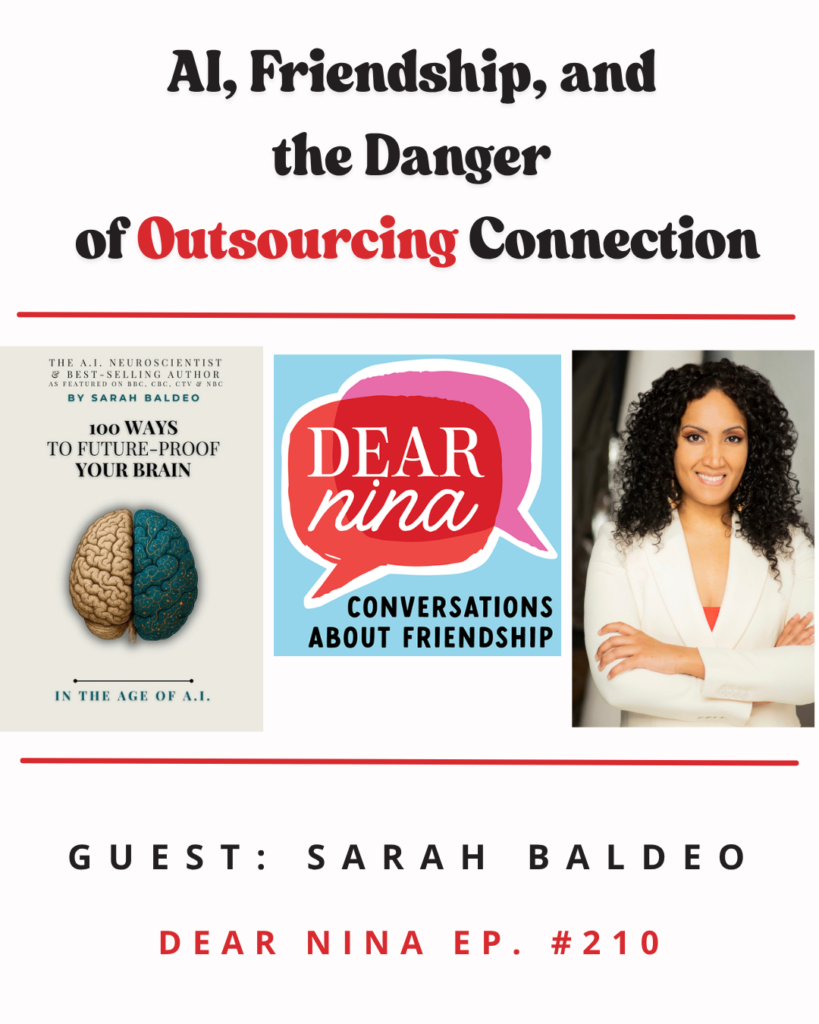
[00:00:00] Welcome to GI Nina, conversations about friendship. I am your host, Nina Badzin. Today I am talking to bestselling author, neuroscientist AI futurist, Ted Speaker and CEO of ID quotient advisory. Sarah Baldeo. She is the author of 100 Ways to Future Proof Your Brain in the Age of ai, she has been featured on many news outlets, including on Oprah, which I know is not a news outlet, but is a fantastic outlet.
I will admit that I come to this topic with a lot of fear. I, I really do. Sarah is able to talk me out of some of it, but not all of it. And she shares some of the concerns as well. Even though she understands AI and
I am not that knowledgeable about ai. I worry about it, like I said, I use it here and there as more of a organizational tool and not as a generative tool. So the idea of relating to it like it’s a person [00:01:00] is not really something I have experience with, but I know it’s an issue out there and it’s something to keep an eye on. It’s as much of an issue for teenagers as it is for people in midlife, as it is for the older generation that may be using it as a companion, which says a lot about where we are in society, about, you know, real loneliness for really all people. let’s just get to, it’ll.
You will get so much out of hearing what Sarah has to say about all of this. She is the one who can explain it to us much better than I can. That is for sure.
Nina: Hello, Sarah. Welcome to Dear Nina. Conversations about friendship.
Sarah: Thanks for having me. I’m excited.
Nina: I normally, in my intro of a guest would go through the entire, well, not the entire I would go through the brief background, I’m asking you to do the background for us because your background is very different than almost every guest I have had on . could you explain what you do and how you got there, and just [00:02:00] a little bit about you before we get into the meat of our topic,
Sarah: it is a very interesting trajectory, non-traditional trajectory that I took. My career actually started out on the path to become a neurosurgeon, people often ask me, how did you decide to do that? I said, well, my parents immigrated from Jamaica and they came to Toronto.
I was born and raised in Toronto, and as I was growing up, they said, pretty much you can be a doctor or a lawyer. Those are the things you can do to validate our immigrant experience. I said, okay, well, I’m gonna become a doctor. And I started that path and I was deep into the weeds of being pre-med, doing all of my thesis research on the brain and technology.
and I was actually scouted by an AI algorithm design company in Canada that built risk models for one of the big banks in Canada and the CEO, for whatever reason, was fascinated with my research on the brain and he said, if anyone can build. Risk model algorithms for the bank I think a [00:03:00] neuroscientist is going to do it. that was my first foray, my gosh, 21 years ago, building these risk models to detect fraudulent behavior. That’s how I really started this intersectionality, Nina, between the brain and ai. When people ask me, Hey, what’s an AI neuroscientist?
I tell them it’s a neuroscientist who actually studies the impact of artificial intelligence on cognition, on your physiology and on your brain activity. I’ve been building AI now for 21 years. And I’ve had the good fortune of being in.
Big consulting world as a partner. as an entrepreneur. I’ve founded six companies and sold two of them and iPod, three of them. I feel like I’ve lived a lot of life in the past 40 years. it’s really given me the opportunity to have one foot in the tech world and one foot in the neuroscience research world and try to build technology that benefits the brain.
That’s really my goal and my passion.
Nina: And then [00:04:00] how did the book come to be? 100 Ways to Future Proof Your Brain.
I feel like what you’re doing is you’re taking a topic you really understand from the inside out, but trying to translate it for maybe someone like me, the regular people who are kind of nervous about where we are going with all of this.
Sarah: I will share with you a publishing secret. That book originally was a thousand pages long. You’re lucky, Nina, you’re getting the version that’s about, I think it’s like two hundred and thirty, two thirty four. Originally when I wrote this book, it was around this concept of how do you build a brain for this world of constant change?
And artificial intelligence is moving at a pace of technological evolution that we’ve never seen before we didn’t see it with the telephone, with cell phones, with the internet. originally when I was writing this book, it very much read like a neuroscience dissertation. I looked at this manuscript and I said.
People will fall asleep reading [00:05:00] this, and that’s not the goal. The goal really is that everything we do as neuroscientists in research labs, I truly believe that it’s not just destined for people with PhDs to read and talk about, the brain is truly the biggest supercomputer. It has a hundred trillion synaptic connections.
Which is a hundred times more than chat. GPT chat, GPT only has a trillion. And the power of the human brain is so fascinating this potential. And so that was really this ethos behind the book. I think this knowledge belongs to everyone. There’s a lot of doom and gloom about navigating the world in the age of ai.
the passion for me was it actually has beneficial potential for us as we think about our personal agency in human connection and human relationships. that’s really not something that we hear about a lot in the news today.
Nina: It is sort of a mix. I feel like we’re hearing about all the new [00:06:00] things that can be done, then we’re hearing about kind of the stuff I worry about that I wanna get into. So one of the things you talk about is outsourcing, emotional processing, one example, so people know what we’re talking about is. You’re not sure what to text a friend and you run it through any AI first. I know we say chat GBTA lot, but we could be talking about Claude, any of them. So your friend, had a huge loss.
they’re grieving and you’re afraid to say, you know, quote unquote the wrong thing. And I’m always saying there’s, really no wrong thing. It’s better to show up, but we have a lot of people criticize each other a lot. People get on social media and rant about somebody who said the wrong thing to them.
So there’s a lot of fear of showing up incorrectly. Okay. So then you run that through chat, GPT or claude or whatever. What is that doing to our brain and everything you know about that, which I know is impossible to answer in one podcast.
Sarah: Nina, it’s such a good example that you use when a friend goes through a loss or what I call an inflection point in life. So let’s say a friend of yours loses someone. Who’s [00:07:00] really close to them. And your first response is not to internally reflect on this series of memories and lived experience that you have and to really tap into, that amygdala, that your amygdala is your emotion center.
So you’re not really tapping into your emotion center. Your first response, and I would say a lot of people lately, is, I’m gonna ask chat. I’m gonna ask chat, and I’m gonna describe the situation, and then I’m. In some cases gonna cut and paste into my text. Exactly what this said. When you outsource your emotional processing, you are quite literally reducing brain activity.
So you are reducing brain activity. You are not practicing empathy, and the brain is a muscle, like any muscle. When you stop using these muscles and you stop using these neural synapses, these brain cell connections, they die. the brain goes through something called neural pruning, it’s kind of a housekeeping model.
When they say, if you don’t, if you [00:08:00] don’t use it, you lose it. That’s really what happens with this emotional kind of scaffolding that we have. And so when we’re not practicing the self-reflection, this empathy, Even just remembering all these experiences we had with this person who’s confiding in us, we do lose brain activity.
We lose brain mass, the brain actually shrinks. the other example I like to use is, you’re just texting with your friends you text LOL, but then you don’t laugh.
Nina: Mm-hmm.
Sarah: so we have this dissonance emotionally with our friends. Because I remember back in the day, back in the day when I had a phone and I would pick up the phone and I would talk to my friends.
I could hear their voice. I could hear their tone, the cadence, maybe a catch, catch in their voice when they got emotional. There’s all this richness of information in friendships that we lose out on when we only text. what I have started to see with this emotional [00:09:00] processing is it’s a lot easier to text sometimes because you’re multitasking, you’ve got other things to do, and what that does is it removes the level of cognitive complexity in the support that you’re providing to your friend.
so I encourage people pick up a phone. Talk to the person. If you’re gonna text LOL, try to actually laugh out loud because you don’t wanna have this emotional dissonance between what you’re saying and what you’re feeling and what you’re expressing on your face. All of these behaviors triggered neurotransmitters, which are chemicals in the brain.
And so when I text somebody, OMG, and I have a deadpan expression, there’s a bit of a mismatch in the brain.
And then when I’m in front of the person, I love to talk about when, you know, when we talk about friendships, and I know you’ve talked about this a bit, that oxytocin, that social bonding hormone, there’s a reason that when I see a person’s face, I get a spike in [00:10:00] oxytocin.
That’s the evolutionary mechanism of seeing a human face. Now, a lot of people don’t know this. If you are in a Zoom call or if you are having a conversation with someone and you don’t see their face, you are 76% less likely to remember what they said. Because when you see a human face and when you’re looking at your friend’s faces, a trigger happens in your hippocampus, in your memory center, and it says, I need to remember what this person is saying.
It’s important because there’s a human face in front of me. you know, these are just some of the examples, Nina, of when we think of AI and outsourcing, what should I say? What should I do? I’m just gonna text somebody and say, Hey, I’m really feeling for you. I make a point of this in my own life. I try, I really try to practice this. You can’t always call someone, you can’t be available at the drop of the hat.
That’s not reasonable. But there are times when having that vocal conversation if you can’t be in person, there’s a lot of long [00:11:00] distance friendships, right? If you can’t be in person video call, please video call so they can see your face, because you’re gonna spike that activity in their memory center.
You’re gonna spike that activity in their emotion center. And AI just can’t replicate this. it simply cannot replicate these. Neurochemical reactions that we are getting. these are some pretty serious concerns I see where a lot of times people are choosing AI friendships over human friendships.
Nina: I mean, that’s my number one concern because a huge part of what we do in Friendship is yes, we support each other, but also push each other a little bit and don’t always agree with everything. that is part of the challenge when you’re chatting with any kind of AI is the way it supports. I know you’re supposed to train it to ask you harder questions, but it’s, still not a person. Why, why do people think it is thinking why can’t people separate? Like what is it in our head that we cannot separate?
That this [00:12:00] is a machine from a person.
Sarah: So this tends to happen, Nina, a lot with technology. we anthropomorphize, which is basically we imbue objects and technology with human feelings and human qualities because it helps us better understand it. there’s a reason we use the pronouns, When you talk to Chad, GPT or Claude for example, we say, how do you think I should respond?
It’s not a you, but as humans, that’s how we’re designed to communicate. the crucial piece, Nina, with, AI specifically, it is the first piece of technology that has this bidirectional interaction effect. No other piece of technology. Is going to respond to us and has ever responded to us in this way. I encourage people to think about it. The reason you are imbuing it with these human qualities is number one, it was designed to do that. So large language models were built [00:13:00] to emulate human language.
That’s what happened. It’s been trained on trillions and trillions and trillions of data, files of human conversation. it’s designed to imitate human conversation. The point you bring up of good friendships challenge you. I truly believe this. my very best friend, our mothers were best friends, our grandmothers were best friends.
We are born eight days apart, but we are so different. a good friendship is one that does push you to grow. It challenges you, it helps reveal elements of you that you wouldn’t have thought of. The issue with AI, unless you’ve trained it properly, is that it has something called an amicability quotient. In simple terms, it’s designed to agree with you. To flatter you because as human beings, we tend to bond and have the highest dopamine response, the pleasure response to people that agree with us. [00:14:00] it’s true. It makes us feel validated. That’s not necessarily a healthy friendship if they’re always agreeing with you.
here is the prompt that I tell people, if you do not want AI to always agree with you and never push back on you, you have to give it a very specific prompt that is going to activate a different version of the model. the prompt is this. Do not agree. With everything I say, only respond with fact-based, third party verifiable information and do not attempt to build an emotional bond with me.
If you give it that prompt, exactly that prompt, you’ll actually see it thinking, looks like it’s thinking, it’ll tell you we have activated, if you do it with Chad or Claude or Gemini, you’ll get a response and it’ll say, we’ve now activated. A different version of the model because you have to tell generative AI what you want it to do or what you don’t want it to do.
this particular piece of that prompt do not [00:15:00] attempt to emotionally bond with me is very, very crucial. And I encourage people to think about AI as any relationship. You are building a relationship with this tool. You have to keep it in mind that it’s responding to you. it’s this duality, it’s this reciprocity effect that you’re getting, and you have to train the tool it’s going to be designed for you to bond with it.
Nina: Oh, it’s so creepy. It’s interesting ’cause you’re in this business but I, do feel like you’re also trying to help us navigate it and keep our humanity, that’s the way I’m thinking
Sarah: I am, I’ve been doing research studies for a really, really long time, but the American Psychological Association, very recently published my largest research study, it is actually the largest generative AI research study ever done in the entire world, and it was done on my goodness, 1,923 people. we looked at [00:16:00] how people make decisions using artificial intelligence and how it can increase cognitive capacity or decrease cognitive capacity. the key takeaway from the study, Nina, is that we noticed when people interacted with artificial intelligence and they used it for research. Ideation dialogue when they argued with it at least two to three times back and forth. And number three, when they made sure that they had a foundational understanding of something before outsourcing it to ai, it actually increased brain activity.
That is such a positive use case for using generative ai.
the key logline, the one thing I say to people is AI is not the problem. People are the problem. It’s how we’re using it. If you train artificial intelligence. You’ll see your, brain activity, your cognitive complexity increase. If you outsource your emotional [00:17:00] processing, your cognitive processing, your critical thinking, your problem solving, you never take a break from using it.
your brain atrophies it literally atrophies.
Nina: Let’s talk more about what that looks like. So your brain atrophies, What does that look like as time goes on. So may, are you saying like when the things that you might’ve felt when you were 80 is gonna be more like when you’re 40? I’m just throwing this out as a non-scientist. I don’t know.
Sarah: this whole conversation about age and AI is very interesting, I find, There’s a lot of use cases where older people are starting to have relationships with AI companions because they’re lonely.
Nina: Yeah, I.
Sarah: And so what we see in elder populations is when people are using AI companions, it’s actually improving their mental health because the alternative is loneliness.
The alternative is they’re not talking to anyone. the sad part of that is ideally they would have human beings. our elder population in North America [00:18:00] really does struggle with loneliness, I think so many people are struggling with loneliness. And the reason the neuroscience reason that it is so easy to form a bond with AI is because it feels like the perfect friend that is always available.
It’s never gonna tell you it’s busy. Probably can agree with you. If you want it to all the time you’re not necessarily, going to be pushed to feel uncomfortable.
Nina: Right, exactly. Like you’re not gonna offend it. It’s not gonna offend you. I see it as, as a really. dangerous cycle this whole thing, this piece of it, because there is some of that solution to that day-to-day loneliness, but. When you don’t feel good, that machine is not coming to bring you food and you haven’t done all the things that it would’ve taken to build the kind of relationship where somebody would be there for you when you really need them.
All those hours in front of the screen and it’s like we’re wasting time. That could have been put towards building a [00:19:00] relationship that does have difficulties but is also has the benefits.
Sarah: Nina, that piece that you bring up is the cognitive friction piece. a tool, anything you’re doing in your life , you should have cognitive friction. You should be challenging your brain. I do talk about this in my work a lot. I say, if you are going through life doing the same thing every day, eating the same thing, driving the same way to work, that actually isn’t cognitively healthy.
So we need that friction in friendships. We need that friction in our day-to-day life. if you want a six pack, you don’t sit there and. that the six pack is gonna show up. If you want your brain to have a six pack, you need to have cognitive friction, change your environment.
my favorite example that I talk about as it pertains to friendships is make friends with people who you have nothing in common with absolutely nothing. And I challenge myself to do this. I do travel a lot in [00:20:00] my work, but at least once a month. I go out and I have a coffee date with a person that I’ve nothing in common with,
Nina: Yeah, that’s hard.
Yeah. it’s really, really, hard, it just jolts your brain wide awake to have this, cognitive diversity in your life that people are pushing you To think about things from different perspectives and that is a great use case for AI in friendship. a good example that I would use is recently my best friend started a new job, and she was approaching something in a way that I really didn’t agree with, which happens ’cause we’re, very different.
Sarah: I have a GPT that is programmed with her personality.
Nina: This is fascinating. Okay. tell me more.
Sarah: And it, you know, it doesn’t have any of her personal information or anything that’s private, it’s a GPT and anybody can do this. You can train A GPT yourself. You don’t have to be a coder or a developer.
I’ve built it to argue with me and to help, me to [00:21:00] think about different perspectives, maybe perspectives that. Are just diametrically opposed to what I think, and that makes me a better friend. It makes me more empathetic friend. the way that I use generative AI is not to give me the answer. I don’t use it to say, Hey, here’s the text that she sent me about what she thinks she should do. How should I reply? How can I be more empathetic? That’s the worst way to use it. I don’t use it like that. I have a folder. I won’t say what her name is, but it’s essentially blank folder, and that’s what I use it for, and it essentially builds a model that encourages me to think about different perspectives.
Nina: Do you feel the average person is using it the other way though? I think so too.
Sarah: they’re using it in, for lack of a better word, the laziest way possible.
Nina: yes. in friendships and work in kind of everything. I find it very exhausting. To me, the worst place is LinkedIn. And I know we’re sort of like off friendship now, but it’s all related to me. [00:22:00] and it’s ’cause I’m a writer, and I think all the AI stuff it starts modeling itself after what’s common and now it’s, training on itself it feels like.
And so everything that is spit out everything is these short little sentences three words. Three words, three words. And I’m like, oh, everyone’s a P is poet. Now everybody’s writing
narrative
poetry.
Sarah: like a, haiku. Oh,
Nina: Yes.
Sarah: every day.
Nina: You could just visually see it. you open LinkedIn, and other social media things and you can just visually see, list, list, list, list.
And my feeling is like, you didn’t take the time to write that. Why should I take the time to read it? It just feels like an insult and a, waste of my time. But now I get it. It’s like there’s all this pressure to produce, produce, produce, But who’s the reader for it? Is it all just to be fed into the machine again?
Who’s the reader?
Sarah: this raises a very interesting point when we talk about emotions and the emotional mind. there is a phenomenon with AI called intellectual leveling. generative [00:23:00] AI doesn’t have unlimited capacity. what it does it’s basically processing data, as you said, and so it groups people into personas.
So we all get put into these little buckets, eventually we all start to sound the same. Because you read LinkedIn and you’re like, where’s the personality of this individual? Is there any personality left? Because everyone sounds the same. The verbiage, the tone, the cadence is the same.
I get asked a lot by people who say, Hey, can I just use it to respond to emails? that’s a really good use case, right? Sarah? Just use it to respond to email. I said, that’s not what you should be using it for actually. If you wanna respond to an email because you’re angry, for example, or because someone is annoying you at work, which happens all the time, take your longest email trail with that person.
Save it as a PDF, upload the file. Into whatever tool you use. And then write the prompt. [00:24:00] Say, this is who I am, this is the way I speak, this is the lexicon I use. How could I reply? Maintaining my sense of personality. You can actually use the prompt, do not change my tone. And if that’s what you wanna use it for, because you are struggling to articulate your feelings in an appropriate corporate way that’s a great way to use it, but just, cutting and pasting and regurgitating. I will tell you, one of the companies that I own has a private equity fund and we get a lot of pitches from founders. one day I was reading an email from a founder, she forgot to delete the prompt.
Nina: Oh gosh. oh, I, I don’t
Sarah: And Nina at the beginning it said Sarah is a scientist. Sarah is very detail oriented. She has no emotions or feelings.
Nina: It says she has no emotions or I gonna pass
Sarah: emotions or feelings. All she [00:25:00] cares about is the numbers. Tell me how I should respond to her. And then she forgot to take out that part and she sent it to me and I said I wasn’t offended.
I said, you know, using generat ai, so powerful but at the very least, you should delete that part that says all this negative stuff.
Nina: You know, it’s the new, sending the text to the wrong person. People. Come on, you gotta erase the prompt.
Sarah: Oh, I have seen it so much on social media feeds you know this question of what’s happening to the brain
when we’re consuming this. and we’re consuming, you know, this term AI slop.
Nina: Yes.
Sarah: what’s really, really, I think, terrifying for me, there’s huge upside and huge cognitive potential. What is scary is that we are as human beings when all we watch is AI generated content. What we’re seeing in the research is people are struggling to perceive [00:26:00] emotions. Because they’re watching AI generated videos, 99% of people at this current time in history cannot tell the difference between an AI generated video and a real video.
Nina: Oh yeah, I’ve fallen for it a few times.
Sarah: that’s how advanced the programming has become, the video generated content is indistinguishable from a real human. what I notice for the most part is there’s usually a problem with blinking. The way the person’s mouth moves you get a sense of This is strange What we call, this is the uncanny valley. So this uncanny valley is what happens to people when you, you know, it’s not quite human, but your brain can’t quite process it.
And so what is occurring with individuals is because we’re consuming all of this visually when we talk to other people, we’re starting to notice in my research labs that people struggle with quite a few emotions. They struggle with [00:27:00] boredom. They struggle with perceiving frustration and they really struggle with how to deal with disagreement in relationships. Why? Because they are now being trained by AI tools they can’t quite perceive the emotions you know, so much of friendship and connection is anticipating and empathizing, and I see that this person is, you know, maybe they’re closing their eyes, maybe there’s just this imperceptible change, and because we’re not exposed to that as much, human beings are really starting to struggle with that kind of emotional processing that AI just doesn’t demonstrate.
Nina: How do you maintain your optimism? . And your book, uh, obviously, but it’s like your book is so necessary and I’m like afraid that people, not enough people will do these practices to, like you say, future proof your brain.
Sarah: The reason I am such an optimist, and this is going to sound, very rose colored glasses. I [00:28:00] have seen firsthand in MRIs, I have seen in EEGs. The human brain is such a powerful tool, and I have unequivocal certainty that people are in control. Human beings are in control. AI is not sentient. It is not self-aware. There’s a lot of headlines that say, oh, AI can go rogue, and AI can make its own decisions.
I really encourage people, when you see these headlines go beyond the headline. Read the research. A lot of this research, unfortunately, is not peer reviewed research as a writer, Nina, you understand citations. You understand the importance of valid sources. I think unfortunately, a lot of people don’t and they don’t have the time.
And so my optimism comes from my optimism in the human brain and just how phenomenally powerful the human brain is. So when we look at the research and we look at what happens when people [00:29:00] use ai, it truly comes down to what we call interaction style. Your interaction style with the tools is directly correlated to your brain activity, and that comes down to the personal choice.
That comes down to, am I just gonna cut and paste emails? Am I going to have all my LinkedIn posts and Instagram posts written by chat GT or Claude? am I gonna take the time to learn why is it working this way? How should I be using it effectively? And so my optimism really comes from an, unyielding faith in the human mind, and, and human ability to make choices.
Is there any one big fear that you’ve got about AI and friendship?
Nina: And it has to do with, teens and kids. I’m nervous as I see how much, they are quickly leaning into it because that’s just how it is. I’m sure I was the same way when email and the internet and everything came along in the nineties, right? It’s like exciting and new. , know, I know you have a teenager.
[00:30:00] What are you. Telling him, What are you thinking about with that generation in terms of friendship specifically? ’cause I know it’s such a big topic, ai, but in terms of relationships with their peers,
Sarah: I do have just one, I have contributed one human to the next generation.
Kudos to you for, quadrupling that, friendships are a crucial part of cognitive development at that age of adolescence. As they move forward to that, inflection point of university and becoming a young adult, I strongly
encourage my son to use generative AI in the right way. We have a lot of debates about this because his argument is, you’re an AI architect. You can’t tell me not to use it. I say, I’m not telling you not to use it. I encourage young people and teenagers to understand it’s not a human. It is not human. It may sound human. It may very believably seem like it can express [00:31:00] empathy. It’s mimicry, It’s just mimicking. It’s like a robot telling you that it loves you.
Anyone can say that, but the underlying human emotion, there’s nothing there. the encouragement and kind of the hope that I give to people who are, they’re still developing their emotion center and their brain.
Nina: Yeah.
Sarah: I tell him, you need to take two to three days a week off of using a generative AI tool. your brain needs that. You need to talk to human beings. You are never ever gonna get the amount of oxytocin, which is the social bonding hormone. You will never get that from, say, sitting on your phone
Nina: Yeah, I feel the same way about social media. they need a break from that too, which I’m sure they never take,
but
Sarah: there are several countries now I know who have banned social media use for 16 and under. I think Canada has just done it as well. so my son actually doesn’t have social media.
No social media by his own choice, he thinks it’s a waste of time it’s boring.
he might be an [00:32:00] outlier because he’s my kid.
I encourage, you know, when I go to universities and I’m guest lecturing they ask me, what do you think? What do you think about the future of relationships? My response is, if you live in an imaginary world that doesn’t have discomfort, that doesn’t have cognitive friction, we started this off, Nina with you saying a good friendship pushes you, it challenges you.
And what I do notice is that with the advent of social media and generative AI and automation across the board, what I find that teenagers are really struggling with is discomfort is things not going according to plan or people disagreeing them or holding divergent perspectives. That is my fear that they will gravitate because when you are, you know, 14, 15, 16, you don’t necessarily think your parents are the smartest people in the world. If you are going to interact with a tool that agrees with everything you say that is [00:33:00] very dangerous for a vulnerable population. They need people to disagree with them. They need us to disagree with them. The big piece with teenagers is the accountability piece. AI’s not gonna hold you accountable.
That accountability piece, that taking ownership of your own cognitive choices and the consequences of those choices, that to me is where, the advice piece comes in for parents, encourage your kids to to understand that it’s a tool.
You don’t want them talking to AI because it’s always gonna agree with them and you never are. Because in that case, they are going to socially bond with it.
Nina: Oh, that’s scary.
Sarah: It’s happened in the news quite a few times, this social bonding that happens with teenagers and AI tools,
that is a big red flag as to when we’re encouraging the use.
It’s like with anything, I encourage them to limit their screen time. I encourage them to limit how many hours they’re on TikTok and Instagram. AI is just a tool. It’s not inherently evil or [00:34:00] negative, and I do think we would do them a great disservice if we just told them not to use it at all. the challenge that I find we’re having generationally is a lot of times parents are learning to use AI at the same time their kids are.
This is one of the rare times where we’re in that boat with them.
Nina: Yeah. Or they’re teaching us, one thing I told my son, from a writer perspective, You had to have at least tried to write some, been a decent writer to edit the AI slap. So okay, fine. You put something that doesn’t mean that much to you. A LinkedIn post, for example, you put it into ai.
How do you even know that what you’re putting up is not that readable? If you don’t know what’s readable? if you’ve never developed taste, you don’t, you don’t have like any taste in your writing and your reading, You can’t edit. ’cause you’re always like, I can edit it.
I’m like, well, based on what standards are you editing it,
Sarah: Do you remember? I’m sure you do. When you were writing essays in high school, I don’t know if this happened to you, but it happened to me. You couldn’t use internet citations. It
wasn’t, it wasn’t allowed. Your teachers would look at you and say, well, how do you know [00:35:00] it’s true? It’s on the internet.
It’s like amorphous internet, the Google, I remember going to the stacks in university and getting a bunch of books that potentially wouldn’t, support my hypothesis and I had to go down the rabbit hole of all these books and it formed all these pathways in my mind that I could, to your point, detect nonsense, detect.
What was I logical and irrational, and I think that this actually raises a very, very crucial element of the AI relationship, AI friendship conversation. How are we learning to detect what is. Not sensible. How are we learning to navigate a conversation? And this does happen with emotional processing, I don’t like to group people by generations, but there is research on Gen Alpha saying that they just have this blank stare.
Nina: yes, I’ve seen that. And Well, if you think about the conversations you have with ai, it’s so one sided. Not only does a friend push you. You also [00:36:00] have to ask your friend questions. It has to go back and forth. You have to, even when you’re not that interested, maybe be a, thoughtful person and ask just as much as you’re being asked.
Right. But it’s very one sided. The ai and yeah, I’m sure the blank stare is like boredom. They’re like, why do I have to listen or engage with anything I’m not interested in?
Sarah: It’s also, apparently the emotional processing issue they’re not being behaviorally conditioned. Because if you think about how, for example, you grew up, or maybe I grew up, or people who are, I don’t like the term elder millennial, but elder millennials
grew up. you had to be bored sometimes in a conversation with your friends or your parents.
You had to go into a library and, find where things were. Sometimes you had to deal with people you didn’t like.
Nina: You just sit in the car and stare at the window. I’m Gen X. Really? I’m like young Gen X, but I’m even like up from the elder millennial. I’m technically young. Gen X, I mean, yeah, we would just sit and stare and [00:37:00] look and argue and.
Sarah: Imagine having to find something to entertain yourself or just sitting with boredom. It’s okay to be bored. It’s actually good for your brain to have that space of boredom or even, you know, I do this with my friends sometimes. We just sit there and enjoy each other’s presence without talking.
You don’t have to be talking to the person and that doesn’t mean you’re bored. It could mean that you’re enjoying another medium of your friendship that isn’t vocal, where you’re just enjoying looking at a lake together. you go down to Lake Michigan and I’m in Chicago. You go down to Lake Michigan and you’re like, it’s a really nice day.
I’m just gonna sit here and enjoy the trees and enjoy the water and enjoy the physical presence of my friend with me. AI really obviously cannot do that for you. And so I do think generationally people are forming bonds with AI tools. It, it actually doesn’t matter, the generation [00:38:00] across. Generations we’re seeing this emotional bonding happening that isn’t happening with other people.
and I do think that social isolation is being magnified in a lot of ways, but it’s important for people to remember that you just can’t replicate what you’re gonna get standing face to face with a person. You just never will be able to. I think the fears around AI all come from not understanding that, it turns 60 this year actually.
So generative AI has been around since 1966. It is not a new technology by any means,
Nina: , It felt like overnight. That’s what it felt like to me as just a regular person it felt like it. All of a sudden I was everywhere. I, all anyone was talking about it’s, you can’t get away from it. And that’s what it felt. It just felt sudden. But it’s interesting that it
Sarah: So the very generative AI therapist was created in 1966 and was available to the general [00:39:00] public,
That was 60 years ago. That was a really, really long time ago. when we kind of ground our knowledge in the fact that it’s not new, it’s not self-aware, it doesn’t make its own decisions.
there was a very interesting article last year that said AI can go rogue. When you read the study, the researchers had to manipulate the security protocols in order for it to go rogue. It doesn’t just happen. There’s a lot of fear, and I think that’s spiking people’s cortisol, their adrenaline, ironically it’s encouraging them to understand AI even less, when really the power and the autonomy that we have is to understand it even more so that we have control over the trajectory that it takes.
Nina: I think that’s a great place to, to end and wrap up. You know so much and you have a very calm, just like a calm way about you that I appreciate. It is a cutting edge time for those of us who are newer to it. You’ve been in [00:40:00] the, thick of it.
But I’ll have all the ways that listeners can find the book and your social media ’cause you have interesting stuff there too, and I just appreciate your time.
Sarah: Thanks so much for having me, Nina. Great conversation with you.
To my listeners, thank you for being here. I hope you’ll come back next week when our friendships are going well. We are happier all around.
And in the meantime, you can always find me in my Facebook group, quite often at Dear Nina, the group where we are having real, non-computer based. Yes, there is a computer there, but we are real people talking to each other as real people, and it’s a really special place that is developed.
That’s at Dear Nina, the group. See you next week.