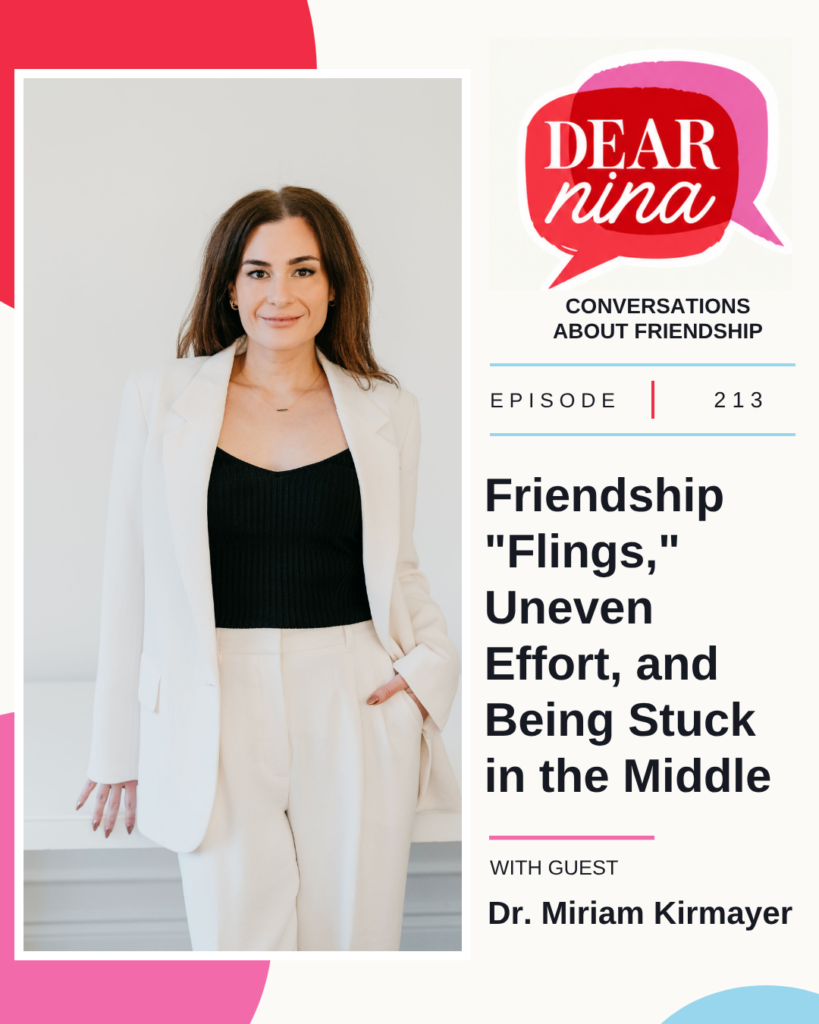
Nina: [00:00:00] Welcome to Dear Nina: Conversations About Friendship. Today’s episode is an extra special treat if you are someone who likes to dive deep into different friendship dilemmas, the nuances of friendships, the gray areas, which is really what I do most weeks, I’d say every week. today’s guest is going to help us go even to the next level.
She cares about this topic as much as I do, and she’s actually been a guest on this show already, a very popular episode about quiet quitting. And our guest is Dr. Miriam Kirmayer. Dr. Miriam is a clinical psychologist and one of the world’s leading experts on friendship
Dr. Miriam has over a decade of research on the science of friendships and thousands of stories about people’s personal and professional relationships
Dr. Miriam is now also a podcast host. So she joins me in the friendship podcasting social connections space on her [00:01:00] podcast, Two Peas on a Pod
I will have links of course to where you can find Dr. Miriam on social media, where you can find Two Peas on a Pod. I am definitely sure you’re going to like today’s conversation where we bring together some questions I have been getting, some questions she has been getting, and some questions we have for each other.
So this isn’t actually just one topic. This is one of the rare times where I have put several topics into one episode, because I don’t normally like to do that. I normally have it very narrow. But having Dr. Miriam is such a unique situation. She can speak on any aspect of friendship, and I knew that my listeners would really appreciate having that clinical psychologist point of view as well, Which I am very clear on every episode, I am not.
I’m not a therapist. I think there’s value to having all kinds of points of view on the topic of friendship, and having Dr. Miriam’s is a hugely valuable opportunity. So here we go Hello, Dr. Miriam. Welcome back to Dear Nina.
Dr. Miriam: Hi, Nina. [00:02:00] I’m so glad to be here
Nina: Your previous episode, that I will have in the show notes, was all about quiet quitting? Do you know that that is still one of my most popular episodes?
Dr. Miriam: I did not know
Nina: Yes, ’cause I’ve had five years of episodes, and that one was about, I think, a year in or so. And yours consistently ranks very high.
Obviously you’re a fantastic and brilliant guest, but it’s also a very juicy topic, and a little bit of that will come up, on today’s episode too, but it’s not our only focus
Dr. Miriam: No. Well, I mean, thank you for sharing that. That’s, that’s really meaningful to hear, thank you for your words of support and encouragement, and I suspect it is also exactly what you said, that it is a juicy topic. people are always curious about the beginnings and endings of relationships of all kinds, especially friendships, and when you throw something like quiet quitting in there, which has a certain emotional salience to it, I can appreciate why, both personally and professionally, why there’s something there that people are interested in.
And you always do such a good job with having your finger on the pulse of what people are thinking about and talking about or not talking about when it comes to friendships, [00:03:00] so kudos to you for always having such meaningful topics that you cover.
Nina: Well, thank you. And today I know that we are going to be covering a variety of topics I have some questions, and you have some questions that we are gonna answer together from our various listeners and followers, for you, you know, not your personal clients, but things that people reach out to you with.
it’s interesting, ’cause when we were first talking about this, we were thinking about it as secret things people ask us, and then I was like, well, everybody asks me things in secret because it’s Dear Nina, right? and people write to me anonymously. But I will say I see certain patterns, of course.
I know you do, too. And so I pulled out a few that I thought would be extra interesting to have a clinical psychologist point of view to answer along with me, instead of just a friendship enthusiast journalist kinda point of view. And I’ll be so curious what yours are, too. And then I have some just for you.
That would help me in my work, and just some curious questions for you, and I think you might have some to give to me, too. So this is gonna be
Dr. Miriam: I, I do. I did, I did my homework.
Nina: Yay!
Dr. Miriam: like the good [00:04:00] student that I am, like the good researcher that I am, I, I have some questions that I’ve been getting from my end, whether it’s from, our online communities, certainly questions that are coming up often in client sessions, some interesting questions that were coming up at some recent workshops that I was giving.
And yeah, this idea of, the questions that people ask in, secret is an interesting one, ’cause again, people… We all have all sorts of friendship experiences that go unsaid, or we try and find those places and spaces where we feel like we can be a little bit more anonymous or, feel a bit safer opening up without judgment.
So I’m looking forward to getting into them.
Nina: listeners, I wanna let you know, we purposely did not share these with each other. We had a discussion about it, like, “Should I send you the question? Should Miriam send me the question?” And we decided, you know what, it actually would be kinda cool for each of us to answer on the spot, and maybe fun for the listeners to know that we had absolutely no prep on this.
So I know my questions, I know what I’m asking, and she knows what she’s asking, Miriam knows, but we don’t know each other’s questions. So this is for both of us, but new to you.
Dear Nina, and now Miriam, [00:05:00] how do you stay neutral when two friends are fighting or arguing? They basically both approach you, and they want you to not take sides, but do they really want you to not take sides?
It seems easy to give the advice, “You should talk to each other,” and I have said that, and I’ve not betrayed any confidence to each other, from one to the other, but I can see a bigger rift coming in the future. Should I get involved?
Dr. Miriam: Such a good question.
Nina: I know, right?
Dr. Miriam: I… Yeah, thank you. What a, what a, what a good question to kick off this conversation with. So a few things are coming up for me here. First of all, I- immediately I’m transported back to graduate school, where I was researching young adult and adult friendship, and we were looking at, what are the most common friendship challenges that come up?
And not only that, which of these friendship challenges are the most important? Meaning, if you don’t say or do the, quote-unquote, right thing, if you don’t handle this appropriately, there will be consequences, either [00:06:00] for your own well-being, for your friend’s well-being, or for your friendship, and in this case, potentially your friend group.
And I say that because, interestingly, without going into too much of the data, I will say there were three broad categories of situations that came up. So we had transgressions, where there was a situation where one friend has clearly violated a core expectation of friendship, a core function of friendship.
So think about things like a friend spills a secret behind your back. they’re talking about you behind your back. They’re inherently unreliable and canceling plans all the time, things like that. we had conflicts, where one person hasn’t necessarily said or done something wrong or gone against the fundamental foundation expectations of friendship, but there’s a tension there.
And then there were support situations too, which we can talk more about later. I share all of this because in that middle category of conflicts, this experience of feeling caught in the middle was one of the more common and one of the more challenging friendship situations that come up. And so I say that [00:07:00] because, on the one hand, unsurprisingly, this person writing it is not the only person in that situation.
But again, we don’t often talk about these situations openly, this difficulty that we have of wondering, “What do I say or do here? How involved do I get? How involved do I have to get?” These are such good questions. So I will answer this question probably with a few questions of my own to anyone listening, but also to myself as I’m, thinking this through.
part of what comes up for me here is the whole idea that friendships are often embedded in a larger social network, and that might be a friend group where you share friends in common, or it just might mean that you are part of a similar community. Or maybe, of course, you have an isolated friendship that exists independent of your other friendships.
And all of that does play a role in terms of wondering, “Okay, well, what’s the right way to act here? What do I want to do here?” part of me is wondering, what are the different relationship and friendship dynamics at play? Because obviously, the circumstances in terms of what that rift is [00:08:00] about, what your friendship is like with each of these people, what their friendship is like, are you still, hanging out or connecting as a group, or is that part of your friendship experience over?
And they are simply coming to you one-on-one. All of that will necessarily dictate how you want to respond in that situation. I part of the challenge is understanding, what are my friends looking for in that situation? This listener’s obviously hinting at that, right? When they say “They’re coming to me, saying that they don’t want me to take sides, but I get the feeling that they really do want me to take sides.”
And I’m questioning that a little bit. maybe, maybe not, right? Are they looking for, are they looking for you to say, “Yes, you’re right. I can’t believe this other person did this to you”? Are they looking for you to mediate the conflict in some way? Are they looking for you to help repair that situation or, or problem solve?
Unclear, right? But potentially having a little bit more information about what they’re looking for [00:09:00] may be helpful for correcting some of those assumptions. And if you got the sense that they really aren’t looking for your involvement in any way and just wanna open up to you, maybe, maybe that puts you in a different position where you are able to show up.
Now, there’s a big asterisk next to all of that because what I am hearing and what tends to happen in these situations is that regardless of the reasons, this is not something that you are comfortable with. You just don’t want to feel caught in the middle, and that is more than okay, and very often, that is the thing that we need to address outright.
And instead of going with the, You are putting me in an uncomfortable position,” or “I don’t wanna be stuck in the middle,” we don’t necessarily have to frame the conflict in order to resolve the conflict, right? We can stick more with what we’re feeling. “I really wanna be able to show up for you, whether it’s about this situation or as a friend, and when we have these kinds of discussions, it’s harder for me to do [00:10:00] that,” or, “It’s important for me to stay a little bit more at a distance from this situation.”
And so if you can stick with your feelings and what your experiences are in that, very often that can be the way through those kinds of discussions as opposed to, “You are putting me in an awkward position,” which is blaming, or again, just centering the conflict as opposed to your desire to stay connected.
Nina: Oh, that’s good. And I can see why it’s hard to be in the middle for all the obvious reasons, but then one extra reason is you might not wanna feel two-faced, to use a expression I don’t think I’ve used since I was in high school. But yeah, it’s something that people would accuse each other of, and it was like the worst thing you could be, really.
It’s like really a terrible thing that, to be called as two-faced, that you’re one way with one person, and then you turn around and you’re still friends with the other person. So if you’re sitting here listening to the issues that someone may have, yes, friends do that for each other. Okay, let’s be clear.
that’s a normal thing for friends to do. if the rift is so big or getting so big that it [00:11:00] seems that there’s maybe this expectation that you are now gonna change your opinion, you as the listener are gonna now change your opinion of the other friend, and then you go ahead and you’re still friends with that other person, each friend may feel like I don’t know, like you are disloyal is
Dr. Miriam: Yes. What I have h- heard and seen friends do as well in this situation, one option is to show up for both people and continue to receive this information, whether this is something you’re comfortable with or not. Continue to be, again, heavy air quotes, “supportive” in that way. The other option is to say, “I’m just not comfortable with this, and I don’t wanna continue these conversations.”
Another option is to bring even more transparency to it and say, “I am open to hearing what you have to say. I’m comfortable having these discussions.” Again, only if you are. We don’t wanna b- engage in that kind of self-betrayal. And to let a friend know, “Just so you know, I am also having these kinds of discussions with our other mutual friend.”
bringing that type of transparency to those discussions can actually be [00:12:00] quite helpful because not only does it reduce some of the uncertainty of, ooh, are they also talking about me behind my back and being two-faced in that way? It reduces the uncertainty. It also gives you a chance to set certain limits and expectations.
Just so you know, I am here for both of you, and what that means is I will receive information, but I will not share any information, and it’s important that you know that, and I’ve communicated the very same thing to our other mutual friend.” sometimes being radically transparent in that way and clear about expectations and boundaries can also be a, path forward, only if that aligns with your willingness and ability to have those kinds of discussions, though.
Nina: so that was great. I say we end that one there. It’s
Dr. Miriam: Great.
Nina: Oh, thank you. All right. Do you have one?
Dr. Miriam: g- I wanna kick it off with a, with a juicy one as well. I got a really interesting question from somebody on social media this week about friendship flings.
Are friendship flings a thing? I recently thought about this concept. I’ve had friendships, especially recently, that felt hot and heavy for a [00:13:00] period of time let’s say maybe a year-ish, for example, and they were super intense. There was this feeling of we are inseparable, and then either over time or seemingly abruptly, there’s a, not necessarily a rift, but there’s this drift process that sets in, and they may never speak again.
And so this is somebody writing in asking about friendship flings. Is this something that you hear about? Is this, quote unquote, normal? And what might be going on there?
Nina: I think it absolutely happens. I think I have experienced it. Have you?
Dr. Miriam: Yeah. Yeah, absolutely
Nina: I don’t know that it’s ended in a complete drift away totally. It’s been maybe more of a, it went, like, from hot and heavy to maybe just more normal. you’re not in touch constantly. But there is definitely that feeling that happens when you’re, well, the negative term I think I see associated with it is love bombing, that I think it might be connected. I mean, you- I don’t like to use therapy speak as a non-therapist, but you can. So
why
Dr. Miriam: h- as, as a therapist, I also don’t love using therapy
[00:14:00] speak, I
Nina: good. That’s funny. I really am careful about that, just so you know. I, like, in your practice or in your profession, I want you to know that I am extremely careful about that.
I do not, because I’m not. I, I say it in almost every episode. I’m not a psychologist, not a therapist, so I don’t engage in that. they are obviously related, what I’m talking about and what people talk about in therapy is obviously related.
So anyway, I know the term love bombing, and it seems similar to what this person is describing, but I think you need to describe that for the listeners
Dr. Miriam: I’m hesitating because as you’re talking about this, there are a few different pathways that I’m considering. I mean, so are friendship flings a thing? I think we have arrived at our answer. Absolutely, right? There are all sorts of people who come into our lives where there is this intensity fairly early on.
There’s that sense of what we call friendship chemistry, we’re pulling from not only therapy speak, but we’re pulling from romantic relationships, and so there is this element of almost like platonic love at first sight, and friendship chemistry is basically that, where very quickly, yeah, [00:15:00] it’s real and I’m sure a lot of people listening to this conversation right now have experienced it.
I see us both nodding. We’ve experienced this, right? There’s something really powerful about that, and so sometimes these very intense, albeit brief, friendships or time-limited friendships are a reflection of that friendship chemistry, of you connect, you connect very quickly, and that itself can be very rewarding, There’s a lot of… I mean, sure, we can talk about all, list off all of the, the neurotransmitters and neurochemicals that get released when we feel connected to somebody, especially when that happens very quickly. It’s very rewarding. it also is just incredibly meaningful, you can get caught in this really positive cycle.
part of the friendship fling experience, I believe, is that, is that you have this friendship chemistry or that close connection that develops fairly quickly and getting really excited about that. over time, just like in romantic relationships, some of those feelings settle, right? The newness of it, the excitement of it wanes, which is completely normal, and it doesn’t mean that you aren’t left with something [00:16:00] special and meaningful.
In some cases, there is still that strong foundation, and that wouldn’t necessarily be a fling. It’s just that intense beginning that turns into a friendship. Sometimes it does yeah, wane over time or become a little bit more distant. I’m thinking there of this whole idea of what we call a friendship downgrade, where it’s not a dissolution, it’s not a breakup, it’s not the sudden ending, but it’s a downgrade.
So this was somebody who you had this intense friendship fling with. Maybe you were even considering each other a best friend, for a year or whatever period of time that was, and now there’s this downgrade where you are still close or you are still connected in some way, but maybe they’re a casual friend or even an acquaintance and not a close friend.
This situation where you are so close and then suddenly no longer in each other’s lives, that’s interesting to me, and when that happens I see that happening for two different reasons, or, and there’s probably more. But one is sure, maybe there was something that happened along the way in that friendship, where for whatever reason, you are no longer able to stay connected or no longer des- desire to be in each other’s [00:17:00] lives.
Sometimes the thing that kept you in the friendship were those really exciting feelings, there’s something about the process of connecting with somebody intensely and early on that is the thing that attracts you, not necessarily who this person is. once you get to know more about this person and once some of those feelings dissipate, there isn’t enough keeping you in that friendship.
Sometimes, though, the most common route to this would be there’s some external circumstance that brought you together that facilitated closeness, and that external circumstance is no longer there or it has shifted, and so the context of your friendship has changed. And so I’m thinking, you know, one example is you know, I, I ha- I have two young children, and early on in both of their lives, I got involved in, in a parents’ group, and I was seeing these fellow moms once, twice, three times a week even, and we were spending all of this time together.
And so you have the time component, and you have the intensity of that life experience, and you have the self-disclosure where you’re opening up about how beautiful and disgusting, right, early childhood is, and how hard it is, and how lonely it is, and all of those meaningful [00:18:00] discussions bring you close together.
And what happens is then you send your child off to daycare, you return to work , if you’re working out of the home, and you start to reinvest in other aspects of your identity. And so that external thing of the parent group is no longer there and keeping you connected, I have not spoken to some of those people in a very long time, if at all.
And so that would be an example for me of a relationship like that, although the intensity of the friendship, speaking personally, wasn’t necessarily there in that case. But I think that helps to illustrate the idea of how external circumstances can play a role. So those are just some of the ideas that are coming up for me.
Do you think there’s other pieces to this,
Nina: the other thing I would add is I don’t think it’s an issue that this… I, ’cause I kinda feel like what the person asking you the question is getting at is, is this an issue? Is this a problem? I don’t think it’s a problem unless it’s a pattern. If all of your friendships, right, or a lot of your friendships are hot and heavy, and then you just kinda get sick of the person, it’s maybe you have unrealistic expectations of what maintaining a friendship looks like, and that looks like not everything is [00:19:00] super fun
and sometimes it’s just the boring stuff of checking in with a text and asking how they’re doing or calling on the ride home even though you’d rather be listening to a book, but you were like, “Well, part of keeping in touch with people is doing things that are inconvenient, and we gotta find out what’s going on.”
And it… Boring, a little
Dr. Miriam: Absolutely. Yeah, the that’s such a great point. So this idea of patterns is something that I come back to time and time again. I love that you’re bringing that up. We I, I just recorded a series on friendship breakups on, on the podcast that,
Nina: was so good. I will link that, guys, in the show notes. It takes, you know, the conversation Miriam and I had about ghosting. It’s, like that but times 1,000 with a couple episodes and yeah, check it out. I’ll, I’ll have it easy to click on
Dr. Miriam: Thank you, thank you. Yeah, so that’s f- that’s from my podcast, Two Peas in a Pod, where we go into the different reasons why people end their friendships, how we end our friendships, and i- in line with that I outline the five questions we need to ask ourselves if we’re thinking about ending a friendship.
And to your point, one of those questions is, is this a pattern? Is this a pattern in this friendship? And even more importantly, is this a pattern in other relationships, other friendships? And if [00:20:00] so, that is communicating something different above and beyond, to your point, is this a problem? Because then it becomes not, is this a problem in this friendship, it becomes, I don’t wanna say, am I the problem?
But is this a pattern that, that is worthy of, of further investigation? And so, yeah, this idea of friendships can be inconvenient and be a little bit more mundane, and some of us struggle more with that. I would also say as time goes on, friendships can also become more vulnerable inherently, Where we are opening up about other sides of ourselves, and that might not only be vulnerable in the sense of opening up about the things that are hard.
It might mean more vulnerable in terms of you’re exposing more sides of yourself in this friendship. for some of us, too, that type of vulnerability and that type of an experience of feeling seen in a different way can actually be quite triggering and lead us to withdraw. And so those would just be two different reasons why somebody might have this intense connection early on that then [00:21:00] dissipates over time, the question of is this a problem might have a different answer in those situations.
Above and beyond the idea that, yeah, friendships do come and go, and that’s okay as long as it isn’t the only friendship experience that you are having. And I would say that’s the other tag on, right? Is not only looking at the pattern of losing friendships or losing that intensity that’s there, but also, do you have other stable friendships in your life?
Do you have other people to turn to so that when you lose touch with these connections even if that’s happening in some friendships and even if that’s happening repeatedly, do you still have that support? Do you still have that solid base to gain support from, to invest in, and to act as a bit of a buffer against this interpretation that necessarily there’s something that you are doing to cause this or to select this?
Nina: hopefully it’s you haven’t distanced yourself from all your friends when you get that new shiny friend. That’s just a
quick bit of advice for people that it’s totally normal to have, like, a shiny new friend, but don’t fall for the trap of ignoring everyone else all of a sudden, ’cause they won’t necessarily be there [00:22:00] to be that cushion
Dr. Miriam: that is such good advice, and actually really important to talk about, ’cause you’re right, that is one of those experiences that we do talk about in terms of the intersection of friendship and romantic relationships, right? We talk about how important it is when you start up a new romantic relationship, you’re dating someone new, to not lose touch with all the other sides of yourself, and to not lose touch with your friends, and to continue to nurture those relationships.
And nurture them intentionally, meaning it’s not just now the case that you only socialize with your friends with your new partner. You need to hold on to and preserve aspects of that individual connection that predated your partner, and we don’t really talk about this in the context of the intersection of friendship and friendship.
And so I love that you’re bringing that up. The shiny new object syndrome. Yeah. We are, we are all very prone to that in a lot of ways, so great to think about in the context of a friendship
Nina: The next one is actually one that I personally want help with from you.
Dr. Miriam: Okay.
Nina: and it’s not necessarily with my own friendships, but as I help people, in my Facebook group, in my podcast and stuff, with friendships, [00:23:00] my number one topic, I mean, I talk about it again and again because people come to me with this issue again and again, and anyone who’s listening to this show could probably fill in the blank.
And I often tell people that redefining reciprocity will completely change their life, will change their friendship life. It has probably come up in my work for 14 years straight, in the podcast specifically for five years straight. I get on that is fair, I don’t totally agree with the pushback, but I want to talk to you about it.
The pushback I get is, ” Okay, fine. Like, maybe they’ll listen to me,” because what I mean when I say redefining reciprocity, mostly people are talking about who reaches out, who initiates. Even though that could be reciprocity can come in a lot of different ways, but nobody is looking at it that way. I’m pushing them to say, ” maybe my friend doesn’t reach out, but they always reach back,” There’s reaching out and there’s reaching back. Not everyone reaches back. You- T- Trust me, if you have a friend who doesn’t really text back much, you will appreciate the friend who does reach back, even if they didn’t text first. But you and I agree on all that, and anyone who’s listened to this knows what I mean, so I don’t want to go [00:24:00] over all of it.
when people say to me, ” Okay, fine. I can accept that it doesn’t need to be 50/50. I can accept that this is my skill set, it’s not the other person’s skill set, but it still bothers me that I always reach out.” It’s like they’re hearing me, but they can’t quite accept. they really feel ultimately if the other person was interested, they would reach out some.
And I say, yes, they should reach out some, and yes, you should express that to your friend. – They may not be able to do it. Some people have, like, terrible executive functioning, honestly. they want to reach out, they simply cannot, and it’s not personal. It’s like not even that they don’t just reach out to you.
They don’t reach out to anyone, and they may not have the same social needs that you have. Okay, so all of that is a given. I’ve heard you talk about, I’ve talked about it, too. We talked about it together on our episode. If you are trying to distance yourself from a friend, one of the first things you may do is reach out less.
I do understand the person who argues with me and says, “Okay, fine. I can accept that they have different ways of showing they want to be friends,” but how could that be true? And also it’s true that if someone [00:25:00] doesn’t want to be friends, one of the ways they distance themselves is by not reaching out.
Dr. Miriam: there’s so much to unpack. And first of all, let me just say, this is why I always love talking with you and hearing what you have to say because on the one hand, I think we share a similar ethos and perspective on friendship and have a shared language, which is so lovely to be able to have these conversations, and everyone tuning in, right, is part of that conversation as well.
And you, always ask the questions that just take it one step further. So
Nina: Thank you. That’s a huge compliment.
Dr. Miriam: oh my gosh, you’re, you’re so welcome. allow me to step onto my soapbox and then kick me off very quickly as soon as I’ve rambled for long enough. So yes, in short, no surprise, I agree with you in terms of, so this whole idea of reciprocity, I, call this in my work respective strengths, so paying attention to each other’s respective strengths, and it really just summarizes exactly what you said so beautifully, which is that we approach friendship, from different perspectives, and we have a different skill set and different levels of comfortability with different types of social skills and experiences that go into those friendships.
to expect that reciprocity will [00:26:00] necessarily look like tit for tat and will always be experienced in a way that feels very equal and perhaps fair isn’t the reality of most of our friendship experiences. Is it beautiful when an initiator meets an initiator and a giver meets a giver?
Yeah. That’s worth celebrating, right? That, that feels so good. for most of us in most of our relationships, that isn’t the case, and that isn’t the case always, Even when a, an initiator meets an initiator or a giver meets a giver, there will be a give and take, and there will be moments where somebody doesn’t show up exactly as we want them to.
So I think that this advice is true for everyone tuning in, no matter where you fall here. I agree with you with your, point about respective strengths. And I think part of the solution there isn’t actually just to accept that this is true, but actually take it a step further and go on a bit of a scavenger hunt.
be very intentional with yourself about noticing your friend’s respective strengths. It’s just a matter of figuring out [00:27:00] what are they and what are the ones that really feel important for me, because there may be a few that they’re really good at that don’t actually carry that much weight in your world because that’s something that you too do, or that’s something that you don’t value as much, or you have other friends who do that for you.
But what I mean by this is maybe it’s a friend, to your point, who, doesn’t reach out but reaches back, they are always so quick to respond. And the scavenger hunt there is not only coming up with that as a category, but then going the extra step of every time they do flagging that, marking that.
And you don’t need to, you don’t need to have a, you know, a, a, a sheet on your wall where you’re, you’re marking off days that they have responded, but Be intentional about it and say, “Okay, there they are doing that thing. That’s helpful. I appreciate that.” It’s that moment of of noticing and out of gratitude.
Maybe it’s not the reaching back, maybe it’s that they don’t initiate, but that when they are there, they are the first friend to say, “Let’s put our phones away,” Let’s have this be a connected experience.” Maybe they bring the the comedic relief, and they’re really good at bringing the energy up in your conversation or in your friend group.
Maybe [00:28:00] they’re great at asking meaningful questions. Whatever the respective strength is, notice it and be on the lookout for it. ‘Cause what our brains do by default is to discount evidence that doesn’t support our hypothesis, that doesn’t support our worldview. if our worldview is this is a friend who doesn’t initiate, and by the way, that is often seen as a sign, as you said, of interest, therefore, the hypothesis isn’t just that this is a friend who doesn’t initiate.
The hypothesis is this is a friend who doesn’t care about me in the way that I care about them, or doesn’t value our friendship, or is pulling away. Then we need to work extra hard to find the contradictory evidence, and so work extra hard to find those respective strengths. Now, there’s also the other side to this, which is the additional piece of the question you added that I love, where what that might also be a proxy for is the distancing, the slow fade, the strategy of ending a friendship.
And we talked about this in this friendship breakup series. This is one of the main ways that we do [00:29:00] end our friendships. Part of what stands out for me there is, again, this word pattern, Is this a clear departure from the norms and expectations that you had in this friendship? Has there been a sudden shift or even a gradual shift where they are no longer initiating in the way that they once did?
that, that is a bit of the distinction as opposed to are they just doing the thing that, or not doing the thing that they always have not done. And I do think that there’s value in having these conversations, not only here on your podcast, but with our friends, and being able to say, ” I notice all the different things that you do for me and for our friendship, and I value all that, and I would love it if you were able to initiate a little bit more because, because I’m feeling overwhelmed, I’m at capacity.
you know, I’m feeling taxed with respect to executive functioning, and I need a little break from planning. Is that something that we can figure out together?” very often, if you can communicate what you want and the why, our friends are open to at least hearing that and maybe trying that out.
And maybe it won’t be [00:30:00] as often as you want, but can you, again, do that extra step of noticing and flagging that they are trying, and use that as evidence that contradicts the story that you’re telling yourself about their interest?
Nina: And having a conversation like that I think also gives your friend, if you are the person who’s always reaching out and you have a conversation like that where you are direct about how it’s getting to you and you could use a little help because, and I love that, the because is so important. Even if it doesn’t turn out exactly like you would like, it might give your friend the opportunity to just thank you.
Maybe that’s the thing that sometimes people are looking for. They’re not necessarily, if they really think about it, they may not really need it to be 50/50, but they just want the other person to acknowledge at least once, “I realize and appreciate that you are carrying the burden of, us getting together, and that we maybe wouldn’t be as in good a touch, and thank you.
Thank you so much ’cause I value our friendship. Thank you for doing that.”
Dr. Miriam: Yes, absolutely. Yeah, it isn’t necessarily always a, a helping hand or an offloading of the work. It is that moment of recognition or appreciation or gratitude. You’re also making me think of something [00:31:00] else, though. I don’t know if you hear this, but very often when I’m working with clients, there’s this other belief that sets in.
it’s not only that my friend doesn’t care about me. The belief that often sets in is a labeling one, where we label ourselves, “I’m a bad friend. I’m a bad friend,” or, “I’m bad at X. I’m bad at initiating, so I can’t do that.” And, and by the way, we label ourselves, and we also label other people.
“Oh, my friend is not good at initiating.” what I have found to be true in the world of, frankly, both research and, clinical psychology is that Being a friend and having a friend, and this whole idea of competence, social competence, this is a collection of skills. This isn’t one thing. So to say, “I am bad at friendship.
I am bad at I am interpersonally incompetent,” right? “I am not socially skilled,” that doesn’t really make sense because there will be things, again, that we are really strong at, and there will be things or, and areas where we struggle. And we can even break down some of these tasks into smaller tasks.
So the whole idea of initiating, think of how much goes into that. You [00:32:00] need to have your almost like working memory there, to be reminded of your friend. Think about when was the last time we spoke? How long has it been? They’re on my mind. Okay, I’d like to reach out. So then you have the awareness and you have the intention.
then there’s the actual step of reaching out. There’s the behavioral step, right? What do I say? Actually following through. When you’re making plans, are you proposing plans? Are you following through on making those plans by calling a, a restaurant to make a reservation, for example? There are so many different steps, and so sometimes the solution is actually identifying, is there one part of this that I can ask for help with?
Is there one part of this that I can offload? Is there one part of this that my friend has no strong feelings about taking on? Meaning maybe you do all the coordination work of getting your time on the calendar that works for both of you, or you’re the one who’s really good at reaching out and sending that first message.
Maybe your friend is totally okay to make the reservation, and that can be something that is on them. I did a speaking gig not too long ago for a multi-generational room of women. I think the youngest was 16, the eldest was 96 or something.
It was such a [00:33:00] cool experience and event, one of the women who was well into her 90s told me that for the last however many decades she has had Wandering Wednesdays with a friend.
Wandering Wednesdays, where the plan is she doesn’t actually know. She doesn’t actually know what the plan is. The friend makes the plan every Wednesday, but she is responsible for coordinating the transportation. So she knows where she has to get her friend and where they will end up or the time of day where she’s getting her friend and the time of day that her friend wants to be back, you know, in bed, And the friend coordinates the rest of it, and that was such a great example of, this shared responsibility of making the plans happen. And so there’s all sorts of creative ways that we can figure this out with our friends as long as we’re willing to have those discussions, to your point.
Nina: Oh, it’s so good. And the final step some people really can’t handle, ’cause maybe they are okay at reaching out, they’re okay at thinking of things to do, it’s finding time on their calendar. they have packed themselves so tight or The idea of putting something on the calendar is so stressful, so they [00:34:00] don’t necessarily reach out because they don’t even have anything to suggest.
a case like that, I would advise people, you can reach out just to talk on the phone. it doesn’t always have to amount to an outing. It can just be talking on the phone or even a little text here and there.
It, goes far. I will end this part with one little story where I’m telling you, everyone, like I said earlier, if you have a friend who isn’t that great at reaching back you will appreciate the friends who are. Because I do have a friend who is a friend. I, I mean, I do see this friend, a lot of times, like, she’ll bemoan, “Oh, we haven’t seen each other in so long,” and I had to sort of point out, “You know, every time I send you a date and you can’t do it, you say, ‘Oh, shoot, we can’t.’
Okay, you can send other dates.” I think I said on the spot, ” You send me dates now. That’s how that works. I’m not going to continue to go into my calendar and find dates just for you to tell me, ‘Oh, we can’t, we can’t, we can’t.’
Send me a date you can.” it made me appreciate the friends who do send me dates in return, and that counts for me. if you’re not gonna send a date, it doesn’t mean you don’t wanna be friends, but it’s [00:35:00] frustrating
Dr. Miriam: yeah. This is a strategy that’s worth underscoring, what you just shared there, I think, in terms of the communication piece of when you have met your limit, when you are at your limit of with all of the reframing that’s out there, with all of the contradictory evidence and scavenger hunting that I can do with all of the open communication, there may come a time where you just feel like I can’t initiate anymore, I can’t be the one to take on all of this and continue to reach out and send options and receive nothing in return.
if and when we get to that point, it is so helpful to do what you did and to say to our friends, ” the ball is in your court here. By the way, this doesn’t mean that I’m not interested. I am very interested. I am just at a point where, this obviously isn’t working with me suggesting dates, so please come back to me, and when you do, I will be very receptive to that.”
for those of us and my hand is in the air right now who do struggle with, sure, busy schedules, but also time management and organization, and now I have two hands in the [00:36:00] air right now, it can also be helpful to plan ahead on your end. And so maybe you’re not committing to plans, but maybe you know, every third Thursday I start work late or I have the morning where I can take a little bit of time and I work later, so I’m gonna block that off, and that’s time that I can slot in a catch-up if and when that makes sense, and if and when I hear from a friend or if I reach out.
And that way you have some availability in your calendar to fill with social time, and we plan ahead for everything else, right? Our doctor’s appointments and our work to-dos, and it sometimes makes sense to do that socially as well.
Nina: I stopped planning recordings most mornings if possible, so on my own podcast where I control the schedule, because I have found that it is nice for me to have some mornings available to walk. And if I’m recording, I have my makeup on, and I’m, you know, kinda ready to go, and I’m also pretty exhausted at the end of a recording, and I don’t really wanna talk to a friend after that.
And it’s not that I’m [00:37:00] getting together with friends every day, but walking is one of my top ways of seeing friends in town. I realized that I was not seeing friends a lot ’cause I was recording so much and and being a guest a lot, and doing all these things in the morning. So I switched it to afternoons so that I could save mornings as more of a friend or my own workout time.
It’s like, that’s sort of my exercise time. that was a good solution for myself
Dr. Miriam: I love that. So the walk and talk is often in person. Do you do a walk and talk for long distance friends where you’ll go for a walk and chat with a friend
Nina: in a while. Not often scheduled, but it will just happen organically. I’ll make a point to call somebody during that time, and it works best when it’s nice out, ’cause when I’m on the treadmill it’s a little loud for me to do that. So, you know, I live in Minnesota, I know you’re in Canada, so we have that in common,
Okay, Miriam, let’s now do one of yours
Dr. Miriam: Okay, so this is a question that interestingly I got from a teen not too long ago, it echoed a very similar question that an older adult had asked me. And so it’s top of mind as one of those, on the one hand, unique friendship experiences, [00:38:00] but again, something that clearly many of us are going through.
So the question is as follows: I have a friend who is really great to me one-on-one. They’re supportive, they’re present they’re a great listener, we have fun together, we have this seemingly really healthy friendship. But when we are with others, when we’re with our friend group, when we’re in front of others, they treat me very differently.
And in one of these cases the friend was actually a little bit inappropriate in terms of a little bit of relational aggression and being unkind in that way. In another situation, it was the friend is just seemingly withdrawn and distant. But that this isn’t a one-time event, that this is a clear pattern that they have picked up on, where this is a friend who’s great to me one-on-one and very different or inappropriate in a friend group.
And so the question is obviously, what do I do? But also this bigger question of, is this a friendship worth holding onto? Especially when in both cases, actually, both people [00:39:00] felt like they didn’t have other great friends to turn to.
And so it,
Nina: caveat was hard. Okay, cause I was r- I was ready to be done with this friendship But oh, that’s hard when you said that
last
Dr. Miriam: let’s… We can break it up into two pieces.
I’d actually be curious about your answer. forget I said that last piece. I’d actually be curious about your answer initially, and then does that change things? ‘Cause I think actually the, the build on that is interesting, too.
Nina: Yeah, it is interesting. See, I love this stuff, . My initial reaction when you said that, both for the teen and the adult, was life is too short to be treated that way in front of other people. And it’s so humiliating.
It’s the- it’s so unkind because of the aspect of humiliation, even if it’s subtle, even if it’s one of the versions you said where the friend more ignores the letter writer, doesn’t outright, make fun of the person or use them as a butt of the joke, but just kind of ignores, maybe that’s less humiliating than the second example of there’s been some actual
When you say relational aggression, here I assume you mean teasing or thing- you know, even it’s like a little comment, but I mean, [00:40:00] I’ve talked about teasing on my podcast. c- I personally can’t stand it. Now, there are some people who don’t mind it, It might depend on how you grew up and if you see that as a loving kind of thing to do.
And it can be, it can be a loving kind of thing to do. I think ’cause I didn’t grow up in a teasing household, I just don’t see that or withstand it as a sign of like love and fun.
I It makes me feel embarrassed it’s possible that with the person who Maybe it isn’t as bad as they think it is. Maybe the friend is so comfortable with you, letter writer, that they feel they can be this way with you in public because you’re so close.
I mean, that’s the glass half full version of that. I think always the answer is to talk to the friend and say, “This is how I feel when we’re in a group, I appreciate our friendship one on one, but I really don’t appreciate in a group being treated differently.
I don’t wanna be punished for being your close friend.” Sometimes people are worse to their closest friends, just like we are with family and siblings. Like, you say things to your siblings you would never in a million years say to a friend.
Dr. Miriam: Mm-hmm.
Nina: There is this- [00:41:00] taking for granted we do have the people closest to us, and we think they’ll always be there. sometimes we do have to tell a friend, I won’t always be there.
Dr. Miriam: Yeah.
Nina: I need to be treated the same in a group as I do in person.”
And you don’t even have to give a reason why. That’s an extremely reasonable expectation yuck, I don’t like this situation. I feel especially for the teen And now let’s bring in the if you don’t have other close friends, you really can feel trapped.
but I still would encourage that teen to really spend time, a lot of time, and a lot of effort trying to develop other friendships, and you may even have to not be in this group anymore if nobody is standing up for you
Dr. Miriam: I love that advice. The other piece that comes up for me is this whole idea of ambivalent friendships. So we talk a lot about toxic friendships, right? And so when you’re talking about teasing that is now bordering on verbal aggression or relational aggression, where we’re kind of using the friendship as ammunition.
So, like, in young kids, this sounds like, “I won’t be your friend unless you…” But we do versions of that as adults, unfortunately, as well. friendships where there is, on the one hand, both this closeness, [00:42:00] and that might be contextual, where you’re close one-on-one or kind one-on-one, but not in a group or there’s just moments of positivity and then moments of, inappropriate behavior and bullying almost, That can bring with it a certain level of ambivalence. And interestingly, ambivalent friendships are worse for our health and wellbeing than our truly toxic ones. I use the word toxic loosely here, but basically what I mean by that is the idea that everything about this friendship doesn’t feel good, and you are just staying in this friendship because, because you feel obligated to, because you don’t know how to get out, because you have a scarcity mindset and don’t think that there’s anyone else out there for you.
the ambivalent friendships, where you have moments where it does feel good, actually are worse for you. I think that’s so important to talk about explicitly, because people are often very afraid to let go of friendships to begin with, let alone friendships where there is something that does work, and yet that comes at a cost.
And so I love this advice of, yes, put in maybe a little bit of effort into figuring out the situation and having conversations, sure, [00:43:00] but also make sure that you are diversifying your social experience and investing in other friendships, because that will reduce the scarcity mindset of there’s no one else out there, and maybe give you a little bit of courage to, to take a step back and realize what you are worthy of.
Nina: Yeah, ’cause that person’s taking up time, and w- we only have so much time. Per most of our conversation here, like, time is so limited, and it, gets in the way of other things we are doing, and our time gets in the way of our friendships. And you only have so much time to invest in close friends. Don’t let one of your closest friends be somebody who doesn’t treat you well in all circumstances.
Boom.
Dr. Miriam: Well said.
Nina: I love it.
I do have one final question, and I wonder if it’s the same you have for me does talking about friendship at this level professionally make you feel self-conscious about your friendships?
Dr. Miriam: Oh my gosh, I… Same question right back to you. Does it make me self-conscious about my friendships? Yes and no. I think it’s a both/and for me. I mean, obviously I’m so interested in this topic, and I, I’m not gonna pretend that my interest in this topic is exclusively academic.
I was drawn to this topic for a certain reason, so I was [00:44:00] already thinking a lot about friendships and my friendships and my friendship history, so those two things are more connected than researchers would have you believe. on the one hand, I love being able to talk about this, and I think it has also made me, in some ways, a more self-aware friend thinking about how I show up and what I can do differently.
It has given me a little bit of I like to think courage, again, to that point of being more willing to have difficult conversations or to be actually a little bit more vulnerable in terms of letting people know how much I appreciate them, so I think that has been an outcome of this work. And yeah, I experience this in different ways and at different moments in my life where I have had moments where I’m like, “Oh, here I am talking about how to be a great friend.
Like, am I really being the best friend I can be to my actual closest friends? I don’t think so. I’m not showing up in the way that I want to. I’m not showing up as my best self.” Sure, for all the normal reasons, but that has made me a little self-conscious in terms of my own personal friendships. I’m sure you get these questions all the time, like, what does your social circle look like?
What are [00:45:00] your closest friendships like? And I am so lucky to have such close friends, but I also have a very small social circle in terms of the people that I keep very close, out of design and necessity. there is a part of me that sometimes feels like that isn’t the answer that people want and that I’m almost either letting people down by, by sharing that information or that I’m communicating something about what the ideal social experience should look like, I can get a little bit in my head about that, as opposed to what I both practice and preach, which is, you know, you get to decide what your social circle looks like.
And I love meeting new people, and I love being part of different communities, and I also don’t have the capacity to keep collecting close friends everywhere I go. And there’s a bit of grief there, too, because I am an extrovert and I do love meeting people, but I need to be very, very intentional about how I spend my time.
Nina: Oh, I echo most of that.
Dr. Miriam: Yeah, I actually… I think I have a pretty large circle, but I come to the same conclusion, which is, but I still can’t be [00:46:00] close with everyone just because of time, because of life, and also there is chemistry. There is not just time. Sometimes you will make time for that friendship fling, like, where it gets hot, whatever, it hopefully doesn’t end, ’cause fling kind of means that it might end.
Nina: But there’s still… I’m almost 50, and there are still times when I meet somebody new and I’m, like, so excited about them and, and I will find a way, I will find a way to bring them in, but it’s not gonna be like that with everyone. And so I think it does make me self-conscious that the word friend and friendly I feel like because I talk about friendship so much, there’s this expectation that I’m gonna be endlessly friendly and open to everyone.
somebody once told me they heard me say on an episode that I don’t have, room or time to be friends with everyone. And, and she said, “You know, nobody wants to hear someone who writes and talks about friendship say that they, aren’t open to new friends.” And I was like, “Well, the truth is, I’m open to the right new friend.
It’s the right time, the right person, the r- It’s not that I won’t make a new friend, but I’m not actively out [00:47:00] there seeking at this point.” I was when I moved here, and I, can speak personally to what that’s like. But just because I also talk about how hard it was to move here makes me self-conscious that I’m not always rolling out the welcome mat for every single person.
I cannot include every person. ‘Cause I also talk a lot about exclusive and inclusive That makes me really self-conscious, ’cause for myself, and you don’t quite have this yet, but you will when your kids get older, on behalf of my kids, who are not going to be perfect friends. I often worry about the, the people out there being like, “Oh, Nina, you know, has so much to say about friendship, and yet her kid did X, Y, Z.”
Well, yeah, ’cause they’re their own people, and they’re kids, and they’re still learning. The way people talk about kids, this one’s a bully, and this one’s exclusive, and you’re talking about children or teenagers who are learning, just like you did when you were a kid, and just like your kids are.
Nobody came out in this world perfectly good at how to do the art of not leaving people out and… Ugh, God, it’s a whole thing. ‘Cause I talk a lot about not everyone can be [00:48:00] included, and I believe it. Does it mean I don’t sometimes feel a twing when I’m not included or worry endlessly when my kids don’t invite everyone to something?
Dr. Miriam: Mm-hmm.
Mm-hmm. Mm-hmm. Yeah. Well, no, I appreciate you bringing in that, piece of, like, the self-consciousness by proxy. ‘Cause I think that, that the child piece of it all is also, yeah, increasingly showing up for me as I think about my two little boys and what their social experiences are like and what I would want for them or what I believe people’s expectations are.
But I think there’s also a difference in terms of that self-conscious experience where it’s rooted in the fear of what other people might be thinking or saying, and sometimes speaking personally, self-consciousness it’s almost, like, reflective of an inner desire or calling. It can almost be like a bit of a compass.
It’s like, okay, I feel insecure about this, not exclusively because I’m worried what other people will think, but because there’s a part of me that wants for this. And so how can I also tune into that and question, okay, is this something I can just let go of and know that people will say whatever they say and that’s fine, or is, is this worthy of a little bit more of my [00:49:00] attention?
And maybe there is a part of me that wants to go out and make a new friend or create a more cohesive friend group or socialize in a different way or experience. And I think part of that, about a year and a half ago, I started doing improv, and so for me, that was, like, a, a very big l- Thank
Nina: No, that’s so hard.
Dr. Miriam: Oh, it… Thank you. It is my very favorite thing I have ever done in my entire life. I have made so many lovely new friends and having a different social experience where I get to be a little bit more playful and creative and meet people that I would never otherwise meet and have this friend group where we all, you know, we, we get, we get together and, and there’s a lot of, of friendship chemistry there, and it’s also very separate from other friendships that I have in my life, so it’s a little bit protected in that way.
There’s, there’s a lot of specialness there, and I think that is the result of some of those uncomfortable feelings that I had for a while of I’m yearning for something, and how can I figure out what that feeling is and what that desire is, and how can I go out , and meet that? I think sometimes there’s value in sitting in the difficult feelings and figuring out what they’re trying to tell you.
Nina: Oh, and to, to give listeners also some inspiration, I [00:50:00] love that idea. I’m so glad you did that, ’cause it’s like you took the advice that we would both give to anybody, which is sign up for something, show up, you know, be open to new people. I made a lot of new friends in the past five, six years actually, and I wasn’t searching, like I said.
I I’m very not just lucky, I actually work quite hard at it, so I’m not gonna say I’m lucky. I have a lot of
friends my own age.
Dr. Miriam: Good for you for taking, s- s- some of that well-earned credibility and
Nina: was, hard work, but I have a lot of friends my own age. But in the past five or six years, I have made some actual good close friends who are much younger.
I mean, I like I said, I’m turning 50 this year. One of my newer, she’s not brand new, one of my newer friends is turning 40 the same month I’m turning 50. We are a full 10 years apart. I also have a couple friends on the other end who are 10 years older, but they’ve been around a while. I was their younger friend for a while.
and a lot of it was through tennis, and I met them through tennis, and we’ve stayed friends, and we do things outside of tennis. I did an overnight with a few of them recently. I mean, it’s…
Dr. Miriam: So fun
Nina: yeah
Anyway, okay, we could talk forever. I’m gonna cut us off because
that’s my job. I forgot that I’m the host [00:51:00] here.
Dr. Miriam: Let’s just Miriam,
Nina: I’m excited for my listeners to discover Two Peas on a Pod, where you are having conversations that are not that different from my own. And so if you like the content on Dear Nina, you will absolutely love hearing Two Peas on a Pod. it’s great to have other points of view on topics that matter to all of us.
Dr. Miriam: Thank you so much. it’s always great to spend time with you, and this is so fun. I’m looking forward to doing it again.
Nina: Yes, and as I tell… Oh, yes, a talk and walk. And as I tell listeners every week, I know you agree, come back next week. When our friendships are going well, we are happier all around.
Thanks for being here today, everybody. if you like having your friendship questions answered anonymously, you can do that in two places. I have a Facebook group called Dear Nina: The Group, people ask anonymous questions and get answers from all kinds of people, lots of people who are in the group.
And if you want something more from me specifically, a longer answer, maybe you have a more nuanced question, The place to really do that is at dearnina.substack.com. Happy to see you in both of those [00:52:00] places, and I’ll see you next week.
Bye.