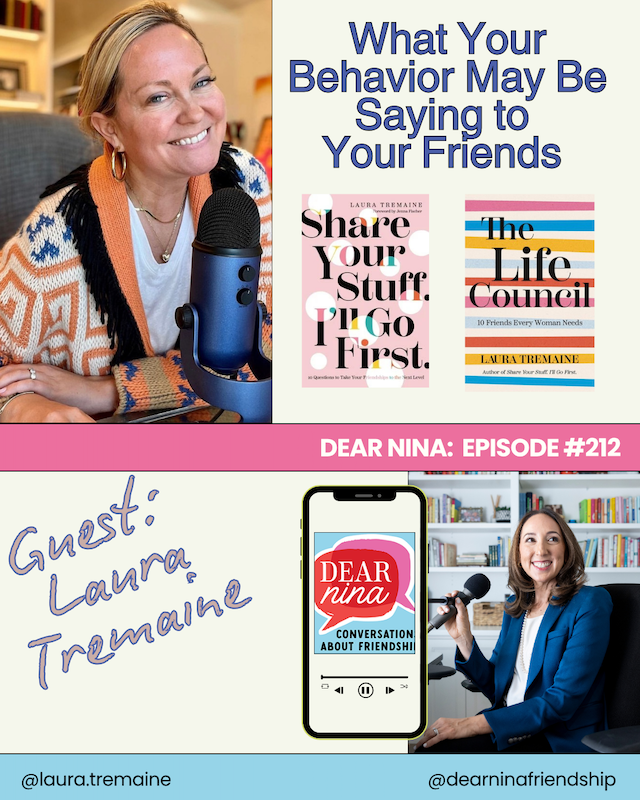
Nina: Welcome to Dear Nina: Conversations about Friendship. This week, I am bringing back a conversation with author Laura Tremaine. It was a really great episode. The original title of the episode was Text Your Friends, which definitely gets at a part of what we discussed.
But listening again, I realize this conversation is really about the difference between caring deeply about your friends and behaving in ways that allow your friends to feel that care. Sometimes those two things do not match up. And Laura had just come out with her second book at the time that we recorded called The Life Council.
It’s all about friendship, different aspects of friendship, the different kinds of friends you would want in your life. And there were a few chapters that were so refreshingly honest from Laura about realizing She had been letting some of those relationships coast. Many of us have been there. Who has not done that at times? And we’ve talked a lot about good intentions [00:01:00] not always being enough. you may think really great things about your friends, you may have really warm feelings towards them, but they may not know that because having a good intention or a good thought doesn’t translate to behavior.
In Laura’s case, she loved these friends, but she was not always texting them back, like at all, or took a really long time. And texting, you know, we talk about texting a lot, but just because it’s a very good and obvious behavioral thing that you can, not measure, but that you can note. It’s notable. when you hear texting, I don’t want you to only think about texting.
It’s just one example of many ways that we could show up for a friend. Anyway, eventually several friends told Laura, and she talks about it in the book and we talk about it in the episode, they were hurt, they were tired of this behavior.
And Laura really listened, and she started putting friendship on her actual to-do list, I love how she explains it in the episode
‘ this is not a [00:02:00] case of you’re not interested in the friendship, by the way. you do wanna be friends with these people, and your behavior is not indicating that that would be the case.
Of course, there are entire episodes I have in my 200-plus episodes, and ones that are coming up that I’m going to be recording this fall, about when you are more sure that you don’t want the friendship to continue. But that’s not what this episode is. This episode is, you want this friendship, but you are doing things that are letting the other person know or making the other person think you don’t.
That’s the issue.
If you don’t know who Laura Tremaine is, you should absolutely check her out. She is a writer and podcaster based in Los Angeles. She’s the author of Share Your Stuff: I’ll Go First. I really love that book. I used several of those prompts in my writing class. It was a really good, accessible book, .
Both books, the Life Console also, they’re both about connection and friendship, really, at the root. And she is the co-host most recently of the Slow Read Podcast. She has had other c- her previous one, Share Your Stuff, [00:03:00] was really great. I was sad when she ended it. Laura writes and hosts regular conversations on her Substack called Secret Stuff, and she and I share a love of books. She talks about books a lot.
You can find all of that in the show notes. I’m excited to bring this conversation back to you. I will be back next week with a fresh new episode. Lots of great guests coming up this fall. I hope you will be right here on this feed to hear them, however you get your podcasts, wherever you’re listening or watching on YouTube
I hope you have a great week
Hi, Laura. Welcome.
Laura: you for having me here. I am so excited to talk to you about friendship because I do feel like you are the friendship
Nina: We’re laughing. I’m going to tell listeners because when Laura first logged on to our recording, she said something about me being the friendship expert. I said, Nope, nope, nope. And all my listeners know anyone who’s listened to this before. And hopefully there’s some new listeners too. Like Laura, we have a lot in [00:04:00] common.
We just love the topic of friendship, but we’re not therapists. And so we, both shy away from that word. So as she was about to say, you’re the friendship, I was giving her the eye.
Laura: I was
Nina: say it, Laura.
Laura: you’re not the friendship expert. You are a friendship person.
Nina: Enthusiast. I say, it’s such a good word. Enthusiast. In your book, you said thinking of friendship as a to do item has helped you with your friendships and you point out that people seem to accept that marriage is work, parenting is work, I mean good lord is it work, both of those, but friendship is supposed to be effortless and probably TV and Books and things have made us feel that way, but tell us a bit about how you came to put friendship on your to do list.
It was one of my favorite suggestions in your book. what was going on before you realized it was something you needed to really think about as a to do item and how it helped after. [00:05:00] Okay.
Laura: It’s one of the reasons that I was hesitant to write this book is because I am not a perfect friend. I had had friendship mess ups that were my fault. And so I felt like, who was I to write a book on friendship? But one of the key ways that I kept messing up Was, I was not
Nina: Um, Um, Um,
Laura: just lived on connection.
Like, I felt like if we had a deep connection, like, we’re friends. I’m good. I don’t need to check in on you. Maybe I don’t always text you back. I don’t really keep up with what you’re posting on social or, whatever, like I just sort of skated along on the fact that we had a great connection or chemistry or [00:06:00] history even.
And it just kept coming up from different friends, different friend groups, totally different relationships where people would kindly Sort of call me out and be like, Hey, like I texted you three weeks ago. no one is that busy or a friend was going through something and I knew they were going through something and I didn’t really check in on them or, you know, just the, barest minimum of checking in on them.
It happened kind of three times in a row enough for me to be like, okay, this isn’t just one misstep. This is me. I obviously have like a gap in this part of my relationships because I’m a working mom. I have a lot of anxiety tied to communication. I get a lot of communication in my life, like a ton of texts because my kids are in sports and blah, blah, blah, just a busy life.
And so I shut down. And I stopped communicating and sometimes for weeks at a time, I just do my family life and my work in my [00:07:00] spirit, like in my heart, I don’t feel disconnected from my friends, but they feel disconnected from me and also not even disconnected, but also like hurt.
Nina: Um,
Laura: available 24 7 with these little devices doesn’t mean you always have to be available to everyone on your phone.
And I understand like the self care of that and the mental health care of that. And also it was hurting my friendships to go like literally weeks and just like ghost them or go MIA, not check in on them. not say hi back, not respond to their question. we’re talking some basic relational skills that I was sort of just hiding behind my anxiety or hiding behind, [00:08:00] that I have like on a notebook, I have personal stuff. I have a column for personal stuff, family life stuff. I have a work to do list and I added in a connection to do list. it literally says things like, text people back.
Nina: No, I love these specific examples. No, seriously. that’s helpful,
Laura: It does. There’s a app that I really love, a voice message app that I use with a bunch of my dear friends called Voxer. And so it will say on there like, You know, vox a friend, to check in or just to let them hear with your voice that you, you could do this with voice memo, whatever you use, use your voice to , say, hi, you miss them.
You love them, whatever I have to put this on a to do list.
Nina: Laura. I’m the queen of the voice memo, to the point where sometimes I do control myself and I find myself teaching. My friends, how to use voice memos. Cause I’m like, you’re going to have to learn how to do this. People. I find WhatsApp to be great because a lot of people are have WhatsApp. They may only use it when they go out of the country or something, but they do have it [00:09:00] the one you have, it’s funny. I don’t know anyone who uses that. And so I would have to teach people and that’s maybe one step too far. everyone has to buy in to the app.
Laura: Right. Well, I feel like I have a lot of friends that use Voxer, so it’s easy. it’s specific friends. I’ve also used Marco Polo. I don’t love that one as much because I don’t always want to be on video.
Nina: Yeah. Okay.
Laura: to do that. I know that that won’t be for everyone. I think that a lot of people expect that we should just naturally be good friends in this way and check on one another and text people back. And that’s just normal, polite etiquette, but it wasn’t happening for me.
And it was actually hurting. My friendships. And so I was the one that needed to fix it, honestly, because it was my issue and just sort of blaming it on, those other factors like I’m busy. I have anxiety. That’s valid, of course, but [00:10:00] it’s also, sort of became an excuse, I guess. that’s not how I wanted my friendships to feel.
Nina: I love your honesty about this It really can be hurtful. And like, most of us have been on both sides of this. we’ve been the person who didn’t receive a text back. And I think any reasonable person, like you’re saying, we’re all busy with different things. Any reasonable person would not expect an immediate response.
And someone who is expecting an immediate response on something that is not an immediate thing, I think is expecting too much and probably needs to do a little work on that, on expectations. cause then you’re just, you’re, Setting yourself up to be disappointed in people. And I’ve said many times, probably sounds insensitive.
If you are constantly disappointed in your friends or people in your family, it might be coming from you, the source, you, everybody cannot be rude and disappointing and not considerate. That’s just not possible unless you’ve really surrounded yourself with a lot of, rude people. I like what you’re saying about sort of acknowledging that there [00:11:00] is.
A reasonable time to respond though. three weeks is too long, but it’s hard to know the exact, there is no exact number. You just know.
Laura: You just know, and it works both ways and that I had to look inward when multiple people called me out on it. I couldn’t just be like, Oh, well, that person’s high maintenance that she expects me to text her back all the time. And then the pandemic shuffled a lot of things for us because another crutch that I leaned into before the pandemic was if I didn’t text someone back, well, I knew I was going to see them at school carpool.
I knew I was going to see them at the thing. And so I would answer their question then, or give them a hug, or we would feel connected in that way. Even if I hadn’t texted them back or whatever. In the pandemic, when all we had was our digital communication,
Nina: Right,
Laura: feel unseen. You know, it it’s rude. I had to look inward, like you’re saying, like, if it’s everyone else’s problem, it might be you. [00:12:00] So I was like, all right, well, this isn’t what I want to be known for. You know, I don’t want to be like, you know how everyone has that friend they never go out to the birthday party or to the thing.
sometimes you still invite them cause they’re part of your friend group, but you’re like, she’ll never come. And then sometimes she stops getting invited because eventually the person that never comes, Should start getting invited.
Nina: 100 percent what I was going to say, where I see we think alike.
Laura: That is the same thing of like, I didn’t want my reputation to be Oh, don’t even bother texting Laura.
She’ll never text you back. Or, you know, whatever variation of that, if it’s not text, don’t even try to communicate with Laura. She only communicates on her own terms. that’s not what I want. To be as a friend.
Nina: I love so many things about this story. How loving of your friends to actually give you the opportunity to change this small thing especially the way you suggest it in your book. And here, just putting it on a to do list, like the work and connection being like separate from work and separate from you, you said something in the book that really resonated if you had to buy a birthday present for someone, for [00:13:00] example, that wasn’t really on the connection list because yes, you’re doing it for a friend and it’s like a loving thing to do, but that was more like a task, like a chore, whereas.
making a point to check out what they’re doing on social media and pressing the like button and writing a comment, which doesn’t take that long, but it actually is something you have to think to do. And that is something that creates connection. It makes a person feel good, I totally got ahead of myself.
We’ll come back to that. The fact that they felt close enough to you. I mean, it really is a testament to the friendships that several different people were able to know that you could handle that. Laura, that’s not a small thing. There are many people who would have those friendships would have just ended because the friends wouldn’t have felt secure enough in the friendship with you that they could even say that to you without you taking it.
I’m not saying you were like super excited to hear it, but you, you took it in and you changed.
Laura: Well, I mean, who knows how many friendships have ended
because they didn’t say it. I mean, you know, just in the normal course of friendships drifting or fading or whatever, I will never know if part of that was [00:14:00] because I check out. I’m sure I feel positive in my track record that it might have been a factor in the past sometimes.
So the fact that I did have, I can think of three specific friends. Who don’t even know each other. I mean, that’s how much I needed to get this message. I felt like the universe was really like, okay, you need to hear this message from all the different sources
Nina: Yeah. Mm hmm.
Laura: and had emailed me the results of the favor. You know what I mean? She had sort of emailed me the, the thing she was working on for me and I hadn’t written her back.
I hadn’t written her back and said, thank you. I hadn’t written her back and said, you know, offered suggestions, like literally nothing. I had not replied. then when I did, she. Oh, wait, did I? Let me think. I don’t think I did. I think she kind of pinged me, you know, [00:15:00] after a week or whatever, and was like, I am feeling really vulnerable that you haven’t replied.
It makes me think you hate this thing I made for you. That’s the story she was telling herself. And that’s what she wrote The fact that you haven’t replied, I’m worried you hate it. Of course I didn’t hate it. It was a huge thing that she had done for me and I hadn’t responded.
What in the world was I doing? that was the final one. That was the real wake up call because that was bigger than just not texting someone back. And a huge thing in that moment was not that I had been rude and disrespectful, which I had been actually. The bigger thing was that.
There was a disconnect between my heart and my actions. My actions were not reflecting what was in my heart. I held this friend so close to me. I was, in my heart, very grateful for this favor that she had done. And I would have sung her praises to others. But I hadn’t, done that. the most immediate task of writing her [00:16:00] back, thanking her profusely, being timely about it.
that was the final one, like I said, and it was the biggest, light bulb moment of, I was like, I gotta get this under control. This is actually damaging some of my most important relationships.
Nina: It’s very hard for people to change that’s why I love this as the better friendship goal. In this example, for you, it worked to make sure you text people back. What were some of the other things that you would add to a list? what else could people add on their connection list?
Laura: check in with my voice. sometimes I send a card, a little bit about this is knowing your friend’s love languages. have a lot of long distance friends. I grew up in Oklahoma. I live in Los Angeles now. you know, I have a lot of childhood friends and, college friends and whatever.
They’re all in different parts of the country. The maintenance of long distance relationships is just different than the maintenance of my local mom friends or whatever. my long distance friends definitely don’t expect a text back. we live across the country, we’re in different time zones.
I don’t even know what their day looks like and vice versa. connecting with them [00:17:00] is really different than people like I actually literally share a carpool with , the urgency is sort of different. So knowing though. How long it’s been with a long distance friend, where you could easily go a couple months and not talk to them.
If they spring to mind, then I will put on the list, go check their social media
Nina: Let’s talk about this one we’re going to flesh this one out. This sort of. Irritation people feel, where someone’s pretty active online you can see them, you know, like sometimes when you go to like a post, you can see mutual friends activity.
I don’t want to admit that I’ve ever been this petty, but I’m human. I have definitely, had that yuck feeling when you’re like, could they throw me a bone once in a blue moon? Yet, when I’m giving advice about this. I often say, and I mean it, You have no idea how that person uses social media.
Maybe they have an intern who does their social media and they don’t know your friends. It’s not personal. A lot of people don’t understand how an algorithm works and they truly may not see your stuff. So I loved your point. I loved your idea of that’s why you sometimes might need to put it [00:18:00] on the list to go look at it.
You’re not going to see it. Probably.
Laura: Right. Maybe you muted everybody in a political season, or they did. I mean, you actually have no idea what’s going on with people. And I know because I’m sort of public on the internet, that my algorithm is mostly feeding me other creators or whatever, like less my real life friends because they post less or So I have to go seek out their social media feeds to see. what’s going on with them, what they’ve been posting. that’s a way to connect also. I mean, I, I encourage people in the book to like every selfie. That’s one of my friendship philosophies, liking and commenting there, but it’s not always like that.
Sometimes it’s like, Oh, I actually just. Want to see what’s been going on in your life so that when we do talk or if I am going to text you or call you or something, I am not totally clueless about it. I’ve sort of checked in on you. all of these things are very easy and yet they can get away from us because we’re busy and we don’t think about it like this.
And we’re scrolling our [00:19:00] phones so I had to just be more intentional about it.
Nina: has that helped? Have you found that it has helped you connect?
Laura: Yes. And I’ve had friends. Say that they’ve noticed and not the same friends that told me I was bad at it. But I’ve had different friends say that they have noticed in the last couple of years, which proves my earlier point of, I was having like a reputation of, I had several friends who They knew I probably wasn’t going to text them back.
They didn’t take it personally because they knew this was kind of what my old rhythms had been. when I started being better about it, it was a pleasant surprise, I guess.
Nina: good.
Laura: when they said it, that they had noticed, I was a little embarrassed. but I was also like, okay, well, it’s working. I did have one friend take issue with it.
Nina: I was going to ask you about that and I really appreciate that you admitted that in the book because I think it’s helpful for anyone who might feel that way. So yeah, tell, tell us the story.[00:20:00]
Laura: So. She actually took issue with that. I had set an alarm on my phone, which is another way you can do this. If you don’t use to do lists or whatever, you can set an alarm on your phone every day, check in with a friend or whatever. There’s so many ways that you can kind of hold yourself accountable in this way.
Well, I had set an alarm on my phone. To check on her. I don’t remember exactly what was going on, but it was like, you know, to check in with her and one time it went off while we were together. We’re like in person. Well, I showed it to her like I thought it was funny or flattering. I don’t know. Like it didn’t cross my mind that it would actually hurt her feelings she Was bummed.
Like she felt like a chore. She was like, I don’t want to be on your to do list. I don’t want you to have to set a phone alarm to think of me or check in on me. It made her feel like she was high maintenance in a way that she’s actually not. She didn’t like the way it made her [00:21:00] feel.
Now she doesn’t have the same friendship issues I do in that. Maybe it is a lot more natural for her to reach out to people when she thinks of them, or she doesn’t need a reminder that they’re going through something, or they have a big doctor’s appointment that day, or all of the different things that I try to write down that I’ll put in my calendar, or on my to do list, or on a phone alarm to maintain my friendships.
She doesn’t need that. She’s naturally Either better at it or more organized in her brain, or I don’t know, has less people in her life. I’m unsure. So for her, she was like, I feel like a chore. Yeah. And she was like, I don’t like to feel that way. It makes me feel like that. You don’t just think of me naturally.
Now we did end up having a really nice talk about it. And I explained to her kind of what I was doing, that I was trying to get better at this part of friendship. You know, we sort of came away with an understanding. Basically, I was like, I’m just not going to tell you anymore. I’ll try to make it look, I won’t check on you at 5 p.
m. every [00:22:00] single day or whatever.
Nina: right.
Switch it
Laura: I’ll try to make it not look like a chore if you , accept that it’s not. you that it’s me.
Nina: That’s such an interesting example because it really shows, it’s a really micro example of how it’s all about perception. Because what she’s calling a chore for you, you are actually making her a priority, which is such a nicer way of thinking about it. And it is what you were doing. You were making her and anyone who’s on your list a priority.
And To think of it as a chore just yet. It speaks to her own mindset. No, I get where someone like, I don’t know her. Obviously I get where someone might feel that way. It’s like, she’s not crazy to maybe feel that way because we do put things on a list that we have to get done and want to cross off.
, so there’s something about that, but I actually see putting something on a list as a priority. It’s the thing you’re going to do. My husband’s super organized He has quarterly goal lists. Daily, if you’re on his list, it will be addressed the chore, whether it’s a chore or a person.
So like if, if one of our [00:23:00] kids behavior is on the list, that might be on a quarterly list. You’re on that list. That’s bad news. Like, because you’re not getting off that list until the thing is addressed.
Anyway, my point is, I guess I see being on a list as, it means you want to address this thing. And it’s actually a compliment in the friendship arena, maybe not in the child behavior arena. But in the friendship arena, it’s, I think it’s wonderful to have made it to someone’s list.
Laura: Well, that’s what I thought too, when I was sort of coming up with this, um, and it’s not a gimmick because again, this was years before I wrote the book. I was fixing these friendships organically, not for the book’s sake by any means at all. But I tried a couple of different ways before I sort of landed on making it part of my to do list.
I had also made a list, reminded me, because you said this about your husband. I had also made a list
[00:24:00] circles
that ended up kind of not really working out. working for me. I sort of then leaned into this sort of to do list idea instead. And if it’s just been a few months and I haven’t checked in with a long distance friend or something, if I just think of them, I’ll just put them on the list That is a little bit more organic as opposed to sort of planning it out. Like every three months I need to check in with Kimmy. I’m not doing it like that, but it is a way to think about it. I mean, I also think as we’re talking more about it, and as I’ve been thinking about it, this is a personality type.
It is. Whatever your life circumstances, overwhelm wise, if you have a million kids or a very demanding job or whatever your life looks like, you might need to think about this versus some people, their life looks really different. Their relationships look really different and this isn’t required.
So I tried to think of that with this friend this just isn’t what her brain and heart requires.
Nina: You have another aspect of your life, I do too, [00:25:00] to a lesser degree, which is you have like a big social media account with a lot of readers and listeners who want to interact with you. And so you may, after a couple hours of spending time on your computer or your phone, feel that you have connected and you have connected, but you still may have this real life friend out there who.
Had, in the past before you were a little more attentive to it, felt that lack of connection. Whereas for you, like your cup was maybe full in a different way, in a different kind of social category, there’s only so many hours in the day. So I could see how it absolutely is necessary to make sure you are checking in with the people who are going to show up with chicken soup, not just the people who are going to buy the book.
Let’s say different people.
Laura: I’m so glad that you brought up that part because this doesn’t apply to everyone who doesn’t work on the internet, but that actually was a part of it. And I don’t even talk about this part very much, but I did have friends who said, even if they’re joking, I hear. What they’re saying, the point of what they’re saying is I haven’t texted them back, but I’m on social media every [00:26:00] day and they can see that.
And I’m replying to DMS because I, screenshot and post my DM conversations really frequently. So they can see that I’m replying to strangers and I’m not replying to them. Now, part of that is it’s my job,
but the other part of that is, I try to be candid about this also. Sometimes it’s easier to communicate with strangers.
Then it is with friends. It’s less vulnerable for me to answer my DMs, than it is to like, do a heartfelt check in with someone. It added to my anxiety overwhelm a little bit of all the digital communication that I’m getting because a lot of it is from, you know, being on social media all day. And so when I close that app, the last thing I want to do is go to my texts or my emails or whatever.
Like, I’m just like, Oh, I’m done with this. It requires too much brain power to, respond to people I actually know and love and need, they need a thoughtful response than it does to just quickly answer a question in DMs And so [00:27:00] like logically I can see one is work, one is relational, but still if you’re on the other side of that, if you’re the friend on the other side of that, it’s not logical.
All you see is that I’m clearly holding my phone. So why am I not writing you back? And I get that. I really do get that.
Nina: LLC. And that’s why you changed it. it’s a huge success story. And I think it was an important piece of the book, which isn’t even about the 10 types, like we’re not, are my episodes just aren’t long enough to even flesh it out and people can listen to your audio book and hear all about it and read the book.
So before we end, I just wanted to, ask you if there’s anything else about this particular piece of your book. Cause like I said, we just can’t cover the whole thing that I haven’t asked you about that I should have, or that you would like to tell us.
[00:28:00] Um,
Laura: the way that you’re going to put it.
on your list as a to do might change based on the way that they like to connect or that your friendship dynamic works best as a way to connect. So we already talked about voice memos or there’s apps because for some people, they’re not on social media or it doesn’t matter to them if you text back or not.
Some people really love a phone call. FaceTimes, you can see each other’s faces, whatever it is. I also. started to really notice what my friends seemed to like, sort of light up about, which this was all happening at the same time. And it all goes back to noticing. because before I wasn’t noticing, I was just in my own world of not texting people back.
And. Definitely not paying attention to what, they needed in the friendship because I just wasn’t thinking that deeply about it. So when I started to notice that, you know, one friend doesn’t really care if I text her back or not, but she loves [00:29:00] it when I offer to pick her up for the event, we’re both going to like, she loves quality time.
Nina: I love when a friend picks me up. I hate driving. And it is like the nicest thing you can do for me is say, I’ll just come grab you. And I’m like, God bless you. I hate driving. I hate parking. It’s a
huge
Laura: So if I knew that about you as a friend, I would always do that because I love to drive. And so that would be like a perfect way for us to spend an extra 15 minutes together in the car and sort of connect before we get to the thing that we’re going to.
Nina: It feels like high school in a good way. Like the, you know, sometimes when things feel like high school, we mean that in a bad way, but how often are you in someone’s passenger seat? Not very often. It’s just the best. And they drop you off. I feel like a child. I love
Laura: I love it too. I have another friend who loves to cook for others.
Nina: Oh, that’s a good friend to
Laura: Yeah, it’s a great friend to have, by the way. And so like sort of receiving her little gifts of food that she’ll drop off on the porch, being open to it instead of just being, Oh no, we’re good. You don’t need to but being like, you know what, this is her way of [00:30:00] showing love.
I get to reap the benefits. So instead of kind of pushing that off or holding that at arm’s length letting her be her best friend version, all of those things to me are adjacent to this to do list item because you are paying attention to what actually works and builds connection instead of just doing it the way you’ve always known because the way I’ve always known was not working for me.
Nina: It’s such good advice. I love that you use the word noticing. That’s exactly what it is. It’s noticing and our lives are also crazy. Sometimes you might notice something and you still might not be able to deliver on that thing. you may notice the person always. prefers to not drive, let’s say, but maybe you also don’t like to drive.
So that’s not going to be the thing that works One of my very first episodes, I think it might’ve been number one. I had my mom on and we answered a question and I titled the episode. My friend will only text. So it was coming from the point of view of someone who. she will leave her friend a voicemail, and then the friend will text back, the [00:31:00] friend will not answer the phone, will not call.
And then who gets to win in that, case? Like, who’s thing, who’s love language is more important? The one who really does not like to pick up the phone for whatever reason, or the one Really would prefer to talk on the phone. It’s hard. And my mom and I came to the conclusion.
It depends, right? Like who feels more strongly? Like, there’s no one answer to that. if somebody can let it go and they, let’s say you prefer to talk on the phone, but you’re like, you know what? I have enough people to talk on the phone with, that’s a gracious way. I think to say this one friend, fine.
We’ll text that I have other people to talk to. I guess it is hard not to put our own stuff on other people. Gosh, it is. Isn’t it?
Laura: totally. I mean, that’s the root of all of this for me is that I was trying to. Put my own stuff on them and sort of having the attitude that the Internet teaches us, by the way, I feel like having the attitude of it works for me my way or the highway I feel like we have in our quest to empower one another or take self care into consideration and all of those things that are [00:32:00] important.
Are mostly good, they can also be damaging to our relationships. And nobody talks about that side of self-care because if it is brought up, it’s like, well, too bad. You gotta take care of yourself. Put your own oxygen mask on, and all of that stuff. And I’m like, okay, but also then you’re gonna end up lonely.
Nina: Yes, I love that, but also it’s, it’s so true. Uh, last week’s episode, well, it won’t be last week’s when this airs, but, I did about toxic friendships. And I said at the very beginning, not all friendships that have issues are toxic. Not all people who disappoint you are toxic.
and, and also. What you’re saying about, self care and that could go too far on the internet boundaries really have gotten out of control.
Laura: of control.
Nina: we just, sometimes you have to help people. Like sometimes you actually have to be inconvenienced and it’s not, somebody isn’t infringing on your boundaries.
They’re like asking you to be a friend and requiring you to be a friend so that when you need a friend, people will show up, you cannot always be like putting up boundaries. And it feels [00:33:00] like. controversial to say that, it’s just too much. It’s, it’s out of control.
Laura: Yeah, we have boundaried ourselves into loneliness. That’s what I say in
Nina: Yeah. Ooh, that’s yes. That’s a good
line.
Laura: I really believe that. What if I had said, you know, a few years ago, what if I’d been like, no, I have boundaries. I don’t text anyone back. between the hours of, you know, 7 p. m. and 7 a. m. or whatever. That was hurting my friendships.
And it wasn’t actually a boundary that I deeply needed. It was an arbitrary thing that I felt like texts are not the boss of me. They’re not the boss of me, but my relationships are important to me. the way that a lot of people foster friendships is through texts. So I needed, To get over myself and pick up the phone and text people back.
I could have hidden behind a boundaries thing. That’s kind of what I was trying to say earlier. And people are doing that. that would have just ended up hurting me. I was the only one losing friends over it, you know?
Nina: we’re going to just end on that because I could talk to you forever and ever and poor Laura is out there [00:34:00] promoting her book and, talking to so many cool people and I want to usurp her because I’m a fan and I’m just so happy to have her. But I’m going to make us say goodbye. I do miss doing the better friendship goal of the week, uh, you guys, I should probably bring that back.
, now we have, two here that I taking from this episode, which is by putting friends on your to do list, you are there for putting connection as a daily to do. To quote Laura, text your friends back. That’s a great one. It’s a great goal for this week.
Text your friends back and I’ll give a third one. Be the first to text initiate, initiate, which is part of the. To do like connecting initiate a text, Laura, thank you so, so much for being here for giving me all your time. And, and you even gave me time before the episode and I had all kinds of just business questions and you’re just super gracious.
I just really, really appreciate
you
You guys, Laura writes a great newsletter too. So check that out as well. Lots of good secret stuff in there. Everybody, I say it every [00:35:00] week. I’m not going to stop saying it because I believe it. When our friendships are going well, we are happier all around. So come back next week for your next episode. Bye.
Thank you so much for being back here with me to revisit that conversation with Laura. I hope it made you think about how you are showing up as a friend. I know it definitely made me think about some things that I would maybe wanna change As always, you can find me on Instagram at dearninafriendship.
Same thing on TikTok and YouTube. The newsletter where I answer a lot of anonymous questions is at dearnina.substack.com. And I am often hanging out in my Facebook group at Dear Nina, their group, where everybody is welcome to join us
Okay, this is the real goodbye now. I will see you next week [00:36:00]