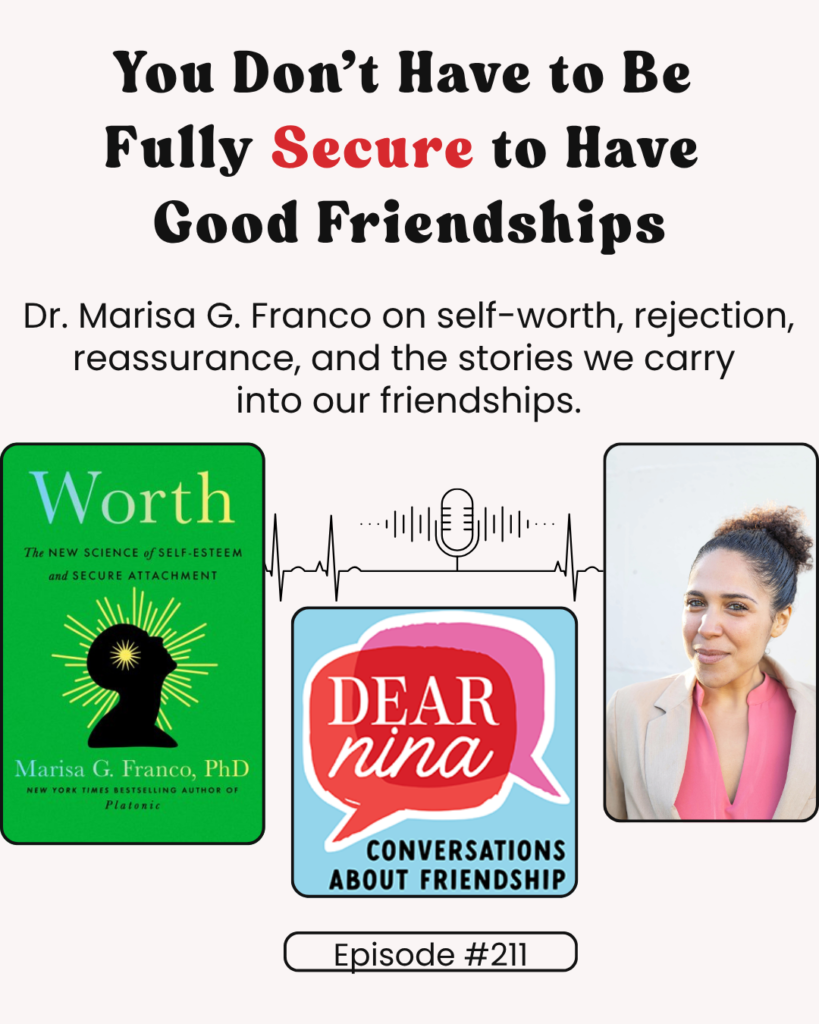
Nina: [00:00:00] Welcome to Dear Nina: Conversations About Friendship. I’m your host, Nina Badzin. Been writing about friendship for about 12, 13 years, maybe it’s 14 years by now. I’m losing track. And the podcast started in 2021, on the early side of the podcast, I had Dr. Marisa Franco on when she was out with her first book, Platonic.
I am thrilled to have her back for her second book, Worth. If you do not know who Dr. Marisa G. Franco is, and you are interested in the topic of friendship, you are missing out. Dr. Franco is a psychologist, an international speaker, a New York Times bestselling author, She works as a professor at the University of Maryland, and she has been featured more places than I could possibly name here. They will all be in the show notes, as will be the link to both her book, Platonic, and her newest book, Worth. We get into a really important topic today of being more secure-ish, Dr. Franco will explain why [00:01:00] being secure is not necessarily the goal, because none of us is secure all the time. It’s impossible, and actually that goal may be keeping you from having really good friendships, really good relationships, being happy enough, secure enough, and secure-ish as the goal, being real and really acknowledging what your hangups are and accepting some of them.
Not all of them are going to change or be healed. Accepting some of them, incorporating them into your relationships, being honest about them, but also dealing with some of the ones that maybe have been plaguing you affecting your self-worth and don’t have to. Because the goal isn’t to completely get rid of everything and never have moments of being self-conscious and feeling unworthy.
So here we have Marisa, who I’ve known for a while now, so I’m calling her Marisa from this point on in the episode, to talk about some of the parts of her book, Worth, that really stuck out to me with one story in particular. So join us, please.
Hi, Marisa. [00:02:00] Welcome to Dear Nina
Dr. Franco: Hi. So happy to be back
Nina: I love having a repeat guest, especially one as knowledgeable and as famous in the friendship world as you are. I mean, Platonic was just like a firecracker. People still talk to me about it all the time, and sometimes people even have the nerve to suggest it to me, and I’m like, “Oh, are you, are you kidding?”
I read it, before it came out and had, Marisa on the show, and then they’re like, “Oh, you did?” And anyway, Welcome back. Well, we are here to discuss your newest book, Worth, which is out in the world. Everyone should go get it because it, what it’s doing is something a little different than Platonic, and that’s where I want you to begin. Why this book? Why now? Tell us that part
Dr. Franco: Yeah. So when I wrote “Platonic,” there was this theory that I didn’t get to include in the book. It was the one that got away, and it was called, self-verification theory, which jargony way of saying that we look for people to verify our sense of self. And that means if you feel badly about yourself, in some [00:03:00] ways you might, be drawn to people who treat you more poorly, ’cause if people treat you too well, you’re sort of like, “They don’t know me.
They’re gonna figure out who I really am. I’m gonna let them down.” There’s all this anticipatory anxiety. And so there’s interesting research, for example, that people can interact with someone that sees them positively or negatively, and the lower your self-worth, the more you choose the person that sees you more negatively.
Or people report being less committed to a spouse that sees them too positively if they have low self-worth. So I realized from that, that our ability to build relationships with others isn’t just about how we’re treating them, but about our relationship inward as well.
Nina: And you, talk about would you say this connects to the good twin, bad twin piece? And will you explain that to the audience
Dr. Franco: Yeah, so, as I’m writing this book on self-worth, I’m diving deep into the research on self-esteem. And interestingly, I find that people that report high self-esteem, there’s two very different profiles. I call them the good twin and the bad twin. One type [00:04:00] that reports high self-esteem, they’re sort of egotistical.
They, um, try to be better than everyone, very hostile, actually have very struggling relationships, very defensive. one, what I call the good twin of self-esteem, they have the best relationships, better than people of any other type of self-esteem. They are compassionate towards people, empathic, non-defensive, able to take accountability.
They are the kind of self-esteem we want, where you both feel good about yourself and you treat everyone else positively. And so I’m trying to understand why are these two different profiles of people saying that they both feel so good about themselves, but their relationships with others are manifesting so differently.
So I go to one of my colleagues, Beth, and I’m like: “What do you– You know, these bad twins, they say they feel so secure, so good, but they’re treating everyone so badly, so maybe it’s not true.” And she says to me, I’m trying to think about when I’m defensive. What I feel inside is a lot of shame, someone triggered that shame.”
And in that moment, something makes sense to me, which I see Beth as one of the good twins, and I’m [00:05:00] seeing how it’s not that none of us feel the urge to be hostile or defensive. All of us have those bad twin type urges. But someone like Beth is able to acknowledge those feelings so that they don’t hijack her and take over.
And so here’s was the people of high self-worth who also treated people more positively. They had a unique relationship with their feelings and experiences, where they were very open to their own internal world. They weren’t trying to push feelings away. They were trying almost, you know, one person I interviewed who’s secure said they would sort of like move their hand over their day and see where their emotional energy lied.
Like they were trying to know every feeling in themselves, ’cause that was a part of themselves they didn’t wanna lose. it made them treat people better because you can only regulate feelings that you’re willing to acknowledge.
Nina: Yeah, it’s the argument for actually exploring your feelings and your reactions and your history, and then dealing with it instead of stuffing it.
Dr. Franco: Yeah. That’s what makes all the difference
Nina: So one of the stories in your book really stuck with me and actually haunted me for days. [00:06:00] It did. I, I felt her feelings. And there are several stories in the book, and this is just for the sake of the, the listeners, that I think, uh, listeners you’ll be able to relate to, especially if you are working, and a lot of my listeners are.
That’s why I was a- really excited about this episode, working on having more secure friendships. I’ve done episodes on, anxious attachment. You and I spoke a lot about attachment theory in our first episode, and really you and I specifically talked more about how to deal with conflict in a friendship.
Platonic, had a lot more about attachment theory. And then I get the same question over and over again, “But how do I have more secure friendship?” It’s like anyone who’s kind of dealt with this information maybe accepts why they’re so anxious in friendships or avoidant, but it’s like, okay, but how on the secure?
So I thought Esme, who is the one I have in mind, was a wonderful example of a really difficult situation that would make anyone anxious or avoidant or both, and then how she worked towards becoming more secure, and let’s discuss.
Dr. Franco: Yeah, sure. So Esme’s someone I interviewed, because she had a sort of [00:07:00] peculiar story. She was hanging out with a new friend and she said to that new friend, ” Hey, you’re gonna have to initiate all future interactions. I can’t because of this one thing that happened when I was younger in middle school that has kind of stuck in my head ever since.”
And so when Esme was younger, she had a new friend and she would call that friend every day and say, “Hey, how’s it going?” “Here’s my, here’s what stood out to me. Here’s the boy that I have a crush on.” And she’s calling this friend every day until one day that friend is like, “I don’t know why you call me. We’re not friends.”
Nina: Just have to pause on that. That is the part when you’re reading it, because when you’re reading, I just have to add a little more color to it, is , Esme really felt they were close friends. That’s why she called her every day. Called her every day to tell her everything. It’s like I would call my friend and just , “Download my day.” I don’t remember if the friend ever shared back. I think no, probably in hindsight, but Esme didn’t, you know, maybe realize that.
Dr. Franco: Mm-hmm. Mm-hmm
Nina: And the friend, yeah, so that just to [00:08:00] repeat what Marisa said, and the friend says, “Why are you calling me every day?” we’re not friends or I don’t want to be friends,
Dr. Franco: Yeah, so horrifying and devastating. But it was that one memory that in every friendship since, Esme is now afraid that they’re not really friends, That anyone she interacts with just doesn’t, secretly doesn’t like them. She’s battled a lot of insecurities. When she meets someone she really likes, she can’t really move towards that person because of this niggling fear since that moment happened that whoever she likes and tries to be friends with secretly doesn’t like her.
Nina: Like she had missed it. Maybe this girl was, by the way, if I were giving advice to someone like this and she said, “I call my friend every day,” ’cause this is the kind of stuff people say to me, “I call this person every day. They don’t really share back. They never initiate.” I hear this a lot.
They never initiate ever, ever. I actually spend a lot of episodes trying to get people to not try to look for tit for tat, but truly if it’s never, and the person ne- more so if the person doesn’t share in the conversation, maybe this person [00:09:00] did think they were giving her a message. So I could see how Esme would be like, “Well, wait, shoot, I missed it.” But she was young,
Dr. Franco: She was young. Yeah. And I guess, if we define traumatic as something that continues to affect the way you see yourself and others since that event, then it was for Esme, who, really still struggles, with friendship and doesn’t reach out. And Esme’s kind of an acquaintance of mine who I really like, but I get frustrated ’cause I’m like, she never reaches out to me.
Nina: So
Dr. Franco: So yeah. So she’s like, “People don’t wanna hear from me because I’m, they don’t, secretly they don’t like me.” And I’m like, “I would love to hear from you more.” But, uh, that’s how our memories work. That’s how our history
Nina: this is so big because of, I don’t even wanna make this whole episode about reciprocity just ’cause so many of mine are, but listeners, I need you to hear this, that one of the reasons sometimes people might not reach out, and it’s true in this example, is this lack of self-worth. The person isn’t going to want to hear from me. That’s maybe why they don’t reach out. Of course, that’s not true for everyone, but it is something to [00:10:00] consider
Dr. Franco: Yeah, absolutely.
Nina: So back to Esme and how, what you realized about this traumatic experience that had to get dealt with
Dr. Franco: So Esme was r- is really my intro into the theory of the book. I was trying to really understand why people have this low self-worth, why people reject people that love them and value them. It doesn’t really make sense. If you had low self, wouldn’t you want people that compliment you and value, you know?
It just doesn’t really make any sense. So as I did my research, I, came across the answer to why people have self-worth, and it’s memories. Researchers say memories are the database of self-esteem. And so obviously Esme had these memories, this memory that, you know, as researchers, other researchers say, memories don’t just record the past, but they predict the future.
So we’ve had this negative experience and we’re like, “I’m gonna get rejected again. They’re gonna not like me again. They’re gonna tell me we’re not really friends again,” right? because of that, we are almost not living in reality as much as we are living in the reality of [00:11:00] our memories, as Esme’s story really shows.
Now, the issue of course, is that maybe that inciting memory was the anomaly. And so everything in your life moving forward is actually miscalibrated if you’re working off of that memory. we have to find a way to live in the present. Now this can sound like really bad news for people because we can’t change the past, but you actually can in a way, in that if memories are made to predict the future and not record the past, then they can be updated with more information.
So I came across this theory called memory reconsolidation theory, which is that every time you revisit a memory, you can change the emotion of it in your brain. I had Esme, I said, “What would you like say to yourself? If you could go back to that moment as an adult, what would you say to yourself, say to your younger self?”
she was sort of like, “It was one tiny blip. It doesn’t define you forever. It doesn’t mean everyone will react to you that way.” And so those are the exercises that I share in the book, these research-backed exercises of finding a way to go back to the [00:12:00] memory and change the memory, which research finds has not only led to increased self-esteem for the people that do it, but it also, at the neural level, you can see changes in the brain, the part of the brain that records memories.
There’s actual changes in the brain when you go back and you reconsolidate or change some of these negative memories that have shaped the way that you build relationships since.
Nina: I found that so fascinating and the concept of an open memory versus a closed memory. Can you explain that?
Dr. Franco: the reality is it’s not all of our memories that continue to shape how we perceive reality now. It’s open memories. What is an open memory? It’s one that you don’t really have closure on. It’s one that still makes you feel some sort of strong emotion. maybe you don’t think about it ’cause it makes you uncomfortable, makes you feel ashamed, makes you feel anxious, makes you feel angry.
those memories, it’s really that they have unprocessed emotions in them. Those are the memories that continue to shape how we see reality now. There’s a study where people wrote down memories of negative [00:13:00] experiences they’ve had, maybe someone who, a theft they had in their house, their house fire, burned down their house, and they found that it wasn’t the negativity of the memory that led to people reporting low self-esteem after they wrote about it, but it was the extent to which the memory was closed or open.
If people reported on a memory and they also said they don’t, they’re confused about why it happened, still makes them upset to think about it, all of these aspects of an open memory, they would then report lower self-esteem after sharing about the memory. So the goal then is to close all of our open memories, and memory reconsolidation is really a way to do that so the past is actually in the past and our prior friendship issues, struggles, problems are no longer shaping reality now.
Nina: You know what just stands out to me is how so many friendship issues, they’re between two people. So again, using Esme ’cause now we have a concrete example, like we have no idea what made that other girl say that, who knows what was going on in her life, and who knows how many people were counting on this girl and maybe [00:14:00] calling her and needing her and, this girl is just like, “I can’t take anymore.”
And maybe if Esme had become her friend two years later or two years earlier, that wouldn’t have happened. I’m just making up a scenario, meaning that we actually don’t ever really know what the other person… Actually, you and I spoke about this a bit in our first episode, is one way to know is to talk about it with the person, but even then you don’t know for sure you’re getting the full story.
And we do a lot to protect ourselves and protect, so even if someone comes to us. but this idea that there’s hope to close the memory with all you can do, your part of it. you can’t control the other person. You- all you can do is your part of it. Do you find that people can accomplish this without therapy, or is that pretty much the only way?
Dr. Franco: well, in my book I give them step-by-step instructions, so I would say I think so.
Nina: I think people should do the audio too, by the way, ’cause as I was reading your book, and because I got a chance to read it before it was out in the public and now people can do the audio, I was thinking like, [00:15:00] “This would’ve been really cool to go through with your voice step by step.” I could have paused it. So I- people should do both, ’cause you’re gonna want the written version too, but I think it would be helpful to have your… Are, are you reading your audio? Good. I figured.
Dr. Franco: So you can, you, we can do it together everybody.
Nina: Seriously
Dr. Franco: But yeah, I would say, , if it’s a memory wherein it completely overwhelms you, you’re getting really dysregulated, and you feel like you shut down when you try to open the memory, then that’s something to maybe seek help with.
I’ve done the, all of the activities in the book with friends, found them very transformative. all of us cried going back into these negative memories. The kind of things that we, reconsolidated were things like bullying, right? So it was harmful, but not necessarily something I, we’re shutting down about when we revisit.
Or, you know, I talked about, my mom always used to pick me up late from soccer and how that affected me. And it’s very fascinating when you do it, ’cause there’s a lot of things or experiences we have that we might think that we’ve gotten over, but when we actually go [00:16:00] deep into what that experience was like for us at that time, which is we’re forming these foundational memories at a time when we’re also very emotionally vulnerable.
We’re young, right? It’s not like an adult going through this experience. It, it’s a young person, and it’s our experience of it at the time. It’s not our experience, looking back on , what would that be like as an adult for me to experience now?
yeah, you’ll be surprised, I would say. You’ll be surprised at the types of emotions that end up coming up when you revisit some of your friendship pains or your relationship pains from the past
Nina: It’s like time travel. It’s the be- next best thing.
Dr. Franco: It really is
Nina: I did it for something and, this isn’t really about friendship, but it’s about, it still has to do with self-worth. And when I was going through the exercises, I wish I could remember exactly which one, ’cause, listeners, Marisa has several, at the end of different chapters of different exercises to deal with, these memories and different things. so this is I’ve never talked about this particular one on the show, and I didn’t even think about it until I was reading the book. So when I was a freshman in college [00:17:00] and we were walking back to our dorm, a guy who I was friendly with s- I mean, he was just being friendly. It wasn’t like, I’m not saying this like a physical assault or anything.
He squeezed the side of my body just to be like, “Hey,” you know, the way you might squeeze someone’s arm, and he squeezed like the side of my body. And he went, “Whoa,” because there was something to squeeze. Like it wasn’t, I wasn’t skin and bones, you know? Like I, I definitely wasn’t skin and bones. I was 18 years old, probably 20 pounds overweight, and he squeezed the side and went, “Whoa,” out loud in front of people. That memory is one that I feel like I’ve pushed away for years because it just made me feel so embarrassed. .. Well, and it confirmed for me at the time something I already worried about, which was my weight, which as a girl is just hard anyway.
but to have someone actually say it out loud, it reminded me of the Esme story. Even though mine had nothing to do with friendship, what’s similar in both stories is somebody said out loud a nagging fear maybe you have. I wonder if Esme had any fears.
Maybe she did notice at [00:18:00] the time, “Oh, you know, this girl never calls me first, never really says anything about her life.” but she picks up the phone, so it’s like, “Okay, maybe she likes me but maybe she doesn’t.” Like maybe Esme did worry about it. And just like I did worry about my weight, to have somebody say out loud, “Whoa,” when they like touch your body, and not in a positive way. I’m 49 years old. I was 18. It is like crystal clear. The exercises, gave me the prompt to sort of think about what I might have said at the time,
Dr. Franco: Hmm.
Nina: And
Dr. Franco: was it? Do you wanna share?
Nina: at least would’ve said That is so rude.” I would’ve embarrassed him back. instead of taking it and holding it in as like a piece of shame, I think I should have… I’m not saying it was the right thing to do, but I think it would’ve helped me. I think I should’ve shamed him in front of everyone for having the audacity. Like, why should I feel ashamed? But that was rude.
Dr. Franco: Mm-hmm.
Nina: Yeah, so that’s what I would’ve done, and I- it forced me to think about it
Dr. Franco: Yeah. And you know what? I love your example because it [00:19:00] shows a couple things, which is one that I don’t know, people often think of something traumatizing. We’re talking about little T traumas that continue to affect you as like, you know, you feared for your life.
But like, it’s the, the, it’s these quote-unquote little things that aren’t little for you, and that’s totally okay. Um, and I think sometimes we, especially if you’re anxiously attached, you’re invalidating the harmful things, and so you’re not even looking at them ’cause you think, “Why am I having this reaction and stuff?”
So I love your example ’cause it’s it just matters because it affects you, and There’s no objectivity to whether it should matter or not. and the second thing that I, really like that you did, which is when you reconsolidate a memory, the other person isn’t there. So go buck wild.
If you wanna yell, if you wanna scream, if you wanna shame someone, you wouldn’t do this in your daily life, but it’s okay to do it for your psyche because they’re literally not even there, right? And if, if, if that’s what you need to heal, like there’s no one harmed and there’s only someone who benefits.
So, I like the way that you described that ’cause I think it reveals some core principles of memory reconsolidation.
Nina: Well, good. Thank you. When Esme said this to this [00:20:00] friend, “You’re gonna have to initiate all the time,” what happened? I don’t remember. What did the friend say? Was the friend like, “Uh, actually no, I’m not gonna do that”?
Dr. Franco: . So I think the friend was happy to initiate realizing that Esme was invested in the friendship with Jay. having that communicated more clearly, I think didn’t leave Jay in a place of wondering, “Does Esme wanna hear from me or not?” But just was able to kind of… ‘ Cause I think the hard part, I’m sure you know about lack of reciprocity is like, do we interpret it as this person doesn’t like us?
‘Cause sometimes it means that, or is it this just this person has self-worth issues. So Esme made it clear, and it was interesting ’cause when I interviewed Jay later, this, these insecurities kept coming up. Esme had a bachelorette party and was like, “Oh, I don’t wanna do anything.” Nobody wants to come celebrate me.”
And Jay’s like, “What are you talking about? We would love the opportunity to celebrate you.” it kept playing out in different ways throughout their friendship, but I think Jay kind of understood Esme, and that’s really what makes their friendship work.
Nina: That’s, yeah, communication. I mean, that’s almost always the answer. It’s communicating. And I- she was lucky that Jay [00:21:00] didn’t mind, but I could see why if you communicate it really clearly what this need is. I often am telling people, a- and I think it’s good advice because reciprocity is such a big one, and people have so many hangups about it.
You have to at least maybe talk to your friend and say, “I feel like I’m always the one reaching out,” give them the opportunity, and maybe you only just need to hear the one time, “No, I really want you to, and I don’t for this reason.” Either the self-worth or all the other reasons people have that they don’t reach out first. Oftentimes it’s not something as deep as self-worth. It’s just a lack of organization.
Dr. Franco: so true
Nina: Either way, it’s not personal a lot of the time. And of course, sometimes it is, and that’s what is very, very, very tricky, and that’s why we don’t just have one friend. That’s why we can’t invest in just one person because, yeah, you need a variety. People who are more organized, people who do reach out more, some don’t. Sometimes you have to be the one who reaches out more. That’s, that’s how it is.
Dr. Franco: Well, it kind of reminds me of, , one of the principles of the book, which is that, I tell people not to be secure but secure-ish
Nina: Yes, I love that
Dr. Franco: [00:22:00] sometimes Secure attachment has become the status symbol, and the research isn’t being used the way that it was intended, where now it’s like, “I’m secure, I’m secure, I’m secure.”
Like coercive security, compulsive security, so much so that we ignore the parts of ourselves that are anxious or avoidant and then enact internally the neglect or the shame when we treat our insecure parts that way that we experience to become anxious or avoidant. And so it’s not about feeling like I have to be secure.
It’s about acknowledging the ways that you aren’t so you can care for those parts of you, and you can even invite other people to care for those parts of you, too. it’s much more about becoming real, and I try to almost have no hierarchy when it comes to attachment styles. It’s just about what you are ’cause that reveals what your needs are and that reveals, what you need in relationship, too.
being secure isn’t necessarily better. It’s just about where you are. and so I think that’s w- a move that I really like that, that Esme made is that she’s able to admit that she’s anxious. And I think the issue with insecure attachment styles, they really come out when you start acting out, when you [00:23:00] don’t say, “Oh, I’m afraid of rejection, so if they don’t reach out, like that’s why.”
but you just pull away from your friend ’cause you think they don’t like you, right? That’s what really damages the friendship, the acting out and the lack of communication and the trying to push away our triggers rather than allowing ourselves to look at them.
Nina: That’s so powerful. Being secure-ish, which I also loved in the book, and real is the goal. Not having to be secure all the time. Who is secure all the
Dr. Franco: Nobody’s
Nina: the no- all the time. Nobody
oh my gosh. this is to say to you and the listeners, I have to, even in all this work I do on friendship and giving advice to other people, still, and I know you relate to this because you write about it in the book too, I still have to self-talk when I am talking to my own friends and they mention something they did together or that they’re about to do together.
“Oh, we’re doing this on Saturday night,” or, “We did this on Saturday night,” or I’ll know like friends were together Friday night and Saturday night, I feel like this little sense of “Oh, why didn’t anybody reach out to us?” and then [00:24:00] I self-talk out of it. That’s the only difference.
It’s not that I’m so much more secure at all than all the people I talk to. It’s that I have developed a self-talk that is very helpful, and the self-talk is all the things I tell other people. Not everyone can be together all the time. That wouldn’t even be fun. I don’t reach out to every single person every time I’m doing something, ’cause I don’t like being in a huge group. So I have to give that grace to other people, and people still like you and, you know? It’s all this, all of this we still have to do. And you talk a little bit in, in the book about what really prompted some of this work, if you’re comfortable … I mean, well, you wrote
Dr. Franco: definitely. I think I, I forced myself to try to be secure in ways that it alienated me from who I truly was in a relationship I was in during the COVID pandemic, where he really pulled away and shut down, and my response was like, what does a secure girlfriend do? Tries to, co-regulate, which is like regulate him and myself.
Tries to express curiosity, use I statements, right? I was so focused on anchoring [00:25:00] him that I wasn’t able to acknowledge, hey, this is hurting me. I’m feeling really neglected. I need more communication, cause he just, like, would kind of get grumpy and give me the silent treatment sometimes.
It just wasn’t right. I say the securest thing that I said in that relationship was that I wanted to leave it because it was the thing that was finally real for me, and I think you can listen to a lot of relationship advice and you can use it as a weapon against the self. a lot of all of our relationship advice should start with you in terms of you saying to yourself, “Can I apply this in a way that works for me?”
for example, , I think that I was trying to give grace to him so much that I was losing grace for myself, sometimes I check into myself, do I have the capacity to give grace, right? Can I do that in a way that feels like it’s in an act of integrity with myself? And sometimes the answer’s yes, sometimes the answer’s no.
I kind of just wanted to encourage people I think what’s missing maybe in the secure attachment dialogue sometimes is like there is great advice. I’ve given it on how to communicate well and how to, work through problems really well. But the [00:26:00] first thing to do is to get clarity inward as to what are your needs?
What do you want? What feelings are coming up for you, right? And does this advice, coordinate, does it align with what you really, how you really feel? And for me, Doing this whole co-regulation, being the perfect anchor thing, I wasn’t anchored. I didn’t feel that internally, and so I should have instead expressed the truth.
Nina: So powerful. Exactly. You gotta start with you. was there anything else that you feel the book was in reaction to, that you wanna say here, from what you were seeing out in the world on
Dr. Franco: Yeah. Oh my gosh. so much stuff. I mean, I, I think it really c- counters a lot of the advice that we get on self-worth, which was like finding this research on people with low self-worth, when they– positive events happen to them, they get sicker months later. When they get positive feedback, their blood pressure rises.
When they’re successful or they think about an experience of success, they get more anxious that, “Oh, now I’m gonna fail the next time. Now I’m gonna fail the next time.” [00:27:00] And yeah, and so for me, ’cause I have friends that, they also will reject compliments, the very thing that you think would raise your worth.
So I have friends that would do these kind of things, and I would say to them, “You have to take my compliments,” which is not the way to give a compliment. I, I got called out by a, a affection researcher who said one part of affection is they receive it, and if they don’t receive it’s more about you than them, right?
‘Cause you’re not actually trying to give them a gift. So I realized that when you’re dealing with friends who maybe have self-worth issues, and you’re trying to give them a pep talk to raise them out of it, that can be very threatening for them. Because again, their memories are predicting that they’re gonna be rejected at the end of the day, and how their brain is interpreting it is, “You’re trying to pull me in to feel better about myself so I get crushed more when I’m ultimately rejected, ’cause that’s what my past tells me.”
So now I notice that when I try to reassure some, “Oh no, you’re great. No, don’t think about yourself that… No, like, you know, you’re awesome.” I notice when they have a retort where they’re like, “Oh, but no, that’s just how I feel.” And I pause and I try to just validate, “Of [00:28:00] course you feel that way,” right?
“Of course your boss talking to you that way made you hurt. Of course, it’s okay to have insecurities. It’s okay to feel the way that you do.” when we have low self-worth, often what we really need is to feel understood in that low self-worth rather than someone trying to yank us out of it.
Nina: What do you do about a friendship where the person really does have such a low self-worth it is affecting the friendship, and they aren’t going to necessarily do the work that it would take for them to heal that, and it’s affecting the friendship? I just wrote about this and, and I titled it “The Reassurance Trap,” I was just thinking about how exhausting it can be for a friend, if the other friend needs constant reassurance about the friendship itself.
Dr. Franco: mm-hmm.
Nina: I could see someone like Esme maybe having this issue with certain friends, and actually she said it directly to Jay, which was great. But if she hadn’t, let’s think about a scenario when she had not said anything to Jay, and Jay had to constantly convince Esme that she wanted to be friends. At what [00:29:00] point does, the Jay in this situation
just kinda go, “I, I can’t take it anymore”? And you kinda wanna blame them
Dr. Franco: Yeah. Well, this is where I feel like connecting to ourselves is really helpful because sometimes you might have the capacity to provide a lot of reassurance, and sometimes you don’t, and you have to understand where your own line is. I’ve had this with friends where if it gets to a line where the desire for reassurance is almost making you feel misunderstood because you’re like, “I’ve just been here loving you this whole time.
You keep telling me that you don’t feel loved or that you’re insecure.” And so just being able to share with that friend, I love you. I’ve always loved you and felt so close to you. I think with the amount of, asking for reassurance that’s coming up for me is, , I’m feeling misunderstood because, those requests are suggesting to me that it’s not coming off that way, that I love you as much as I do.
maybe what moving forward, I can be very transparent if there’s ever an issue between us, and that you know if that’s not something that I’m bringing up that, [00:30:00] I am invested in this friendship and I’m here.” Bringing up that conversation whenever it’s something’s leading you to pull away from the friendship, I always think it’s so much kinder to just offer that to your friend, ’cause then you at least give them the chance to repair
Nina: Yes
Dr. Franco: rather than just pulling away.
And now your friend who needs a lot of reassurance has the option to, A, maybe not ask as much, or B, trust that you’ll bring it up if there’s a problem.
Nina: That’s great advice. the I statement, I think this is permission to people that you can say to a friend, ” I feel misunderstood.” Or, another thing I’m hearing in this example and I hear it in real life is we feel underappreciated sometimes. I am calling a lot. I am texting back pretty quickly.
I am pretty available. Am I available all the time, every time? No. But the things we do have to count. I often tell people let the stuff your friends are doing count.
It would be understandable that someone would give up and pull away if they feel like everything they do is starting from zero each time. The other friend [00:31:00] feels a sense of relief in that moment.
“Oh, okay. Phew, she texted me back quickly this time.” But then the next time, we’re back to zero, and all the other times that you were quick to respond didn’t count because this time you were busy. But if you’re the friend in that situation where you feel like the other friend needs too much, it would be kind to talk about it and maybe give that friend a chance to not need as much.
Dr. Franco: To, to trust you a little more.
yeah, I was just, wanting to add it’s really important for us to think about, and this is something I’ve learned from writing the book too, is my reaction here coming from something I’m assuming or something that actually happened?
Because I’ve realized how self-worth it creates its own sense of reality that’s really beyond and outside of what’s actually happening. And so recognizing that, for example, if your friends give you a compliment that doesn’t resonate with your sense of self-worth, what you’re probably going to do is reject it.
I’ve realized that, just because it doesn’t necessarily reflect how I s- doesn’t mean it’s wrong, or if you’re making an [00:32:00] assumption about, “Oh, they just invited me ’cause it’s a pity invite,” it’s disingenuous, that’s an assumption that’s maybe more about your own feelings about yourself than about how your friends actually feel about you.
there’s research that finds that people’s view of how their romantic partner sees them more strongly correlates with their own, how they see themselves, than how their romantic partner actually sees them. And so we have to have a lot of humility around our assumptions about how people view us, how people are responding to us, what people really think about us, recognizing that it’s not necessarily true, as in this person definitely feels that way ’cause I think they’re feeling that way, but rather often a reflection of our own sense of self and how that sense of self is trying to protect us, I guess, in a way.
‘Cause I think , when the conflict really goes awry is when you have a set of assumptions about how the other person’s engaging in the relationship and you no longer hear their reality anymore. And I hear that, you know, there was a disingenuous invite or, you treat [00:33:00] me so badly, you don’t, you know, you don’t reach out, versus the other person being like, “Oh my God, I’ve been having 12-hour workdays.”
I just encourage, , understanding the sense of self more and how it is the s- the sort of root of all of our projections as to what’s really happening, for us to just leave a little bit of room for, humility and oxygen. And for me, it’s often okay, are some of my assumptions here about what’s actually happening?
what has tangibly happened to suggest that this person is upset with me, doesn’t like me? yeah, just be open to different ways of seeing.
Nina: That’s a great message to end on. Humility is huge. I mean, it cannot be overstated. It would solve a lot of issues. We just don’t know. I even tried to give that to Esme’s middle school friend, right? Like, that we actually don’t even know what preceded her just being fed up, and who knows what was going on in her life that directed her to say something like that.
And maybe credit to her for not dragging Esme along all through middle school and high school. I mean, that would’ve been a different story., Esme’s [00:34:00] just a good example. I appreciate that she was open to having this example in the book, ’cause I think it’s so relatable to people. ultimately, read the book, go through the exercises, and really consider what are open memories still.
I think that’s a huge message of the book is to confront those open memories in yourself.
Dr. Franco: I think finding worth ironically is about being okay with being insecure, being more okay with feeling unworthy, being okay with being flawed. It’s not the unworthiness that gets to us as much as it is the feelings of shame around it. I hope that if you’re anxious, if you’re avoidant, if you have insecurities, we all do, and that’s part of the human experience.
welcome. Welcome to being a human. I hope that the book really gives you transformative ways to navigate some of those things. But there was never anything wrong with you aside from the fact that you thought that something was wrong with you
Nina: Oh, that’s beautiful. Dr. Marisa Franco, thank you so much for being here. Again, I will link our old episode, and I’ll be here waiting for you when the [00:35:00] next book comes out
Dr. Franco: My pleasure. Bye, Nina
Nina: Bye.
Hey, listeners. Thanks for being here to have Dr. Marisa Franco on for the second time. I’ll have that other episode linked in the show notes, Which was about conflict and coming to your friends with conflict and Give them the chance to explain themselves and apologize, and you apologize, and just being honest about your feelings, which is related to this episode too.
You can find Marisa at Dr. Marisa G. Franco on Instagram. That’s one S, and don’t forget the G. I’m at Dear Nina Friendship on Instagram and TikTok and YouTube and all the places. as always, you can join my Facebook group, Dear Nina, the group where people write a lot of anonymous questions. People write them under their own name, too, and lots of listeners chime in to answer. It’s a really beautiful community that’s come together over these five-plus years, over five years now of the podcast. thanks for being here. I’ll see you next week. When our friendships are going well, we are happier all around. Bye.
[00:36:00]